Confidential Computing for AI
Introduction
As enterprises deploy artificial intelligence (AI) across hybrid and cloud environments, data confidentiality becomes a top concern.
Training modern models requires vast amounts of private information — from medical images and financial records to customer interactions — often processed on shared or multi-tenant infrastructure.
Traditional security measures protect data at rest through encryption and in transit through secure protocols like TLS. Yet, data remains exposed in use during computation — a gap attackers can exploit.
Confidential Computing closes this gap. It secures data while it is actively being processed by using Trusted Execution Environments (TEEs) — isolated, hardware-protected enclaves inside CPUs. Within these enclaves, data remains encrypted and inaccessible even to privileged users, hypervisors, or the cloud provider itself.
Learn more from Google Cloud’s Confidential Computing for AI guide for architectural insights.
Confidential Computing extends zero-trust principles to runtime environments — ensuring end-to-end data protection from the chip upward.
The Need for Confidential AI
AI systems involve several interdependent layers — ingestion, preprocessing, training, and inference. Each layer introduces its own exposure surface:
- Data in Transit: Information sent between cloud services can be intercepted.
- Data at Rest: Improper encryption or access policies can lead to unauthorized data retrieval.
- Data in Use: When decrypted in memory, sensitive data can be accessed by insiders or compromised operating systems.
Most enterprises already handle the first two states with mature security tools such as database encryption and network-layer protection. However, data in use remains vulnerable because encryption must be temporarily lifted for computation.
Confidential Computing eliminates that requirement. It keeps computation encrypted, ensuring that raw data never leaves the secure enclave. This makes it indispensable for federated learning, cross-border analytics, and regulated industries where compliance with GDPR, HIPAA, and PCI DSS is mandatory.
How Confidential Computing Works
Confidential Computing leverages hardware-based TEEs like Intel SGX, AMD SEV, and ARM TrustZone. These enclaves are small, dedicated portions of CPU memory that guarantee integrity, confidentiality, and attestation.
Inside a TEE:
- Data is decrypted and processed only inside the enclave boundary.
- Code execution remains isolated from the operating system, hypervisor, and other virtual machines.
- Remote attestation verifies that only authorized, untampered code runs within the enclave before sensitive keys are provisioned.
This model ensures that even system administrators, insiders, or compromised hypervisors cannot spy on or modify the workload.
It transforms cloud AI environments into trusted compute zones, ideal for confidential workloads like multi-party model training or secure inference on user data.
AI Workflows Secured by Confidential Computing
1. Training Sensitive Models
High-risk datasets, such as genomic or financial data, can be securely processed within TEEs without ever being exposed.
This allows institutions to train models collaboratively across jurisdictions while keeping sensitive records confidential.
2. Federated Learning and Data Collaboration
Organizations can contribute encrypted data to a shared training process.
Only the resulting model parameters — not the raw inputs — leave the enclave, enabling privacy-preserving collaboration among hospitals, banks, or research centers.
3. Secure Inference and Prediction
User input (e.g., a medical image or loan application) can be analyzed securely within the enclave, shielding both the input and the model weights from external access.
4. Regulatory Compliance
Confidential Computing enables continuous compliance with privacy regulations like GDPR, HIPAA, and PCI DSS.
It ensures audit-ready processing without compromising performance or accessibility.
Architecture Overview
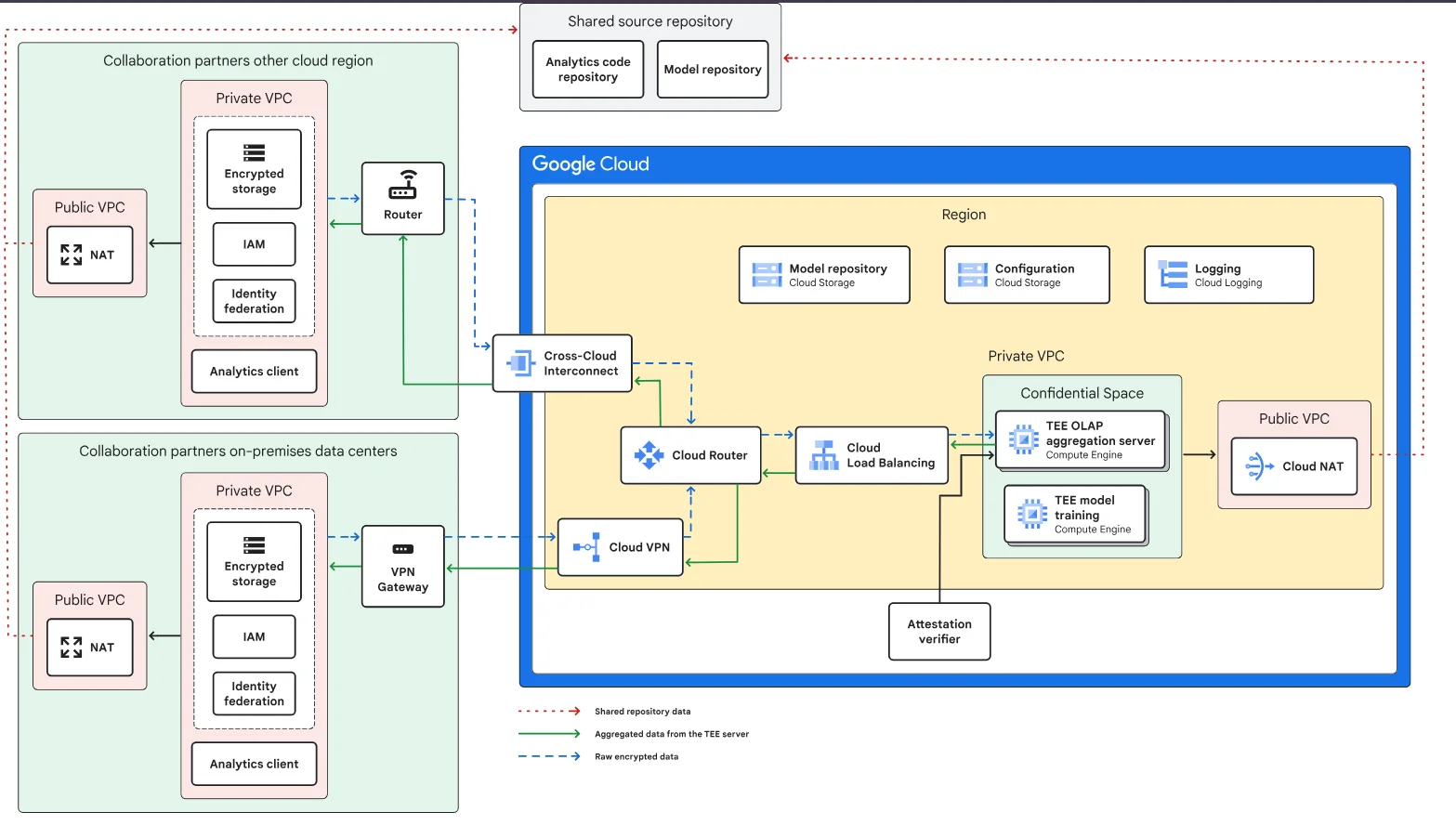
Below is a conceptual reference architecture from Google Cloud’s confidential AI Guide.
Architecture Breakdown
| Component | Role | Security Function |
|---|---|---|
| Confidential Space (TEE) | Runs sensitive computations | Encrypts and isolates data in use |
| Encrypted Storage | Holds training datasets | Protects data at rest with managed keys |
| Cloud Load Balancer & Router | Directs traffic between enclaves | Maintains network segmentation and encryption |
| Cross-Cloud Interconnect / VPN | Connects partner environments | Ensures encrypted communication |
| Attestation Verifier | Confirms enclave integrity | Prevents execution of unverified code |
| Logging & Monitoring | Tracks enclave events | Supports audit logs and compliance verification |
Example: Enclave-Based Model Execution
Below is a simplified example of enclave-based model execution with remote attestation before running sensitive code:
class ConfidentialEnclave:
    def __init__(self, enclave_id: str):
        self.enclave_id = enclave_id
        self.attested = False

    def attest(self, signature: str):
        """Verify enclave integrity through attestation."""
        if signature == "valid_signature":
            self.attested = True
            print("Enclave verified and trusted.")
        else:
            raise PermissionError("Attestation failed!")

    def run_model(self, data: list):
        if not self.attested:
            raise PermissionError("Model cannot execute in an unverified enclave.")
        print(f"Processing {len(data)} records securely inside enclave {self.enclave_id}.")

# Example usage
enclave = ConfidentialEnclave("TEE-01")
enclave.attest("valid_signature")
enclave.run_model(["record1", "record2"])
In production environments, the process involves secure key provisioning and hardware-based signature checks before allowing access to encrypted model weights or sensitive datasets.
Operational and Security Advantages
Confidential Computing introduces measurable improvements across both operational efficiency and compliance assurance:
- Enhanced Privacy: Encrypted memory prevents data leakage through system tools or memory dumps.
- Verifiable Trust: Hardware attestation provides proof of enclave integrity for external auditors.
- Secure Collaboration: Multiple organizations can process shared data without revealing proprietary details.
- Compliance Alignment: Built-in encryption mechanisms simplify audits under frameworks like SOX or GDPR.
- Resilience Against Insider Threats: Even privileged accounts cannot view or manipulate enclave data.
These capabilities make Confidential Computing essential for secure AI model lifecycle management, from data ingestion to inference.
Integrating Confidential Computing into AI Pipelines
Organizations can integrate TEEs into their existing ML pipelines with minimal redesign.
A typical implementation flow includes:
import hashlib

def secure_pipeline_hash(stage: str, payload: bytes) -> str:
    """Generate an immutable hash for each AI pipeline stage."""
    stage_hash = hashlib.sha256(stage.encode() + payload).hexdigest()
    print(f"Stage '{stage}' recorded with hash: {stage_hash}")
    return stage_hash

# Example: record secure training stages
secure_pipeline_hash("data_preprocessing", b"normalized_features")
secure_pipeline_hash("model_training", b"weights_v3.4")
secure_pipeline_hash("evaluation", b"accuracy_0.98")
Immutable hashing and attestation logs ensure full traceability for compliance audits and incident forensics — aligning with best practices in database activity monitoring.
Challenges and Considerations
While Confidential Computing offers strong isolation, organizations must consider practical factors before large-scale deployment:
- Performance Overhead: Encrypted computation can introduce slight latency, requiring capacity planning.
- Ecosystem Maturity: Integration with GPUs, TPUs, and accelerators is still evolving.
- Application Compatibility: Legacy code may need refactoring to run within TEEs.
- Key Management: Security depends on robust lifecycle management for encryption keys.
Combining Confidential Computing with existing security policies and continuous vulnerability assessment helps mitigate these challenges effectively.
Compliance Mapping
Confidential AI directly supports several compliance requirements that govern data protection during processing.
| Regulation | Confidential AI Requirement | Solution Approach |
|---|---|---|
| GDPR | Data minimization and pseudonymization during AI computation | Isolate and encrypt datasets in secure enclaves |
| HIPAA | Protect patient health information during AI-based analytics | Perform model training and inference within TEEs |
| PCI DSS 4.0 | Prevent exposure of payment data in model inference | Process sensitive records only in attested environments |
| SOX | Ensure accountability and auditability in AI data processing | Maintain verifiable [audit trails](https://www.datasunrise.com/professional-info/aim-of-a-db-audit-trail/) for enclave operations |
| NIST AI RMF | Integrity and resilience of trusted AI execution | Leverage hardware attestation and runtime verification |
Conclusion
Securing AI systems requires protecting data throughout its entire lifecycle — at rest, in transit, and now in use.
Confidential Computing completes this protection model by encrypting data during computation, ensuring that even the most privileged insiders or cloud providers cannot access it.
Organizations implementing this approach can enable cross-cloud AI collaboration, privacy-preserving analytics, and regulatory compliance without compromising scalability.
By extending zero-trust design into the compute layer, they build a foundation of trust, transparency, and accountability for next-generation AI systems.
Protect Your Data with DataSunrise
Secure your data across every layer with DataSunrise. Detect threats in real time with Activity Monitoring, Data Masking, and Database Firewall. Enforce Data Compliance, discover sensitive data, and protect workloads across 50+ supported cloud, on-prem, and AI system data source integrations.
Start protecting your critical data today
Request a Demo Download Now