LLM Application Security Checklist
Introduction
As organizations integrate Large Language Models (LLMs) into production, the attack surface expands beyond data leaks and prompt injection. Every LLM-connected system—whether embedded in chatbots, analytics tools, or enterprise search—must balance usability with data security and compliance.
While modern AI APIs protect model endpoints, vulnerabilities often lie in integration points: input sanitization, plugin permissions, vector storage, or unguarded prompt logic. Building secure AI applications means implementing continuous monitoring, encryption, and least-privilege policies from prompt to response.
LLMs are not inherently secure — their safety depends on how data, prompts, and access are managed around them.
Understanding LLM Application Security
An LLM application typically combines four elements:
- The model (e.g., GPT, Claude, LLaMA)
- The data store or vector database
- The middleware (retrieval, context injection, fine-tuning)
- The user-facing layer (API or UI)
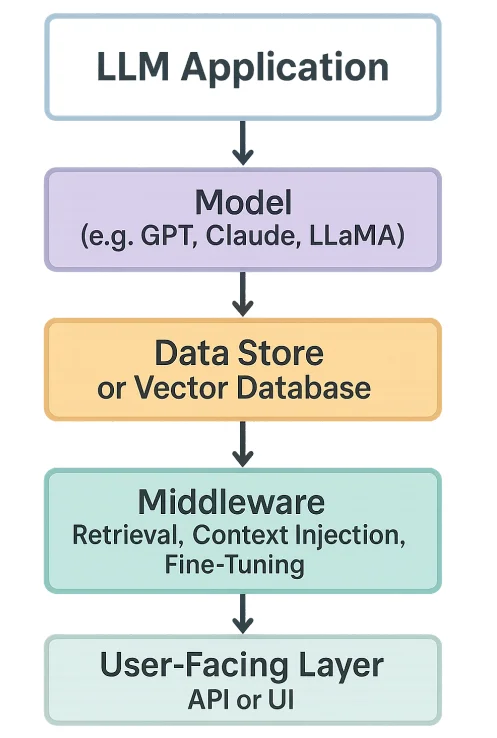
Each layer introduces risks:
- The model may memorize sensitive data.
- The retrieval layer might expose private embeddings.
- Plugins could execute unintended actions.
- Logs may store PII or confidential tokens.
Security here means protecting both the pipeline and the intelligence it generates.
Key Security Challenges
- Prompt Injection Attacks – Malicious inputs that manipulate model behavior to leak or modify sensitive data.
- Data Exfiltration through Plugins – Unrestricted plugin APIs or external tool calls that export private data.
- Training Data Poisoning – Corrupted fine-tuning or retrieval corpora that inject false facts or vulnerabilities.
- Model Output Injection – Attackers embedding malicious payloads in responses (e.g., cross-site scripts).
- Compliance Drift – When LLMs process sensitive data without audit trails, violating GDPR or HIPAA standards.
LLMs may expose indirect leaks through embeddings, logs, or auto-suggestions even when prompts seem benign. Use layered protections.
Core Security Layers for LLM Applications
1. Data Security and Compliance
- Encrypt stored embeddings and vector indexes using database encryption.
- Classify and mask sensitive data with dynamic masking or static masking before feeding it to the model.
- Validate alignment with frameworks like GDPR and PCI DSS.
2. Access Control and Monitoring
- Enforce role-based access control.
- Implement reverse proxy gateways for authentication, rate limits, and anomaly detection.
- Centralize activity monitoring for every API call and model query.
3. Prompt & Context Protection
- Sanitize user input and redact secrets before passing to the LLM.
- Apply “guardrails” that validate responses and strip confidential identifiers.
- Log all prompts securely using audit logs.
4. Model Lifecycle Security
- Sign and version every model and dataset.
- Review all fine-tuning datasets for injection or malicious content.
- Apply continuous integrity checks using hashing or digital signatures.
5. Network and API Defense
- Use HTTPS/TLS for all model traffic.
- Limit outbound connections from LLM apps.
- Monitor all plugin and external API calls for data exfiltration.
Treat your LLM app like a mini data center — isolate critical paths, log every transaction, and verify every dependency.
Implementation Best Practices
For Organizations
- Data Classification First: Identify which inputs are sensitive or regulated.
- Unified Compliance View: Leverage data discovery and compliance reports from DataSunrise to monitor usage.
- Zero-Trust AI Deployment: Assume every prompt or response could be an attack vector.
- Regular Security Testing: Run red-team and adversarial evaluations on LLM outputs.
For Technical Teams
- Fine-Tuning Hygiene: Validate datasets before fine-tuning or RAG ingestion.
- Secure Secrets Management: Never embed API keys in prompts or environment variables without encryption.
- Behavior Analytics: Use behavior analytics to detect anomalous query patterns.
- Least Privilege Policy: Follow the principle of least privilege across APIs and model access layers.
LLM Application Security Checklist (Summary)
| Area | Key Controls | Tools / Techniques |
|---|---|---|
| Data Layer | Encryption, masking, compliance tagging | Database Encryption, Dynamic Masking |
| Access Control | RBAC, MFA, proxies | Reverse Proxy, RBAC |
| Prompt Layer | Sanitization, context filters | Custom guardrails, validation scripts |
| Model Lifecycle | Versioning, signing, validation | GitOps, CI/CD scanning |
| Monitoring | Centralized audit and anomaly detection | Activity Monitoring, Audit Logs |
FAQ: LLM Application Security
Q1. What’s the biggest security risk in LLMs?
Prompt injection and data exfiltration through connected plugins or external APIs.
Q2. Can an LLM leak training data?
Yes — especially fine-tuned or RAG models trained on sensitive text without masking or encryption.
Q3. How can I ensure compliance with GDPR or HIPAA?
Enable data masking, consent tracking, and audit trails for all model interactions.
Q4. What is the best way to detect malicious activity?
Use behavior analytics and real-time monitoring for unusual query patterns or excessive token usage.
Q5. How does DataSunrise secure LLM pipelines?
By combining proxy-based activity monitoring, masking, and data protection within a unified compliance framework.
Conclusion
Just as federated learning taught the world that privacy-preserving collaboration is possible, securing LLMs proves that intelligence and governance can coexist.
DataSunrise enables organizations to enforce encryption, monitoring, and compliance across the entire LLM ecosystem — from vector stores to fine-tuned models — ensuring no insight comes at the cost of security.
Recommended Reading: