Databricks SQL Database Activity History
Databricks SQL is widely adopted as an analytical query layer in lakehouse architectures, enabling organizations to run dashboards, ad-hoc analytics, and scheduled reporting on shared datasets. As these environments scale across teams and applications, understanding how the database is used over time becomes as important as tracking individual queries. This is where a Databricks SQL database activity history plays a critical role.
Database activity history provides continuous visibility into how SQL operations are executed, how frequently specific objects are accessed, and how usage patterns evolve. Rather than focusing on isolated events, it captures long-term behavior across users, sessions, and workloads. This perspective is essential for security, governance, performance optimization, and regulatory compliance.
This article explains what database activity history means in the context of Databricks SQL, why native query history is insufficient at scale, and how DataSunrise builds a centralized, query-aware activity history suitable for operational analysis and compliance reporting.
What Is Database Activity History?
Database activity history is a structured, time-ordered record of SQL operations collected continuously. It includes executed statements, execution timestamps, query types, user identities, session identifiers, and execution outcomes. Together, these elements form a behavioral timeline of how the database is accessed and modified.
Unlike audit logs, which capture individual events, or audit trails, which focus on evidentiary sequencing, database activity history is designed for analysis over time. It answers questions such as which tables are accessed most frequently, which users generate the highest query volume, and how access patterns change during business cycles.
This long-term visibility is especially valuable in environments where multiple BI tools, automated jobs, and applications query the same Databricks SQL warehouse concurrently.
Native Databricks SQL Activity Visibility
Databricks SQL provides a native query history interface that displays recently executed statements together with basic execution metadata. Administrators commonly use this view to troubleshoot failed queries or analyze short-term performance issues.
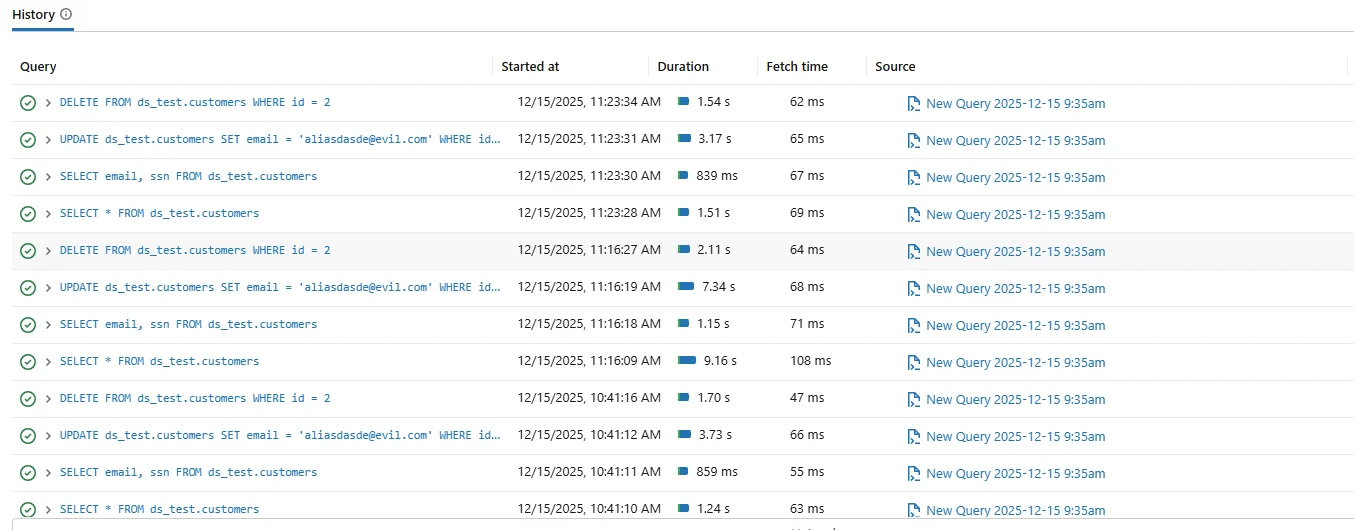
Native Databricks SQL history view showing executed queries, timestamps, and execution status.
While native history offers immediate visibility, it is not designed to function as a comprehensive database activity history. Retention is limited, records are scoped to recent activity, and there is no built-in mechanism to correlate events across sessions or users.
In practice, organizations often export native logs to external platforms such as Azure Log Analytics or Amazon CloudWatch. However, these systems still require manual aggregation and analysis to extract meaningful activity trends.
Why Native History Is Not Enough
Native Databricks SQL history focuses on individual query execution rather than usage behavior. It does not reliably show how queries relate to one another, how sessions evolve, or how access patterns change over time.
For security teams, this limitation creates blind spots. Sudden spikes in data access, unusual query timing, or unexpected access to sensitive tables may go unnoticed without historical context. For governance teams, the lack of centralized activity history complicates oversight and policy validation.
To address these gaps, organizations require a system that captures database activity continuously and preserves it in a form suitable for long-term analysis.
Connecting Databricks SQL for Activity History Collection
Building a reliable database activity history begins with establishing a secure connection to Databricks SQL. DataSunrise connects to the SQL warehouse and captures SQL activity in real time without interfering with query execution.
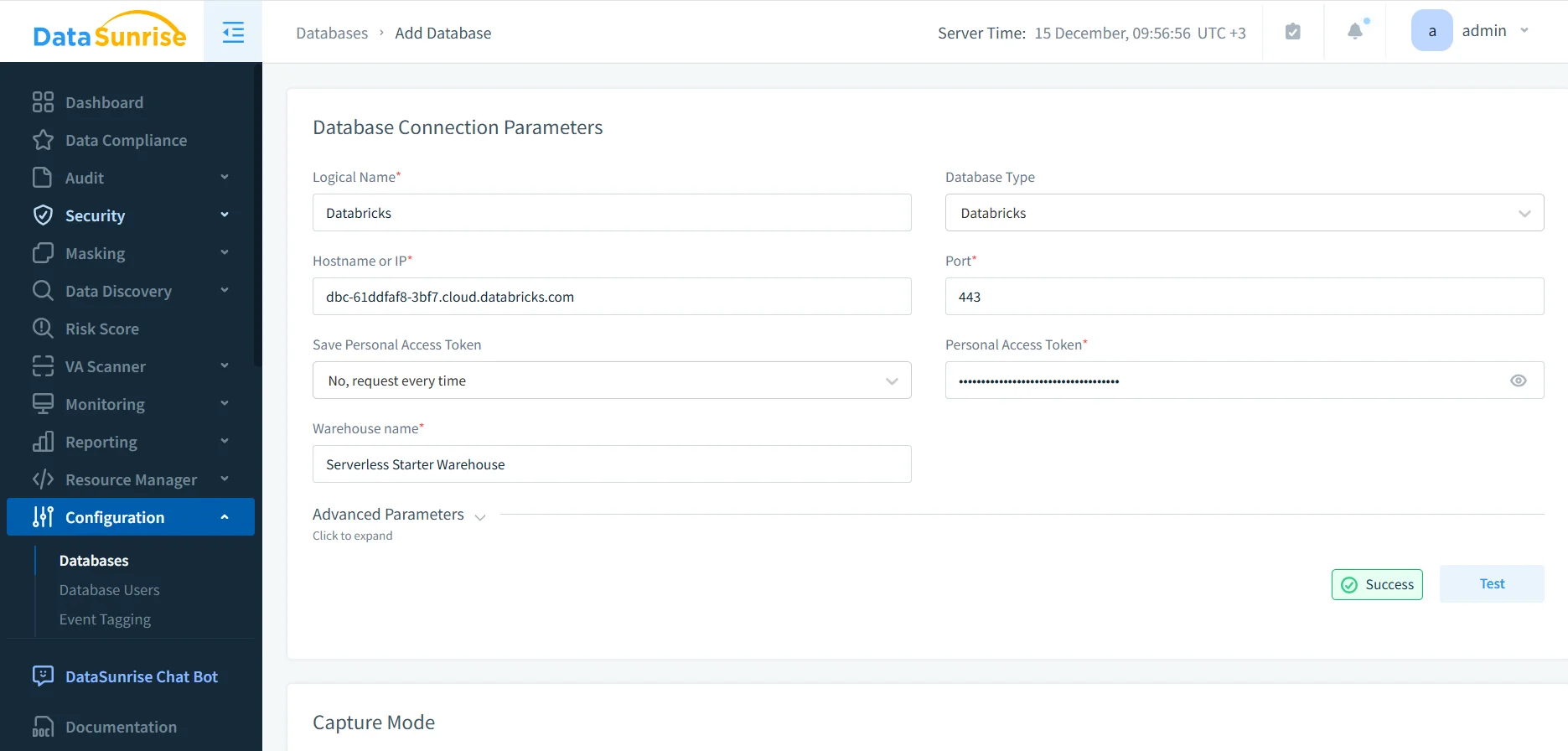
Configuring a Databricks SQL connection in DataSunrise to enable continuous database activity history collection.
During configuration, administrators define connection parameters such as hostname, port, warehouse name, and authentication method. Once connected, DataSunrise begins collecting activity across users, applications, and BI tools.
This continuous capture ensures that all relevant SQL activity contributes to a complete activity history from the moment monitoring is enabled.
Centralized Database Activity History with DataSunrise
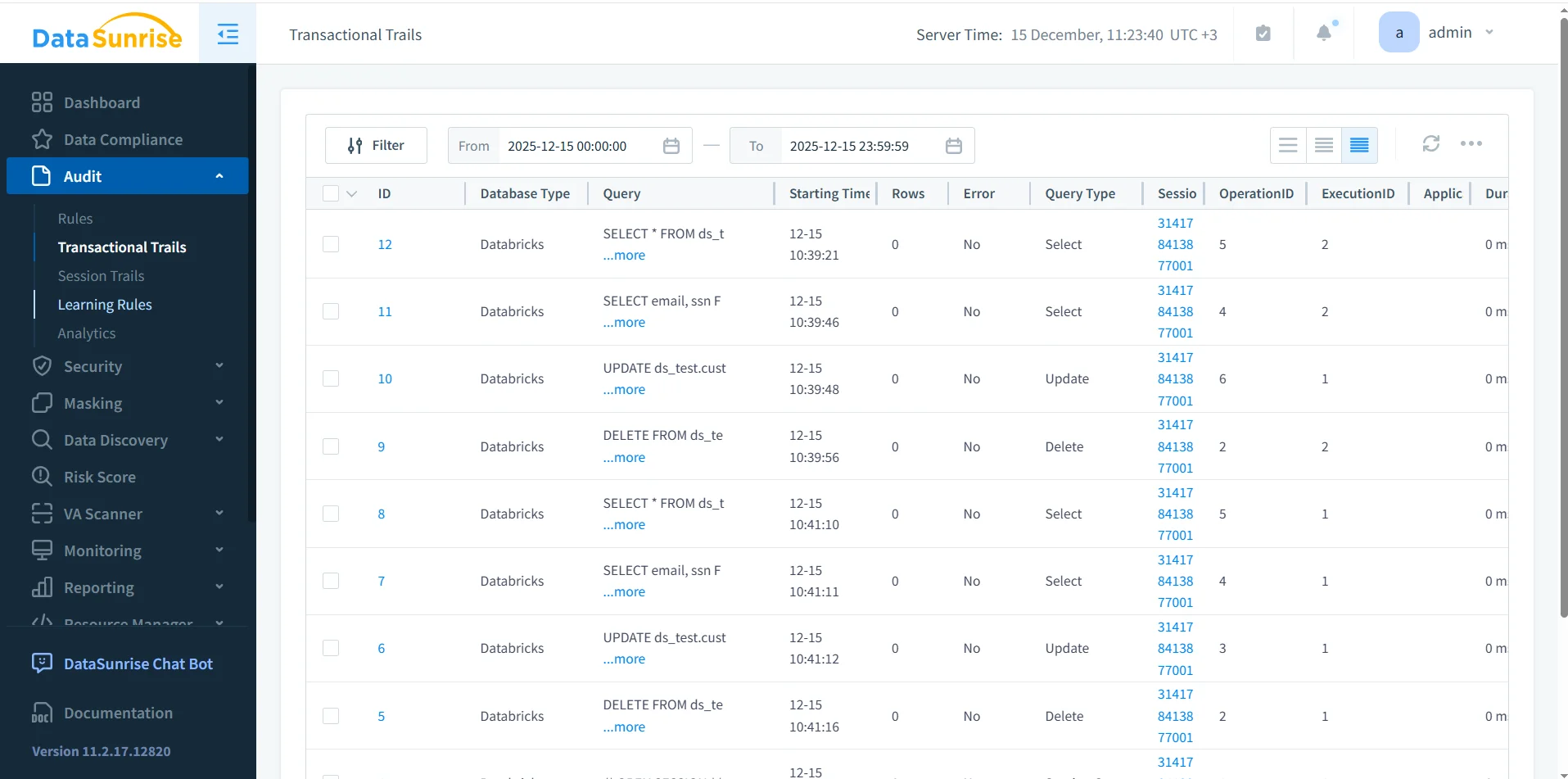
DataSunrise builds a centralized database activity history by consolidating SQL events into a unified repository. Each activity record includes query text, execution time, query type, user identity, session identifier, and execution result.
By correlating events across sessions and users, DataSunrise transforms raw SQL telemetry into a coherent behavioral dataset. This allows teams to analyze how data is accessed over time rather than examining isolated events.
Database Activity History vs Native Query Logs
| Capability | Native Databricks History | DataSunrise Activity History |
|---|---|---|
| Retention | Short-term | Configurable long-term storage |
| Session correlation | Not available | Automatic correlation |
| Behavior analysis | Manual | Built-in aggregation |
| Cross-user visibility | Limited | Unified view |
| Audit readiness | Partial | Compliance-ready |
Operational Use Cases for Database Activity History
A Databricks SQL database activity history supports several operational scenarios. Security teams use it to investigate suspicious access patterns and validate access controls. Data owners rely on it to understand how datasets are consumed across teams.
From a governance perspective, activity history helps enforce the principle of least privilege by identifying unused or excessive access rights. It also supports continuous database activity monitoring.
Compliance and Reporting Perspective
| Regulation | Activity History Requirement | How DataSunrise Helps |
|---|---|---|
| GDPR | Ongoing monitoring of data access | User-attributed activity records |
| HIPAA | Tracking access to sensitive records | Detailed query-level history |
| PCI DSS | Monitoring database interactions | Session-aware activity tracking |
| SOX | Auditability of data operations | Searchable, immutable history |
Conclusion: Building Databricks SQL Database Activity History
Databricks SQL delivers powerful analytical capabilities, but modern data platforms require continuous visibility into database usage. Native query history provides a starting point, yet it lacks the depth needed for long-term analysis and governance.
A centralized Databricks SQL database activity history built with DataSunrise captures SQL behavior in real time, correlates activity across users and sessions, and produces actionable insights for security, operations, and compliance.
With a robust activity history in place, organizations can scale Databricks SQL confidently while maintaining control, transparency, and regulatory alignment.
Protect Your Data with DataSunrise
Secure your data across every layer with DataSunrise. Detect threats in real time with Activity Monitoring, Data Masking, and Database Firewall. Enforce Data Compliance, discover sensitive data, and protect workloads across 50+ supported cloud, on-prem, and AI system data source integrations.
Start protecting your critical data today
Request a Demo Download Now