AI Threats and Security Risks
Artificial Intelligence has become a central pillar of modern enterprise technology — optimizing decisions, detecting fraud, and enabling real-time analytics across industries.
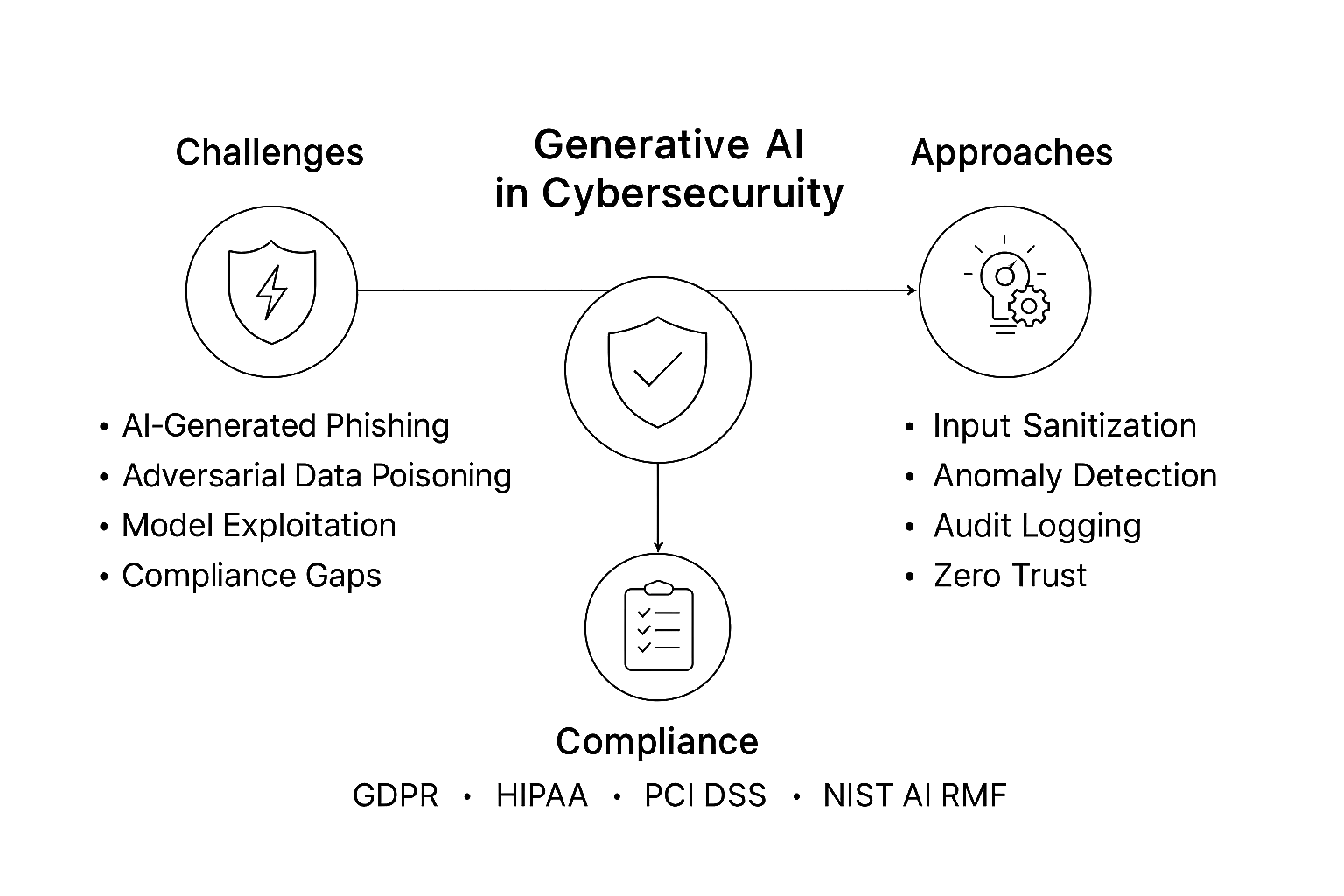
Yet, as AI systems grow in complexity and autonomy, so do the AI threats and the attack surfaces. Adversaries have begun to weaponize AI itself, using generative models, adversarial training, and automated exploitation techniques to outpace human defenders.
Nowadays more and more organizations face new categories of cyber risk directly tied to AI adoption. From model manipulation to data extraction, AI’s advantages can easily turn into vulnerabilities when left unguarded.
AI systems can become both targets and tools for attackers. Securing them requires understanding the technology’s inner logic — and its capacity for misuse.
Understanding AI Threats
AI systems process massive datasets, adapt autonomously, and make high-impact decisions — attributes that also make them attractive to attackers.
Threats can occur at every stage of the AI lifecycle: from data ingestion to model inference.
1. Data Poisoning
AI models learn from what they’re given. Poisoned datasets — containing manipulated or mislabeled samples — can alter a model’s decision boundaries.
In intrusion detection, this might cause malicious activity to appear benign. Even minor contamination can significantly reduce accuracy, a phenomenon often invisible until exploited in production.
2. Model Inversion and Extraction
When users query a deployed model repeatedly, they can infer patterns that reveal internal data or parameters.
Attackers have reconstructed proprietary datasets and sensitive attributes (like medical details or financial indicators) purely from model responses — effectively performing AI espionage.
3. Adversarial Examples
Small, carefully engineered perturbations in inputs — such as imperceptible pixel changes or modified embeddings — can fool AI systems completely.
A self-driving car might misread a stop sign as a speed limit, or a fraud detector might classify suspicious transactions as normal. These exploits require no access to code, only to the model’s exposed interface.
4. Generative Deepfakes
Text, image, and voice generation models are being used to fabricate identities, spread misinformation, and execute social-engineering campaigns at scale.
Combined with automated delivery systems, deepfakes create highly convincing phishing or impersonation attacks that bypass traditional filters.
5. Autonomous Agent Exploits
AI agents capable of executing commands, scheduling actions, or accessing APIs can be manipulated into performing harmful operations.
Malicious prompts, known as prompt injections, can override rules, trigger data leaks, or execute unauthorized workflows through indirect manipulation.
Technical Solutions for AI Security
Protecting AI systems demands a fusion of classic cybersecurity discipline and adaptive machine intelligence. Defensive design begins at the data layer and extends into continuous monitoring and audit.
1. Data Integrity Validation
Before training, every dataset must be verified for authenticity and integrity.
The snippet below illustrates a hashing-based validation method for ensuring that only approved data enters the pipeline.
import hashlib
import os

def verify_dataset(path: str, expected_hash: str) -> bool:
    """Validate dataset integrity using SHA-256."""
    if not os.path.exists(path):
        raise FileNotFoundError("Dataset not found")

    hasher = hashlib.sha256()
    with open(path, "rb") as f:
        for chunk in iter(lambda: f.read(4096), b""):
            hasher.update(chunk)

    return hasher.hexdigest() == expected_hash

# Example usage
if not verify_dataset("train.csv", "a91b...c2d"):
    raise ValueError("Dataset integrity compromised!")
By recording dataset fingerprints in audit logs, organizations can detect tampering early — long before poisoned samples reach production models.
2. Defensive Adversarial Training
The best way to defend against adversarial inputs is to learn from them.
AI teams can intentionally generate perturbations and retrain models to improve robustness.
import numpy as np

def adversarial_noise(x, epsilon=0.01):
    """Add small perturbations to simulate adversarial attacks."""
    noise = epsilon * np.sign(np.random.randn(*x.shape))
    return np.clip(x + noise, 0, 1)

# Example: augment training data with noise
x_train_adv = adversarial_noise(x_train)
model.fit(x_train_adv, y_train)
This controlled exposure strengthens models against real-world attacks and complements behavior analytics systems that track anomalies across inference requests.
3. Continuous Audit and Explainability
Explainable AI (XAI) frameworks combined with immutable logging allow investigators to reconstruct what decisions were made — and why.
Recording every inference event provides both operational transparency and compliance documentation.
import datetime, json

def log_inference(user, input_summary, prediction):
    timestamp = datetime.datetime.utcnow().isoformat()
    entry = {"time": timestamp, "user": user, "input": input_summary, "prediction": prediction}
    print(json.dumps(entry))

log_inference("analyst01", "login attempt from unknown IP", "flagged_suspicious")
These audit records can be correlated with database activity monitoring to detect cross-system anomalies — bridging AI decision logic with backend transaction trails.
Organizational Strategies for Managing AI Risks
Technology can only go so far without structured governance. AI risk management must be embedded into corporate policy, engineering workflows, and compliance reporting.
1. Establish AI Risk Frameworks
Adopt frameworks aligned with NIST AI RMF or ENISA’s AI Threat Landscape guidelines.
These help define clear responsibilities across teams — data scientists, DevOps, compliance officers — ensuring that every AI component undergoes consistent risk assessment and change control.
2. Secure AI Supply Chains
AI pipelines depend on third-party data, pre-trained models, and open-source dependencies.
All artifacts should be verified using cryptographic signing and tracked via immutable provenance logs.
A single compromised library can infect the entire inference environment — much like supply-chain attacks seen in traditional DevOps.
3. Build Red-Team and Blue-Team Integration
Red-teaming AI means attacking your own models before adversaries do.
By running simulated exploit prompts, model extraction attempts, and adversarial inputs, organizations identify weak points early.
Blue teams then adapt security rules and response playbooks accordingly.
4. Implement Context-Aware Access Controls
AI systems accessing production databases should operate under the principle of least privilege.
Integrate role-based access control with contextual risk signals — user location, session behavior, and query type — to dynamically restrict access to sensitive datasets.
The Compliance Dimension
Regulatory requirements are converging toward accountability in AI — ensuring systems are both explainable and secure.
Non-compliance no longer means fines alone; it can halt operations in regulated sectors like healthcare or finance.
| Regulation | AI Security Focus | Recommended Control |
|---|---|---|
| GDPR | Transparency in automated decision-making | Maintain explainable models with full audit trails |
| HIPAA | Protection of PHI used in AI diagnostics | Implement [dynamic masking](https://www.datasunrise.com/knowledge-center/dynamic-data-masking/) and encryption |
| PCI DSS 4.0 | AI models analyzing payment data | Apply tokenization and access segmentation |
| SOX | Financial model accountability | Use [audit trails](https://www.datasunrise.com/knowledge-center/audit-trails/) and immutable logs for traceability |
| NIST AI RMF | Risk and provenance documentation | Deploy continuous [data discovery](https://www.datasunrise.com/knowledge-center/data-discovery/) and integrity validation |
Strong AI compliance strategy not only reduces risk exposure but also builds confidence with regulators, customers, and investors — proving that AI can be both innovative and accountable.
Conclusion: Building Resilient AI Systems
AI threats will continue to evolve as fast as the technology itself.
Attackers are no longer just breaching networks — they’re corrupting algorithms, manipulating data, and exploiting cognitive weaknesses in human–machine interactions.
Defending against these risks requires a multi-layered security posture:
- Prevention — validate data and secure the supply chain
- Detection — monitor behaviors using adaptive and generative models
- Response — maintain immutable logs and explainability for audits
- Governance — align with global compliance frameworks and ethical standards
AI will remain both a weapon and a shield. The organizations that thrive will be those who treat it as both — building systems that anticipate, withstand, and evolve faster than the threats they face.
Protect Your Data with DataSunrise
Secure your data across every layer with DataSunrise. Detect threats in real time with Activity Monitoring, Data Masking, and Database Firewall. Enforce Data Compliance, discover sensitive data, and protect workloads across 50+ supported cloud, on-prem, and AI system data source integrations.
Start protecting your critical data today
Request a Demo Download Now