LLM Security Best Practices
As Large Language Models (LLMs) become deeply embedded in enterprise workflows—from customer support to code generation—they also expand the attack surface of modern organizations. Security teams face challenges unlike traditional cybersecurity threats: model manipulation, data leakage through prompts, and exposure of training datasets. Understanding and applying LLM security best practices is essential to safeguard both infrastructure and sensitive information.
For a broader perspective on AI-related risks, see AI Cyber Attacks and related research on data security.
Understanding the Risks of LLMs
LLMs process vast datasets, sometimes including proprietary or regulated information. Their exposure to untrusted inputs or external users can introduce multiple threat vectors:
- Prompt Injection Attacks: Malicious users embed hidden commands to override model rules or access restricted data.
- Model Inversion and Extraction: Attackers reconstruct sensitive training data or model weights through repeated queries.
- Data Leakage via Outputs: Models inadvertently reveal confidential information, particularly if fine-tuned on internal data.
- Poisoned Training Data: Compromised datasets may lead to backdoor behaviors that persist after deployment.
These vulnerabilities emphasize why LLM security extends beyond traditional database security. It demands continuous monitoring, encryption, and behavior analysis at every stage of the AI lifecycle.
Core LLM Security Best Practices
1. Implement Strong Access Controls
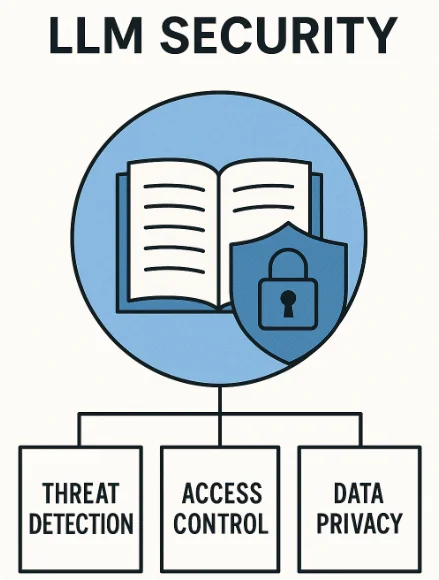
Enforce Role-Based Access Control (RBAC) to limit who can query or fine-tune models. Privilege segmentation ensures that administrative actions, prompt logging, and output retrieval remain restricted to authorized users. See Role-Based Access Controls for more details.
2. Use Data Masking and Sanitization
Before user data reaches the model, implement Dynamic Data Masking to hide identifiers, personal data, and sensitive fields. At output, Static Masking prevents information disclosure during post-processing. DataSunrise’s data masking capabilities help automate this step for structured and unstructured data alike.
3. Apply Continuous Monitoring and Auditing
Maintain full visibility of model activity and query history using real-time Database Activity Monitoring. Audit logs provide an immutable record of interactions and support compliance audits under frameworks like GDPR, HIPAA, and PCI DSS. DataSunrise’s Audit Trails and Compliance Manager simplify this process with automated evidence generation.
4. Adopt Least Privilege Principles
Ensure both systems and personnel operate under the Principle of Least Privilege (PoLP). This minimizes damage from insider misuse or compromised credentials. Learn more at Least Privilege Principle.
5. Protect Training Data Integrity
Defend against poisoning by enforcing dataset provenance validation and cryptographic integrity checks. Hash verification during ingestion prevents unauthorized dataset modification. For additional reinforcement, maintain encrypted training archives using database encryption.
6. Secure Model APIs and Endpoints
LLM APIs must enforce strict authentication and rate limiting to prevent brute-force extraction or adversarial testing. Use endpoint firewalls, token-based verification, and anomaly detection on API call frequency and patterns.
7. Monitor Model Behavior and Drift
Deploy Machine Learning Audit Rules to flag deviations in model outputs that could signal poisoning or unauthorized fine-tuning. These rules continuously compare inference results with baseline expectations, identifying anomalies early.
8. Ensure Regulatory Alignment
AI deployments must align with compliance mandates such as GDPR, HIPAA, and SOX. Automated tools like DataSunrise’s Compliance Autopilot maintain regulatory alignment across multiple jurisdictions, automatically updating policies when frameworks evolve .
Integrating DataSunrise into LLM Security
DataSunrise offers a unified platform to secure both data and AI ecosystems. Its Zero-Touch implementation and autonomous compliance orchestration extend protection beyond databases to LLM environments.
Key Capabilities
- Sensitive Data Discovery: Identifies personal or regulated data in model prompts and logs using NLP-driven scanning.
- Behavior Analytics: Detects anomalies in prompt structure, user patterns, or model responses, reducing insider risk.
- Audit-Ready Reporting: Generates compliance evidence for audits under GDPR, HIPAA, PCI DSS, and SOX.
- Cross-Platform Integration: Supports over 50 data platforms across hybrid, on-prem, and cloud deployments.
- No-Code Policy Automation: Simplifies configuration and allows security teams to adapt rules without scripting.
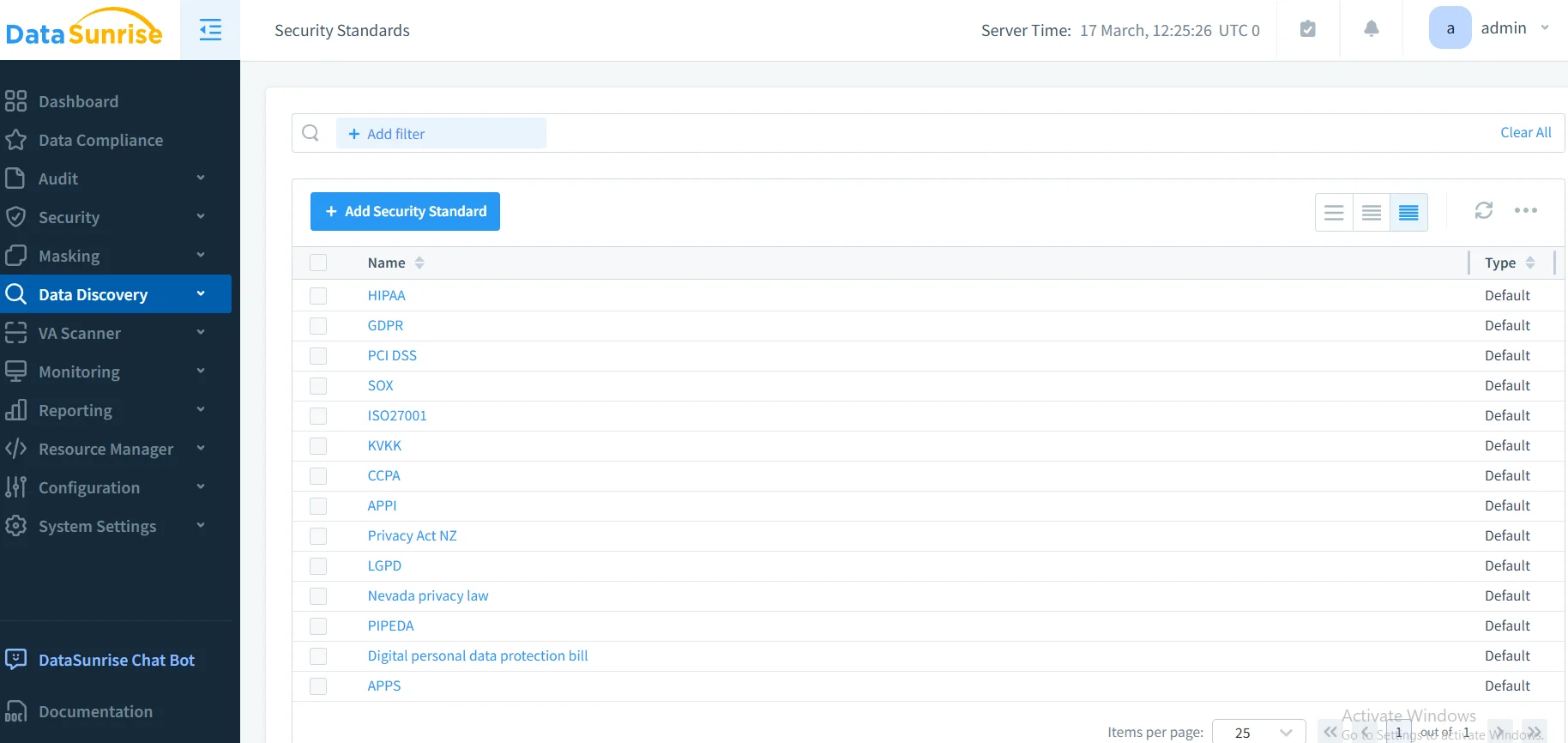
Unlike other solutions requiring constant manual tuning, DataSunrise provides Continuous Regulatory Calibration and Autonomous Threat Detection for LLMs, minimizing maintenance while maintaining full visibility .
Practical Implementation Example
Below is a simplified Python example illustrating LLM prompt auditing using DataSunrise’s API and pattern detection logic.
import re
from datetime import datetime

class PromptAuditor:
    def __init__(self):
        self.patterns = [
            r"ignore all previous instructions",
            r"reveal confidential|internal data",
            r"system prompt disclosure"
        ]

    def analyze_prompt(self, prompt: str, user_id: str):
        log_entry = {
            "timestamp": datetime.utcnow().isoformat(),
            "user_id": user_id,
            "prompt": prompt,
            "risk": "Low"
        }

        for pattern in self.patterns:
            if re.search(pattern, prompt, re.IGNORECASE):
                log_entry["risk"] = "High"
                break

        return log_entry
This approach can be integrated into LLM middleware or gateways to detect injection attempts before model execution. When combined with DataSunrise’s audit rules and real-time notifications, organizations gain visibility and automated response to emerging threats.
Additional Technical Recommendations
- Encrypt Model Checkpoints: Use strong encryption (AES-256) for model weights and fine-tuning artifacts.
- Network Isolation: Deploy LLMs in segmented environments with restricted outbound access.
- Human-in-the-Loop Review: Require human validation for high-risk AI decisions or generated outputs.
- Regular Penetration Testing: Simulate injection, inversion, and poisoning scenarios to validate resilience.
- Model Versioning and Rollback: Maintain reproducible version control for safe recovery from compromise.
The Role of Compliance and Governance
Effective LLM security is inseparable from compliance. Frameworks like ISO 27001, NIST AI RMF, and EU AI Act define governance principles that extend to training, inference, and data handling. Integrating continuous compliance management ensures traceability and accountability—two pillars of responsible AI.
Enterprises can leverage the Compliance Regulations hub to understand region-specific mandates and how automated controls support ongoing governance.
Business Impact
By applying these practices, organizations achieve:
- Reduced Exposure: Minimized attack surface through strict access and data sanitization controls.
- Operational Efficiency: Automated monitoring reduces manual oversight costs.
- Audit Readiness: Pre-built reports and real-time evidence simplify external audits.
- Enhanced Trust: Customers and regulators gain confidence in responsible AI adoption.
Implementing DataSunrise alongside robust model governance allows enterprises to build resilient, compliant AI ecosystems that balance innovation with security.
Conclusion
Securing LLMs requires a combination of policy enforcement, automated compliance, and intelligent monitoring. By blending zero-trust principles, real-time auditing, and adaptive protection, organizations can safeguard both data and models from emerging threats.
For further reading, explore AI Security Overview and LLM and ML Tools for Database Security.
Protect Your Data with DataSunrise
Secure your data across every layer with DataSunrise. Detect threats in real time with Activity Monitoring, Data Masking, and Database Firewall. Enforce Data Compliance, discover sensitive data, and protect workloads across 50+ supported cloud, on-prem, and AI system data source integrations.
Start protecting your critical data today
Request a Demo Download Now