LLM Security vs Safety
Large Language Models (LLMs) are transforming software development, education, and analytics. Yet the rush to deploy them has sparked a growing debate: LLM security vs safety — and which matters more.
The two concepts often overlap but represent very different challenges in responsible AI deployment.
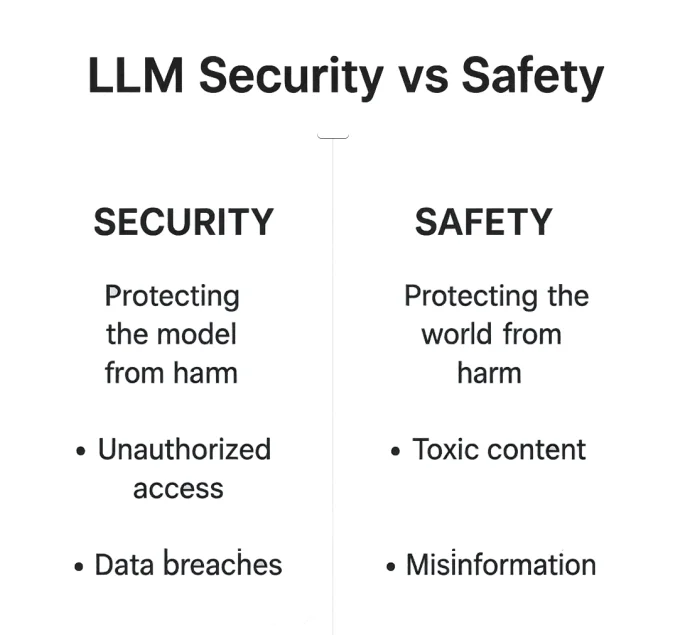
Security protects the model from harm. Safety protects the world from the model. Both are essential for implementing a trustworthy AI.
LLM Security vs Safety: Understanding the Difference
When people discuss securing Large Language Models, they often use security and safety interchangeably — but they operate on very different layers of the AI ecosystem.
LLM Security is about fortifying the model’s environment: protecting databases, access points, and APIs from exploitation. Meanwhile, LLM Safety focuses on what the model says — ensuring its responses stay ethical, factual, and within acceptable boundaries.
Security is a battle against external manipulation. Safety is a safeguard against internal misalignment. In practice, both overlap. A compromised model can produce unsafe outputs, and an unsafe model can become a security risk through social engineering or data leaks. Understanding the nuances between these two dimensions is essential for building AI systems that are both trustworthy and resilient.
| Aspect | LLM Security | LLM Safety |
|---|---|---|
| Focus | Protecting infrastructure, data, and models from unauthorized access | Preventing harmful, biased, or unethical outputs |
| Threats | Injection attacks, unauthorized access, data breaches | Toxic content, misinformation, ethical violations |
| Goal | Keep the model and data secure | Keep the outputs safe and aligned |
| Example | SQL injection prevention | RLHF content filtering |
The two together form the backbone of responsible AI deployment — where technical protection ensures trust, and ethical alignment ensures accountability.
1. What Security Means in LLMs
LLM security focuses on protecting infrastructure, models, and data pipelines from unauthorized access or manipulation.
It’s the technical shield that guards confidential data, intellectual property, and system integrity — the silent barrier between safe operation and data catastrophe.
Common Security Risks
Attackers constantly probe LLM systems for weak spots: injecting hidden instructions, exploiting unfiltered prompts, or harvesting tokens from unsecured logs.
Even the most advanced model can be compromised if it relies on an unprotected retrieval pipeline or exposes confidential embeddings.
Typical weak points include:
- Unauthorized data access via prompt injection or misconfigured APIs
- Exposure of sensitive fields or tokens in logs
- Lack of encryption in retrieval or fine-tuning pipelines
These threats turn intelligent models into liability vectors — unless robust defensive layers are in place.
Mitigation Controls
LLM security isn’t a single wall — it’s a system of layered defenses:
- Database firewall for perimeter protection
- Data protection and encryption for stored and transmitted data
- Database activity monitoring to identify abnormal behavior before it spreads
2. What Safety Means in LLMs
Safety addresses how an LLM behaves — its ethical boundaries, factual reliability, and ability to avoid harm.
If security is the vault around the model, safety is the conscience within it.
Safety is less about stopping hackers and more about preventing social, reputational, or moral damage that can result from unchecked outputs.
An unsafe model can spread misinformation as easily as a compromised one can leak credentials.
Safety Risks
Poorly tuned models might produce:
- Toxic, biased, or offensive content
- Hallucinated or misleading information
- Prompt jailbreaks that override moderation filters
Each of these failures erodes user trust — and in regulated sectors, may lead to serious compliance consequences.
Safety Measures
Developers counter these risks by combining training strategies and data controls:
- Reinforcement Learning from Human Feedback (RLHF)
- Data discovery and PII detection to identify sensitive information
- Static data masking before training to prevent exposure
# Simple output guardrail example
def safe_response(output: str) -> str:
    banned = ["password", "SSN", "card number"]
    return "[REDACTED]" if any(b in output.lower() for b in banned) else output
A “safe” model resists both malicious prompts and harmful completions. It filters sensitive data before and after generation.
3. Where LLM Security and Safety Intersect
The line blurs at the model interface — where prompts, retrieval, and generation meet.
This is the gray zone where a secure system might still produce unsafe outputs, and a “safe” model might unintentionally expose internal data.
A system can be secure but unsafe (leaking private data responsibly stored) or safe but insecure (censored but easily hacked). The strongest frameworks address both fronts simultaneously.
Shared Controls
In this convergence zone, certain mechanisms protect both infrastructure and output quality:
- Role-based access control (RBAC)
- SQL injection detection
- Guardrailed prompt handling and content moderation filters
| Overlap Area | Example Control | Purpose |
|---|---|---|
| Input Validation | Prompt sanitization | Prevent injection or sensitive leakage |
| Access Control | RBAC / reverse proxy | Restrict model tools and plugins |
| Output Review | Post-generation filter | Remove unethical or private data |
The intersection of safety and security isn’t theoretical — it’s operational. The most resilient LLM environments merge access management, prompt analysis, and ethical moderation into one continuous process.
4. LLM Security in Practice
In production, LLM security means layered protection — not just encrypting data but controlling how it flows.
Every API call, vector search, or embedding lookup should be treated as a potential attack vector.
Core Practices
- Continuous data protection throughout the model lifecycle
- Audit logs for transparent traceability
- Automated compliance validation integrated with activity monitoring
DataSunrise’s proxy-level architecture filters and anonymizes payloads before they reach model endpoints, ensuring that even complex RAG or fine-tuning workflows remain compliant and protected.
Assume every model request is a potential attack vector — secure every hop from API call to embedding lookup.
5. LLM Safety in Practice
Safety, unlike security, is often evaluated in hindsight. But proactive safety mechanisms can stop most ethical or reputational incidents before they occur.
Techniques
- Reinforcement learning (RLHF) for ethical adaptation
- Context moderation filters for output control
- Compliance alignment across jurisdictions
- Static data masking to prevent harmful training exposure
Example: Output Filtering Logic
def moderation_layer(text):
    if "hate speech" in text.lower():
        return "Content blocked for safety"
    return text
Through layered moderation, organizations can align AI behavior with social, cultural, and legal norms — not as an afterthought, but as part of the training and deployment pipeline.
6. Toward a Unified Framework
Security and safety should reinforce, not compete.
A mature AI governance strategy weaves them together into one operational thread — ensuring the model is technically robust and socially responsible at once.
Unified Approach
- Behavior analytics for anomaly and bias detection
- Audit trails for transparency and traceability
- Data classification for contextual risk management
| Layer | Security Goal | Safety Goal |
|---|---|---|
| Data | Encryption & Masking | Ethical training data |
| Model | Isolation & Access Control | Alignment & Guardrails |
| Output | Logging & Validation | Toxicity Filters & Transparency |
By uniting security controls and ethical policies, enterprises create AI systems that not only withstand external pressure but also uphold human values internally.
Conclusion
Security keeps the model protected from the world.
Safety keeps the world protected from the model.
Both dimensions define the credibility of any AI system.
Only when they coexist — harmonized by policy, monitoring, and compliance automation — can enterprises unlock the full potential of LLMs without compromising privacy, integrity, or trust.
Protect Your Data with DataSunrise
Secure your data across every layer with DataSunrise. Detect threats in real time with Activity Monitoring, Data Masking, and Database Firewall. Enforce Data Compliance, discover sensitive data, and protect workloads across 50+ supported cloud, on-prem, and AI system data source integrations.
Start protecting your critical data today
Request a Demo
Download Now
Protect Your Data with DataSunrise
Secure your data across every layer with DataSunrise. Detect threats in real time with Activity Monitoring, Data Masking, and Database Firewall. Enforce Data Compliance, discover sensitive data, and protect workloads across 50+ supported cloud, on-prem, and AI system data source integrations.
Start protecting your critical data today
Request a Demo Download Now