Adversarial Machine Learning
As artificial intelligence scales across business-critical workflows, about 91% of U.S. banks now use AI for fraud detection, according to Elastic Insights (2025).
While most organizations invest heavily in database security and infrastructure controls, adversarial machine learning (AML) exposes a new, subtler threat — one that targets the algorithms themselves rather than the systems around them.
This article explores how adversarial attacks work, why they’re so dangerous for AI pipelines, and how technologies like DataSunrise’s data-inspired security approach can strengthen model integrity from training to deployment.
Understanding Adversarial Machine Learning
Adversarial machine learning focuses on intentionally crafting inputs that cause AI models to make mistakes — from misclassifying images to generating false predictions. In essence, it’s the science of turning a model’s intelligence into a weakness.
Unlike classic cybersecurity threats that exploit software flaws, adversarial attacks target the statistical heart of machine learning itself. A few bytes of perturbed input can manipulate the model’s output with no visible change to humans. That’s why defending AI systems demands a fusion of real-time monitoring, anomaly detection, and data provenance tracking across all learning stages.
The Core Adversarial Threats
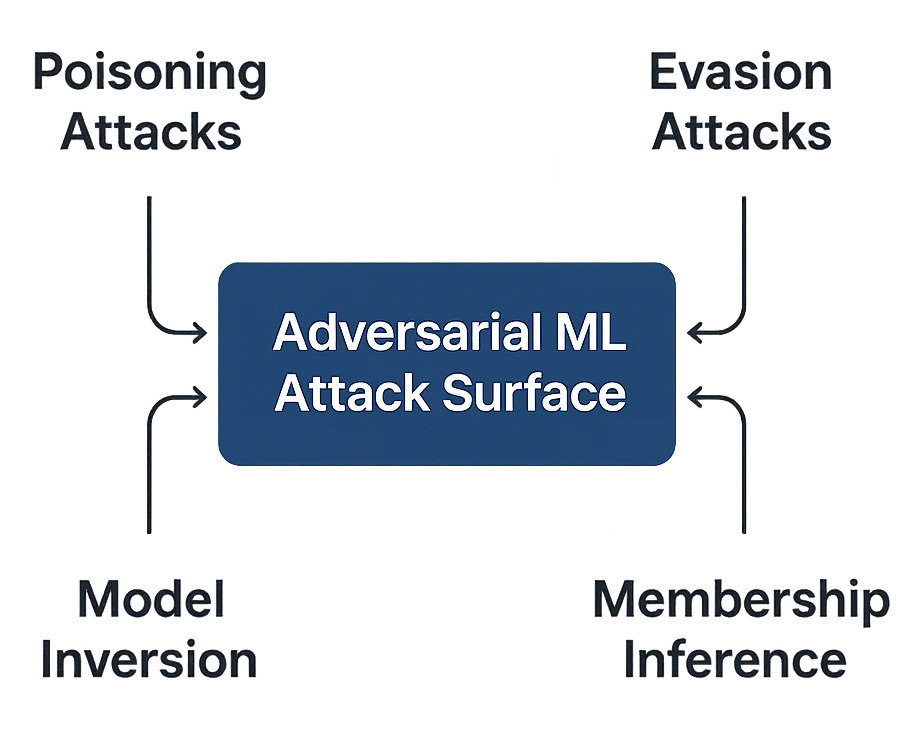
Adversarial ML can appear in several forms, depending on when and how attackers interfere:
- Poisoning Attacks – Corrupting training datasets with malicious examples. Even minor data pollution can bias models and sabotage compliance-critical predictions.
- Evasion Attacks – Crafting inputs that bypass model detection. Common in facial recognition, spam filters, and fraud detection.
- Model Inversion – Reconstructing sensitive training data from model outputs, threatening PII exposure.
- Membership Inference – Guessing whether a particular record was part of the training set, undermining data confidentiality guarantees.
Combine audit logs and differential privacy. Even if the model leaks signals, regulated entities can prove compliance through verifiable audit trails.
Detecting Adversarial Behavior in Real Time
Traditional monitoring tools can’t easily recognize an adversarial input. A slightly altered pixel array or text embedding may appear normal but can completely derail model behavior. To address this, security teams rely on ML-based detectors that flag anomalies in gradient behavior, feature variance, or output entropy.
Below is a simplified example of such a detector:
import numpy as np

class AdversarialDetector:
    """Detects adversarial perturbations based on feature deviation analysis."""

    def __init__(self, baseline_vector: np.ndarray, threshold: float = 0.15):
        self.baseline = baseline_vector
        self.threshold = threshold

    def detect(self, input_vector: np.ndarray) -> dict:
        delta = np.linalg.norm(input_vector - self.baseline) / len(input_vector)
        is_adversarial = delta > self.threshold
        return {
            "threat_detected": is_adversarial,
            "risk_score": float(delta * 100),
            "severity": "HIGH" if is_adversarial else "LOW",
            "recommendations": ["Re-train on verified data"] if is_adversarial else []
        }
This routine compares new inputs against a baseline of trusted data distributions, providing both quantitative and qualitative indicators for downstream behavior analysis.
Hardening Models with Defensive Training
Beyond detection, organizations must harden their models against future manipulation. One effective technique is adversarial training — deliberately exposing the model to modified samples during learning so it learns to resist them.
class RobustTrainer:
    """Performs adversarial training to improve model resilience."""

    def __init__(self, model, epsilon: float = 0.1):
        self.model = model
        self.epsilon = epsilon

    def perturb(self, x):
        noise = np.random.uniform(-self.epsilon, self.epsilon, x.shape)
        return np.clip(x + noise, 0, 1)

    def train(self, data, labels):
        adv_data = self.perturb(data)
        combined = np.vstack((data, adv_data))
        combined_labels = np.concatenate((labels, labels))
        self.model.fit(combined, combined_labels)
        return {"status": "Model trained with adversarial robustness"}
Such defensive strategies work best when integrated into broader pipelines that include data discovery and dynamic masking to control sensitive input visibility.
Best Practices for Adversarial ML Security
For Organizations
- Secure the Data Lifecycle – Establish continuous activity history tracking to spot early anomalies.
- Establish Model Governance – Define ownership and policies that align with compliance frameworks such as GDPR and HIPAA.
- Audit Everything – Enable unified audit trails to verify model lineage and training integrity.
- Educate Stakeholders – Ensure that data scientists understand security implications of adversarial noise.
For Technical Teams
- Use Explainable AI Tools – Interpret model outputs and trace anomalies through security dashboards.
- Integrate Continuous Validation – Automate checks within pipelines using reverse proxy controls for request filtering.
- Apply Role-Based Access – Restrict model training and inference access with RBAC.
- Encrypt Datasets – Use field-level encryption to prevent unauthorized data recovery.
DataSunrise: Comprehensive Adversarial ML Protection
DataSunrise extends protection beyond infrastructure — embedding resilience directly into the AI workflow. Its platform delivers Zero-Touch Security Orchestration with Context-Aware Protection and Autonomous Threat Detection across 50+ supported platforms.
Key Capabilities
- ML-Powered Anomaly Detection – Correlates abnormal gradient and feature behavior.
- Data Provenance Tracking – Ensures every record used in model training is verifiable.
- Compliance Autopilot – Maps model and data operations to regulatory controls.
- Unified Audit Framework – Links logs, events, and user activity into one dashboard.
- Adaptive Masking Engine – Dynamically hides high-risk features during model evaluation.
Together, these modules ensure AI compliance by default — preventing both intentional and accidental adversarial manipulations within enterprise environments.
Conclusion: Building Trustworthy AI Models
Adversarial machine learning reminds us that intelligent systems can be deceived as easily as humans — and that their protection requires equal intelligence in defense.
By combining strong data controls, explainable models, and continuous database firewall enforcement, organizations can transform vulnerability into vigilance.
Protect Your Data with DataSunrise
Secure your data across every layer with DataSunrise. Detect threats in real time with Activity Monitoring, Data Masking, and Database Firewall. Enforce Data Compliance, discover sensitive data, and protect workloads across 50+ supported cloud, on-prem, and AI system data source integrations.
Start protecting your critical data today
Request a Demo Download Now