The Role of AI in Cybersecurity
Introduction
Cyber threats evolve faster than human analysts can respond. Attackers now use automation, polymorphic code, and large-scale social engineering to bypass static defenses.
To keep pace, defenders are turning to artificial intelligence (AI) — not as a tool, but as a core component of their security architecture.
AI brings scale, precision, and prediction to cybersecurity. From threat intelligence correlation to autonomous remediation, it transforms how enterprises detect, respond to, and prevent attacks.
Platforms like DataSunrise extend this intelligence to the database layer, applying machine learning audit rules, behavior analytics, and real-time masking for continuous protection and compliance.
AI doesn’t just automate security — it learns, predicts, and adapts. That’s what makes it indispensable in modern defense.
AI’s Expanding Role in Cyber Defense
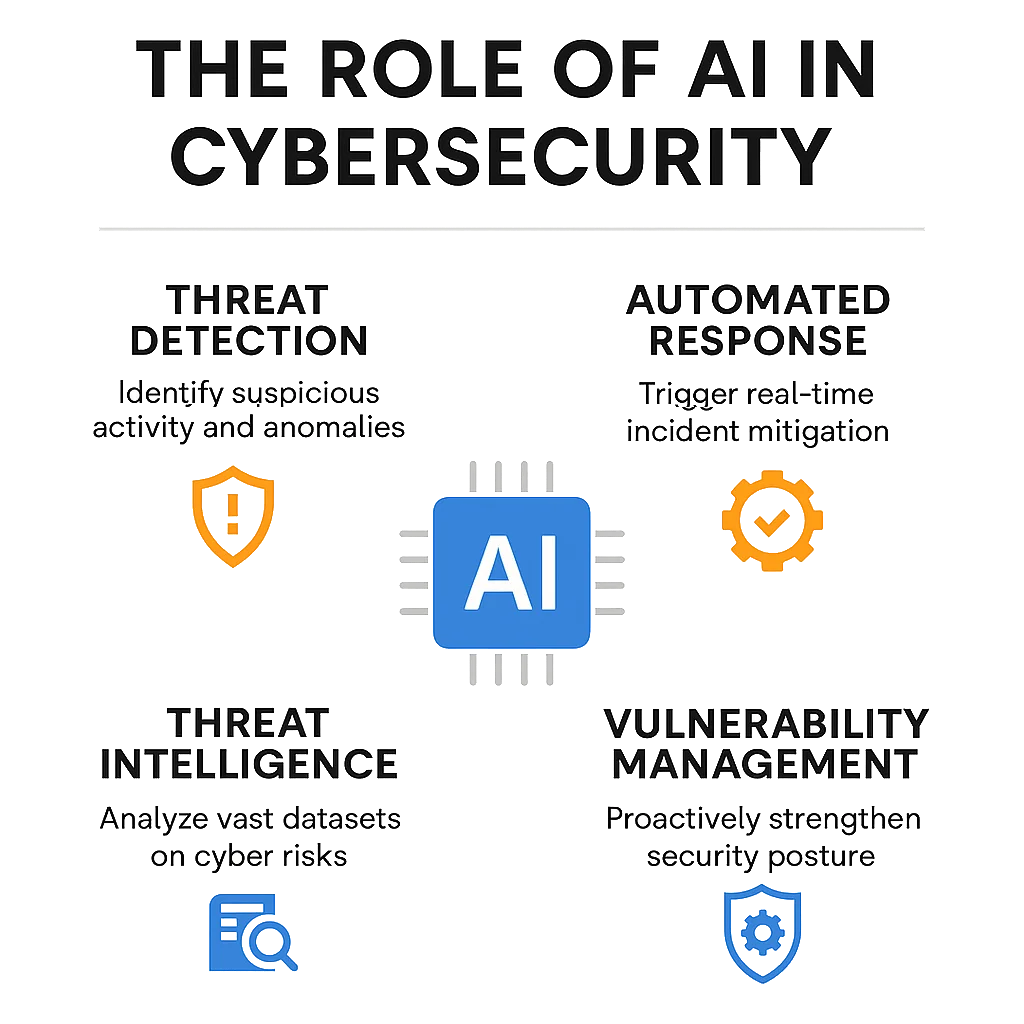
AI enhances cybersecurity at every stage of the defense lifecycle — prediction, detection, and response.
Predictive Defense
Machine learning models process massive event streams to anticipate attacks before they happen.
By analyzing network behavior, access logs, and anomaly patterns, AI systems build baselines of “normal” activity and identify early deviations.
import statistics

class BaselineDetector:
    def __init__(self):
        self.samples = []

    def learn(self, value: float):
        self.samples.append(value)

    def detect(self, current: float):
        mean = statistics.mean(self.samples)
        stdev = statistics.stdev(self.samples)
        return abs(current - mean) > 2 * stdev

bd = BaselineDetector()
for latency in [120, 118, 125, 130, 127]:
    bd.learn(latency)
print(bd.detect(200))  # True = anomaly detected
This self-learning process underpins adaptive security — systems that evolve as threats evolve.
Threat Detection and Correlation
Traditional Security Information and Event Management (SIEM) systems depend on predefined rules.
AI extends this by automatically correlating threat indicators across multiple data sources — databases, APIs, endpoints, and cloud logs.
For instance, DataSunrise’s database activity monitoring uses machine learning-driven correlation to detect suspicious access attempts that would go unnoticed in static log analysis.
Combined with behavior analytics, these models learn from human and system behavior, detecting insider threats and unusual privilege escalations before damage occurs.
Automated Incident Response
Once an attack is detected, AI-driven systems can isolate or neutralize it without human intervention.
Automation accelerates mean time to response (MTTR), ensuring that breaches are contained before they escalate.
Example:
def auto_isolate(ip, score):
    """Block high-risk connections automatically."""
    if score >= 0.9:
        print(f"Blocking {ip}: High risk detected.")
    else:
        print(f"Monitoring {ip}: Risk below threshold.")

auto_isolate("192.168.0.9", 0.94)
Such automation is especially vital in hybrid infrastructures where manual containment is too slow.
Key Benefits of AI in Cybersecurity
| Benefit | Description |
|---|---|
| Speed | Processes thousands of events per second for real-time detection. |
| Precision | Reduces false positives through continuous learning. |
| Scalability | Handles complex, distributed data sources across clouds. |
| Resilience | Adapts dynamically to new attack vectors. |
| Compliance | Supports governance via explainable AI and automated reports. |
These capabilities transform AI from a passive analytic tool into an active defense mechanism.
AI Applications Across Security Layers
AI integrates seamlessly into every component of enterprise cybersecurity:
- Network Security: Identifies abnormal traffic patterns and zero-day attacks.
- Application Security: Detects injection, privilege escalation, and API misuse.
- Database Security: Monitors queries and prevents unauthorized data extraction using DataSunrise’s Database Firewall.
- Cloud Security: Flags cross-tenant data leaks and risky access policies.
- Compliance Automation: Aligns audit evidence with frameworks like GDPR and HIPAA through real-time validation.
Challenges of AI in Cybersecurity
Despite its advantages, AI introduces new risks if left unchecked.
1. Model Vulnerabilities
Attackers can poison AI models, altering decision logic or creating blind spots. This demands model integrity checks and version auditing.
2. Data Privacy
Security AI requires massive datasets — often including sensitive information.
Without proper dynamic data masking and encryption, monitoring systems themselves can become compliance liabilities.
3. Adversarial Attacks
Adversarial inputs crafted to deceive models can cause misclassification or false negatives. Defensive training and anomaly filtering are essential.
4. Overreliance on Automation
AI should augment, not replace, human expertise. Human oversight ensures accountability and contextual judgment.
AI can make cybersecurity faster — but without governance, it can also amplify mistakes at scale.
Integrating AI with DataSunrise
DataSunrise incorporates AI to secure data at its source — where most breaches begin.
Its Machine Learning Audit Rules detect anomalies in query patterns, while Continuous Data Protection ensures masking, logging, and real-time alerting across over 40 supported platforms.
Highlights:
- Adaptive threat scoring for database queries.
- Automated masking policies that protect sensitive fields.
- Centralized compliance dashboards with real-time risk visualization.
- Integration with SIEM tools for enterprise visibility.
These capabilities bridge the gap between AI-powered defense and data-layer protection.
Compliance and Regulatory Alignment
AI-driven cybersecurity must remain transparent and auditable to meet compliance standards.
| Regulation | AI-Centric Focus | DataSunrise Alignment |
|---|---|---|
| GDPR | Data minimization and explainability | Automated masking and activity logs |
| HIPAA | PHI protection in health analytics | Encryption and dynamic access control |
| PCI DSS 4.0 | Transaction monitoring | Real-time audit reporting |
| SOX | Accountability and traceability | Unified compliance dashboards |
AI enhances not only defense but also compliance, reducing the human workload involved in manual evidence generation.
Future of AI in Cybersecurity
The next generation of AI defense will emphasize autonomous learning and collaborative intelligence — models that exchange threat data in real time across organizations.
Emerging trends include:
- Federated Learning for Threat Detection: sharing threat intelligence without exposing sensitive data.
- Generative Threat Simulation: AI-generated attack scenarios for continuous red-teaming.
- Explainable AI (XAI): improving visibility into automated decisions for compliance auditors.
- Self-Healing Infrastructure: systems that automatically repair and reconfigure after an attack.
AI’s long-term role is not to replace analysts but to empower them — giving defenders a faster, more adaptive, and predictive edge.
Conclusion
The role of AI in cybersecurity is both transformative and essential.
It transforms raw telemetry into insight, manual response into automation, and static policies into adaptive defenses.
Yet, as AI strengthens enterprise resilience, it also demands responsible implementation — integrating ethical safeguards, compliance assurance, and continuous oversight.
With platforms like DataSunrise, organizations can unite AI intelligence with data-layer security, ensuring that the digital core of every enterprise remains both intelligent and impenetrable.
Protect Your Data with DataSunrise
Secure your data across every layer with DataSunrise. Detect threats in real time with Activity Monitoring, Data Masking, and Database Firewall. Enforce Data Compliance, discover sensitive data, and protect workloads across 50+ supported cloud, on-prem, and AI system data source integrations.
Start protecting your critical data today
Request a Demo Download Now