Confidentiality, Integrity, Availability Examples
The CIA triad—confidentiality, integrity, and availability—is a foundational model in information security. It guides organizations in securing data by ensuring it’s protected from unauthorized access, accurately maintained, and reliably available when needed. From designing access policies to responding to incidents, these three principles influence nearly every security decision.
One of the most common questions related to this model is: what does availability in the CIA triad ensure? Simply put, it guarantees that authorized users have timely access to systems and data—even during outages, spikes in usage, or unexpected disruptions.
Modern tools like DataSunrise help implement these principles in real-world environments. In this article, we explore the CIA triad definition, its practical challenges, emerging technologies, and real-world CIA examples that demonstrate its ongoing relevance in today’s digital world.
Defining Confidentiality, Integrity, and Availability
What Availability Means in the CIA Triad
Availability refers to ensuring systems and information are accessible to authorized users when needed. Whether during regular operations or disaster recovery, the goal is minimal downtime and uninterrupted access. Strategies for maintaining availability include redundancy, fault tolerance, and incident recovery planning. In short, availability ensures business continuity under any conditions.
Let’s break down the full CIA triad:
- Confidentiality: Restricts access to data so only authorized users can view or handle it. Common methods include encryption, access control lists, and multi-factor authentication.
- Integrity: Maintains data accuracy and consistency. It involves using validation checks, cryptographic hashes, digital signatures, and logging to prevent or detect unauthorized modifications.
- Availability: Keeps systems functional and accessible. Redundant infrastructure, load balancers, and backup strategies ensure operations continue even when components fail.
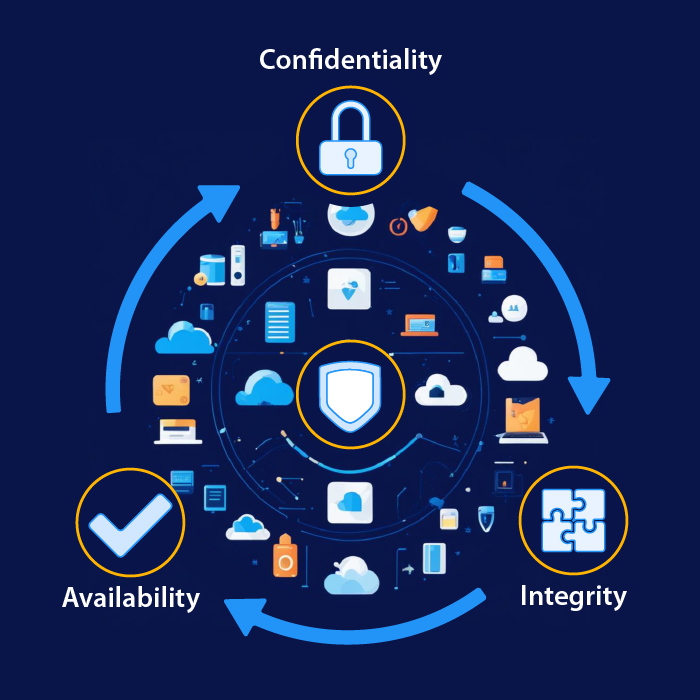
Each component supports the others. Confidentiality means nothing if data isn’t available. Integrity is irrelevant if unauthorized users can manipulate records. Together, the triad forms the foundation for data security policies across industries.
Key Challenges in Applying CIA Principles
While the CIA triad offers a solid framework, real-world application brings several difficulties. These include:
Adapting to emerging threats: Cyberattacks evolve rapidly. New exploits like ransomware, phishing-as-a-service, or supply chain compromises constantly test confidentiality, integrity, and availability. Staying ahead requires real-time monitoring and adaptive defenses.
Human error: Mistakes remain a major risk. Employees may click on malicious links, expose credentials, or misconfigure systems. Training, awareness programs, and internal controls are essential to support the triad’s success.
System complexity: IT environments now span on-prem, cloud, and hybrid architectures. Managing confidentiality, integrity, and availability across these distributed infrastructures increases operational complexity and introduces new failure points.
Regulatory pressure: Compliance frameworks like GDPR, HIPAA, and PCI DSS mandate specific security controls aligned with the triad. Meeting them demands consistent policies, clear documentation, and regular audits—often with limited resources.
How Emerging Technologies Affect the CIA Triad
New technologies both support and complicate CIA goals. Artificial intelligence helps detect unusual access behavior. Blockchain secures data integrity through immutable records. Edge computing improves latency but introduces new availability risks at the network edge. DevSecOps integrates CIA principles into development pipelines. Quantum computing, however, threatens today’s encryption algorithms—posing a long-term challenge to confidentiality.
Organizations must evaluate how these innovations influence security architecture and adjust accordingly.
CIA Examples in Real-World Scenarios
Confidentiality
In healthcare, patient data must remain private and secure. Hospitals encrypt records, enforce strict access policies, and adhere to regulations like HIPAA. Tools like DataSunrise enable dynamic data masking and field-level encryption to protect personal health information—even during analysis or reporting.
Integrity
In the financial sector, transaction integrity is critical. Banks use digital signatures, logs, and real-time monitoring to ensure that no one tampers with records. DataSunrise’s activity monitoring module adds another layer by tracking and alerting on any suspicious or unauthorized database actions.
Availability
E-commerce platforms illustrate availability at scale. These businesses deploy failover systems and performance monitoring to handle seasonal spikes or infrastructure issues. DataSunrise’s database firewall helps prevent attacks that could impact availability—such as SQL injections—while ensuring that customers and internal users can continue to access the system without interruption.
These CIA examples show how each pillar of the triad plays a distinct role, depending on the industry and threat model involved.
Why Availability Isn’t Just Uptime Anymore
Availability used to mean servers stayed online. Today, it includes performance, failover speed, and secure access under pressure. In multi-cloud environments, one provider’s outage shouldn’t take your business offline. Organizations now deploy geo-redundant architectures, automated failover scripts, and zero-trust network access to maintain availability—even in the face of DDoS attacks, zero-day exploits, or regional service failures.
Layered tools like DataSunrise contribute by monitoring query behavior, blocking abnormal traffic patterns, and isolating suspicious access in real time—without degrading system performance. These features align availability with active defense, ensuring business continuity is both secure and resilient.
Conclusion
The CIA triad remains essential for modern information security. It offers a simple but powerful structure to align technical measures with business goals. Confidentiality protects sensitive information. Integrity ensures it hasn’t been tampered with. And availability guarantees people can access what they need—when they need it.
What availability in the CIA triad ensures, above all, is uninterrupted access. Whether for customer transactions, emergency response, or internal analytics, downtime isn’t an option. Solutions like DataSunrise help make availability a reality through robust database protection and recovery strategies.
By focusing on CIA principles and adapting them to emerging technologies, organizations can strengthen their defenses and remain resilient in the face of evolving threats.