Data Dictionary

Organizations generate and store more data than ever before. Without clear definitions and centralized documentation, that data becomes hard to manage. A data dictionary provides structure—serving as a shared reference for the meaning, format, and relationships of every element in your system.
By using tools like DataSunrise to secure and automate metadata, teams gain clarity, reduce redundancy, and improve decision-making. This shared understanding forms the backbone of governance, compliance, and effective collaboration.
Why Data Dictionaries Matter in Engineering and Analytics
Data pipelines depend on reliable definitions. Without them, even the most advanced infrastructure can fail to deliver meaningful insights. A data dictionary resolves this by describing how each element is defined, stored, and interpreted across systems.
Consider an e-commerce example. If marketing calls total order value “revenue” while finance calls it “sales,” confusion follows. A centralized dictionary enforces consistency—ensuring that customer, product, and transaction data have shared meanings across departments.
Common Uses of a Data Dictionary
At its core, a data dictionary documents metadata. It defines field types, naming conventions, relationships, and rules for how data should behave. This helps teams avoid duplicate definitions, mislabeling, and misinterpretation—especially in cross-functional environments.
Implementation Example
class DataDictionary:
    def __init__(self):
        self.elements = {}

    def add_element(self, name, data_type, description, format=None, constraints=None):
        self.elements[name] = {
            'data_type': data_type,
            'description': description,
            'format': format,
            'constraints': constraints
        }

    def get_element(self, name):
        return self.elements.get(name, None)

    def update_element(self, name, **kwargs):
        if name in self.elements:
            self.elements[name].update(kwargs)

    def remove_element(self, name):
        self.elements.pop(name, None)
This approach gives teams a consistent programmatic way to manage schema documentation. Paired with visualization tools or Excel-style exports, it scales to meet large enterprise needs.
Sample Dictionary Table
| Data Asset Name | Data Type | Format | Description |
|---|---|---|---|
| customer_id | Integer | INT | Unique customer identifier |
| first_name | String | VARCHAR(50) | Customer’s first name |
| String | VARCHAR(100) | Email address | |
| purchase_id | Integer | INT | Unique purchase reference |
| product_id | Integer | INT | Product catalog ID |
When consistently maintained, dictionaries reduce miscommunication and simplify onboarding, documentation, and data integration.
How Data Dictionaries Support Governance
Data governance sets the policies for how information is stored, accessed, and protected. A dictionary supports that framework by documenting ownership, sensitivity, and business logic for each element. This is especially useful for audits, compliance reviews, and data lineage analysis.
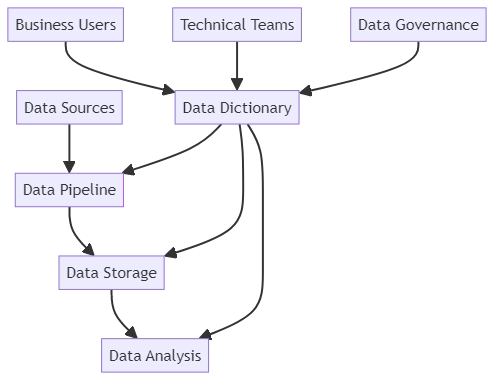
For example, healthcare organizations can use dictionaries to classify protected health information (PHI). This enables HIPAA-compliant access restrictions and audit logging—tasks made easier with automated support from platforms like DataSunrise.
What a Dictionary Typically Includes
While specific fields may vary, most dictionaries include:
- Unique names for data assets (e.g., user_id)
- Storage format and data type
- Field relationships (e.g., foreign keys)
- Business context and allowed value ranges
- Access permissions and sensitivity tags
- Associated systems or APIs
This unified view eliminates guesswork and reduces dependency on tribal knowledge or undocumented data practices.
Active vs. Passive Dictionary Models
Dictionaries can be active (linked to live systems) or passive (maintained manually). Active versions reflect real-time schema changes and minimize errors. Passive versions offer flexibility across systems, allowing additional context that isn’t captured in production databases.
For example, a logistics company may use an active dictionary for customer IDs and shipping info but keep a passive reference for partner contact data, legal definitions, or branding rules.
Business and Technical Benefits
While often seen as a technical asset, a dictionary adds significant value for non-technical teams. Business users benefit from simplified access to complex data definitions. Analysts reduce redundant effort. Engineers improve consistency in modeling and reporting.
In practice, this shared vocabulary drives:
- Faster integration across departments
- Reduced analytics rework and errors
- Clearer business logic behind KPIs and reports
Whether in retail, healthcare, or SaaS, organizations that maintain dictionaries gain better governance, collaboration, and confidence in their decisions.
How DataSunrise Enhances Metadata Management
Data dictionaries aren’t useful if they’re outdated or isolated. DataSunrise helps by automating metadata capture, enforcing access policies, and aligning dictionaries with real-time database activity. It supports:
- Audit trails showing when definitions were updated
- Data masking and classification based on dictionary metadata
- Role-based access enforcement per schema element
- Integration with BI, DLP, and compliance systems
This makes DataSunrise especially valuable in regulated industries or fast-scaling enterprises, where metadata shifts quickly but must remain accurate.
Conclusion
Without a data dictionary, misunderstandings multiply. With one, teams align on definitions, security improves, and insights become more reliable. From modeling and governance to business strategy, dictionaries play a central role in today’s data ecosystems.
DataSunrise strengthens that role by combining visibility, security, and automation into one cohesive platform. To see how we integrate dictionaries into a full metadata-aware security stack, book a live demo.