Understanding the Key Differences Between Data Dictionary, Data Inventory, and Data Catalog
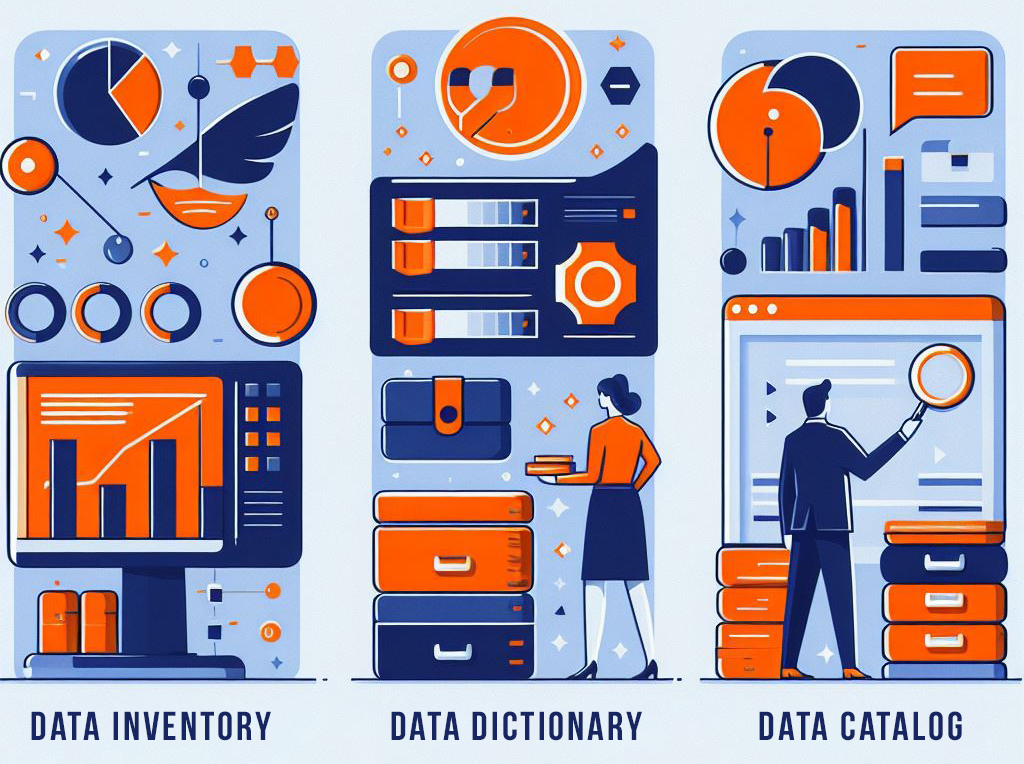
To manage a lot of information effectively, it’s important to understand the tools and concepts used in data management. Three key terms that often come up in this context are data dictionary, data inventory, and data catalog.
Data Compliance Overview | Regulatory Frameworks
While these terms are sometimes used interchangeably, they actually refer to distinct aspects of data management. This guide will explain what definitions, purposes, and examples are. Furthermore, it will show how they work together to create a strong data management framework.
Data Dictionaries
A data dictionary, also known as a metadata repository, is a central resource. It provides detailed information about the structure, format, and meaning of data elements. This information is for a database or information system.
This guide is for developers, database administrators, and other technical stakeholders. They need to understand the complexities of a database.
A data dictionary helps make sure that data is defined and used consistently and clearly throughout an organization.
By providing a single source of truth for data definitions, it helps prevent ambiguity, misinterpretation, and duplication of effort. Data dictionaries typically include information such as:
- Table and column names
- Data types and lengths
- Constraints and default values
- Relationships between tables
- Business rules and definitions
Example of a Data Dictionary
Let’s consider a retail company that maintains a product database. The data dictionary for this database would include entries like:
- Table: Products
- Column: ProductID (Integer, Primary Key)
- Column: ProductName (String, Max Length 100)
- Column: Category (String, Max Length 50)
- Column: Price (Decimal, Precision 10, Scale 2)
- Column: QuantityInStock (Integer)
This data dictionary provides a clear and concise description of the structure and format of the Products table, making it easier for developers and analysts to work with the data.
Benefits of a Data Dictionary
Having a well-maintained data dictionary offers several benefits to an organization, including:
- Better data quality: A data dictionary helps keep data accurate and reliable by making sure to consistently define and format it.
- Efficiency: A central source for definitions allows developers and analysts to easily understand the database structure, saving time.
- Enhanced collaboration: It facilitates communication by offering a shared language and understanding of the data.
- Simplified maintenance: It helps manage database changes, reducing risk of inconsistency or error.
Data Inventories
While a data dictionary describes the structure and meaning of database elements, a data inventory examines all of an organization’s data assets.
An inventory is a list of all data assets in an organization. This includes databases, spreadsheets, reports, and other data sources.
The primary purpose of a data inventory is to provide a high-level overview of an organization’s data landscape. It helps answer questions like:
- What data assets do we have?
- Where are they stored?
- Who owns and maintains each asset?
- How is the data being used?
- What is the quality and completeness of the data?
Example of a Data Inventory
Let’s say a manufacturing company wants to create a data inventory. They would start by identifying all data assets, such as:
- Enterprise Resource Planning (ERP) system
- Customer Relationship Management (CRM) database
- Supply chain management system
- Quality control databases
- Sales and marketing spreadsheets
For each asset, the inventory would capture:
- Data owner and steward
- Storage location and format
- Update frequency and freshness
- Access permissions and security controls
- Data quality and completeness metrics
Benefits of a Data Inventory
Maintaining a complete inventory offers advantages such as:
- Better data management and compliance tracking
- Enhanced data security through visibility into sensitive data
- Improved efficiency by reducing duplication of effort
- Stronger decision-making backed by a clear understanding of available data
Discovering Data Catalogs
A data catalog is a searchable index of data assets, enabling users to easily find, understand, and access data.
It builds upon data inventory by adding richer metadata, data lineage, and data quality scoring.
Catalogs help democratize access to data across the organization, especially for analytics and reporting.
Example of a Data Catalog
Imagine a healthcare provider using a data catalog. A data scientist searching for patient info can use the catalog’s keyword search to locate relevant datasets from clinical records and research studies. Each dataset includes:
- Detailed metadata and schema
- Lineage showing where the data originated
- Sample records for preview
- Quality ratings and user comments
Benefits of a Data Catalog
A well-deployed catalog offers:
- Easier discovery of datasets across silos
- Better governance via visibility into ownership and access
- Improved collaboration through tagging, rating, and sharing
- Faster analytics and more confident decision-making
Putting It All Together
Each of these tools plays a unique role:
- Data dictionary: defines individual elements
- Data inventory: tracks high-level assets
- Data catalog: supports access, discovery, and collaboration
Together, they build a cohesive data strategy. For best results:
- Assign clear data ownership
- Standardize metadata
- Automate discovery where possible
- Train users in catalog adoption
Modern Challenges and Automation Strategies
In large-scale environments, maintaining consistency across dictionaries, inventories, and catalogs becomes increasingly difficult. Data is often scattered across cloud platforms, shadow systems, and unstructured storage. Manual tracking doesn’t scale—and that’s where automation makes the difference.
Modern platforms use automated data discovery to scan and classify sensitive information across sources. Tools like DataSunrise help detect personal and regulated data, assign ownership, and populate metadata fields without manual effort. This accelerates catalog updates and keeps your inventory in sync with real conditions.
Automation also supports compliance efforts. Whether it’s GDPR, HIPAA, or CCPA, regulators expect up-to-date records of where sensitive data lives, who owns it, and how it’s protected. By integrating discovery with your data governance stack, you can meet these requirements and respond quickly to audits or subject access requests.
Conclusion
Data dictionary, data inventory, and data catalog are not redundant—they complement each other. Combined, they improve visibility, governance, and usability of enterprise data. Organizations embracing all three will gain stronger decision-making capabilities, regulatory readiness, and competitive advantage.