Vertica Data Governance
Vertica often sits at the core of analytical ecosystems: BI dashboards, data marts, and machine learning workloads rely on its columnar engine to process large volumes of business data. As a result, organizations must approach Vertica Data Governance proactively to ensure consistent visibility and control across sensitive assets. Moreover, teams need clear awareness of where regulated records live, who can access them, how they are used, and whether existing controls satisfy internal and external requirements.
Data governance for Vertica is not only about access control. Instead, it also covers data discovery, masking, monitoring, retention, and audit reporting across the entire environment. To keep regulatory expectations in check and avoid data misuse, Vertica clusters should be managed as part of a broader governance and data compliance strategy aligned with frameworks like GDPR, HIPAA, PCI DSS, and SOX.
This article explains how to build a practical Vertica data governance model using native capabilities and DataSunrise. Furthermore, it outlines how to improve data classification, access control, masking, monitoring, and automated compliance. These steps align with governance principles described in DataSunrise articles on data management, data security, and data accessibility. Additionally, organizations may reference the official Vertica documentation for platform-level best practices.
Why Vertica Data Governance Matters
- Vertica concentrates large volumes of sensitive and business-critical data, including personal, financial, and operational records.
- Columnar storage, projections, and distributed execution make it harder to maintain a clear inventory of who can see which columns and how they are used over time.
- BI tools, ETL processes, data science notebooks, and applications often share the same Vertica cluster, blurring the line between production analytics and experimentation.
- Regulations such as GDPR, HIPAA, PCI DSS, and SOX require traceable access, adequate data protection, and demonstrable controls for sensitive information.
- Poor data governance directly affects business outcomes, making it harder to treat information as a managed asset.
Consequently, without a clear governance framework, Vertica can become an opaque system where answering essential operational or audit-related questions becomes increasingly difficult.
Key Data Governance Challenges in Vertica
1. Locating Sensitive Data Across Schemas and Projections
Vertica environments grow organically, and as a result, sensitive data can quickly spread across multiple schemas and projections. Manual catalog reviews rarely scale, especially when frequent DDL changes occur. Without systematic discovery, organizations cannot reliably control or protect regulated data.
2. Fragmented Access Controls and Role Models
Permissions drift over time as responsibilities evolve. Therefore, consistent governance requires a stable and enforceable RBAC model aligned with the principles of least privilege and centrally managed oversight. Moreover, BI and ETL tools often introduce additional access pathways, making coordinated control essential.
3. Limited Native Masking for Regulated Columns
Vertica does not offer built-in, policy-driven masking. As a result, analysts may receive full datasets unless external masking systems enforce restrictions. This limitation often conflicts with masking policies and test data management practices.
4. Disconnected Audit Logs and Activity History
Vertica’s telemetry resides in multiple system tables, which complicates building a complete audit trail. Consequently, security teams often lack unified evidence for compliance, investigations, or incident response unless logs are centralized and correlated.
Implementing a Vertica Data Governance Framework
1. Discover and Classify Sensitive Data in Vertica
Effective governance begins with identifying which Vertica objects contain PII, PHI, financial data, or operationally critical fields. DataSunrise discovery scans classify tables and columns, creating a structured inventory for governance decisions.
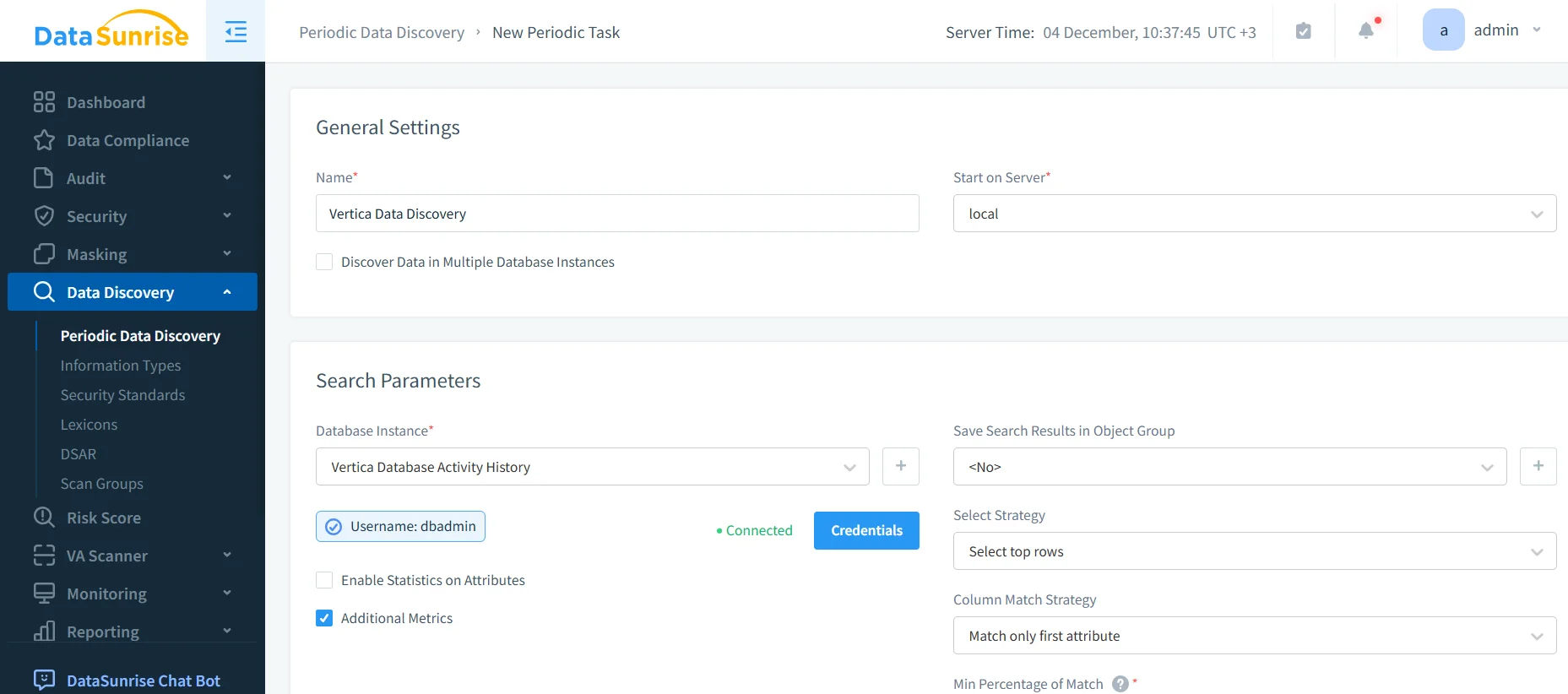
This configuration step includes instance selection, credentials, and match strategies, ensuring that Vertica discovery tasks run consistently and produce repeatable governance evidence.
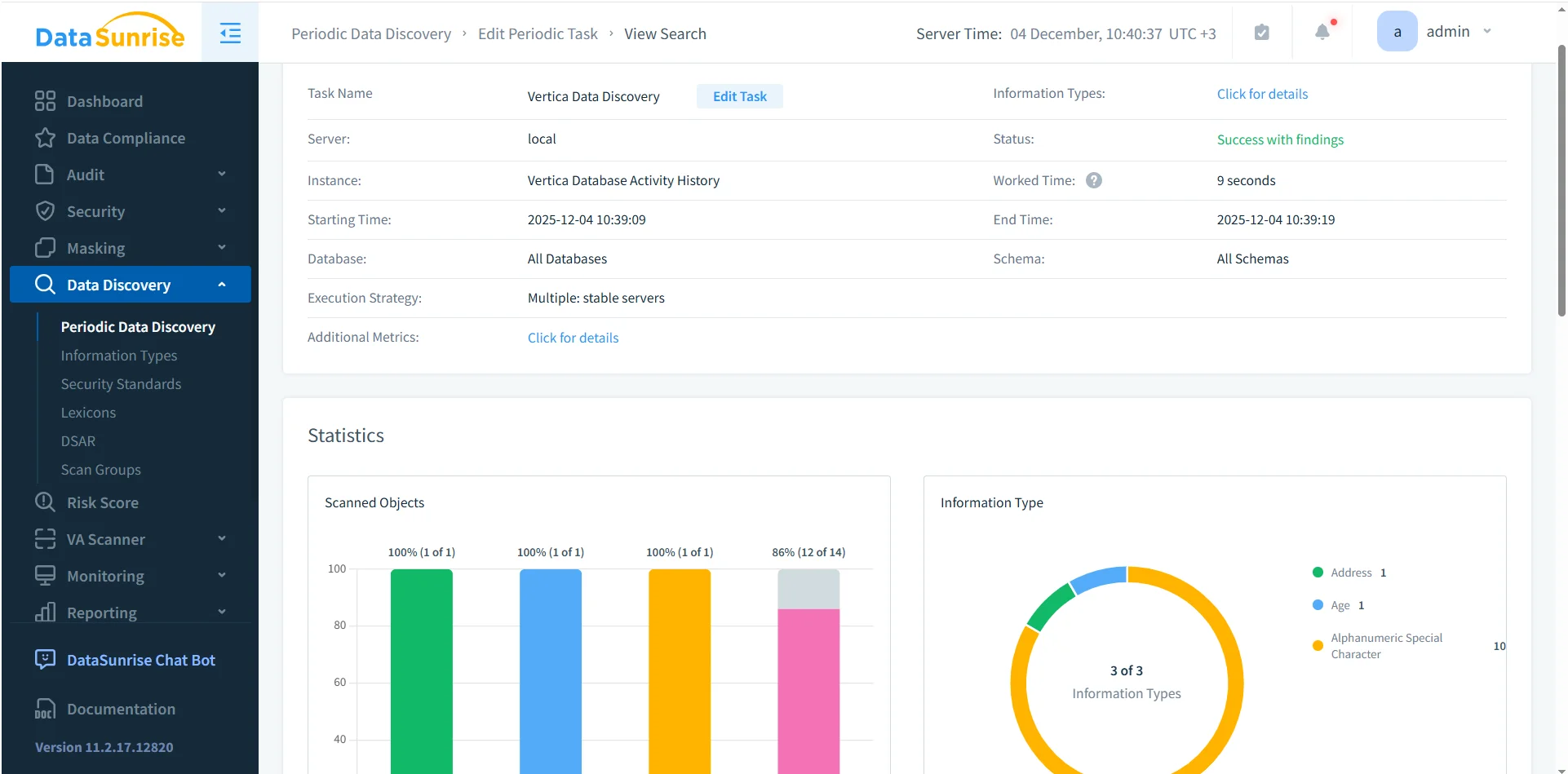
Once discovery tasks execute, administrators can review identified PII, PHI, or financial attributes to confirm alignment with internal governance expectations.
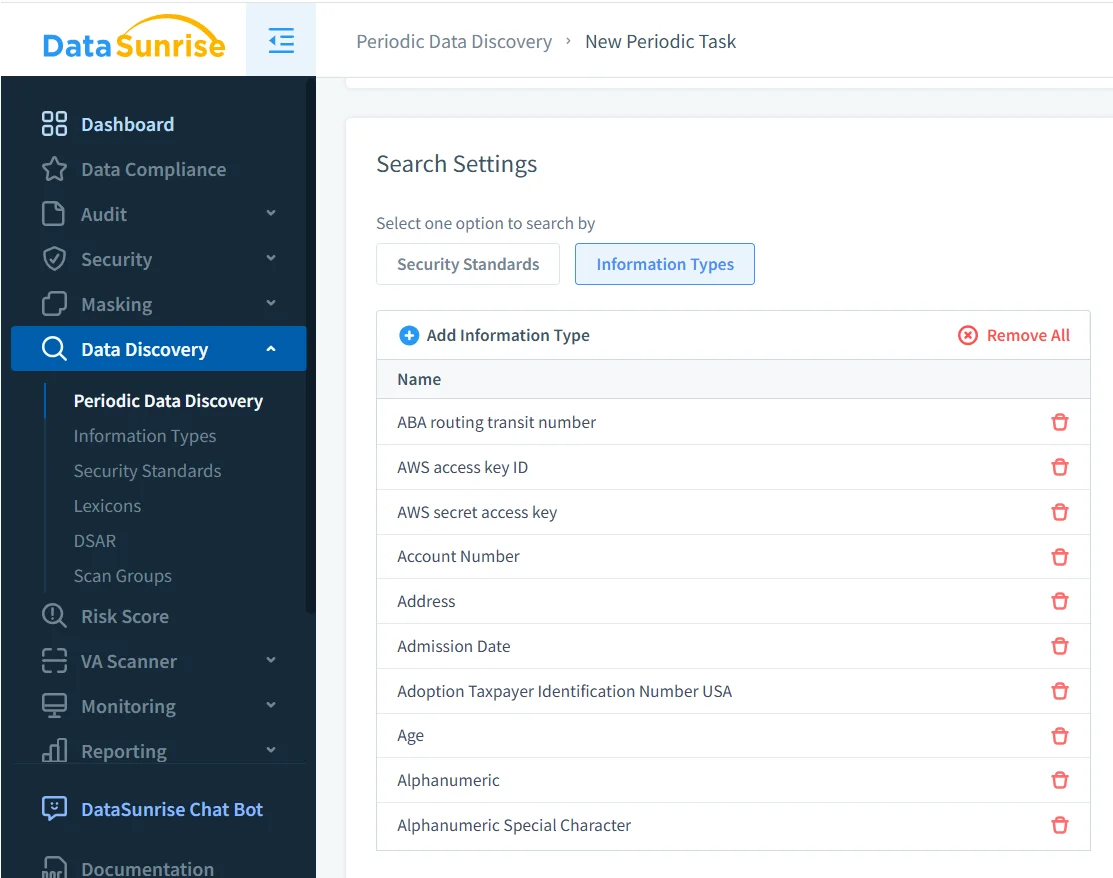
Altogether, this inventory becomes the foundation for Data Discovery, masking rules, and data compliance reporting.
2. Align Access Controls with Governance Policies
- Map user roles to business responsibilities.
- Enforce least-privilege access across BI, ETL, and analytical workloads.
- Use DataSunrise as a unified control layer to stabilize RBAC and eliminate permission drift.
3. Apply Dynamic and Static Data Masking for Vertica
- Dynamic Data Masking protects production data.
- Static Masking secures non-production datasets.
Because masking prevents unnecessary exposure while preserving analytical value, it is a core requirement for Vertica Data Governance.
4. Monitor Vertica Activity and Build an Audit Trail
DataSunrise monitoring correlates SQL queries, user behavior, masking rules, and policy enforcement into a unified audit trail. Consequently, teams gain complete visibility into Vertica activity.
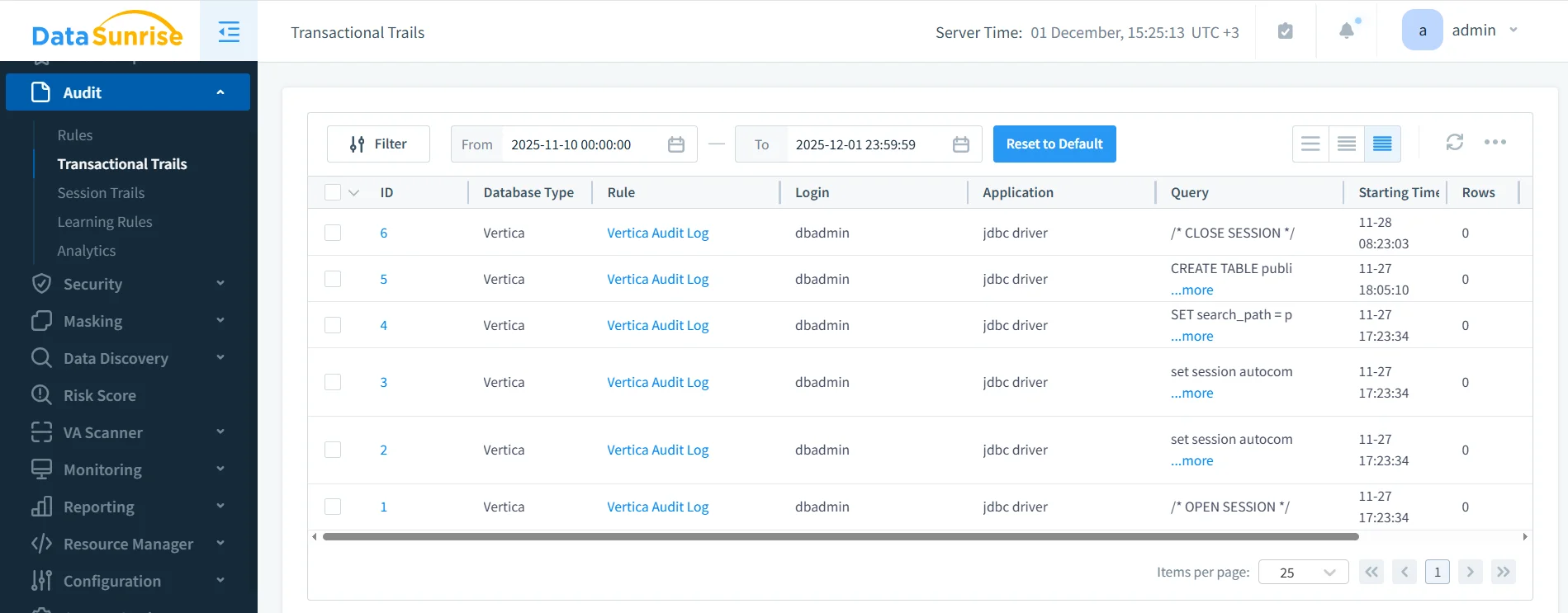
Centralized auditing supports investigations, forensics, and regulatory reporting across all Vertica workloads.
Comparing Native Vertica Controls with DataSunrise
| Capability | Native Vertica | DataSunrise for Vertica |
|---|---|---|
| Sensitive data discovery | Manual reviews only | Automated classification & periodic scanning |
| Access governance | RBAC only | RBAC + behavior analytics + rule enforcement |
| Data masking | No masking | Dynamic + static masking |
| Audit trails | System tables, fragmented | Unified audit dashboard with correlation |
| Compliance reporting | Manual | Automated reports via Compliance Manager |
DataSunrise: A Unified Governance Layer for Vertica
Comprehensive Data Discovery
- Scans Vertica datasets for PII, PHI, and financial attributes.
- Integrates with enterprise-wide catalogs and governance repositories.
Dynamic Protection and Masking Controls
- Applies masking rules per user, role, or application.
- Ensures compliance without altering existing Vertica schemas.
Centralized Monitoring, Audit, and Compliance
- Tracks SQL activity, DDL operations, and anomalous behavior.
- Feeds structured evidence into Compliance Manager.
The Compliance Perspective
Each regulatory framework introduces specific obligations that directly influence how Vertica environments must be governed.
| Regulation | Requirement | Solution Approach |
|---|---|---|
| GDPR | Protect EU personal data in Vertica | Classification + masking + unified audit trails |
| HIPAA | Protect PHI in analytics pipelines | Masking + RBAC enforcement + audit monitoring |
| PCI DSS 4.0 | Prevent unauthorized access to payment data | Least privilege + dynamic masking |
| SOX | Trace changes to financial data | Centralized query auditing & reporting |
Conclusion: Building Sustainable Vertica Governance
Ultimately, Vertica Data Governance connects discovery, access control, masking, monitoring, and reporting into a unified and repeatable framework. With DataSunrise, organizations strengthen their Vertica deployments, reduce operational risk, and maintain compliance across diverse analytical workloads. As regulatory expectations continue to evolve, a well-structured governance program ensures that enterprises remain both agile and protected.
Protect Your Data with DataSunrise
Secure your data across every layer with DataSunrise. Detect threats in real time with Activity Monitoring, Data Masking, and Database Firewall. Enforce Data Compliance, discover sensitive data, and protect workloads across 50+ supported cloud, on-prem, and AI system data source integrations.
Start protecting your critical data today
Request a Demo Download Now