Data Anonymization in MongoDB
DataSunrise deploys autonomous Sensitive Data Discovery and Zero-Touch Data Masking to deliver seamless data anonymization in MongoDB with zero-touch implementation.
Modern MongoDB environments store high volumes of customer records, authentication tokens, financial identifiers, telemetry data, and operational metadata. As organizations scale across cloud-native and hybrid architectures, anonymizing sensitive fields becomes a compliance-first requirement rather than a best practice.
Regulations such as GDPR, HIPAA, PCI DSS, SOX, and ISO 27001 demand strict control over personally identifiable information (PII) and regulated attributes. Failure to anonymize sensitive data in development, analytics, testing, and third-party integrations can introduce regulatory exposure and measurable business risk.
MongoDB provides native security mechanisms. However, structured anonymization workflows require deeper orchestration. In this article, we explore MongoDB’s native anonymization approaches and demonstrate how DataSunrise delivers Autonomous Compliance Orchestration, Continuous Regulatory Calibration, and enterprise-ready anonymization across structured, semi-structured, and unstructured data environments. For broader context on centralized governance models, you can also review our guidance on database security and sensitive data discovery.
What is Data Anonymization?
Data anonymization is the process of transforming sensitive information so that individuals cannot be identified, directly or indirectly, while preserving the operational or analytical value of the dataset.
Unlike encryption, which protects data from unauthorized access but allows full restoration with a key, anonymization permanently or conditionally alters identifiable elements. The objective is to remove the link between data and a specific person while keeping structure, format, and usability intact.
In MongoDB environments, anonymization typically applies to:
- Names, emails, phone numbers
- Government-issued identifiers
- Financial records
- Health information
- Behavioral and telemetry metadata
Effective anonymization reduces exposure of personally identifiable information (PII) and supports compliance with frameworks such as GDPR and HIPAA. It also aligns with broader data compliance regulations that require minimizing unnecessary access to sensitive attributes.
There are several technical approaches:
- Masking – replacing values with obfuscated equivalents
- Tokenization – substituting identifiers with non-sensitive tokens
- Generalization – reducing data precision (e.g., full date → year only)
- Suppression – removing fields entirely
In MongoDB, anonymization must operate across structured collections, semi-structured JSON documents, and even unstructured content stored alongside database records. Therefore, modern implementations combine contextual access control with automated discovery and enforcement to maintain both usability and regulatory alignment.
Understanding Native MongoDB Anonymization Capabilities
MongoDB does not include a built-in anonymization engine. Instead, anonymization is implemented through manual transformation mechanisms at the query, client, or access-control layer.
Field-Level Redaction Using Aggregation Pipelines
MongoDB’s aggregation framework allows runtime data transformation before exposure. This method is commonly used to mask or partially redact sensitive attributes without modifying stored records.
Extended Example: Dynamic Field Redaction
// Dynamic anonymization using aggregation pipeline
db.customers.aggregate([
  {
    $project: {
      _id: 1,
      name: 1,

      // Mask email while preserving domain
      email: {
        $concat: [
          "****@",
          {
            $arrayElemAt: [
              { $split: ["$email", "@"] },
              1
            ]
          }
        ]
      },

      // Static masking for phone
      phone: "***-***-****",

      // Replace SSN with anonymized placeholder
      ssn: "XXX-XX-XXXX",

      // Example of conditional masking
      credit_card: {
        $cond: {
          if: { $gt: ["$account_balance", 10000] },
          then: "REDACTED",
          else: "$credit_card"
        }
      }
    }
  }
]);
This approach masks sensitive fields dynamically during query execution.
Client-Side Field Level Encryption (CSFLE)
MongoDB supports Client-Side Field Level Encryption (CSFLE) to protect sensitive fields before they are written to storage. Encryption ensures confidentiality but does not create anonymized datasets for non-production use.
Extended Example: Encrypted Field Configuration
// Schema configuration for Client-Side Field Level Encryption
{
  "encryptedFields": {
    "fields": [
      {
        "path": "ssn",
        "bsonType": "string",
        "algorithm": "AEAD_AES_256_CBC_HMAC_SHA_512-Deterministic"
      },
      {
        "path": "credit_card",
        "bsonType": "string",
        "algorithm": "AEAD_AES_256_CBC_HMAC_SHA_512-Random"
      }
    ]
  }
}
Encryption prevents unauthorized access to stored data. However, encrypted data remains sensitive and identifiable once decrypted by authorized clients.
Role-Based Access Control (RBAC)
MongoDB’s RBAC mechanism restricts access at the database or collection level. It reduces exposure but does not alter field-level visibility dynamically.
Extended Example: Custom Role Definition
// Create a custom role with restricted privileges
db.createRole({
  role: "limitedAccess",
  privileges: [
    {
      resource: { db: "sales", collection: "customers" },
      actions: ["find"]
    },
    {
      resource: { db: "sales", collection: "transactions" },
      actions: ["find"]
    }
  ],
  roles: []
});

// Assign role to user
db.createUser({
  user: "reportUser",
  pwd: "StrongPassword123",
  roles: [
    { role: "limitedAccess", db: "sales" }
  ]
});
RBAC reduces the exposure surface by limiting who can query collections.
Enterprise-Ready Data Anonymization in MongoDB with DataSunrise
MongoDB enables flexible document modeling and rapid application development. However, enterprise-grade data anonymization requires more than aggregation pipelines and role restrictions. It demands centralized orchestration, compliance intelligence, and consistent enforcement across environments.
DataSunrise delivers enterprise-ready data anonymization in MongoDB through autonomous policy control, intelligent discovery, and real-time enforcement — without schema changes or application rewrites.
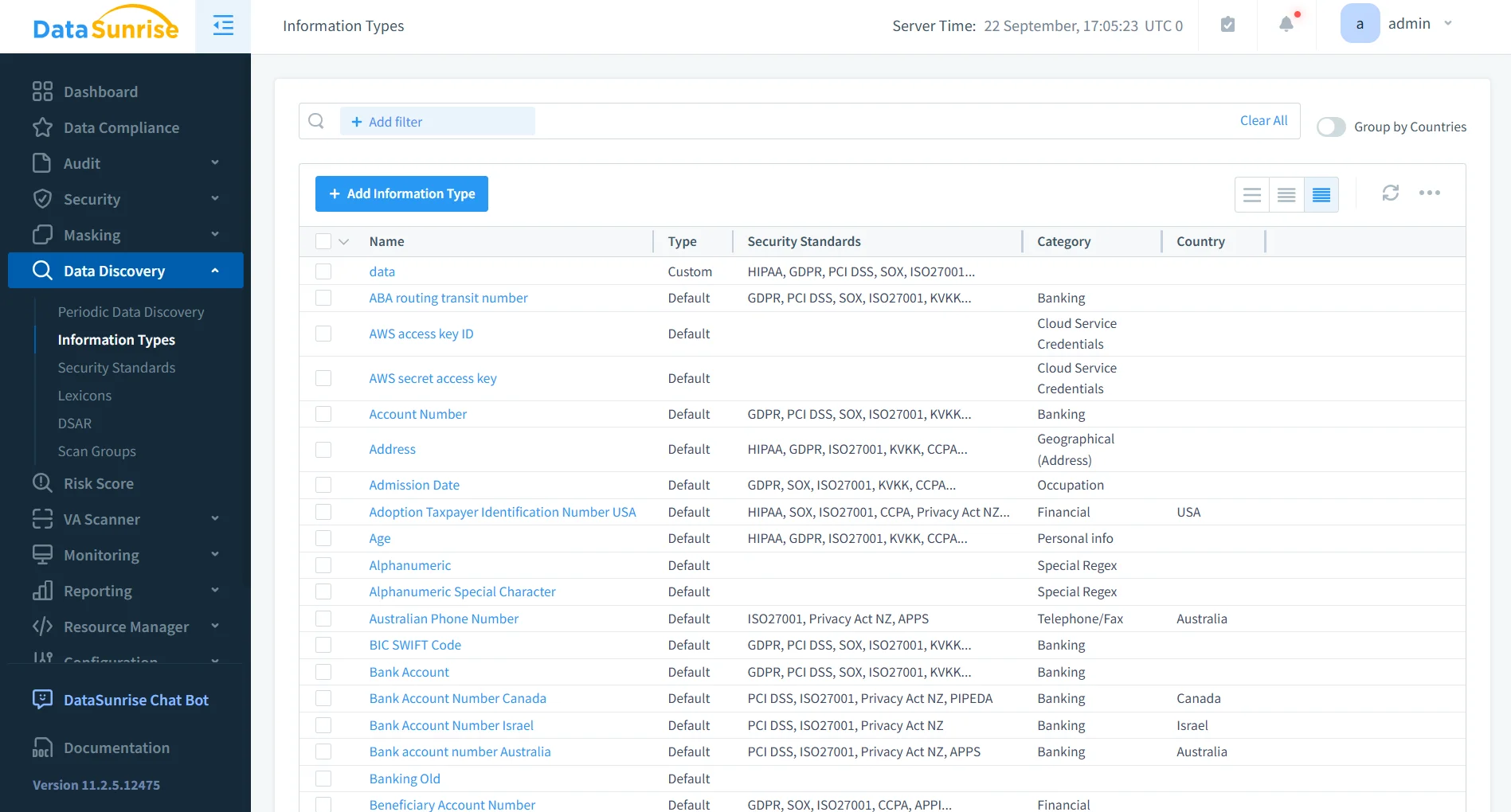
Autonomous Sensitive Data Discovery
Effective anonymization begins with visibility. Without knowing where sensitive data resides, masking policies remain incomplete and reactive.
DataSunrise automatically identifies sensitive data across MongoDB collections using NLP-driven content analysis, pattern-based detection, and context-aware classification. The platform also supports OCR scanning for image-based content and extends discovery across structured collections, semi-structured JSON documents, and unstructured storage sources.
The system detects personally identifiable information (PII), financial identifiers, health records, authentication credentials, and custom business-defined sensitive attributes. Unlike manual tagging approaches, discovery operates continuously, identifying newly introduced sensitive fields as collections evolve. This continuous inspection ensures that anonymization coverage remains accurate even as data models change.
Context-Aware Zero-Touch Data Masking
After discovery, anonymization must be applied consistently and intelligently. DataSunrise enforces anonymization dynamically and centrally through Zero-Touch Data Masking.
The platform supports field-level anonymization, conditional masking based on user roles, context-aware exposure control, time-based masking policies, and environment-specific anonymization for production and non-production environments. Instead of relying on manual aggregation scripts or application-level logic, masking policies are defined once and enforced consistently across MongoDB clusters.
There are no duplicated environment rules and no need for application-layer rewrites. Enforcement occurs transparently, preserving system performance and usability while protecting sensitive fields.
** Compliance-Aware Anonymization Intelligence**
Enterprise anonymization strategies must align with regulatory frameworks. DataSunrise integrates anonymization directly with compliance requirements through Compliance Autopilot and Continuous Regulatory Calibration.
Supported frameworks include GDPR, HIPAA, PCI DSS, SOX, ISO 27001, SOC 2, NIST, CCPA, APPI, and LGPD. Policies automatically align with regulatory requirements, eliminating compliance drift and reducing manual oversight. As regulations evolve, anonymization policies adapt accordingly.
This intelligence-driven approach ensures that anonymization strategies remain compliant without constant administrative intervention.
Centralized Policy Management Across Environments
MongoDB environments rarely operate in isolation. Organizations typically maintain hybrid infrastructures that span on-prem deployments, AWS, Microsoft Azure, Google Cloud, and multi-cloud architectures.
DataSunrise provides centralized policy management, cross-database visibility, a unified security framework, and cross-cloud governance. The platform supports more than 50 data storage technologies, enabling consistent anonymization policies across heterogeneous data ecosystems.
This centralized architecture eliminates fragmented security controls and ensures consistent enforcement regardless of where MongoDB instances are deployed.
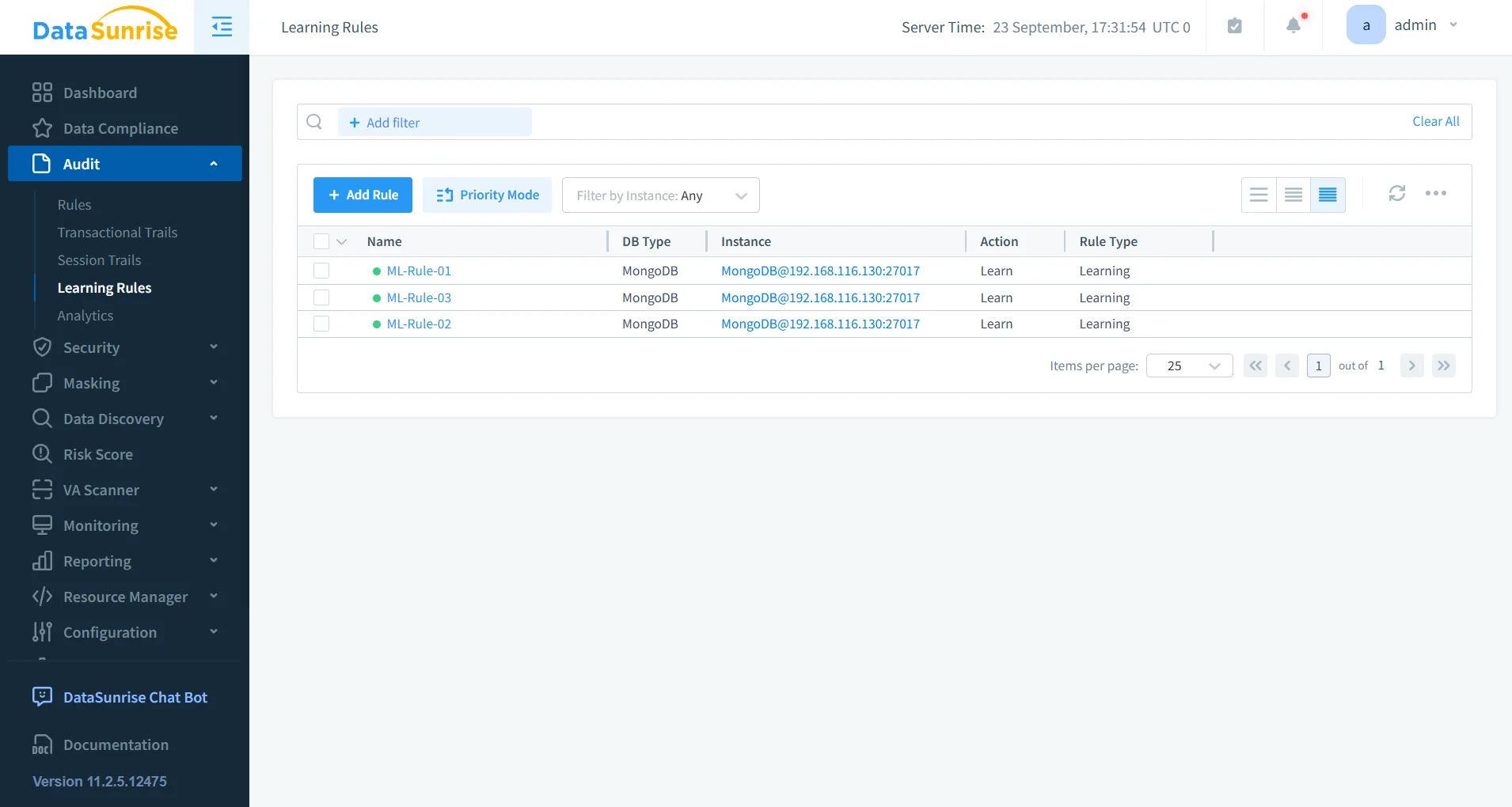
ML-Driven Behavioral and Audit Integration
Anonymization must operate in coordination with monitoring and threat detection. DataSunrise integrates anonymization with ML Audit Rules, user behavior analytics, suspicious behavior detection, and real-time enforcement triggers.
If abnormal access patterns are detected, anonymization policies can escalate dynamically. For example, additional masking layers can be applied automatically when risk thresholds are exceeded. This adaptive enforcement strengthens protection without interrupting legitimate workflows.
By combining anonymization with behavioral intelligence, DataSunrise transforms MongoDB protection from static masking into a dynamic, risk-aware security model.
Business Impact of Automated Data Anonymization
Organizations implementing autonomous anonymization for MongoDB achieve measurable operational and compliance improvements.
| Business Outcome | Impact Description |
|---|---|
| Quantifiable Risk Reduction | Elimination of exposed PII and regulated data significantly lowers breach probability and regulatory penalties. |
| Streamlined Compliance Workflows | Automatic report generation accelerates regulatory reviews and simplifies audit cycles. |
| Reduction in Manual Effort | Developers and security teams avoid repetitive masking scripts and environment-specific rule maintenance. |
| Optimized Total Cost of Compliance | Centralized policy management reduces operational overhead and long-term governance expenses. |
| Enhanced Audit Preparation | One-click compliance evidence generation supports faster auditor validation and documentation readiness. |
| Adaptive Threat Protection | Zero-Trust Data Access combined with Suspicious Behavior Detection provides both proactive and reactive protection layers. |
Conclusion
MongoDB offers powerful flexibility and scalability for modern applications. However, enterprise-grade data anonymization requires more than manual redaction scripts and role-based access restrictions. Sustainable protection demands automation, centralized governance, and compliance-aware enforcement aligned with broader data security strategies.
DataSunrise delivers Zero-Touch Data Masking, Autonomous Compliance Orchestration, Continuous Regulatory Calibration, a Unified Security Framework, and Intelligent Policy Orchestration within a single platform. These capabilities complement advanced dynamic data masking and integrate directly with centralized database activity monitoring to ensure consistent enforcement across environments.
All features operate seamlessly across on-premise, cloud, and hybrid infrastructures without configuration complexity or disruptive architectural changes. Integrated automated compliance reporting further strengthens regulatory alignment and audit readiness.
By eliminating compliance gaps while reducing manual oversight, organizations strengthen their security posture, reduce operational risk, and accelerate time-to-compliance. For teams seeking scalable, policy-driven anonymization in MongoDB, DataSunrise provides a structured and future-ready path forward.
To explore how autonomous anonymization can enhance your MongoDB environment, review the DataSunrise platform overview or request a live demonstration to evaluate its capabilities in action.
Protect Your Data with DataSunrise
Secure your data across every layer with DataSunrise. Detect threats in real time with Activity Monitoring, Data Masking, and Database Firewall. Enforce Data Compliance, discover sensitive data, and protect workloads across 50+ supported cloud, on-prem, and AI system data source integrations.
Start protecting your critical data today
Request a Demo Download Now