Databricks SQL Audit Trail
Databricks SQL plays a central role in modern analytics by enabling organizations to query large datasets directly within a lakehouse architecture. As more business-critical and regulated data flows through this platform, maintaining a reliable Databricks SQL audit trail becomes essential for security oversight, investigations, and regulatory compliance.
An audit trail is not simply a list of executed queries. Instead, it is a chronological, contextual record of database activity that allows organizations to reconstruct who did what, when it happened, and how the system responded. In distributed Databricks SQL environments, building such a trail requires more than basic platform logging.
This article explains how Databricks SQL audit trails work, reviews native auditing mechanisms, and demonstrates how DataSunrise creates centralized, investigation-ready audit trails using real-time transactional monitoring.
What Is an Audit Trail in Databricks SQL?
A Databricks SQL audit trail is a structured history of database actions captured over time. It includes SQL statements, execution metadata, user identity, session context, and operation outcomes. Together, these elements allow teams to trace database activity back to its source.
Unlike simple query logs, an audit trail preserves relationships between events. For example, it links SELECT, UPDATE, and DELETE operations to a single session or user action, making it possible to follow activity step by step.
This level of traceability is especially important for organizations subject to regulations such as GDPR, HIPAA, PCI DSS, and SOX.
Native Databricks SQL Audit Trail Capabilities
Databricks provides native audit logging that captures SQL execution events and workspace-level activity. These logs record query text, timestamps, user information, and operation types. Many teams rely on these logs as a starting point for audit trail creation.
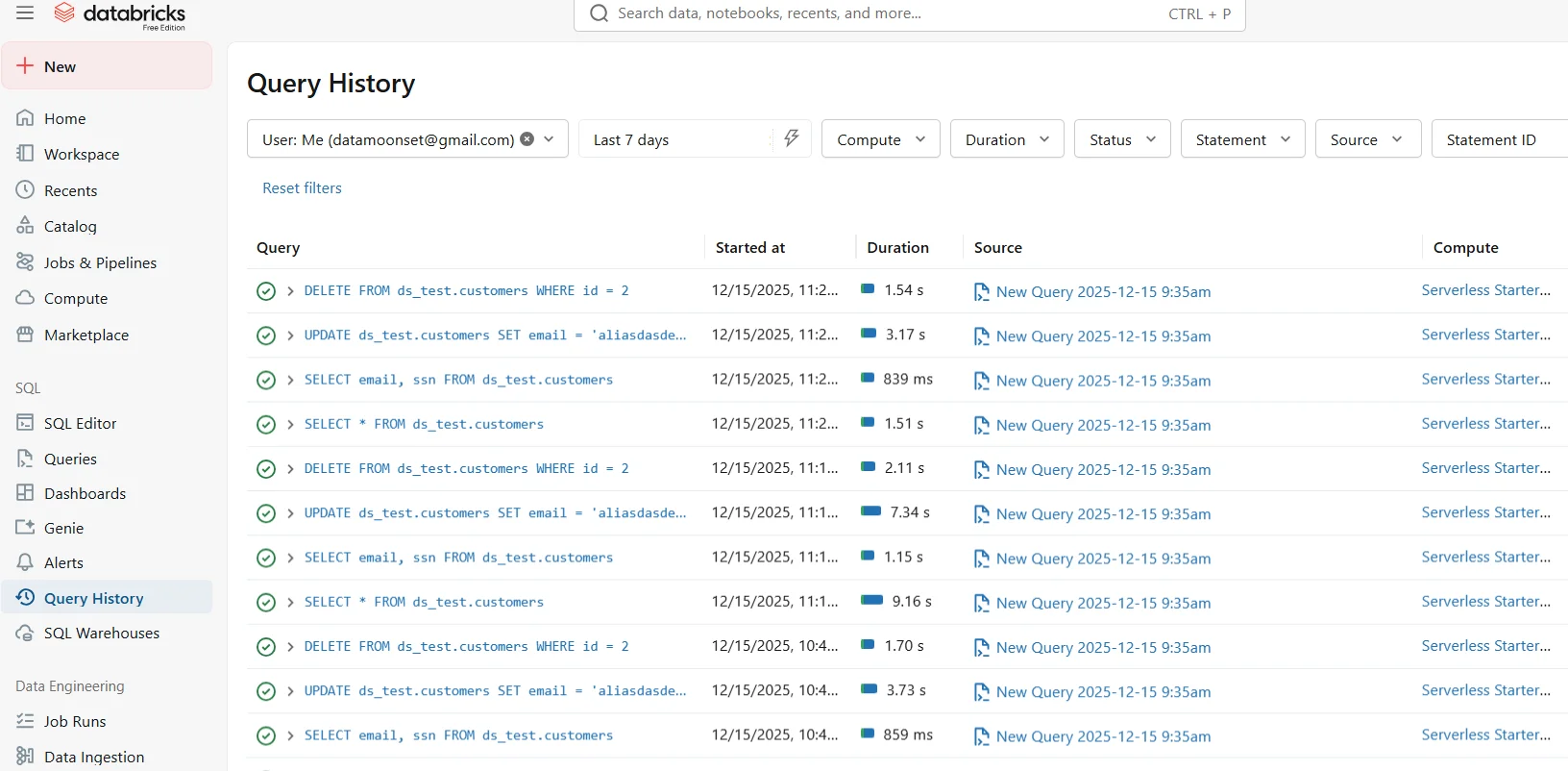
Native Databricks SQL audit logs showing query execution events captured at the platform level.
Although native logs offer baseline visibility, they present limitations when used as a complete audit trail. Logs are often distributed across services, stored externally, and lack built-in correlation between related events.
As a result, teams must manually reconstruct audit trails by stitching together log entries from different sources, which increases investigation time and introduces human error.
Challenges of Building a Complete Audit Trail
Creating a reliable Databricks SQL audit trail becomes increasingly difficult as environments scale. Multiple users, BI tools, and applications generate overlapping activity, often across multiple workspaces or clusters.
Furthermore, native logs typically focus on operational telemetry rather than compliance evidence. They capture what happened, but they do not always explain the broader context or business impact.
Without centralized correlation, security teams struggle to identify suspicious behavior, while compliance teams face delays during audits and incident reviews.
DataSunrise Audit Trail for Databricks SQL
DataSunrise addresses these challenges by building a centralized audit trail on top of Databricks SQL activity. Instead of relying on scattered logs, DataSunrise captures SQL events in real time and correlates them into a single, continuous timeline.
Each event is enriched with additional metadata, including database type, query category, execution context, and session identifiers. This enrichment transforms raw SQL telemetry into an investigation-ready audit trail.
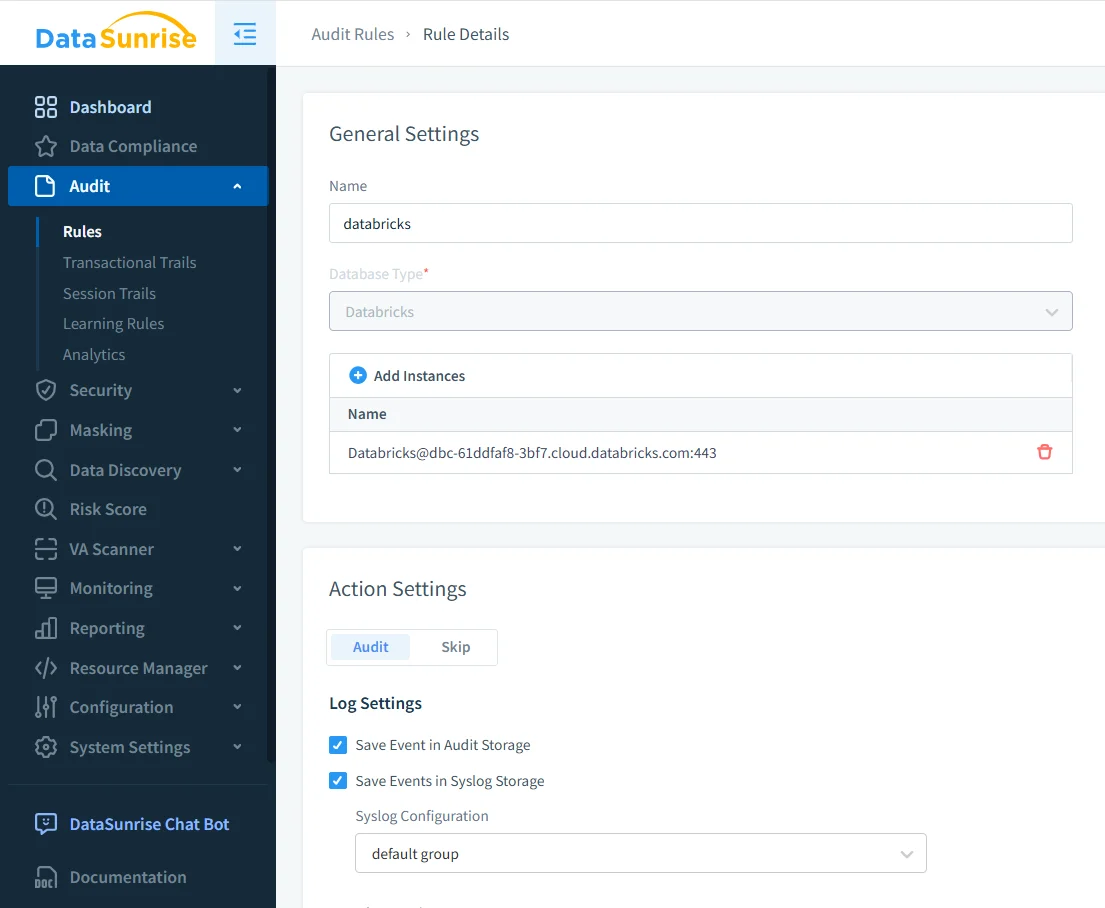
DataSunrise audit rule configuration for capturing Databricks SQL activity based on query type and session filters.
By applying flexible audit rules, organizations can control exactly which operations appear in the audit trail. For example, teams may track SELECT statements on sensitive tables while closely monitoring UPDATE and DELETE operations across the environment.
Transactional Audit Trails in DataSunrise
Once DataSunrise captures activity, it records events in a centralized transactional trail. This trail preserves the exact execution order of database operations, making it possible to reconstruct events with precision.
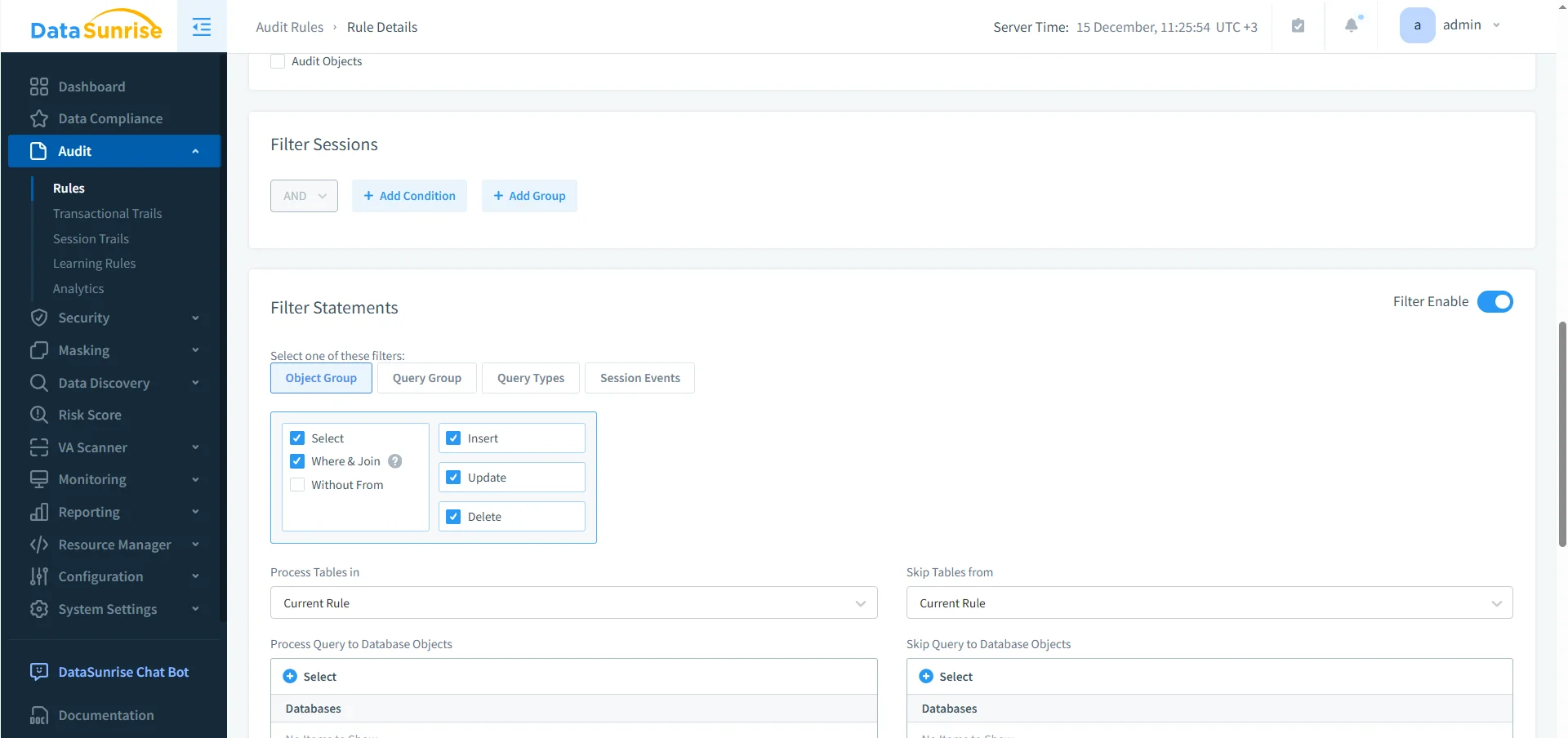
DataSunrise transactional trails displaying a chronological audit trail of Databricks SQL queries.
Each entry in the transactional trail includes query text, execution time, operation type, session ID, and execution status. Together, these attributes form a complete audit narrative.
This approach aligns closely with best practices described in audit logs and audit trail methodologies.
Native Audit Logs vs Centralized Audit Trail
| Capability | Native Databricks Logs | DataSunrise Audit Trail |
|---|---|---|
| Event correlation | Manual | Automatic and session-aware |
| Chronological accuracy | Fragmented | Preserved transactional order |
| Retention | External systems | Centralized audit repository |
| Investigation readiness | Limited | Immediate forensic analysis |
| Compliance reporting | Manual scripts | Automated evidence generation |
Compliance and Investigation Use Cases
A complete Databricks SQL audit trail supports both regulatory compliance and internal investigations. Auditors rely on audit trails to verify that controls operate effectively, while security teams use them to detect misuse or insider threats.
By integrating audit trails with database activity monitoring and data compliance frameworks, organizations reduce audit preparation time and improve incident response.
This unified approach ensures that audit trails remain accurate, accessible, and defensible over time.
Conclusion: Building a Reliable Databricks SQL Audit Trail
Databricks SQL enables powerful analytics, but enterprise environments demand accountability. Native logs provide basic visibility, yet they fall short of delivering a complete audit trail.
A centralized Databricks SQL audit trail captures activity in real time, preserves execution order, and enriches events with meaningful context. Platforms such as DataSunrise make this possible by transforming raw SQL activity into a structured, compliance-ready audit history.
With a reliable audit trail in place, organizations can confidently scale Databricks SQL while maintaining security, transparency, and regulatory alignment.
Protect Your Data with DataSunrise
Secure your data across every layer with DataSunrise. Detect threats in real time with Activity Monitoring, Data Masking, and Database Firewall. Enforce Data Compliance, discover sensitive data, and protect workloads across 50+ supported cloud, on-prem, and AI system data source integrations.
Start protecting your critical data today
Request a Demo Download Now