The Impact of Democratized Access
Introduction
In today’s rapidly evolving digital landscape, the concept of democratized access has emerged as a powerful force for change. It refers to the idea that technology and information should be accessible to everyone, regardless of their background, location, or socioeconomic status. Equal access can change lives and promote innovation globally by removing obstacles and providing necessary tools for success.
How Democratized Access Empowers People
Democratized access is about more than just providing people with technology. It’s about leveling the playing field and giving everyone an equal opportunity to participate in the digital economy.
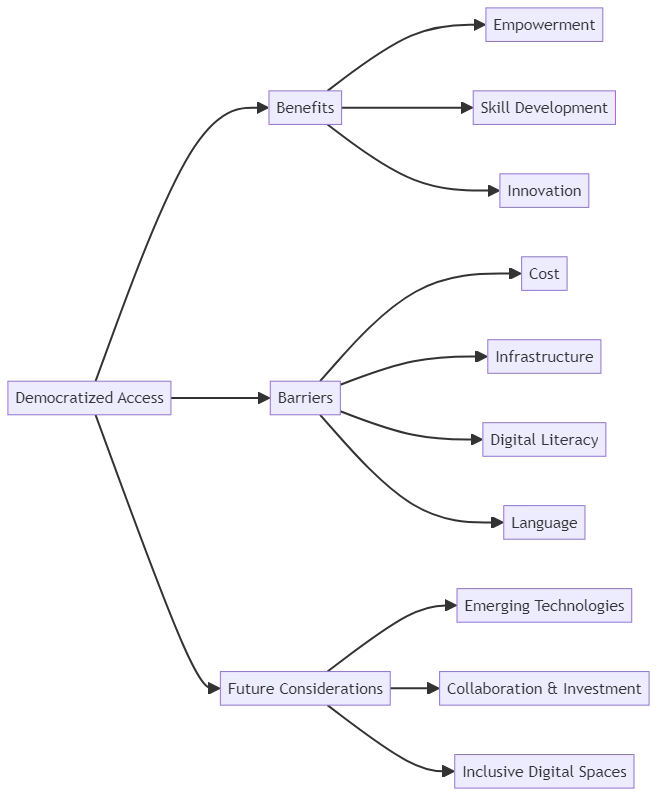
When people have access to the same tools and resources, they can:

By democratizing access to technology, we can unlock the full potential of individuals and communities around the world.
Breaking Down Barriers
Despite the many benefits of democratized access, significant barriers still exist. These include:
- Cost: High-quality technology and internet access can be expensive, putting them out of reach for many people.
- Infrastructure: In many parts of the world, the necessary infrastructure for reliable internet access simply doesn’t exist.
- Digital literacy: Some people may not know how to use technology properly, even if they have access to it.
- Language: Most online content and resources are in English, creating a barrier for non-English speakers.
True democratized access means removing all systemic, cultural, technical, and economic hurdles that prevent equal participation in the digital economy. It’s not just about getting online—it’s about meaningful engagement, contribution, and equity in outcomes.
To truly democratize access, we need to address these barriers head-on. This requires investment in affordable technology, expansion of internet infrastructure, digital literacy education, and the creation of multilingual content and resources.
Examples of Democratized Access in Action
One Laptop per Child
The One Laptop per Child (OLPC) initiative aims to provide low-cost, durable laptops to children in developing countries. OLPC helps kids by giving them technology and educational tools, bridging the digital gap, and offering new learning opportunities.
Wikipedia
Wikipedia is a free online encyclopedia that anyone can edit. It has over 55 million articles in 300+ languages, making it a top source of information globally. By democratizing access to knowledge, Wikipedia is empowering people to learn, share ideas, and make informed decisions.
Khan Academy
Khan Academy is a non-profit organization that provides free online education to anyone, anywhere. It offers over 6,000 video lessons and practice exercises on various subjects like math, science, history, and economics. It provides high-quality education to learners worldwide.
The Future of Democratized Access
As technology continues to evolve at a rapid pace, the possibilities for democratized access are endless. New technologies like AI, blockchain, and IoT can benefit people worldwide by removing obstacles and opening new opportunities. These technologies can remove obstacles and create new opportunities for people worldwide.
However, realizing the full potential of democratized access will require ongoing collaboration and investment from governments, businesses, non-profits, and individuals. We need to work together to:
- Develop affordable, accessible technologies that meet the needs of diverse communities
- Invest in digital infrastructure and expand internet access to underserved areas
- Provide digital literacy education and support to help people navigate the digital world
- Create inclusive, multilingual online spaces that welcome and empower all users
Democratized Access in the Enterprise
Democratized access isn’t just a public good—it’s a powerful framework for internal innovation. In the enterprise, it means breaking down silos so employees across departments can access tools, data, and insights that were previously locked behind technical or organizational barriers.
For example, when marketing teams can explore product usage analytics, or when operations teams have visibility into financial performance, companies unlock faster decision-making and cross-functional collaboration. Cloud platforms, self-service BI tools, and no-code interfaces are making this kind of access possible at scale.
However, democratizing access inside the enterprise must be balanced with risk controls. Just as open access can drive agility, it also increases the need for:
- Role-based access control (RBAC): to ensure people only access what they’re authorized to use
- Audit logging and monitoring: to detect misuse or anomalous activity
- Data masking and classification: to reduce exposure of sensitive or regulated fields in shared environments
Platforms like DataSunrise help enterprises achieve this balance—by enabling access to data while protecting its integrity and enforcing governance at scale.
Democratized Access and Data Privacy
As democratized access grows, so does the need to protect individual privacy. Giving people open access to technology and data means we also need clear safeguards for how that data is used. Without privacy and security protections, equal access can quickly become a liability rather than an advantage.
For example, open educational tools like Khan Academy or collaborative platforms like Wikipedia often rely on user-generated content and personal activity data. Ensuring that this information is collected and handled ethically is critical to building trust—especially in communities that may already be skeptical of digital systems.
Strong privacy policies, transparent data practices, and tools like data masking can help strike a balance between openness and safety. By integrating these controls into platforms that promote democratized access, we protect users without limiting their opportunities.
Privacy should not be a trade-off for participation. If democratized access is to become a global standard, it must be built on a foundation of ethical data use and secure infrastructure.
What Democratized Access Enables
With equitable access to digital resources, individuals and organizations gain far more than just connectivity. They unlock new capabilities to solve problems, innovate, and participate in global progress—regardless of geography or status.
Inclusive Innovation
When diverse voices have access to technology, innovation becomes more representative, impactful, and scalable.
Resilient Communities
Access to education, tools, and secure infrastructure empowers communities to respond to economic, health, and climate challenges.
Digital Literacy at Scale
Free platforms like Khan Academy and Wikipedia help close knowledge gaps and accelerate skills development globally.
Privacy-Respecting Participation
With proper safeguards—like data masking and ethical data governance—access can be open without compromising user trust or privacy.
Conclusion
Democratized access plays a transformative role in empowering individuals and communities worldwide. By eliminating barriers and equipping people with the right tools and resources, we unlock new opportunities for creativity, growth, and innovation. This inclusive approach enables individuals to realize their full potential and contribute meaningfully to society. As access becomes more equitable, we can expect a surge of diverse ideas and breakthroughs across industries. It also promotes fairness in education, entrepreneurship, and technological development, making progress more accessible to all.
Looking ahead, universal access will be essential in shaping the future of our digital society. Democratized access will evolve from a visionary goal into a core principle—driving ethical innovation, fostering global collaboration, and ensuring that digital transformation benefits everyone, not just a privileged few.