Efforless Data Compliance for Amazon DynamoDB
Cloud-native databases simplify scalability, but they also complicate compliance. Amazon DynamoDB is a fully managed NoSQL service designed for massive throughput and low latency. However, its event-driven architecture, API-based access model, and schema-less design introduce unique challenges for regulatory compliance and long-term data security.
Traditional database compliance models rely on SQL logs, transaction trails, and schema-level controls. DynamoDB does not operate this way. Instead, compliance depends on API visibility, IAM context, data discovery, and continuous monitoring across distributed workloads.
This article explains how DynamoDB compliance works in practice, outlines native AWS capabilities and their limitations, and shows how DataSunrise enables automated, audit-ready compliance through centralized database activity monitoring without re-architecting applications.
What Data Compliance Means for DynamoDB
Compliance for DynamoDB is not limited to logging read and write operations. It requires continuous control across four dimensions that directly affect data compliance in distributed cloud environments:
- Who accessed the data (identity, role, service, region), which ties directly to effective access controls
- What data was accessed (items, attributes, sensitive fields), requiring accurate sensitive data discovery
- How access occurred (API calls, SDKs, services), forming the basis of reliable database activity monitoring
- Whether access aligns with regulatory requirements
Because DynamoDB is often used for user profiles, session data, IoT telemetry, and application state, it frequently stores PII, financial identifiers, and regulated metadata without explicit schemas. This lack of structural boundaries makes compliance visibility significantly harder than in relational databases and increases the risk of unmanaged data exposure.
Native AWS Capabilities for DynamoDB Compliance
AWS provides several native building blocks that support DynamoDB compliance requirements. However, these controls are fragmented across multiple services and typically require manual integration, correlation, and ongoing maintenance to achieve meaningful compliance visibility.
CloudTrail API Logging
AWS CloudTrail records DynamoDB API calls such as GetItem, PutItem, and Query. These logs capture the identity of the caller, the source IP address, the API action performed, the timestamp of the request, and the target table involved in the operation.
Below is an example of a CloudTrail event for a DynamoDB GetItem request:
{
  "eventSource": "dynamodb.amazonaws.com",
  "eventName": "GetItem",
  "awsRegion": "us-east-1",
  "sourceIPAddress": "203.0.113.42",
  "userIdentity": {
    "type": "AssumedRole",
    "principalId": "AROAXXXXX:user-session",
    "arn": "arn:aws:sts::123456789012:assumed-role/AppRole/user-session"
  },
  "requestParameters": {
    "tableName": "UserProfiles"
  },
  "eventTime": "2024-02-10T12:41:33Z"
}
CloudTrail is a foundational component for DynamoDB auditing because it provides immutable records of API-level activity. However, it does not inspect data payloads, track attribute-level access, or identify sensitive content within requests and responses. In addition, CloudTrail does not provide compliance-oriented reporting or contextual analysis required for regulatory audits.
IAM Policies and Fine-Grained Access Control
DynamoDB supports IAM-based permissions, including condition keys that allow fine-grained access control at the table, item, and attribute levels. These controls define who is allowed to access DynamoDB resources and under which conditions.
The example below shows an IAM policy that allows read access to a specific DynamoDB table:
{
  "Version": "2012-10-17",
  "Statement": [
    {
      "Effect": "Allow",
      "Action": [
        "dynamodb:GetItem",
        "dynamodb:Query"
      ],
      "Resource": "arn:aws:dynamodb:us-east-1:123456789012:table/UserProfiles"
    }
  ]
}
While IAM policies are powerful, they are static by nature and difficult to audit at scale in dynamic environments. They operate independently of data sensitivity and are not compliance-aware by default. IAM enforces access decisions, but it does not generate compliance evidence or explain whether access was appropriate under regulatory requirements.
AWS Config and Encryption Controls
AWS Config enables tracking of configuration changes and helps detect drift from approved baselines. DynamoDB encryption at rest protects stored data using AWS-managed or customer-managed keys.
Below is an example AWS Config rule configuration monitoring DynamoDB tables:
{
  "ConfigRuleName": "dynamodb-table-encryption-enabled",
  "Source": {
    "Owner": "AWS",
    "SourceIdentifier": "DYNAMODB_TABLE_ENCRYPTION_ENABLED"
  },
  "Scope": {
    "ComplianceResourceTypes": [
      "AWS::DynamoDB::Table"
    ]
  }
}
These mechanisms provide essential security assurances, but they do not answer key compliance questions. They cannot determine who accessed personal data, whether that access was justified, or whether masking or data minimization rules were applied. As a result, they function as baseline security controls rather than comprehensive compliance solutions.
Automated DynamoDB Compliance with DataSunrise
DataSunrise deploys autonomous compliance orchestration to deliver continuous regulatory alignment with zero-touch implementation. Instead of stitching together logs, policies, and scripts across multiple AWS services, the platform introduces a centralized compliance layer purpose-built for DynamoDB environments. This approach removes operational fragmentation and replaces manual correlation with automated, policy-driven controls.
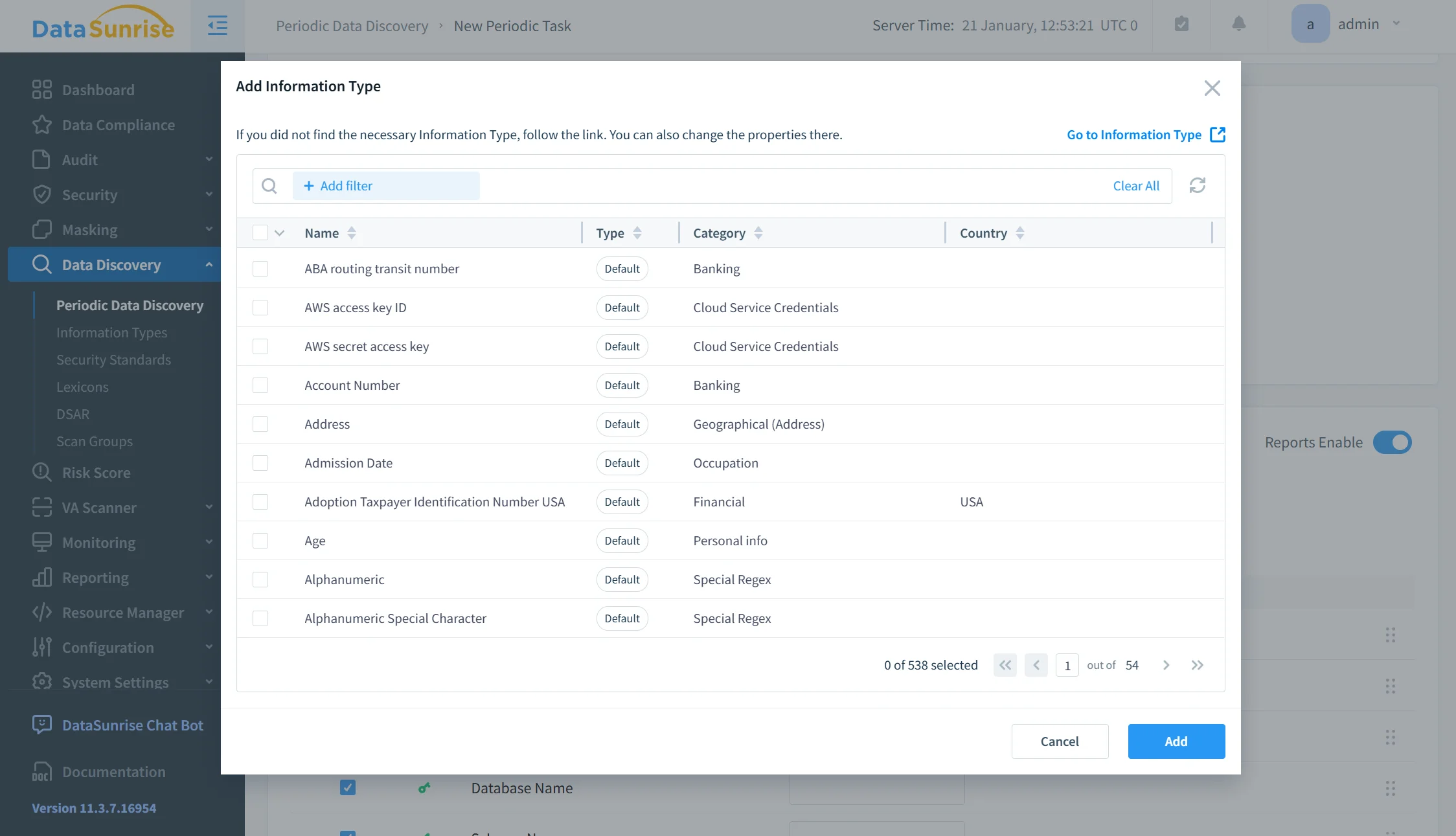
Sensitive Data Discovery for DynamoDB
The schema-less design of DynamoDB is one of its primary advantages, but it also represents a significant compliance risk. Without fixed schemas, sensitive attributes can be introduced at any time and remain undetected.
DataSunrise performs automated sensitive data discovery across DynamoDB tables by analyzing attribute names, stored values, and observed access patterns. This allows organizations to identify PII and other regulated data accurately, maintain continuous discovery as datasets evolve, and generate compliance-aware policies automatically. Discovery results are not isolated findings; they feed directly into audit, masking, and reporting workflows to ensure consistent enforcement.
- Detects sensitive data even when attributes are added dynamically or renamed
- Supports continuous re-scanning to account for data drift and evolving schemas
- Classifies data based on regulatory relevance, not just naming conventions
- Provides a foundation for downstream audit, masking, and compliance automation
Real-Time Activity Monitoring and History
DataSunrise builds a compliance-grade activity history by correlating DynamoDB API events with identity context and data sensitivity. Instead of relying on raw event streams, the platform reconstructs meaningful access narratives that reflect who accessed which data, under what conditions, and why that access matters from a compliance perspective.
This results in unified activity timelines, context-aware access records, and long-term retention suitable for investigations and audits. Unlike CloudTrail logs, this activity history is normalized, searchable, and immediately usable for regulatory reporting.
- Correlates API activity with IAM roles, services, and execution context
- Preserves historical access records for long-term compliance and forensics
- Enables fast filtering by user, data type, action, or timeframe
- Converts low-level events into audit-ready, human-readable records
Dynamic Data Masking for NoSQL Workloads
For read-heavy DynamoDB applications, masking sensitive data is often more effective than outright access denial. Blocking access can disrupt applications, while masking preserves functionality without exposing regulated information.
DataSunrise applies dynamic data masking based on user roles, access context, data classification, and applicable compliance requirements. As a result, applications continue to operate normally while sensitive attributes are protected in real time, reducing exposure without introducing architectural friction.
- Masks sensitive attributes at query time without altering stored data
- Applies different masking rules for different user roles or services
- Supports selective exposure for trusted users while protecting others
- Reduces insider risk without breaking application logic
Compliance Autopilot and Regulatory Coverage
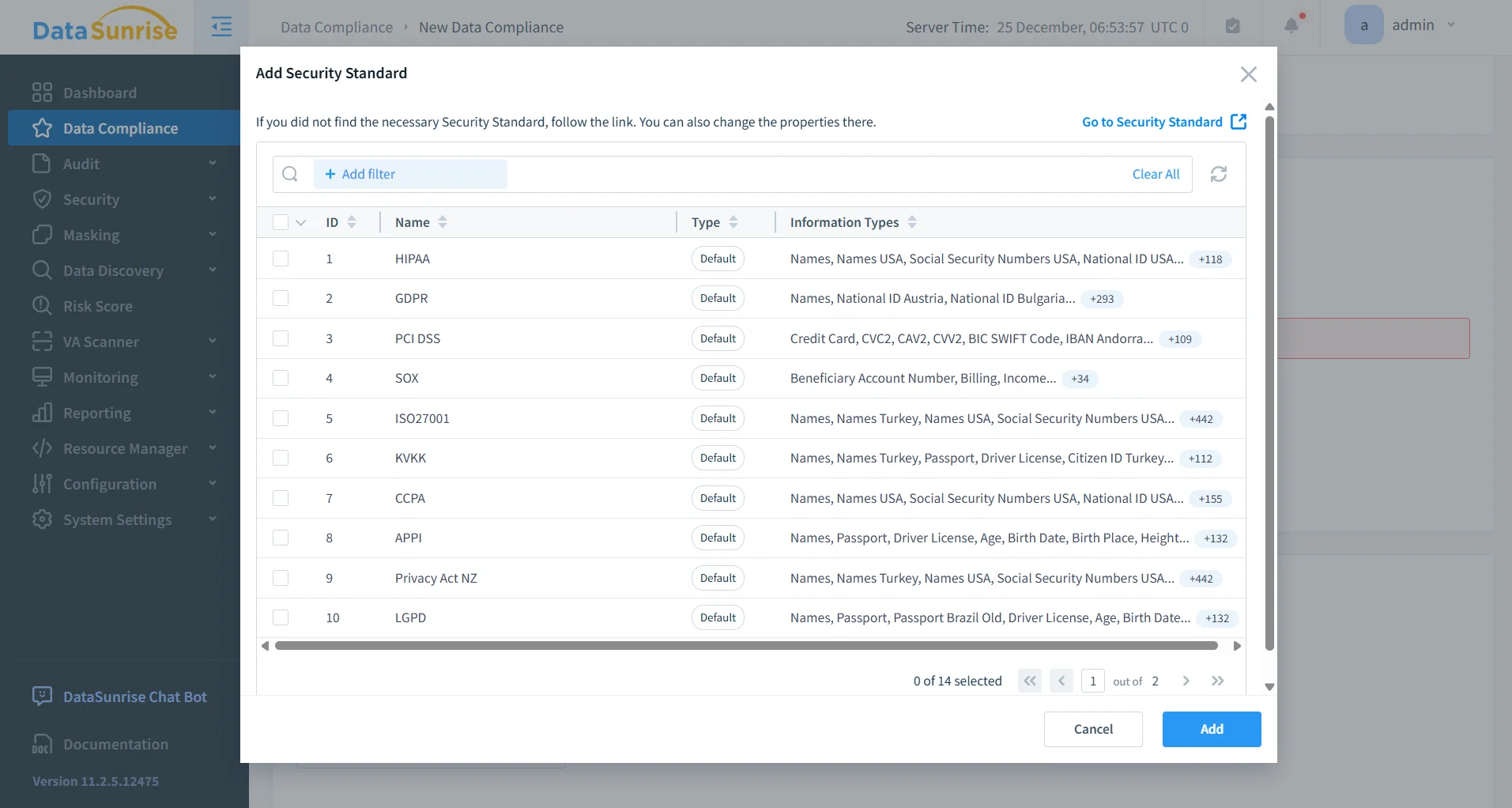
DataSunrise automates compliance enforcement across major regulatory frameworks, including GDPR, HIPAA, PCI DSS, and SOX. Compliance Autopilot continuously validates policies, detects drift, and ensures alignment with regulatory requirements as data and access patterns change.
Audit evidence is generated automatically, allowing organizations to respond to regulatory requests with one-click reports instead of manual investigations and log reconstruction.
- Continuously evaluates compliance posture as data and usage evolve
- Detects misconfigurations and policy drift in near real time
- Aligns technical controls directly with regulatory requirements
- Eliminates manual evidence collection during audits
Deployment Without Application Changes
DynamoDB environments are commonly embedded deep within microservices and serverless architectures, making invasive security changes impractical. DataSunrise integrates non-intrusively, supporting cloud-native deployments without requiring application code modifications.
The platform supports cloud-only environments, hybrid architectures, and multi-account AWS setups. Deployment timelines are measured in days rather than months, allowing teams to achieve compliance improvements quickly without disrupting production workloads.
- No changes required to application code, SDKs, or deployment pipelines
- Compatible with serverless, microservice, and event-driven architectures
- Supports centralized governance across multiple AWS accounts
- Enables rapid rollout without downtime or service interruption
Business Impact of Automated DynamoDB Compliance
| Business Area | Without Automation | With Automated DynamoDB Compliance |
|---|---|---|
| Audit preparation | Manual log collection across CloudTrail, IAM, and Config | Centralized, audit-ready evidence generated automatically |
| Compliance operations | High operational overhead and repeated manual reviews | Lower operational costs through continuous policy enforcement |
| Regulatory risk | Gaps caused by delayed detection and fragmented controls | Minimized risk through continuous monitoring and enforcement |
| Security visibility | Limited, service-level visibility across distributed workloads | Unified visibility across identities, APIs, and sensitive data |
| Compliance posture | Reactive, event-driven response to audits | Continuous compliance by design |
Most importantly, compliance shifts from a reactive, audit-driven exercise to a continuous operational control embedded directly into DynamoDB environments.
Conclusion
Amazon DynamoDB enables speed and scale, but compliance requires more than API logs and IAM rules. Native AWS controls provide a foundation, yet they lack the intelligence, visibility, and automation required for modern regulatory demands and end-to-end data security.
DataSunrise transforms DynamoDB compliance into an autonomous, centralized, and audit-ready process. By combining sensitive data discovery, real-time activity history, dynamic data masking, and automated reporting through the Compliance Manager, organizations can meet regulatory obligations without sacrificing agility.
For teams operating in regulated industries, effortless DynamoDB compliance is no longer optional—it is architectural.
Protect Your Data with DataSunrise
Secure your data across every layer with DataSunrise. Detect threats in real time with Activity Monitoring, Data Masking, and Database Firewall. Enforce Data Compliance, discover sensitive data, and protect workloads across 50+ supported cloud, on-prem, and AI system data source integrations.
Start protecting your critical data today
Request a Demo Download Now