Elasticsearch Data Compliance Automation
As enterprises expand their use of Elasticsearch to index, search, and analyze massive datasets, the challenge shifts from scalability to compliance automation. Managing regulatory adherence across distributed indices requires a framework that not only monitors activity but also adapts in real time to new rules, data models, and regions.
That’s where DataSunrise enters the scene. It transforms Elasticsearch into a compliance-ready data platform through zero-touch automation, continuous calibration, and AI-driven regulatory intelligence.
By integrating seamlessly in proxy, sniffer, or log-trailing modes, DataSunrise provides non-intrusive, cross-platform compliance orchestration — unifying audit, masking, discovery, and reporting into one centralized system.
Importance of Data Compliance Automation
Modern organizations process enormous volumes of data — personal details, payment information, healthcare records, and behavioral analytics. Each category falls under strict regulatory oversight, from GDPR and HIPAA to PCI DSS and SOX. Manual enforcement across Elasticsearch clusters simply doesn’t scale.
Without automation, teams face three major obstacles:
- Fragmented Visibility: Elasticsearch indices grow dynamically, making manual tracking of sensitive data nearly impossible.
- Human Error: Hand-tuned rules often lead to incomplete protection or outdated policies as data evolves.
- Audit Delays: Manual reporting cycles can’t keep pace with real-time compliance verification.
Automated compliance transforms this reactive process into a self-adjusting ecosystem. By continuously scanning for sensitive fields, applying dynamic masking, and syncing with evolving frameworks, DataSunrise Compliance Manager ensures every data transaction aligns with current legal requirements — without downtime or manual intervention.
This results in consistent compliance posture, faster audit readiness, and significantly reduced regulatory risk. For industries like finance, healthcare, and e-commerce, such automation isn’t just convenience — it’s survival.
Native Elasticsearch Compliance Controls
Elasticsearch includes a set of built-in mechanisms to enhance security and compliance readiness. These features focus on role-based access management, activity auditing, and granular control over sensitive fields. Together, they provide the foundation for enforcing data governance in a distributed search environment.
Role-Based Access Control (RBAC)
RBAC is a key element of Elasticsearch’s security framework, designed to restrict user access according to assigned roles. Managed through Elasticsearch Security (X-Pack), this mechanism ensures that users can interact only with specific indices, documents, or fields depending on their privileges.
Roles define permissions, such as index access, cluster operations, or data manipulation rights. By assigning users to roles, administrators can enforce the principle of least privilege, limiting exposure of sensitive data and reducing compliance risks.
A typical RBAC configuration might look like this:
POST /_security/role/data_reader
{
  "cluster": ["monitor"],
  "indices": [
    {
      "names": [ "transactions", "logs*" ],
      "privileges": [ "read", "view_index_metadata" ]
    }
  ]
}
In this example, the data_reader role allows users to read documents and view index metadata but not modify them.
Such granularity enables precise control over what users can view or modify, forming the basis for data privacy and compliance enforcement.
Audit Logging
Audit logging records critical security-related events within an Elasticsearch cluster. It tracks operations such as authentication attempts, authorization decisions, index access, and changes to system configurations.
Administrators can review audit logs to trace user activity, detect suspicious access patterns, and validate adherence to compliance frameworks such as GDPR or SOX.
To enable audit logging, the following configuration can be added to elasticsearch.yml:
xpack.security.audit.enabled: true
xpack.security.audit.outputs: [ index, logfile ]
With this setup, Elasticsearch generates detailed logs in both the internal audit index and local log files. The logs capture essential information, including:
- Timestamp of the event
- Username and role
- Source IP and request type
- Action performed (e.g., search, update, delete)
- Authorization outcome (granted or denied)
Example of a typical audit event entry:
{
  "type": "audit",
  "event": "access_granted",
  "user": "reporting_user",
  "action": "indices:data/read/search",
  "indices": ["transactions"],
  "timestamp": "2025-11-18T09:45:12Z"
}
These audit trails are crucial for forensic analysis and compliance verification, giving administrators visibility into every action taken within the cluster.
Field- and Document-Level Security
Elasticsearch provides granular data protection through field- and document-level security, enabling administrators to define precisely which parts of a document a user can view or modify.
This is particularly important in compliance contexts where different departments or user roles require restricted data access — for example, exposing transaction metadata but hiding customer identifiers.
Field-level security is configured within role definitions. The following example demonstrates how to restrict access to specific fields in an index:
"indices": [
  {
    "names": [ "sensitive_index" ],
    "privileges": [ "read" ],
    "field_security": {
      "grant": [ "user", "timestamp" ],
      "except": [ "credit_card", "email" ]
    }
  }
]
In this example, users can view the user and timestamp fields but are prevented from seeing credit_card and email.
Combined with document-level filters, this approach enforces data minimization — a key GDPR principle — while keeping query results functional for authorized users.
While these native Elasticsearch controls provide essential building blocks for compliance, they lack policy automation, cross-cluster coordination, and centralized oversight. That’s where DataSunrise enhances the stack.
Zero-Touch Compliance Automation with DataSunrise
DataSunrise Compliance Manager automates Elasticsearch data governance through Compliance Autopilot, continuously enforcing policies without manual oversight. Once connected, it identifies sensitive entities in JSON documents using AI-powered data discovery and applies masking, auditing, and reporting aligned with frameworks like GDPR, HIPAA, and PCI DSS.
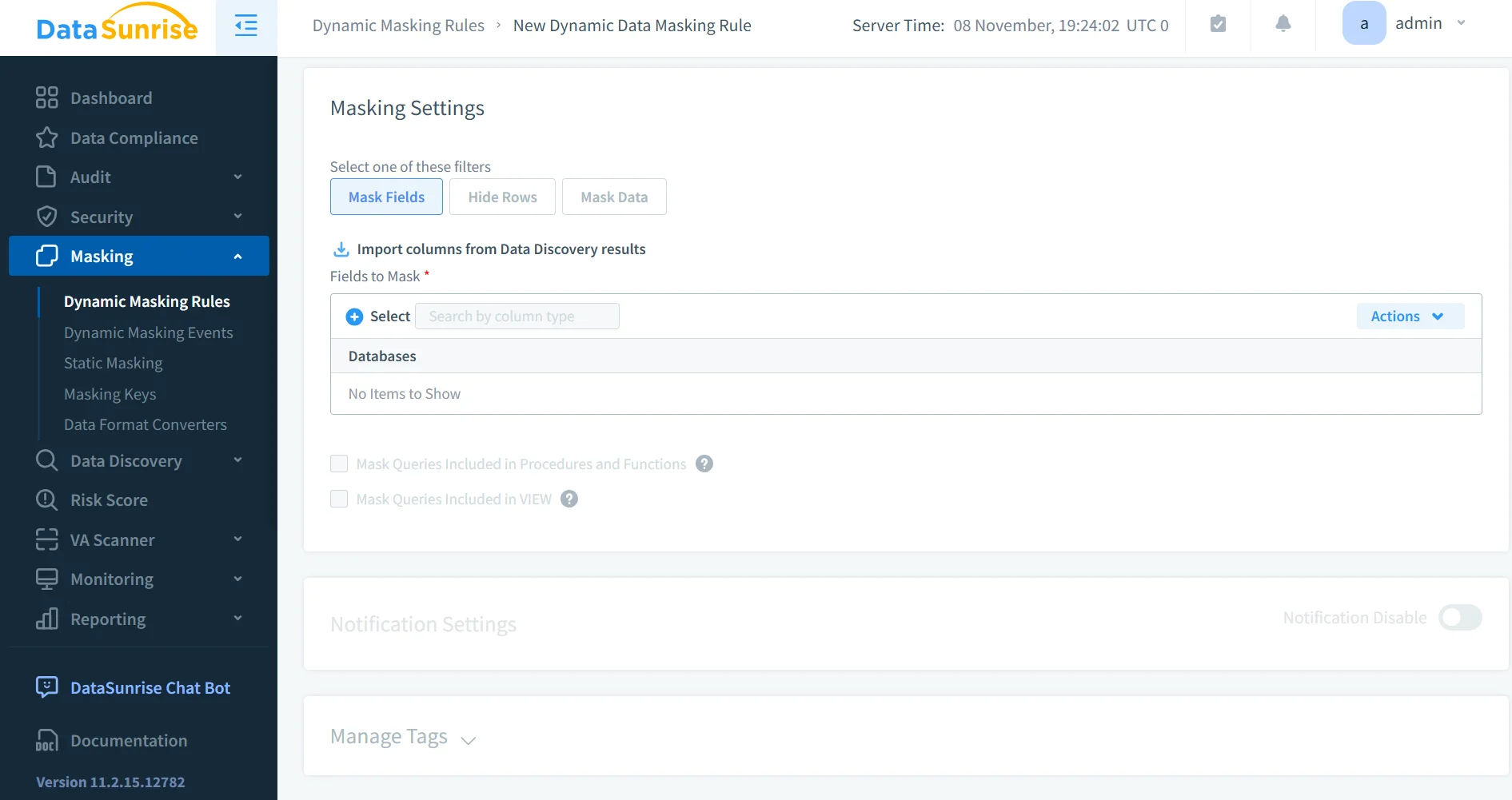
1. Autonomous Discovery and Masking
Through NLP-based Data Discovery, DataSunrise scans structured and semi-structured Elasticsearch indices, identifying PII, PHI, and financial data entities. Sensitive attributes such as names, emails, or account IDs are instantly protected through Dynamic Data Masking, which alters only query results while preserving original data integrity.
- Detects PII, PHI, and financial identifiers across indices.
- Applies context-aware masking dynamically based on user roles.
- Supports both structured (JSON) and semi-structured fields.
- Enables policy inheritance for new indices and documents.
- Reduces manual intervention by automating rule propagation.
2. Continuous Regulatory Calibration
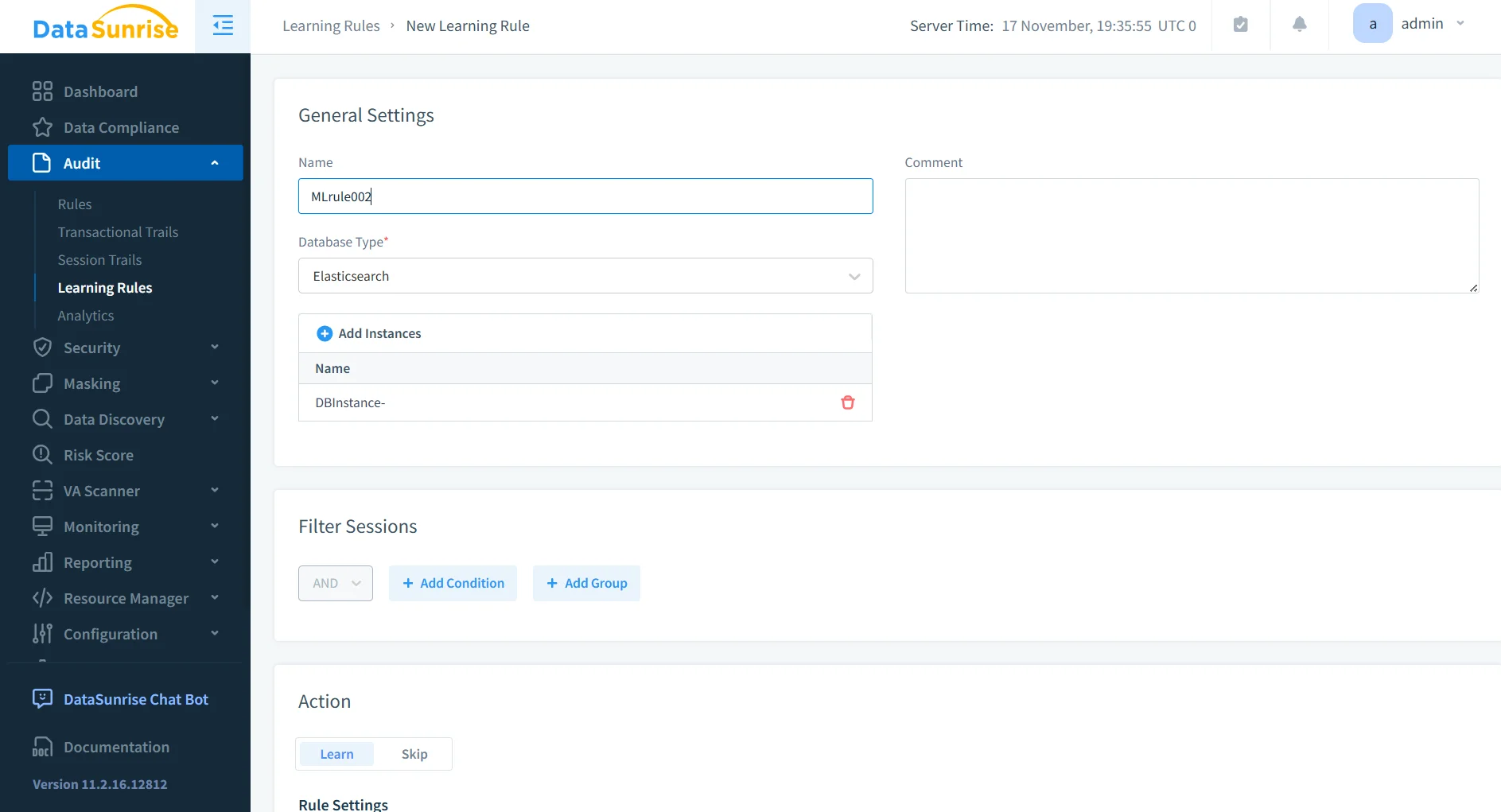
Using Machine Learning Audit Rules, DataSunrise continuously audits new fields and documents, automatically mapping them to evolving regulations. When schema or regulation changes occur — for example, when a new index is added — the platform recalibrates policies in real time to prevent compliance drift.
- Monitors schema evolution across clusters.
- Automatically detects new fields containing sensitive information.
- Adjusts policies based on changing compliance standards.
- Alerts administrators to potential non-compliance events.
- Minimizes human oversight through continuous feedback loops.
3. Unified Multi-Cluster Governance
Through its Centralized Compliance Platform, DataSunrise delivers unified visibility across hybrid Elasticsearch deployments — on-prem, cloud, or multi-region. Teams can manage, audit, and report compliance posture through a single pane of glass, reducing manual configuration time by over 70%.
- Consolidates compliance dashboards across all environments.
- Synchronizes rules between development, staging, and production clusters.
- Provides unified audit trail management with cross-index correlation.
- Integrates with SIEM and reporting tools for enterprise visibility.
- Simplifies compliance evidence collection for audits and certifications.
Business Impact
| Impact Area | Description |
|---|---|
| Reduced Compliance Costs | Eliminates manual log reviews and configuration overhead, streamlining regulatory workflows. |
| Regulatory Agility | Instantly adapts to GDPR, HIPAA, and CCPA rule updates, maintaining continuous compliance. |
| Data Protection by Design | Enforces zero-trust access principles and context-aware masking to safeguard sensitive data. |
| Audit-Ready Evidence | Generates one-click reports for auditors with cross-index correlation for faster reviews. |
Through DataSunrise, organizations evolve from reactive compliance efforts to self-healing regulatory alignment, maintaining full transparency across their Elasticsearch infrastructure.
Conclusion
Native Elasticsearch auditing and access controls form a solid base, but they fall short of full compliance automation. DataSunrise bridges this gap with autonomous discovery, continuous calibration, and centralized governance.
It doesn’t just audit Elasticsearch activity — it automates compliance end-to-end, ensuring every document, index, and user interaction remains within regulatory boundaries.
Protect Your Data with DataSunrise
Secure your data across every layer with DataSunrise. Detect threats in real time with Activity Monitoring, Data Masking, and Database Firewall. Enforce Data Compliance, discover sensitive data, and protect workloads across 50+ supported cloud, on-prem, and AI system data source integrations.
Start protecting your critical data today
Request a Demo Download Now