Elasticsearch Regulatory Compliance
Elasticsearch is one of the most widely deployed search and analytics engines in modern data architectures. It powers everything from log aggregation and observability to full-text enterprise search.
Yet as organizations index sensitive customer data into Elasticsearch clusters, ensuring regulatory compliance becomes a critical challenge.
Native Elastic features such as audit logging and field-level security provide foundational visibility, but maintaining continuous compliance across diverse data sources often requires an autonomous, centralized platform.
That is where DataSunrise extends Elasticsearch’s native controls—automating data discovery, masking, and reporting to align with key frameworks like GDPR, HIPAA, PCI DSS, and SOX .
Importance of Regulatory Compliance
Compliance regulations define how sensitive data must be stored, processed, and accessed. For Elasticsearch—which often indexes personal identifiers, transaction details, and proprietary business data—these frameworks ensure that information remains confidential, traceable, and auditable.
Adhering to regulatory standards such as GDPR, HIPAA, and PCI DSS helps organizations achieve the following:
- Data Protection and Privacy: Prevent unauthorized access and maintain control over personally identifiable information (PII).
- Accountability: Ensure that every query, modification, and user action in Elasticsearch is recorded and verifiable.
- Reputation and Trust: Demonstrate transparency and compliance readiness during external audits.
- Financial Security: Avoid penalties, data breach fines, and compliance violations.
However, with Elasticsearch clusters distributed across multiple environments—on-premises, hybrid, and cloud—compliance maintenance becomes complex. Centralized monitoring and automated auditing are key to sustaining ongoing alignment with global standards.
Native Elasticsearch Compliance and Security Controls
1. Enabling Native Audit Logging
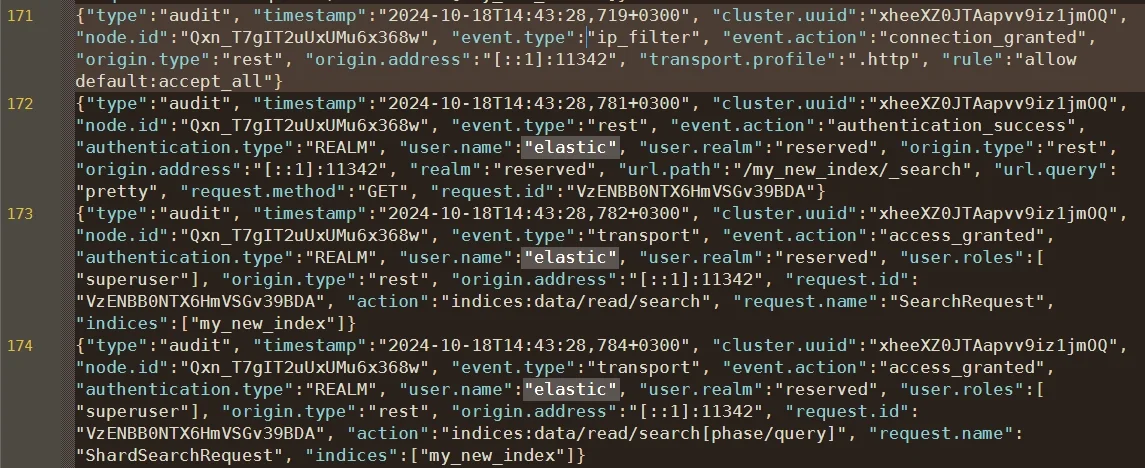
Elasticsearch provides an Audit Log Appender that records every access event, configuration change, and API request. To enable it, administrators define a dedicated audit index in elasticsearch.yml:
xpack.security.audit.enabled: true
xpack.security.audit.outputs: index
xpack.security.audit.logfile.events.include: [ "access_granted", "access_denied", "authentication_failed" ]
After restarting the node, audit logs begin capturing details such as user, role, source IP, and action.
2. Role-Based and Field-Level Security
Elasticsearch’s built-in role-based access control (RBAC) ensures users only see permitted indices or documents.
You can refine permissions with field-level masking:
{
  "indices": [
    {
      "names": [ "customer_data" ],
      "privileges": [ "read" ],
      "field_security": {
        "grant": [ "name", "region" ],
        "except": [ "ssn", "credit_card" ]
      }
    }
  ]
}
These native security definitions support baseline privacy controls but often stop short of end-to-end compliance automation across multiple data stores and regulatory domains.
Limitations of Native Elasticsearch Tools
| Native Capability | Limitation |
|---|---|
| Audit logging for authentication and index access | No built-in reporting or long-term archival |
| RBAC and field-level security | Lacks centralized cross-platform policy governance |
| API and index encryption | Manual key rotation and minimal compliance context |
| Snapshot and restore | No compliance retention workflow or evidence packaging |
While suitable for internal auditing, these controls can become difficult to scale in hybrid or multi-cloud deployments where sensitive data flows across clusters.
Extending Elasticsearch Compliance with DataSunrise
DataSunrise introduces a Compliance Autopilot that continuously aligns Elasticsearch activity with regulatory requirements.
It automatically discovers sensitive fields (PII, PHI, financial data), enforces data-centric policies, and generates audit-ready reports in just a few clicks.
1. Autonomous Compliance and Policy Orchestration
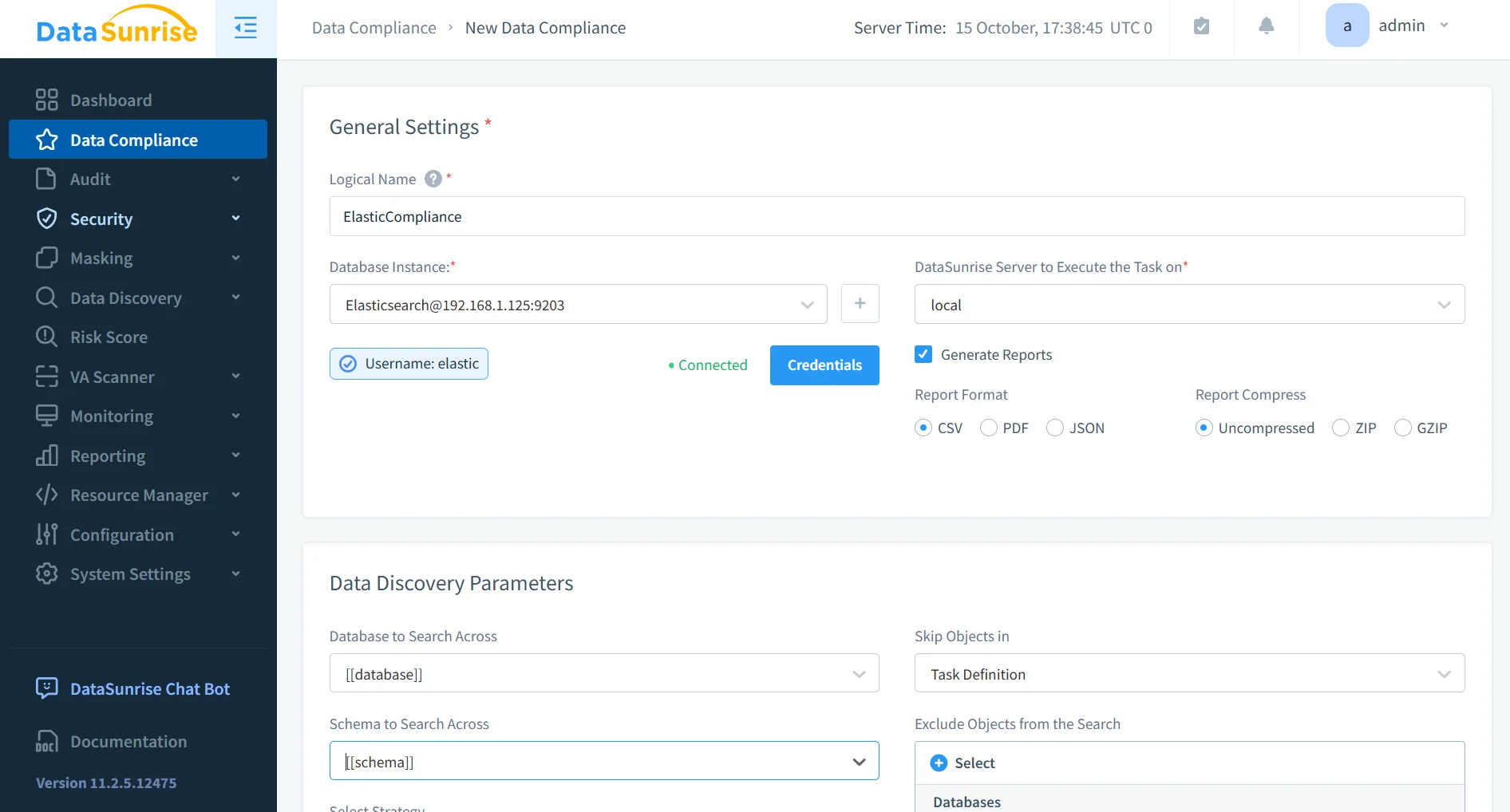
Once connected to your Elasticsearch cluster, DataSunrise’s Zero-Touch Compliance Engine performs:
- Sensitive Data Discovery across indices, snapshots, and documents using NLP and pattern recognition.
- Auto-Generated Masking Rules for detected PII elements (names, emails, card numbers).
- Continuous Regulatory Calibration ensuring GDPR, HIPAA, PCI DSS, and SOX alignment without manual rule tuning.
This automated orchestration allows organizations to maintain continuous compliance even in high-velocity clusters without manual intervention.
2. Real-Time Audit and Activity History
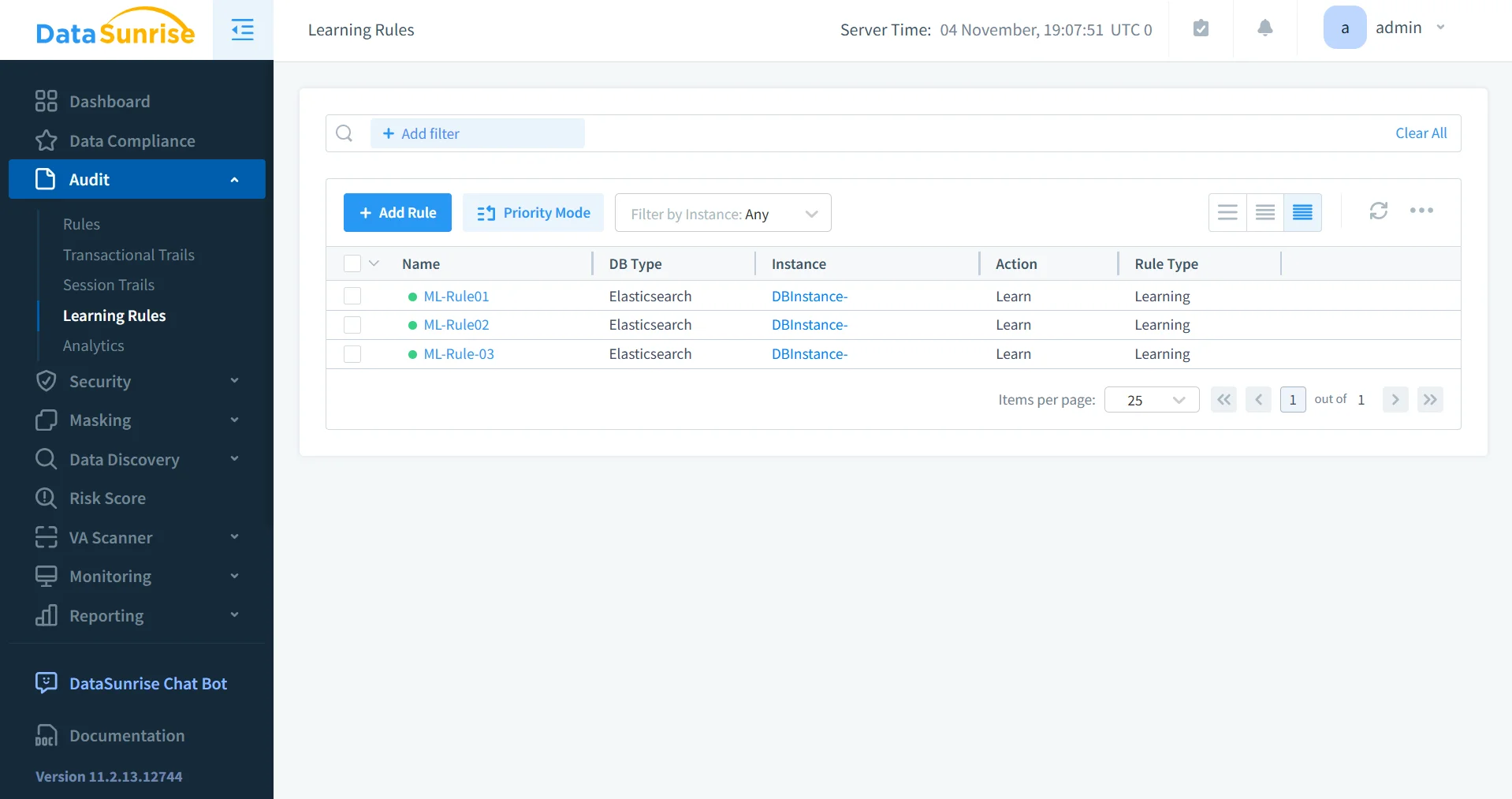
DataSunrise captures complete data activity history for Elasticsearch—index reads, writes, and query access—within its centralized monitoring dashboard.
Administrators can visualize:
- User and API activity timelines
- Policy enforcement events
- Suspicious behavior detected by ML Audit Rules
3. Automated Reporting and Audit-Ready Evidence
The Compliance Manager module automatically generates reports for major frameworks, with one-click export to CSV or PDF.
These reports consolidate audit trail data, user behavior analytics, and masking compliance summaries.
- Comprehensive Framework Support: Reports cover GDPR, HIPAA, PCI DSS, SOX, and other global standards.
- Customizable Report Templates: Adapt report content and structure to internal governance or auditor-specific requirements.
- Automated Scheduling: Set up recurring compliance report generation to ensure continuous readiness for audits.
Auditors receive consistent evidence packages across all environments, simplifying periodic reviews and certification renewals.
Business Impact
Implementing DataSunrise for Elasticsearch compliance offers measurable operational and regulatory benefits:
| Outcome | Description |
|---|---|
| Compliance Efficiency | Automated discovery and audit rule generation cut manual workload by up to 70%. |
| Reduced Risk Exposure | Real-time anomaly detection and data masking minimize breach potential. |
| Cross-System Consistency | Uniform compliance across databases, data lakes, and Elastic clusters. |
| Audit Readiness | Instant, verifiable evidence for internal and external auditors. |
| Lower Total Cost of Compliance | No-code automation reduces maintenance overhead while ensuring regulatory accuracy. |
Conclusion
Elasticsearch provides a strong foundation for search and analytics, but compliance assurance demands continuous alignment with data privacy laws and auditability standards. By integrating DataSunrise’s autonomous compliance orchestration, organizations can achieve greater transparency and security across all Elastic environments.
With its unified audit and reporting capabilities, zero-touch policy enforcement, and real-time monitoring, DataSunrise enables consistent compliance across hybrid infrastructures without additional complexity. It transforms Elasticsearch from a powerful search engine into a fully compliant data platform—bridging the gap between visibility, governance, and automated protection.
Protect Your Data with DataSunrise
Secure your data across every layer with DataSunrise. Detect threats in real time with Activity Monitoring, Data Masking, and Database Firewall. Enforce Data Compliance, discover sensitive data, and protect workloads across 50+ supported cloud, on-prem, and AI system data source integrations.
Start protecting your critical data today
Request a Demo Download Now