How to Apply Data Governance for Vertica
As modern analytical platforms continue to expand in scale and complexity, organizations increasingly face challenges related to visibility, control, and regulatory alignment. Because Vertica is engineered for high-performance analytical workloads, the question of how to apply Data Governance for Vertica becomes especially important. Its architecture allows massive parallel ingestion and query execution. However, this very strength introduces unique governance requirements that teams must address at both the data plane and control plane layers.
In Vertica environments, Data Governance is not simply a policy checklist; it is a technical framework that defines how data is classified, accessed, masked, monitored, and verified. Since Vertica stores diverse datasets—from financial metrics and operational telemetry to customer-linked identifiers—governance layers must ensure that sensitive data behaves according to regulatory obligations such as GDPR, HIPAA, PCI DSS, and SOX. Therefore, understanding how to apply Data Governance for Vertica requires examining how Vertica structures, processes, and exposes data internally. Additionally, external governance tooling such as DataSunrise enforces classification, masking, auditing, and security controls across distributed query paths. For regulatory context, organizations can consult the official GDPR regulation and the Vertica documentation.
Vertica Architecture and Data Governance Considerations
When evaluating how to apply Data Governance for Vertica, the database architecture itself becomes a central factor. Vertica operates as a distributed, shared-nothing columnar engine where data is segmented, compressed, and projected into optimized physical structures, and this design accelerates analytical workloads while still introducing governance complexity. Sensitive attributes may appear in multiple projections, replicas, or query paths, which traditional row-store governance approaches cannot fully interpret.
Moreover, Vertica supports concurrent access from BI tools, ETL pipelines, machine learning notebooks, and service accounts. As a result, governance must consider not only static schema permissions but also dynamic workload patterns. Analysts may query the same table from dashboards, exploration tools, and Python scripts, and each access pattern produces a distinct risk signature. Consequently, organizations applying Data Governance for Vertica must incorporate workload context, identity, masking rules, and behavioral baselines into access evaluations.
Data Classification and Sensitivity Mapping in Vertica
Before Data Governance controls can take effect, organizations must determine where sensitive data resides within Vertica’s schemas and projections. Vertica deployments often accumulate wide analytical tables, highly denormalized structures, and projection variants where sensitive attributes such as PII, PHI, authentication tokens, and financial identifiers appear in unexpected locations. Additionally, schema drift or newly generated projections may expose information that earlier remained contained.
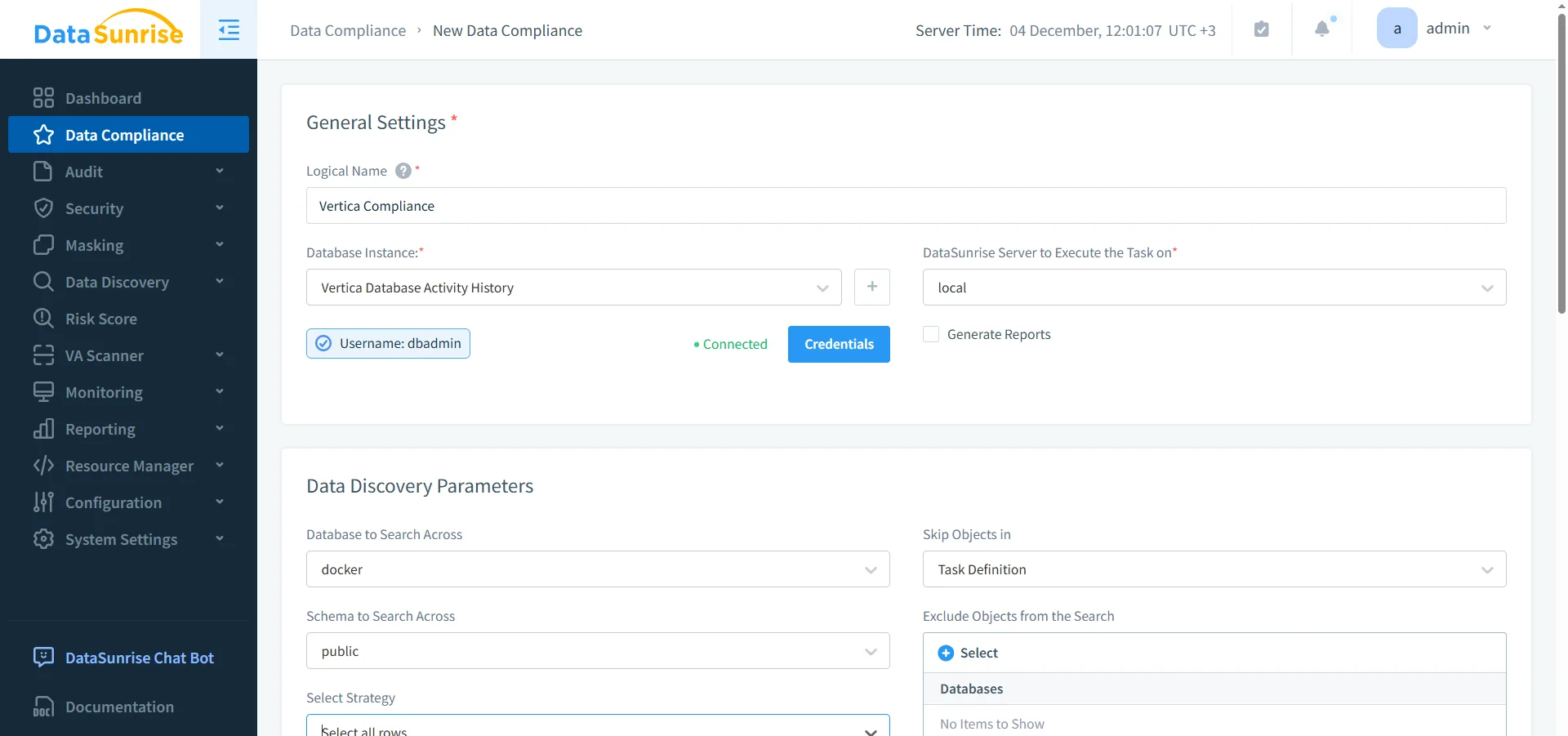
DataSunrise extends Vertica with Sensitive Data Discovery, and it uses pattern matching, dictionaries, and contextual logic to classify regulated fields automatically. DataSunrise stores discovery results centrally so governance teams can maintain a continuously updated map of sensitive assets. This classification dataset directly supports downstream components such as masking rules, role design, and compliance validation.
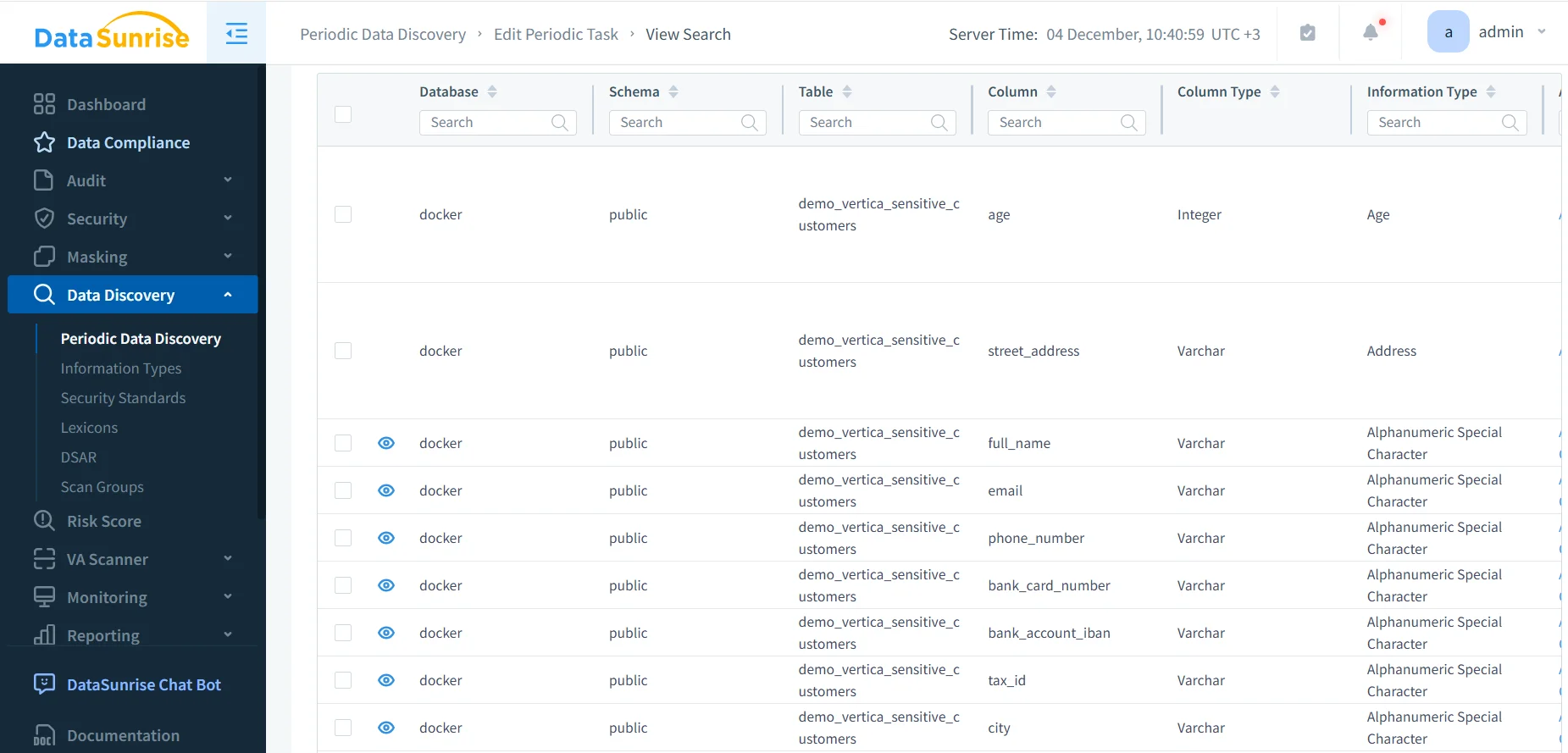
Furthermore, teams can correlate classification output with internal guidance and other DataSunrise resources such as PII classification and broader data security requirements.
Access Control Behavior and Policy Enforcement
Vertica offers a role-based access control (RBAC) system. In practice, however, real-world governance requires more granular and contextual policies. Workloads may originate from dashboards, ETL engines, JDBC integrations, or ML pipelines, and each may expose sensitive data differently. Therefore, governance must evaluate not just object-level privileges but also identity, request origin, query structure, and masking context.
DataSunrise becomes a policy enforcement layer by inspecting SQL traffic before it reaches Vertica. This allows administrators to implement advanced controls that Vertica does not natively support, including:
- context-aware masking of sensitive fields,
- behavior-driven access decisions,
- rule-based query blocking through Security Rules,
- risk scoring for unusual or high-impact operations.
Even when a Vertica role grants SELECT access to a table, DataSunrise can still mask specific columns, restrict queries, or override visibility according to Data Governance requirements. Conceptually, a governance policy enforced by DataSunrise for Vertica workloads may resemble the following structure:
{
  "database_type": "Vertica",
  "rule_name": "Mask PII in customer table",
  "match": {
    "schema": "public",
    "table": "customers",
    "columns": ["email", "phone", "ssn"]
  },
  "actions": [
    {
      "type": "dynamic_masking",
      "profile": "default_pii_mask"
    }
  ],
  "conditions": {
    "roles_excluded": ["DS_ADMIN", "COMPLIANCE_OFFICER"]
  }
}
This example illustrates how a governance policy can describe Vertica objects, select which columns require protection, and define which roles are exempt from masking for investigation or compliance purposes. Additionally, the same pattern can extend to other tables and schemas without changing application code or Vertica structures.
Masking and Data Protection for Vertica Workloads
Applying Data Governance for Vertica requires consistent masking across all access paths. Because Vertica does not provide built-in masking functionality, DataSunrise enforces masking rules at the query layer and protects sensitive data regardless of whether requests originate from BI dashboards, SQL tools, notebooks, custom apps, or automation pipelines.
- Dynamic Masking replaces sensitive values in real time during query execution.
- Static Masking generates anonymized Vertica datasets for development and testing.
- Context-aware masking adapts behavior based on identity, source application, or workload classification.
Because DataSunrise applies masking independently from Vertica’s storage structures and projections, the masking layer remains predictable, auditable, and compliant across varied consumption workflows. Related concepts appear in Dynamic Data Masking and Static Masking, which describe masking patterns beyond Vertica as well.
Auditability and Monitoring Across Vertica Workloads
Vertica maintains operational logs across multiple system tables. However, correlating these logs into a unified governance record becomes difficult when distributed execution fragments query behavior. A single user operation may trigger multiple internal steps across nodes and projections. Consequently, governance teams need normalized audit trails that reflect the complete context of each action.
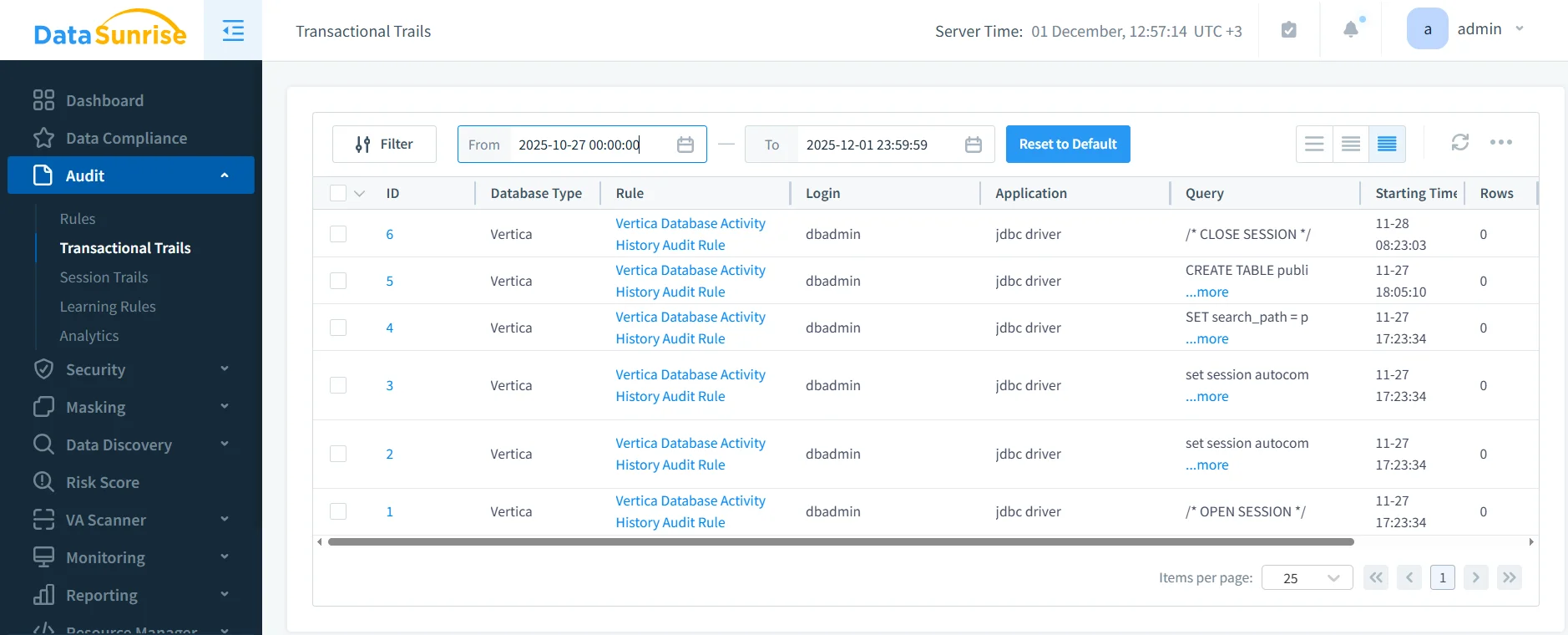
DataSunrise consolidates all Vertica access into unified audit streams. It correlates session behavior, query-level actions, masking outcomes, and security rule triggers. This correlation enables reliable forensic reconstruction, policy validation, and compliance documentation. Furthermore, teams can augment this information with Database Activity Monitoring, detailed Audit Logs, and automated reporting using Compliance Manager.
Governance Capabilities: Vertica vs. DataSunrise
The table below contrasts Vertica’s native capabilities with the governance-focused functionality provided by DataSunrise. This comparison highlights exactly where supplemental controls improve the way organizations apply Data Governance for Vertica and related platforms.
| Governance Domain | Vertica Native Capability | DataSunrise Enhancement |
|---|---|---|
| Data Classification | Manual review; limited patterns | Automated Sensitive Data Discovery with PII/PHI detection |
| Access Governance | Basic RBAC | Context-aware access decisions + Security Rules |
| Data Masking | No masking functionality | Dynamic Masking and Static Masking with policy logic |
| Audit and Monitoring | Fragmented logs | Unified audit trails and cross-platform correlation |
| Compliance Readiness | Manual evidence assembly | Automated reports for GDPR, HIPAA, PCI DSS, SOX |
Conclusion: How to Apply Data Governance for Vertica Successfully
Understanding how to apply Data Governance for Vertica requires a technical perspective on classification, access enforcement, masking behavior, and audit visibility. Because Vertica functions as a distributed analytical engine, its governance needs extend beyond native RBAC and logging. External enforcement layers such as DataSunrise deliver consistent masking, centralized audits, automated discovery, and behavioral controls that keep Vertica aligned with regulatory and internal policies. With this governance architecture in place, Vertica becomes a secure, compliant foundation for large-scale analytics and enterprise intelligence.
Protect Your Data with DataSunrise
Secure your data across every layer with DataSunrise. Detect threats in real time with Activity Monitoring, Data Masking, and Database Firewall. Enforce Data Compliance, discover sensitive data, and protect workloads across 50+ supported cloud, on-prem, and AI system data source integrations.
Start protecting your critical data today
Request a Demo Download Now