How to Manage Data Compliance for Elasticsearch
Elasticsearch is widely used for distributed search, log analytics, and observability — but its speed and scalability come with hidden compliance risks. Managing sensitive data in JSON documents, log indices, and cluster snapshots requires more than encryption or access controls. A solid compliance strategy ensures auditability, data privacy, and alignment with frameworks like GDPR, HIPAA, and PCI DSS.
This guide explores how to manage data compliance for Elasticsearch, covering both native security tools and extended governance through DataSunrise Compliance Manager.
Importance of Data Compliance Management
Data compliance management ensures that organizations handle sensitive data responsibly and within the boundaries of legal and regulatory frameworks. For Elasticsearch environments — where vast amounts of log and event data flow continuously — compliance oversight is critical for maintaining security, trust, and operational stability.
Without proper governance, Elasticsearch clusters can unintentionally store personal identifiers, financial information, or health records in plain text. This not only violates data protection regulations but also exposes the organization to risks such as:
- Regulatory penalties — Non-compliance with GDPR or HIPAA can lead to multimillion-dollar fines.
- Data breaches — Unauthorized access or accidental exposure of PII can cause severe reputational harm.
- Operational disruption — Poor data lifecycle control can result in data sprawl and complex remediation efforts.
Proper compliance management enables organizations to track data lineage, audit all access events, and enforce privacy rules automatically. When implemented effectively, it transforms Elasticsearch from a high-performance search engine into a secure and audit-ready data platform.
Native Elasticsearch Compliance Capabilities
Elasticsearch provides several native mechanisms that form the foundation for compliance management:
1. Role-Based Access Control (RBAC)
Through Elastic Security features, administrators can define granular roles, control access to indices, and limit permissions to sensitive fields.
You can assign roles using the REST API:
POST /_security/role/audit_compliance_role
{
  "cluster": ["monitor"],
  "indices": [
    {
      "names": ["logs-*", "sensitive-*"],
      "privileges": ["read", "view_index_metadata"]
    }
  ]
}
RBAC ensures that only authorized users access sensitive data and aligns with least privilege principles. For more insight, see Role-Based Access Control (RBAC).
2. Audit Logging
Elasticsearch audit logging captures access events and configuration changes across clusters. When enabled, the xpack.security.audit.enabled flag records authentication, authorization, and index access events:
xpack.security.audit.enabled: true
xpack.security.audit.outputs: [ index, logfile ]
xpack.security.audit.logfile.events.include: ["access_granted", "access_denied"]
Logs can be sent to a local file or an internal .security_audit_log index for centralized review. For enhanced analysis, organizations often forward these logs to SIEM systems.

3. Field- and Document-Level Security
Fine-grained controls allow restricting visibility to specific document attributes, essential for protecting PII and PHI. For example:
"query": {
  "term": { "region": "EU" }
}
By configuring field filters, compliance officers can ensure GDPR-mandated minimization of personal data exposure.
Extending Compliance Management with DataSunrise
DataSunrise Compliance Manager elevates Elasticsearch compliance through autonomous auditing, masking, discovery, and continuous policy calibration.
1. Zero-Touch Compliance Automation
DataSunrise deploys Compliance Autopilot to continuously enforce data protection policies across all Elasticsearch indices. Without modifying the core cluster configuration, it automatically detects sensitive data entities in JSON documents using Data Discovery, applies dynamic or static masking based on access context, and synchronizes regulatory mappings for GDPR, SOX, HIPAA, and PCI DSS.
This zero-touch deployment works in proxy, sniffer, or log-trailing modes, ensuring minimal performance impact and non-intrusive integration across environments.
- Enables instant detection of sensitive fields across new or existing indices
- Eliminates manual rule configuration through automated mapping
- Reduces compliance maintenance effort with self-updating policies
- Provides full visibility into regulated data exposure
- Ensures consistent enforcement across hybrid and multi-cloud deployments
2. Continuous Regulatory Calibration
Unlike static Elastic configurations, DataSunrise uses Continuous Regulatory Calibration to adapt automatically as schemas, fields, or regulations evolve. It leverages machine learning audit rules to identify compliance anomalies, such as unprotected sensitive fields or missing access restrictions. The system autonomously aligns audit policies across environments, ensuring consistency between test, production, and hybrid Elasticsearch clusters.
- Detects configuration drift across indices and environments
- Updates compliance mappings in real time as schemas change
- Utilizes machine learning to identify potential compliance gaps
- Generates alerts for policy misalignment or missing protection
- Maintains continuous regulatory alignment without manual reconfiguration
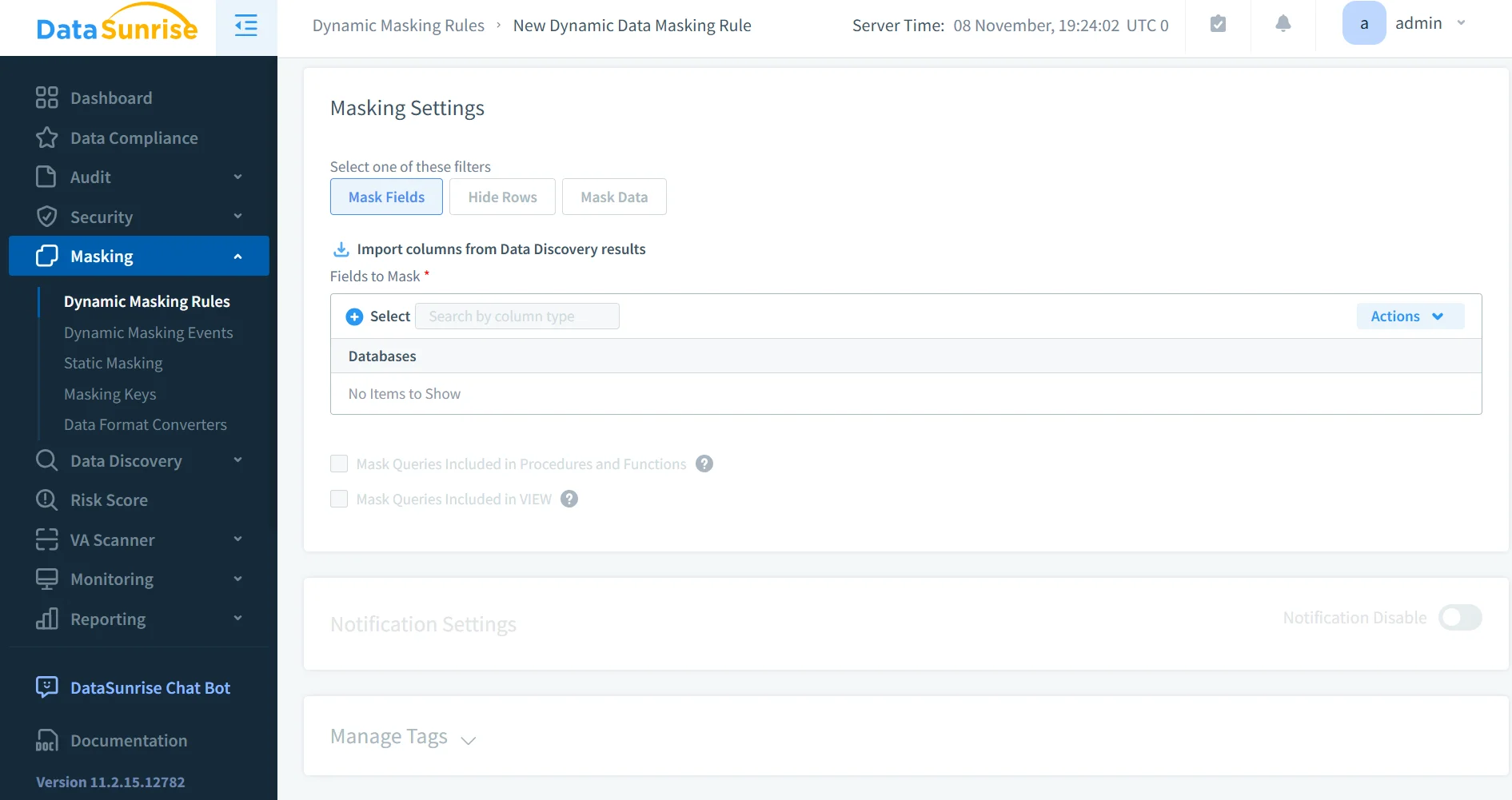
3. Dynamic Data Masking for Search Results
Through Dynamic Data Masking, sensitive fields such as names, SSNs, or card numbers are masked in query results without modifying stored data. This enforces zero-trust access and ensures data minimization during searches and visualizations.
- Masks sensitive data dynamically without altering raw JSON content
- Ensures compliance with privacy-by-design principles
- Applies context-aware masking rules based on user roles
- Supports hybrid data access scenarios across clusters
- Enhances auditability by recording every masking operation
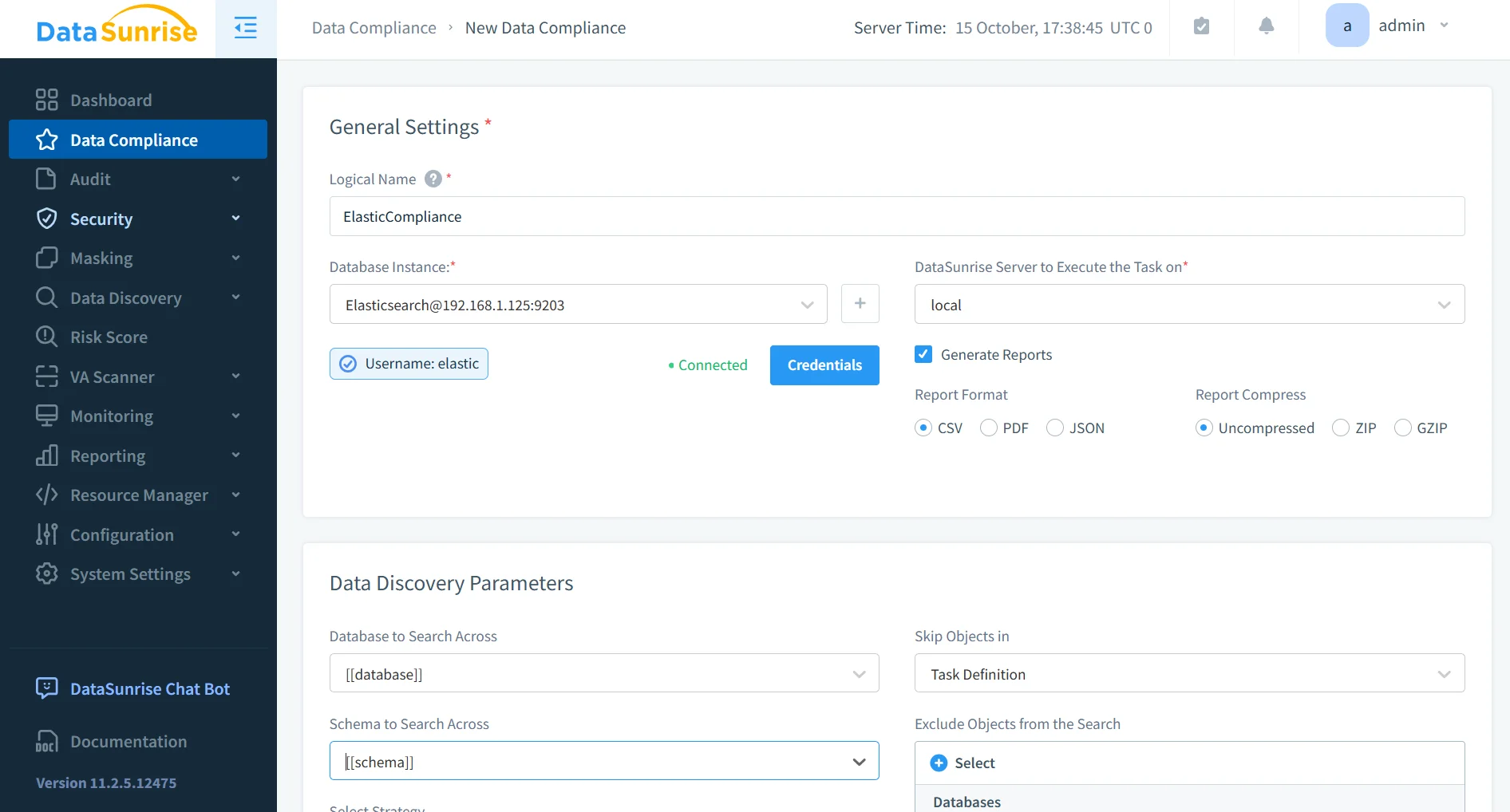
4. Automated Compliance Reporting
The Compliance Manager module automatically generates audit-ready reports for GDPR, HIPAA, PCI DSS, and SOX. These reports include audit trail summaries, masking compliance matrices, and user access analytics. Exportable in PDF or CSV, they provide traceable, repeatable evidence for audits while significantly reducing manual review cycles.
- Generates comprehensive audit documentation on demand
- Consolidates activity logs from multiple Elasticsearch nodes
- Visualizes data access and masking compliance metrics
- Simplifies auditor review with standardized reporting templates
- Supports export in PDF, CSV, and automated scheduled delivery formats
Business Impact
Implementing automated compliance for Elasticsearch yields measurable outcomes:
| Business Metric | Impact |
|---|---|
| Audit Preparation Time | Reduced by up to 70% with one-click reporting |
| Compliance Drift Risk | Eliminated through continuous calibration |
| Incident Response | Accelerated via real-time anomaly alerts |
| Data Protection Posture | Strengthened through centralized masking and discovery |
Conclusion
Elasticsearch’s native features provide a good starting point for compliance, but manual setups cannot keep up with dynamic data and evolving regulations.
DataSunrise transforms Elasticsearch into a fully compliant data platform — delivering real-time visibility, adaptive enforcement, and audit-ready automation.
With autonomous policy orchestration and cross-platform security integration, DataSunrise ensures continuous regulatory alignment and measurable reduction in compliance risk.
Protect Your Data with DataSunrise
Secure your data across every layer with DataSunrise. Detect threats in real time with Activity Monitoring, Data Masking, and Database Firewall. Enforce Data Compliance, discover sensitive data, and protect workloads across 50+ supported cloud, on-prem, and AI system data source integrations.
Start protecting your critical data today
Request a Demo Download Now