Name Shuffling
Introduction
Organizations often struggle to protect sensitive data while still needing realistic datasets for testing and development. That’s where techniques like name shuffling and data masking come into play.
Here’s a fun fact: the U.S. Social Security Administration publishes annual data on baby names, with roughly 30,000 to 35,000 unique names used each year. This kind of dataset is ideal for generating believable, yet anonymized test data.
This article explores how name shuffling works, how it’s implemented, and why it’s effective for creating secure test environments.
DataSunrise delivers advanced data masking capabilities—including intelligent shuffling—that preserve realism while ensuring privacy. Our platform helps organizations meet compliance requirements and protect sensitive data without sacrificing functionality.
With DataSunrise, you can randomly select values from custom lexicons—either built manually or sourced from live databases. This enables both deterministic shuffling and random substitution for high-quality, secure test data generation.
What is Data Masking?
Before diving into name shuffling, let’s briefly touch on data masking. Data masking is a method used to create a structurally similar but inauthentic version of an organization’s data. It replaces sensitive information with realistic but fake data. This allows companies to use masked data for testing, development, and analytics without risking exposure of confidential information.
Data Masking Regulations and Compliance
Regulatory frameworks increasingly mandate data protection through masking techniques. GDPR requires appropriate safeguards for personal data processing. HIPAA mandates protection of health information in non-production environments. PCI DSS prohibits using real cardholder data for testing. CCPA gives consumers control over personal information use. Industry standards often require test data anonymization. Healthcare organizations face strict patient data privacy requirements. Financial institutions must protect customer financial details during development. Penalties for compliance failures can reach millions of dollars. Data masking provides documented evidence of privacy compliance. Regulations often require formal risk assessments for data handling. Regular compliance audits verify proper masking implementation. Companies must demonstrate reasonable security measures through techniques like shuffling.
Understanding Name Shuffling
What is Name Shuffling?
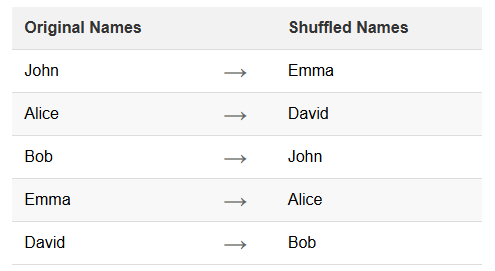
Name shuffling is a specific data masking technique. It involves rearranging existing data within a dataset. This method maintains data integrity and realism while obscuring individual identities. Shuffling is particularly useful for protecting personal information in databases.
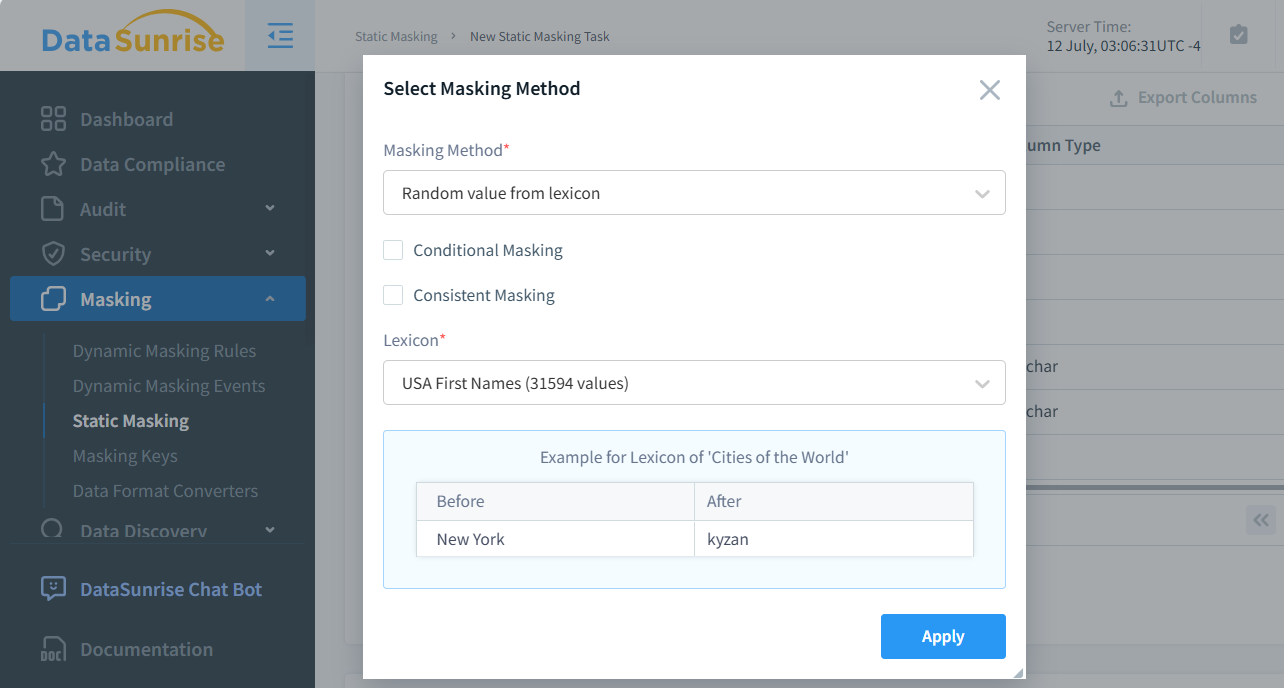
As mentioned in Introduction, DataSunrise allows you to create lexicon-based random value selection for masking. The figure below shows the selection of this masking method in the DataSunrise user interface. As you can see, 31,594 values are available, which is much more reliable than simply shuffling a given set. This increased reliability is because when there are n unique values in a column, the probability of any single value being mapped to itself is 1/n.
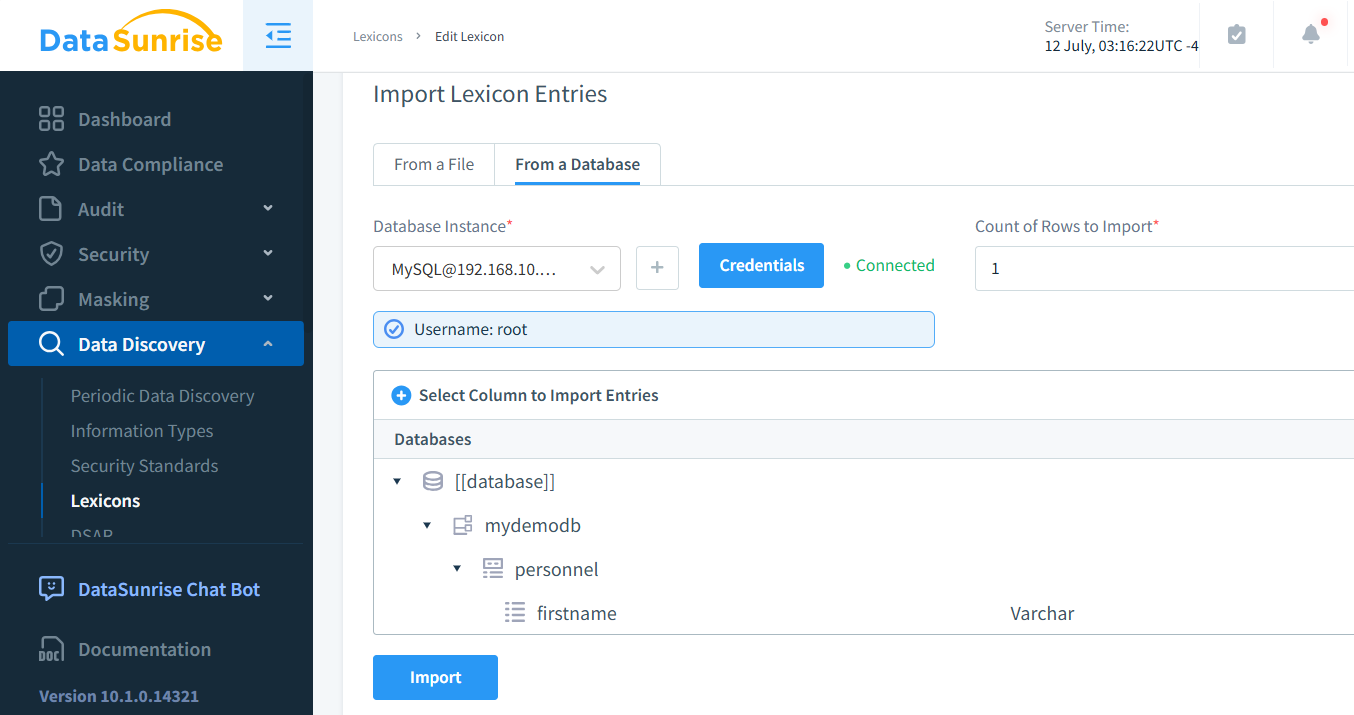
If you prefer to map with existing values, you can easily accomplish this by creating a custom lexicon. This approach is particularly beneficial in situations where the shuffled values are not U.S. first names, as it allows for more contextually appropriate data masking.
How Does Name Shuffling Work?
The process is straightforward:
- Select a column containing names (first names, last names, or both).
- Randomly reorder the values within that column.
- Replace the original values with the shuffled ones.
This technique preserves the distribution and characteristics of the original data. However, it breaks the connection between individuals and their information.
Implementing Name Shuffling in R and Python
Let’s explore how to implement simplest name shuffling in two popular programming languages: Python and R.
It’s important to note that the level of usability offered by DataSunrise is unparalleled in this context. Creating a flexible, all-in-one solution with just a few lines of code is not feasible using standard programming languages. Our aim here is to highlight the capabilities of specialized tools like DataSunrise compared to general-purpose programming languages.
Name Shuffling in Python
Python offers simple and efficient ways to shuffle data. Here’s an example using pandas, a powerful data manipulation library:
import pandas as pd
import numpy as np
# Create a sample dataset
data = pd.DataFrame({
'FirstName': ['John', 'Alice', 'Bob', 'Emma', 'David'],
'LastName': ['Smith', 'Johnson', 'Williams', 'Brown', 'Jones'],
'Age': [32, 28, 45, 36, 51],
'Salary': [50000, 60000, 75000, 65000, 80000]
})
# Shuffle the FirstName column
data['FirstName'] = np.random.permutation(data['FirstName'])
# Shuffle the LastName column
data['LastName'] = np.random.permutation(data['LastName'])
print(data)
This script creates a sample dataset and shuffles both the FirstName and LastName columns. The result maintains the original names but randomizes their order, effectively masking individual identities.
Name Shuffling in R
R also provides straightforward methods for data shuffling. Here’s an example:
# Create a sample dataset
data <- data.frame(
FirstName = c("John", "Alice", "Bob", "Emma", "David"),
LastName = c("Smith", "Johnson", "Williams", "Brown", "Jones"),
Age = c(32, 28, 45, 36, 51),
Salary = c(50000, 60000, 75000, 65000, 80000)
)
# Shuffle the FirstName column
data$FirstName <- sample(data$FirstName)
# Shuffle the LastName column
data$LastName <- sample(data$LastName)
print(data)
This R script achieves the same result as the Python example. It shuffles the FirstName and LastName columns, maintaining data integrity while masking individual identities.
Name Shuffling: Benefits and Considerations
Name shuffling is a popular data anonymization technique that replaces original names with shuffled alternatives to protect privacy while preserving data utility. Below is a breakdown of its key advantages and considerations:
| Benefit | Consideration |
|---|---|
| Maintains Data Realism Shuffled values resemble the original dataset, making the data useful for testing and analytics. |
Uniqueness Risks Rare or unique names may still be identifiable after shuffling. |
| Preserves Data Distribution Frequency patterns remain unchanged, supporting statistical integrity. |
Consistency Across Tables Ensure the same name maps consistently across related tables to avoid referential issues. |
| Simple to Implement Shuffling algorithms are straightforward and easy to apply. |
Contextual Leakage Other data fields may still reveal identity even if names are shuffled. |
| Optionally Reversible With a key or mapping table, the process can be reversed if needed. |
Key Management Required Reversibility introduces risk if the shuffle key or mapping is not securely stored or properly retired. |
Best Practices for Name Shuffling
To maximize the effectiveness of name shuffling:
- Use Large Datasets: The larger the dataset, the more effective the shuffling.
- Combine Techniques: Use name shuffling with other masking methods for better protection.
- Consistent Application: Apply shuffling consistently across all related data.
- Regular Updates: Periodically re-shuffle data to prevent reverse engineering.
Name Shuffling in Test Data Creation
Name shuffling is particularly valuable in creating test data. It allows developers and testers to work with realistic data without compromising privacy. Here’s why it’s crucial:
- Realistic Testing: Shuffled names maintain the characteristics of real data.
- Privacy Compliance: It helps meet data protection regulations.
- Streamlined Development: Developers can use data that closely mimics production environments.
Conclusion
Name shuffling is a powerful data masking technique. It offers a balance between data utility and privacy protection. By implementing name shuffling, organizations can create realistic test data while safeguarding sensitive information. As worries about data privacy increase, methods like shuffling will become more important in managing data.
For those seeking advanced data masking solutions, DataSunrise offers user-friendly and flexible tools for database security. Our comprehensive dynamic and static data masking tool includes robust shuffling and encryption capabilities. Visit the DataSunrise website for an online demo and explore how our solutions can enhance your data protection strategies.