AI Data Compliance Tools for Amazon DynamoDB
Modern compliance programs increasingly rely on machine learning, natural language processing (NLP), and large language models (LLMs). These technologies help organizations keep pace with fast-changing data environments. This shift is especially visible in Amazon DynamoDB environments. Here, traditional database-level audit trails do not exist. Instead, compliance evidence must be inferred from distributed cloud telemetry generated by services such as AWS CloudTrail and IAM authorization flows (AWS DynamoDB security overview).
Unlike relational systems, DynamoDB does not generate query logs or internal audit records. As a result, compliance automation depends on interpreting signals produced by surrounding AWS services. In practice, this means organizations cannot rely on native database artifacts alone. Therefore, centralized database activity monitoring and structured data compliance frameworks become essential for regulated environments. At the same time, NLP, ML, and LLM-based tools play a growing role. They translate fragmented telemetry into usable compliance context (AWS CloudTrail logging for DynamoDB).
In this article, we explain how AI-driven compliance tools operate in DynamoDB architectures. We also examine what problems they solve. Finally, we show how they differ from traditional audit and data activity history approaches used in SQL databases.
What Is NLP, LLM & ML Data Compliance Tools
NLP, LLM, and ML data compliance tools are analytical systems. They interpret operational signals, metadata, and access behavior to establish compliance context when native audit mechanisms are limited or absent. In Amazon DynamoDB environments, these tools do not replace security controls. Instead, they act as an intelligence layer. This layer reconstructs what happened, why it matters, and whether it violates regulatory expectations.
Unlike traditional database compliance tools, AI-driven solutions do not rely on query logs or transaction trails. Instead, they operate on indirect evidence. For example, they ingest API activity records, identity decisions, infrastructure metadata, configuration states, and data samples. Machine learning models then identify behavioral patterns and anomalies across this telemetry. At the same time, NLP engines extract semantic meaning from resource names, policies, and unstructured descriptors. Finally, LLMs correlate these findings into coherent compliance narratives aligned with regulatory language.
From a functional standpoint, these tools focus on three core objectives. First, they infer data sensitivity in schema-flexible environments. To do this, they analyze attribute patterns, values, and contextual signals rather than fixed schemas. Second, they evaluate access behavior by modeling normal usage patterns. As a result, they can detect deviations that may indicate policy drift or misuse. Third, they translate low-level technical events into audit-ready explanations that compliance teams and regulators can understand.
In DynamoDB architectures, this approach is essential. The database does not expose query intent or internal execution history. Because of this, compliance tools must reason around the database rather than inside it. NLP, LLM, and ML technologies provide the reasoning capability needed to bridge this gap. As a result, fragmented cloud telemetry becomes structured compliance evidence without altering application behavior or database performance.
AI-Driven Capabilities of Amazon DynamoDB in NLP, LLM & ML Data Compliance
Amazon DynamoDB itself does not provide native machine learning, natural language processing, or large language model functionality for compliance purposes. Instead, its AI-driven compliance capabilities emerge from how DynamoDB integrates with the broader AWS ecosystem. Telemetry generated by DynamoDB is exposed through AWS-native services, where AI and ML models can be applied without interfering with database performance or application logic.
This architectural separation is intentional. DynamoDB remains a high-throughput, low-latency data store, while compliance intelligence is delegated to external analysis layers. Machine learning models evaluate access behavior and operational patterns, NLP engines derive semantic meaning from configuration and metadata, and LLMs synthesize these signals into regulatory context. Together, these capabilities form an AI-driven compliance layer that operates around DynamoDB rather than inside it.
By externalizing compliance intelligence, AWS enables organizations to apply advanced analytics, continuous monitoring, and adaptive controls to DynamoDB environments without modifying table schemas, enforcing rigid data models, or introducing query-level overhead. This approach aligns AI-driven compliance tooling with DynamoDB’s serverless design principles and allows compliance capabilities to scale independently from database workloads.
Role of Machine Learning in Amazon DynamoDB Compliance
In Amazon DynamoDB environments, machine learning is not embedded inside the database engine. Instead, ML capabilities are applied at the AWS service layer to analyze activity signals generated around DynamoDB rather than within it.
Native AWS services such as CloudTrail, CloudWatch, and IAM Access Analyzer provide the raw telemetry required for ML-based compliance analysis. Machine learning models consume this telemetry to identify patterns across large volumes of low-context events, including API usage, identity behavior, and resource interaction trends.
Typical ML-driven compliance use cases for DynamoDB include behavioral baselining of application access patterns, detection of abnormal request frequency, and identification of access deviations tied to specific IAM roles or workloads.
Example: CloudTrail event used as ML input
{
  "eventSource": "dynamodb.amazonaws.com",
  "eventName": "PutItem",
  "awsRegion": "us-east-1",
  "userIdentity": {
    "type": "AssumedRole",
    "arn": "arn:aws:sts::123456789012:assumed-role/app-lambda-role/app"
  },
  "requestParameters": {
    "tableName": "customer_records"
  },
  "sourceIPAddress": "AWS Internal",
  "eventTime": "2025-01-12T22:14:33Z"
}
Machine learning models ingest streams like this to establish behavioral baselines per role, function, or service.
For example, an ML model may learn that a particular Lambda function normally performs read-only operations during predictable time windows and flag unexpected write activity or access originating from new execution contexts.
Because DynamoDB does not expose query semantics or transaction intent, machine learning focuses on behavioral inference rather than query inspection. This allows compliance teams to detect policy drift, misuse, or anomalous access patterns without relying on database-native audit logs.
NLP for Interpreting DynamoDB Compliance Signals
Natural language processing plays a complementary role by adding semantic meaning to otherwise technical or unstructured AWS artifacts associated with DynamoDB usage. While DynamoDB stores data as key-value or document-style items, the surrounding ecosystem produces human-readable descriptors that NLP engines can analyze.
In DynamoDB compliance workflows, NLP is applied to sources such as IAM policy documents, resource tags, table and attribute naming conventions, infrastructure-as-code templates, and CloudTrail event descriptions.
Example: IAM policy document analyzed by NLP
{
  "Statement": [
    {
      "Effect": "Allow",
      "Action": [
        "dynamodb:GetItem",
        "dynamodb:Query"
      ],
      "Resource": "arn:aws:dynamodb:us-east-1:123456789012:table/customer_records"
    }
  ]
}
NLP models extract semantic signals from identifiers like customer_records, correlate them with regulatory vocabularies, and infer potential sensitivity without requiring schema definitions.
For example, NLP models can correlate table names, tag values, and attribute identifiers with regulatory concepts such as personal data, billing information, or healthcare records. This enables automated classification of DynamoDB resources without requiring rigid schemas or manual labeling.
In environments where table structures evolve frequently, this semantic interpretation layer becomes critical for maintaining accurate compliance context.
LLMs and Compliance Context Reconstruction for DynamoDB
Large language models extend NLP capabilities by reasoning across multiple AWS signals simultaneously. In DynamoDB-focused compliance workflows, LLMs are not used to monitor the database directly. Instead, they synthesize information from identity decisions, access events, configuration states, and ML-derived insights into structured compliance explanations.
Example: Aggregated context provided to an LLM
{
  "table": "customer_records",
  "accessedBy": "app-lambda-role",
  "actions": ["GetItem", "PutItem"],
  "timeRange": "2025-01-01 to 2025-03-31",
  "baselineDeviation": true,
  "dataClassification": "PII"
}
LLMs are commonly applied to interpret IAM policy intent, identify gaps between documented controls and observed behavior, and generate audit-ready narratives that explain access patterns over time.
Example: LLM-generated compliance explanation (conceptual)
During Q1 2025, the application role app-lambda-role accessed the DynamoDB table
"customer_records" outside its established read-only baseline. Write operations
were detected during non-standard execution windows, increasing GDPR exposure
risk for personal data stored in the table.
When auditors ask questions such as who accessed regulated data, under what conditions, and for what operational purpose, LLM-based systems translate technical AWS events into human-readable compliance evidence. DynamoDB itself cannot answer these questions natively, but LLMs reconstruct the context by reasoning across CloudTrail records, IAM evaluations, and behavioral baselines.
AI-Driven Data Discovery Using DynamoDB and AWS Services
DynamoDB’s schema-less design complicates sensitive data discovery, as attribute names and data structures are defined entirely by applications. AWS addresses this challenge by enabling ML- and NLP-based discovery workflows outside the database engine.
Data discovery tools sample DynamoDB items, analyze attribute names and values, and apply probabilistic classification models to detect patterns associated with PII, PHI, or financial data.
Example: Sample DynamoDB item analyzed by ML
{
  "user_id": "983742",
  "email": "[email protected]",
  "phone": "+1-555-0199",
  "created_at": "2025-01-12"
}
ML classifiers identify attribute/value combinations matching known sensitive data patterns and continuously re-evaluate tables as schemas evolve.
Unlike static classification approaches, AI-driven discovery aligns well with DynamoDB’s flexible data model. It allows organizations to maintain visibility into sensitive data exposure even as applications scale, schemas shift, and usage patterns change—without enforcing rigid database constraints that DynamoDB was never designed to support.
Centralized NLP, LLM & ML Compliance for Amazon DynamoDB with DataSunrise
While AWS-native services provide the raw telemetry required for AI-driven compliance analysis, they operate as independent components rather than a unified compliance system. DataSunrise introduces a centralized compliance layer that consolidates DynamoDB-related signals, enriches them with NLP, LLM, and ML intelligence, and transforms fragmented cloud telemetry into structured, audit-ready compliance evidence.
Instead of replacing AWS controls, DataSunrise builds on top of them. It correlates identity activity, access behavior, and discovered data sensitivity across DynamoDB environments and other data platforms, enabling consistent compliance governance without modifying application logic or database architecture.
ML-Based Behavioral Analysis for DynamoDB Access Patterns
DataSunrise applies machine learning to DynamoDB access telemetry collected from AWS services to model normal behavior and detect deviations that indicate compliance risk. ML models analyze access frequency, identity usage, operation types, and temporal patterns associated with DynamoDB tables and indexes as part of centralized database activity monitoring.
By establishing behavioral baselines per IAM role, service account, or workload, DataSunrise detects anomalous activity such as unexpected write operations, access outside approved execution windows, or sudden shifts in access volume. These detections help identify policy drift and misuse scenarios that DynamoDB itself cannot surface due to the absence of native query logs, extending traditional database activity history concepts into cloud-native environments.
This ML-driven behavioral analysis enables continuous compliance monitoring without relying on static rule sets or manual log inspection, aligning with automated data compliance workflows.
NLP-Driven Sensitive Data Discovery for Schema-Less Tables
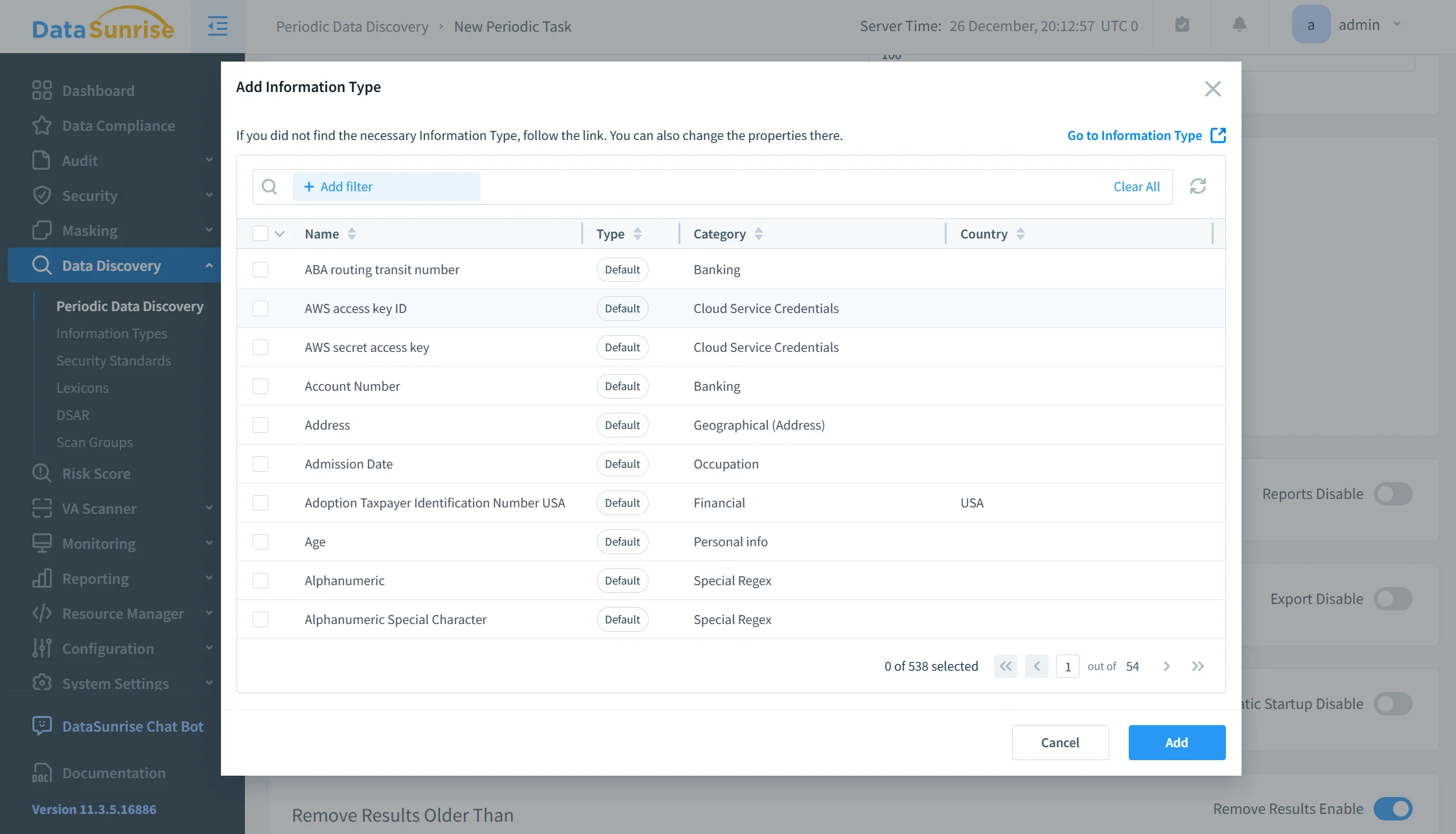
DynamoDB’s flexible data model makes manual data classification impractical at scale. DataSunrise uses NLP-enhanced discovery techniques to analyze DynamoDB attribute names, values, metadata, and contextual descriptors to identify sensitive data types as part of automated data discovery processes.
NLP models correlate semantic cues such as attribute naming conventions, table identifiers, and resource tags with regulatory concepts including personal data, financial records, and healthcare information. This allows DataSunrise to dynamically classify DynamoDB tables containing PII, even as schemas evolve and attributes change over time.
As a result, organizations maintain continuous visibility into sensitive data exposure across DynamoDB environments without enforcing rigid schemas or application-side labeling.
LLM-Assisted Compliance Interpretation and Audit Narratives
DataSunrise integrates large language model capabilities to transform technical telemetry into human-readable compliance context. LLMs synthesize ML findings, NLP-derived classifications, IAM policy intent, and access history into structured explanations aligned with regulatory language and formal audit trails.
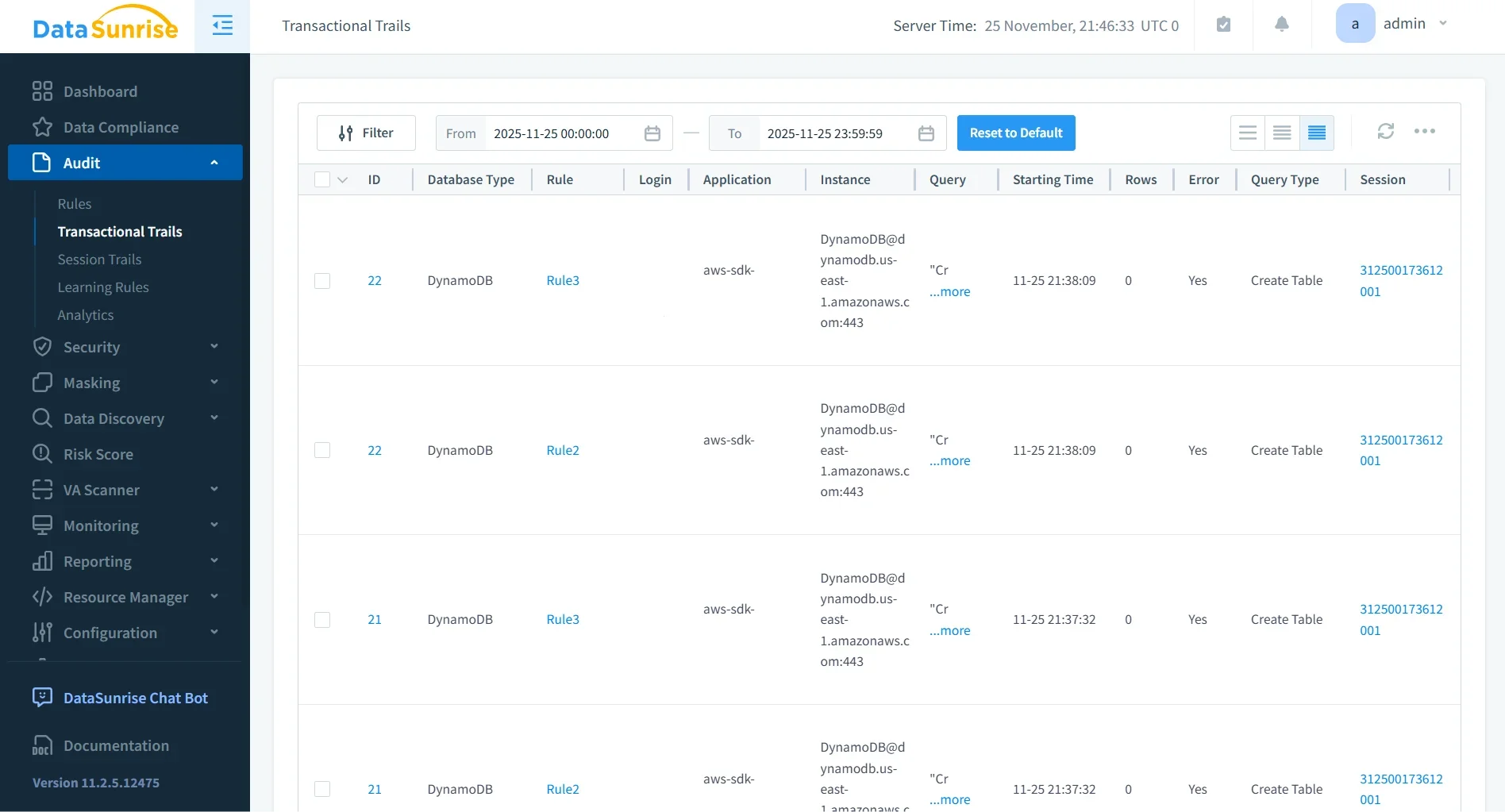
This capability is particularly valuable during audits and investigations. Instead of presenting raw CloudTrail logs or fragmented event records, DataSunrise generates clear narratives explaining who accessed sensitive DynamoDB data, under what conditions, and how that access aligns with regulatory requirements supported by automated compliance reporting.
By bridging the gap between technical signals and compliance language, LLM-assisted interpretation reduces audit preparation time and improves communication with regulators and internal stakeholders.
Unified Compliance Governance Across DynamoDB and Other Data Stores
DynamoDB environments rarely exist in isolation. DataSunrise extends AI-driven compliance beyond DynamoDB to provide centralized governance across relational databases, data warehouses, data lakes, and cloud storage platforms, forming a unified data security control layer.
This unified approach ensures consistent compliance policies, discovery logic, and behavioral analysis across heterogeneous environments. Compliance teams gain a single control plane for monitoring DynamoDB alongside other data systems, eliminating blind spots created by service-specific tooling.
Through centralized policy management, automated compliance reporting, and AI-driven analytics, DataSunrise enables organizations to operationalize NLP, LLM, and ML capabilities for DynamoDB compliance at enterprise scale.
Business Impact of AI-Driven DynamoDB Compliance
| Business Area | Impact of AI-Driven Compliance |
|---|---|
| Audit Preparation | Reduced manual effort by automating evidence collection and compliance context reconstruction |
| Regulatory Response | Faster responses to auditor and regulator inquiries through AI-generated, human-readable narratives |
| Access Visibility | Improved visibility into DynamoDB access behavior across IAM roles, services, and workloads |
| Risk Detection | Earlier detection of compliance drift, misuse, and anomalous access patterns |
| Audit Communication | Clearer, structured explanations of access events aligned with regulatory language |
By shifting compliance analysis from static rule validation to continuous behavioral interpretation, AI-driven tooling transforms DynamoDB compliance into an adaptive control process. This approach aligns compliance oversight with the operational realities of DynamoDB’s serverless, telemetry-driven architecture rather than forcing relational audit assumptions onto a NoSQL environment.
Conclusion
DynamoDB’s architecture fundamentally changes how compliance must be implemented. It does not provide native audit trails or query history. Because of this, organizations must rely on interpretation rather than inspection. As a result, traditional database activity monitoring approaches must extend beyond the database engine itself.
NLP, ML, and LLM-based tools provide this interpretive layer. They translate fragmented telemetry into clear compliance context. In addition, they reconstruct access intent and generate audit-ready explanations. DynamoDB alone cannot produce this level of insight. Therefore, these tools form the foundation for continuous data compliance in cloud-native environments.
By correlating identity activity, access behavior, and discovered data sensitivity, AI-driven platforms enable structured audit trails. This is possible even when no database-native audit records exist.
In DynamoDB environments, AI is not a luxury add-on. Instead, it is a core mechanism. It makes scalable data security and regulatory compliance operationally possible.
Protect Your Data with DataSunrise
Secure your data across every layer with DataSunrise. Detect threats in real time with Activity Monitoring, Data Masking, and Database Firewall. Enforce Data Compliance, discover sensitive data, and protect workloads across 50+ supported cloud, on-prem, and AI system data source integrations.
Start protecting your critical data today
Request a Demo Download Now