Teradata Data Governance
Effective data governance in Teradata is vital for organizations handling large-scale, sensitive information across finance, healthcare, and government sectors. Governance ensures that data remains accurate, accessible, and protected, while aligning with compliance standards such as GDPR, HIPAA, PCI DSS, and SOX.
Modern enterprises face increasing challenges: regulatory complexity, multi-cloud environments, and rising data volumes. Data governance is the foundation of responsible data use, ensuring accountability and consistency across the enterprise. In parallel, the Data Governance Institute defines it as the exercise of authority and control over data assets. These perspectives highlight governance not just as a technical process, but as a strategic necessity.
Teradata provides robust tools for managing enterprise data assets, but native features alone may not address today’s complex compliance and security demands. By integrating DataSunrise, businesses can establish governance that combines policy enforcement, security monitoring, and compliance automation.
What is Data Governance?
Data governance is the practice of managing data availability, usability, integrity, and security in an organization. It establishes a framework of policies, roles, standards, and metrics that ensure effective use of data across the enterprise. Unlike simple data management, governance focuses on accountability, responsibility, and regulatory alignment.
Key aspects of data governance include:
- Policies and Standards: Defining how data should be collected, stored, shared, and protected.
- Roles and Responsibilities: Assigning ownership to data stewards, administrators, and compliance officers.
- Data Quality Assurance: Ensuring data remains accurate, consistent, and complete across systems.
- Regulatory Alignment: Meeting compliance requirements for GDPR, HIPAA, PCI DSS, SOX, and other frameworks.
- Security and Privacy: Protecting sensitive information through encryption, masking, and access control.
In the context of Teradata, data governance ensures that large-scale enterprise datasets are not only secure but also properly classified, monitored, and compliant with evolving industry standards.
Native Teradata Data Governance Features
1. Role-Based Access Controls
-- Grant read-only access to the FinanceAnalyst role
GRANT SELECT ON FinanceDB.Transactions TO FinanceAnalyst;

-- Revoke update privileges from the same role
REVOKE UPDATE ON FinanceDB.Transactions FROM FinanceAnalyst;

-- Create a new role for auditors with read-only access across multiple tables
CREATE ROLE FinanceAuditor;
GRANT SELECT ON FinanceDB.Customers TO FinanceAuditor;
GRANT SELECT ON FinanceDB.Transactions TO FinanceAuditor;

-- Assign the FinanceAuditor role to a user
GRANT FinanceAuditor TO User_Audit01;
This ensures users only access data they are authorized to use.
2. User-Level Logging
-- Enable DBQL for a specific user
BEGIN LOGGING WITH SQL, OBJECTS
ON FinanceDB.Transactions
USER = FinanceAnalyst;

-- Run queries here
SELECT * FROM FinanceDB.Transactions WHERE Amount > 10000;

UPDATE FinanceDB.Transactions
SET Status = 'Closed'
WHERE TransactionID = 1005;

-- End logging session
END LOGGING ON FinanceDB.Transactions USER = FinanceAnalyst;
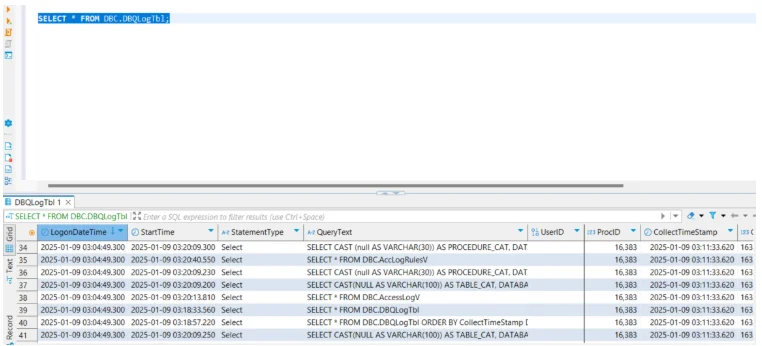
DBQL records user sessions, query text, and object references, which administrators can later analyze.
3. Metadata Management
-- View metadata for all tables in FinanceDB
SELECT DatabaseName, TableName, CreateTimeStamp, LastAlterTimeStamp, OwnerName
FROM DBC.TablesV
WHERE DatabaseName = 'FinanceDB';

-- View column-level details for sensitive data classification
SELECT DatabaseName, TableName, ColumnName, ColumnType, Nullable
FROM DBC.ColumnsV
WHERE DatabaseName = 'FinanceDB'
AND TableName = 'Transactions';
This enables ownership tracking and lineage mapping to maintain compliance.
4. Security Integration
<!-- Example fragment from tdgssuserconfig.xml -->
<Mechanism Name="ldap" LibraryName="gssldap">
  <Property Name="LDAPServerName" Value="ldap.company.com"/>
  <Property Name="LDAPPort" Value="389"/>
  <Property Name="BaseDN" Value="dc=company,dc=com"/>
  <Property Name="SearchScope" Value="subtree"/>
</Mechanism>
This allows enterprises to centralize authentication through LDAP, Kerberos, or Active Directory.
Limitations:
- No built-in dynamic data masking.
- Limited automation for compliance alignment.
- Logs must be manually parsed for anomalies.
- Governance policies vary across hybrid environments.
Data Governance in Teradata with DataSunrise
While Teradata provides a strong governance baseline, DataSunrise extends its capabilities with automation, advanced security, and compliance orchestration.
Dynamic Data Masking
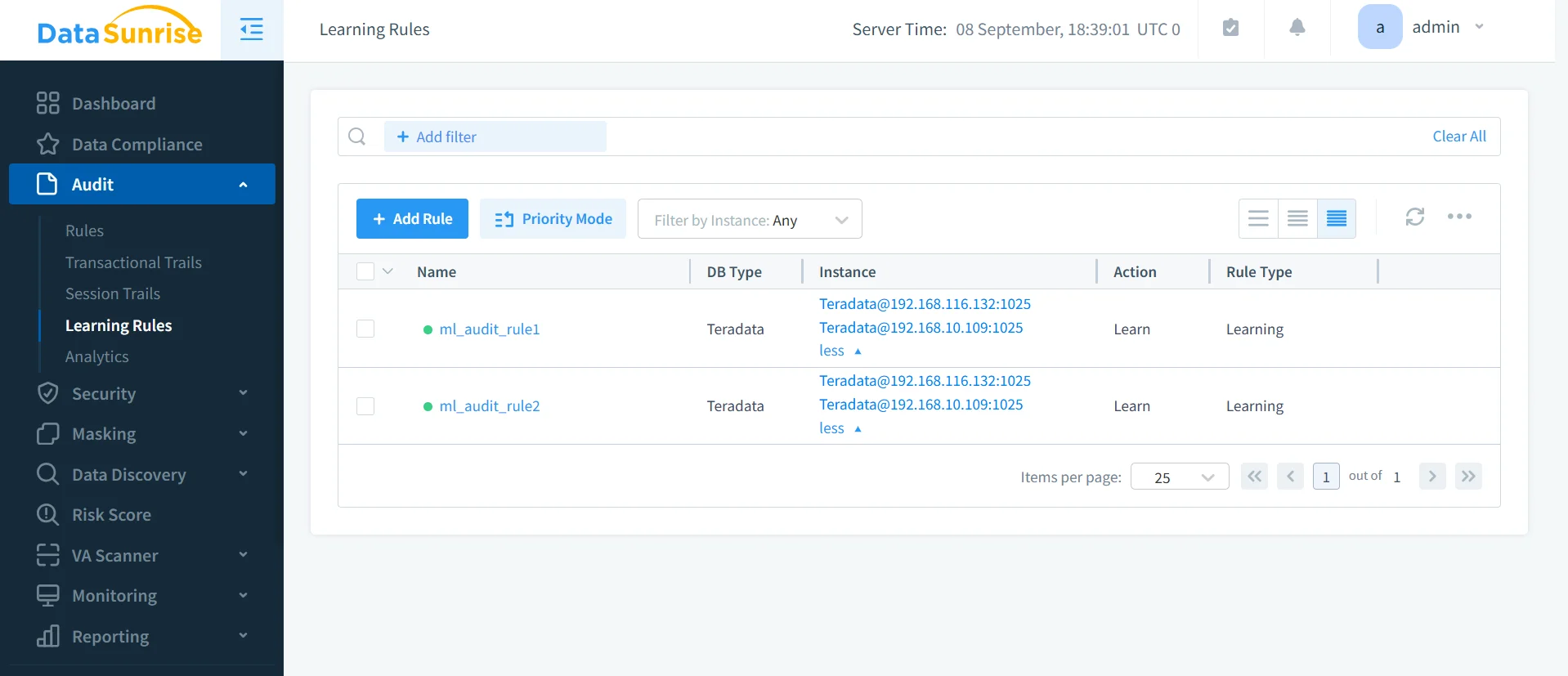
Unlike static controls, dynamic data masking in DataSunrise adapts to user roles and query context. Sensitive fields such as credit card numbers or medical IDs are masked in real time, ensuring only authorized users can see full values. This protects privacy without disrupting business processes, as applications continue to function normally while unauthorized queries return obfuscated results.
Machine Learning Audit Rules
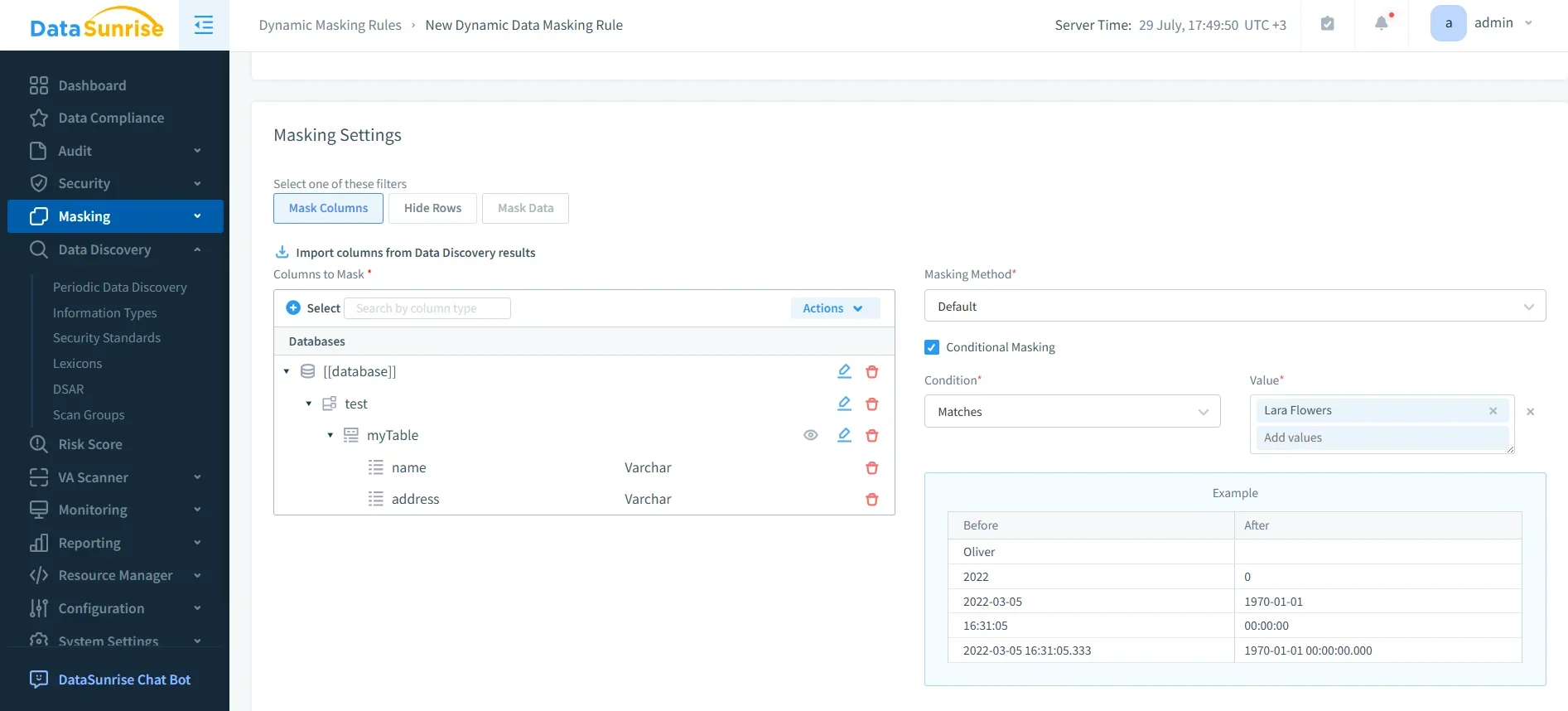
Traditional audit rules require frequent tuning, but DataSunrise introduces machine learning-driven policies. By analyzing user behavior and query patterns, the system detects anomalies such as privilege misuse, unusual query frequency, or attempts to exfiltrate data. These ML-based rules adapt dynamically, strengthening governance against evolving threats.
Automated Compliance Reporting
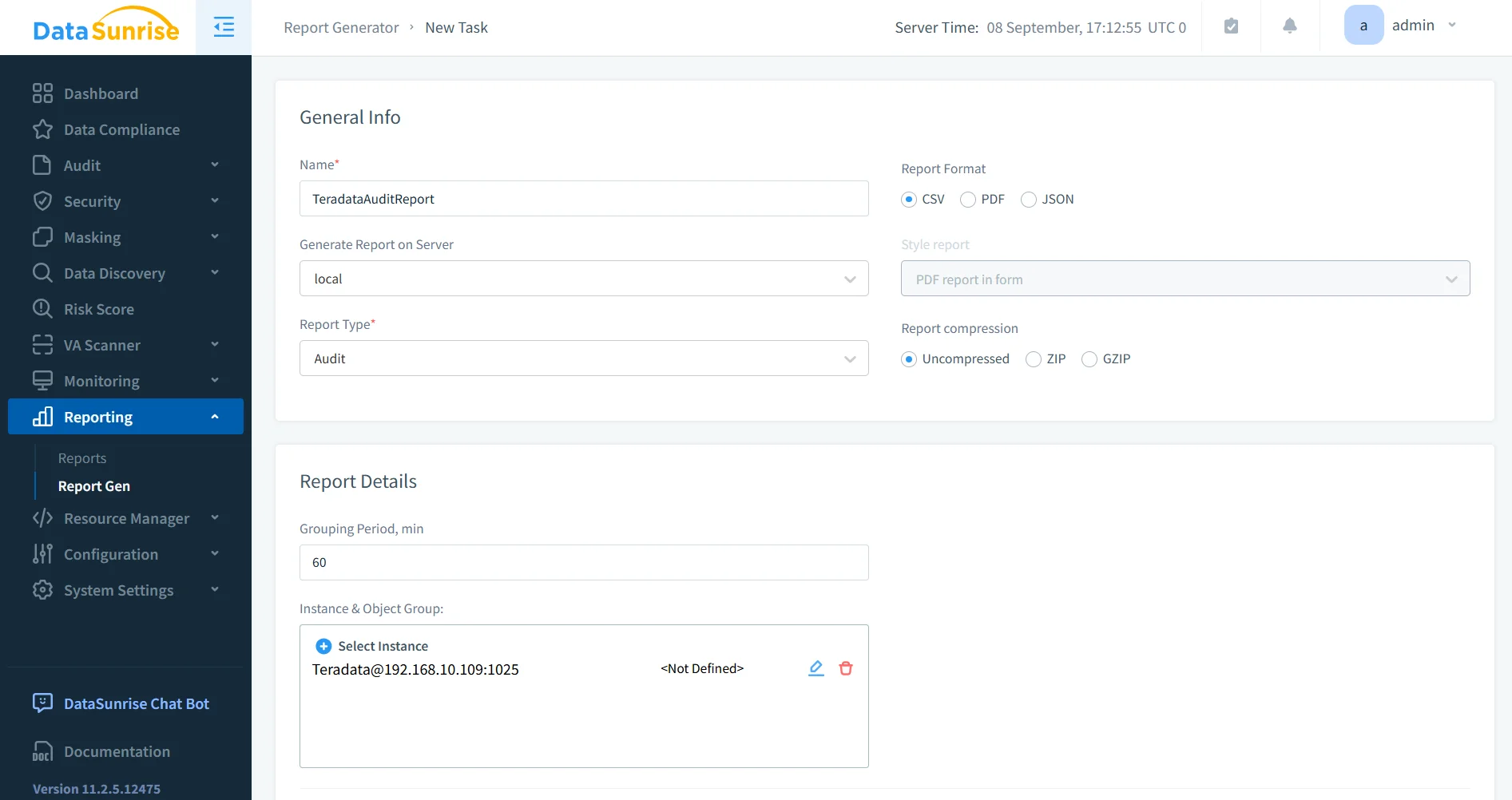
Generating compliance evidence can be resource-intensive. DataSunrise simplifies this with one-click, audit-ready reports for frameworks like GDPR, HIPAA, PCI DSS, and SOX. Reports include sensitive data classification, rule enforcement history, and detected violations. This automation reduces manual reporting burdens and accelerates audit cycles.
Sensitive Data Discovery
DataSunrise automatically scans Teradata databases to identify PII, PHI, and financial records. It uses pattern recognition, dictionaries, and contextual analysis to detect regulated data. Additionally, OCR-based scanning covers unstructured sources such as scanned contracts or invoices. This proactive discovery ensures no sensitive dataset is overlooked, enabling administrators to enforce masking and auditing policies before compliance gaps arise.
- Detects sensitive information across structured, semi-structured, and unstructured datasets
- Integrates with classification workflows to label regulated fields automatically
- Reduces the risk of shadow data repositories going unnoticed
- Provides visual discovery reports for compliance and audit teams
Unified Security Framework
DataSunrise provides a centralized governance platform across hybrid and multi-cloud Teradata environments. Whether data resides on-premises or in cloud platforms, policies are applied consistently. Administrators gain a single pane of glass for monitoring, enforcement, and reporting, avoiding fragmented governance strategies. This unification ensures enterprise-wide consistency.
- Centralizes rule creation and monitoring across multiple Teradata clusters
- Supports both on-premise and cloud-native deployments without reconfiguration
- Reduces complexity by consolidating fragmented governance practices
- Ensures consistent enforcement of policies across business units and geographies
Compliance Autopilot
With Compliance Autopilot, governance policies stay aligned with frameworks like GDPR, HIPAA, PCI DSS, and SOX in real time. Rules are continuously calibrated as standards evolve, eliminating compliance drift. The system automatically tracks new Teradata objects and users, applying governance policies without manual intervention. This reduces audit preparation time and keeps organizations audit-ready.
- Monitors regulatory updates and adapts rules accordingly
- Eliminates the need for repetitive manual policy reviews
- Continuously applies governance to new users, roles, and database objects
- Provides automatic alerts when compliance posture changes
Business Impact of Data Governance for Teradata
| Benefit | Description |
|---|---|
| Risk Reduction | DataSunrise reduces risks of insider threats, breaches, and compliance violations. |
| Operational Efficiency | Centralized dashboards and automation streamline governance workflows. |
| Compliance Readiness | Continuous calibration ensures alignment with GDPR, HIPAA, PCI DSS, and SOX. |
| Improved Trust | Builds stakeholder confidence by demonstrating proactive governance. |
| Scalability | Extends policies seamlessly across on-premise and multi-cloud Teradata deployments. |
| Cost Optimization | Reduces the expense of manual audits, rework, and regulatory fines. |
| Faster Audit Cycles | Automated reporting accelerates preparation for external audits. |
| Data Transparency | Improves visibility into how sensitive data is stored, used, and protected. |
| Stronger Decision-Making | Ensures business leaders rely on accurate, compliant, and trustworthy data. |
Conclusion
Teradata provides a solid governance framework through access controls and metadata management. However, modern enterprises demand more comprehensive tools to meet evolving compliance standards and mitigate risks.
DataSunrise extends Teradata governance with sensitive data discovery, compliance autopilot, dynamic masking, ML-driven audit rules, and audit-ready reporting. This ensures organizations maintain regulatory alignment while reducing manual oversight.
Protect Your Data with DataSunrise
Secure your data across every layer with DataSunrise. Detect threats in real time with Activity Monitoring, Data Masking, and Database Firewall. Enforce Data Compliance, discover sensitive data, and protect workloads across 50+ supported cloud, on-prem, and AI system data source integrations.
Start protecting your critical data today
Request a Demo Download Now