AI for Fraud Detection
As artificial intelligence reshapes financial operations, about three-quarters of banks worldwide rely on AI and machine learning to combat fraudulent activity (RMA, 2023).
Yet fraudsters continuously adapt, using automation and synthetic identities to exploit weak detection systems.
This article explores how AI transforms fraud prevention—from behavior modeling to real-time anomaly scoring—and how DataSunrise integrates these capabilities across multi-platform environments.
The Modern Fraud Landscape
Financial crime today extends beyond stolen cards and phishing. Fraud patterns evolve through automation, large-scale data breaches, and complex laundering networks.
Machine learning now forms the backbone of adaptive defense—analyzing billions of transactions, building behavior baselines, and identifying abnormal deviations faster than any human analyst.
Using tools such as database activity monitoring, audit trails, and user behavior analysis, financial teams can correlate fraud attempts across different databases and channels.
Real-time analysis is essential—fraudulent transfers often complete in seconds, leaving no time for manual review.
AI vs Traditional Fraud Detection
The following matrix contrasts legacy rule-based systems with AI-driven fraud detection frameworks.
| Aspect | Traditional Systems | AI-Driven Detection |
|---|---|---|
| Detection Method | Static rules and manual thresholds | Adaptive ML models and continuous training |
| Accuracy | High false positives | Dynamic scoring based on real user behavior |
| Response Time | Delayed (batch analysis) | Real-time alerts and automated response |
| Scalability | Limited to fixed datasets | Expands across cloud and distributed environments |
| Compliance Alignment | Manual log correlation | Automated mapping to data compliance regulations |
AI systems not only reduce alert fatigue but also contextualize suspicious events using correlated audit data and behavioral fingerprints.
Technical Deep Dive: ML Fraud Detection Engine
Below is a simplified implementation demonstrating how anomaly scoring can detect potential fraud in transaction datasets.
from datetime import datetime
import numpy as np

class FraudDetectionEngine:
    def __init__(self, threshold: float = 0.85):
        self.threshold = threshold
        self.user_baselines = {}

    def train(self, user_id: str, transactions: list[float]):
        """Establish behavioral baseline for a user."""
        self.user_baselines[user_id] = np.mean(transactions)

    def evaluate(self, user_id: str, new_tx: list[float]):
        """Compare new transaction behavior to baseline."""
        baseline = self.user_baselines.get(user_id, np.mean(new_tx))
        deviation = abs(np.mean(new_tx) - baseline)
        score = deviation / (baseline + 1e-6)
        return {
            "timestamp": datetime.utcnow().isoformat(),
            "user_id": user_id,
            "anomaly_score": round(score, 3),
            "fraud_detected": score > self.threshold
        }
This engine models individual user patterns and flags outliers when deviation exceeds the threshold.
In production, statistical models can be replaced with ensemble algorithms such as Isolation Forests or neural autoencoders.
Integrate dynamic data masking when handling real transaction data to prevent leakage during model training.
Fraud Response Lifecycle
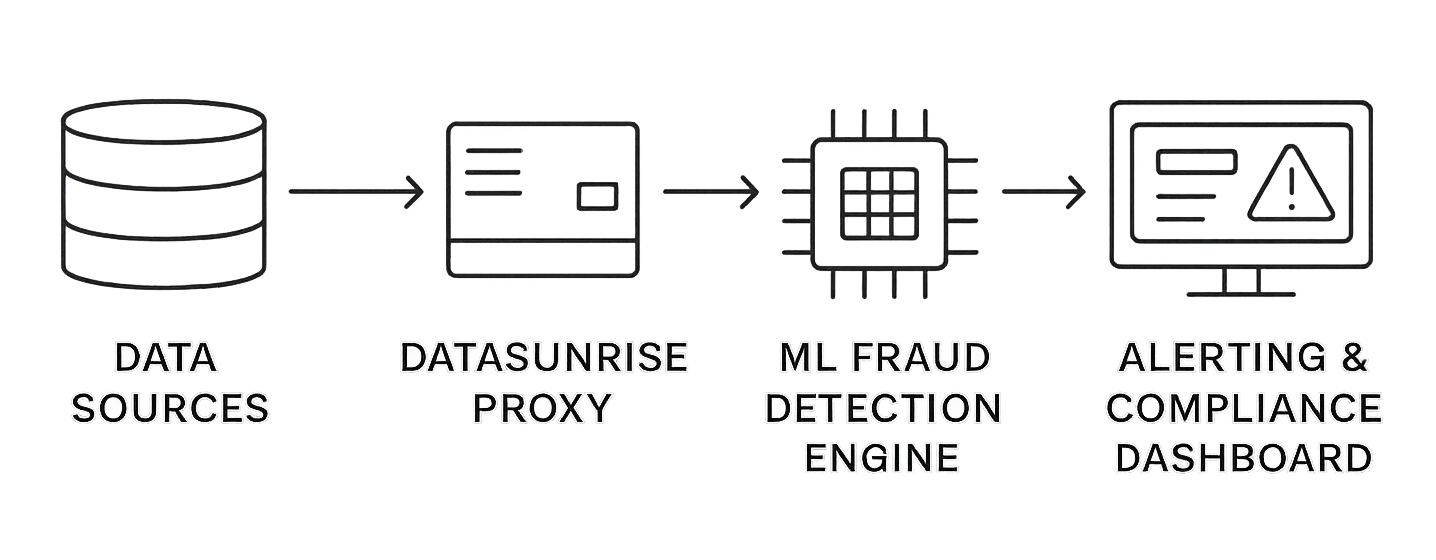
Fraud detection doesn’t end with anomaly scoring—it extends into a full response cycle. DataSunrise automates this process through its integrated modules:
- Detection: Real-time analysis of audit logs and user activity.
- Correlation: Behavior profiling via user behavior analysis aggregates multi-source anomalies.
- Alerting: Automated incident generation using real-time notifications.
- Resolution: Policy-driven response using database firewall and access controls.
Strategic Recommendations
Governance Principles
- Maintain Transparent Auditability: Use data activity history to trace every transaction and approval.
- Ensure Regulatory Mapping: Leverage Compliance Manager for PCI DSS alignment and automated audit reporting.
- Separate Duties and Privileges: Enforce role-based access control to reduce insider risk.
- Use Synthetic Datasets for Testing: Apply synthetic data generation for model validation without exposing sensitive data.
Technical Controls
- Automate Masking Workflows: Implement dynamic masking during live fraud analysis.
- Integrate SIEM Systems: Route alerts through reverse proxy for centralized monitoring.
- Apply Granular Audit Rules: Fine-tune audit configurations for transaction-level precision.
- Continuously Retrain Models: Adapt ML thresholds as fraud patterns evolve.
Unified Fraud Defense with DataSunrise
DataSunrise provides an Autonomous Fraud Defense Platform with AI Compliance by Default—fusing transaction monitoring, anomaly detection, and compliance analytics into a single adaptive layer.
Key Capabilities
- Context-Aware Risk Scoring: Merges activity metrics and ML models to minimize false positives.
- Zero-Touch Orchestration: Automatically updates security policies as new fraud types emerge.
- Cross-Platform Integration: Covers over 50 financial databases and cloud services.
- Regulatory Intelligence: Generates reports compliant with SOX and HIPAA.
Conclusion: Smarter Fraud Prevention Starts with AI
Fraudsters exploit automation; defenders must out-automate them.
Machine learning gives organizations predictive power—spotting subtle deviations invisible to human review. Combined with DataSunrise’s Surgical Precision in correlation and masking, financial systems can achieve both security and compliance at scale.
Protect Your Data with DataSunrise
Secure your data across every layer with DataSunrise. Detect threats in real time with Activity Monitoring, Data Masking, and Database Firewall. Enforce Data Compliance, discover sensitive data, and protect workloads across 50+ supported cloud, on-prem, and AI system data source integrations.
Start protecting your critical data today
Request a Demo Download Now