AI Security Essentials
As artificial intelligence revolutionizes business operations, 91% of organizations are deploying AI systems across mission-critical workflows. While AI delivers transformative capabilities, it introduces sophisticated security challenges requiring comprehensive security protection strategies.
This guide examines essential AI security principles, exploring foundational protection strategies that enable organizations to safeguard their AI investments while maintaining operational excellence.
DataSunrise's AI security platform delivers Zero-Touch AI Protection with Autonomous Security Orchestration across all major AI platforms, providing Surgical Precision security management for comprehensive AI system protection.
Understanding AI Security Fundamentals
AI security represents a paradigm shift from traditional application protection. Unlike static systems, AI platforms process unstructured data, make autonomous decisions, and continuously evolve through learning mechanisms. This creates unique security vulnerabilities requiring specialized data security protection approaches.
Effective AI security encompasses input protection against malicious prompts, model integrity preservation, and output validation to prevent data breaches while ensuring comprehensive data protection.
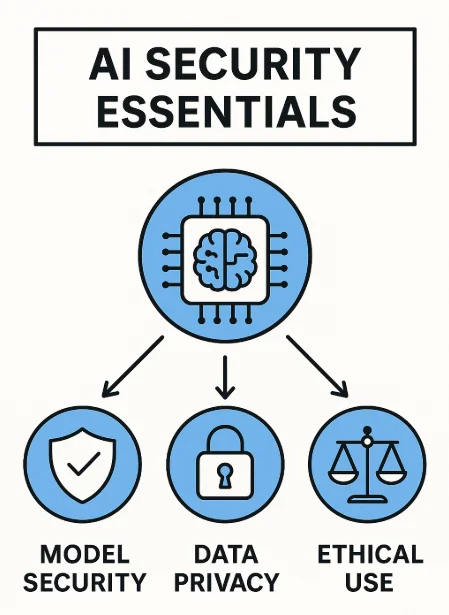
Essential AI Security Principles
Input Validation and Sanitization
AI systems face sophisticated prompt injection attacks designed to manipulate model behavior. Organizations must implement comprehensive input validation including pattern detection for malicious prompts, content filtering, and rate limiting to prevent SQL injection and other abuse attempts.
Deploy automated scanning with threat detection capabilities while maintaining detailed audit trails of all interactions and enforcing security policies.
Model Protection and Integrity
AI models represent valuable intellectual property requiring sophisticated protection. Security strategies must address model theft prevention, adversarial attack resistance, and secure versioning.
Implement database encryption for model storage, maintain audit logs of access, and deploy database firewall protection.
Data Privacy and PII Protection
AI systems often process sensitive information requiring robust privacy safeguards. Essential protections include dynamic data masking for PII, data minimization principles, access controls, and automated PII detection with real-time redaction.
Practical Implementation Examples
AI Security Validator
This validator protects AI systems from prompt injection attacks and automatically detects and masks PII. It performs real-time security checks, identifying malicious patterns and scanning for sensitive data like emails before the prompt reaches the AI model.
import re
from datetime import datetime

class AISecurityValidator:
    def validate_interaction(self, user_id: str, prompt: str):
        """Validate AI interactions for security threats"""
        result = {
            'timestamp': datetime.utcnow().isoformat(),
            'threat_detected': False,
            'risk_level': 'LOW'
        }

        # Check for prompt injection
        if re.search(r'ignore\s+previous|forget\s+all', prompt, re.IGNORECASE):
            result['threat_detected'] = True
            result['risk_level'] = 'HIGH'

        # Detect and mask PII
        email_pattern = r'\b[A-Za-z0-9._%+-]+@[A-Za-z0-9.-]+\.[A-Z|a-z]{2,}\b'
        masked_prompt = re.sub(email_pattern, '[EMAIL_MASKED]', prompt)
        result['masked_prompt'] = masked_prompt

        return result

# Usage
validator = AISecurityValidator()
result = validator.validate_interaction("user123", "Analyze [email protected]")
AI Access Control Manager
This implementation shows an access control system that enforces authentication and authorizes requests based on role-based permissions. The system generates secure JWT tokens for authenticated sessions and restricts access to specific AI models based on user roles.
import jwt
from datetime import datetime, timedelta

class AIAccessControlManager:
    def __init__(self):
        self.secret_key = "your-secret-key"
        self.access_policies = {
            'admin': ['*'],
            'data_scientist': ['gpt-4', 'claude'],
            'analyst': ['gpt-3.5']
        }

    def authenticate_user(self, username: str, password: str):
        """Authenticate user and generate token"""
        if not self._validate_credentials(username, password):
            return {'authenticated': False}

        token = jwt.encode({
            'username': username,
            'role': self._get_user_role(username),
            'exp': datetime.utcnow() + timedelta(hours=8)
        }, self.secret_key, algorithm='HS256')

        return {'authenticated': True, 'token': token}

    def authorize_request(self, token: str, model_name: str):
        """Check if user can access the AI model"""
        try:
            session = jwt.decode(token, self.secret_key, algorithms=['HS256'])
            allowed = self.access_policies.get(session['role'], [])
            return '*' in allowed or model_name in allowed
        except:
            return False

    def _validate_credentials(self, username, password):
        return True  # Validate against credential store

    def _get_user_role(self, username):
        return 'data_scientist'
Security Best Practices
For Organizations
- Establish AI Security Governance: Create dedicated security committees with cross-functional expertise
- Implement Defense-in-Depth: Deploy multiple security layers across input validation, model protection, and output filtering
- Conduct Regular Reviews: Perform quarterly security assessments with monthly threat updates and vulnerability assessment
- Maintain Documentation: Create detailed security policies and incident response procedures
For Security Teams
- Deploy Continuous Monitoring: Implement real-time database activity monitoring across AI infrastructure
- Automate Threat Response: Configure automated responses with real-time notifications
- Maintain Threat Intelligence: Keep updated databases of AI-specific attack patterns using behavior analytics
- Apply Least Privilege: Implement principle of least privilege across all access
DataSunrise: Comprehensive AI Security Solution
DataSunrise provides enterprise-grade AI security solutions for modern artificial intelligence environments. Our platform delivers AI Compliance by Default with Maximum Security, Minimum Risk across ChatGPT, Amazon Bedrock, Azure OpenAI, Qdrant, and custom AI deployments, leveraging LLM and ML tools for advanced protection.
Key Security Capabilities
- Real-Time Monitoring: Zero-Touch AI Monitoring with Context-Aware Protection and data discovery
- Threat Detection: ML-Powered detection identifying prompt injection and data exfiltration
- Data Protection: Surgical Precision Data Masking for PII protection
- Cross-Platform Coverage: Unified security across 50+ supported platforms
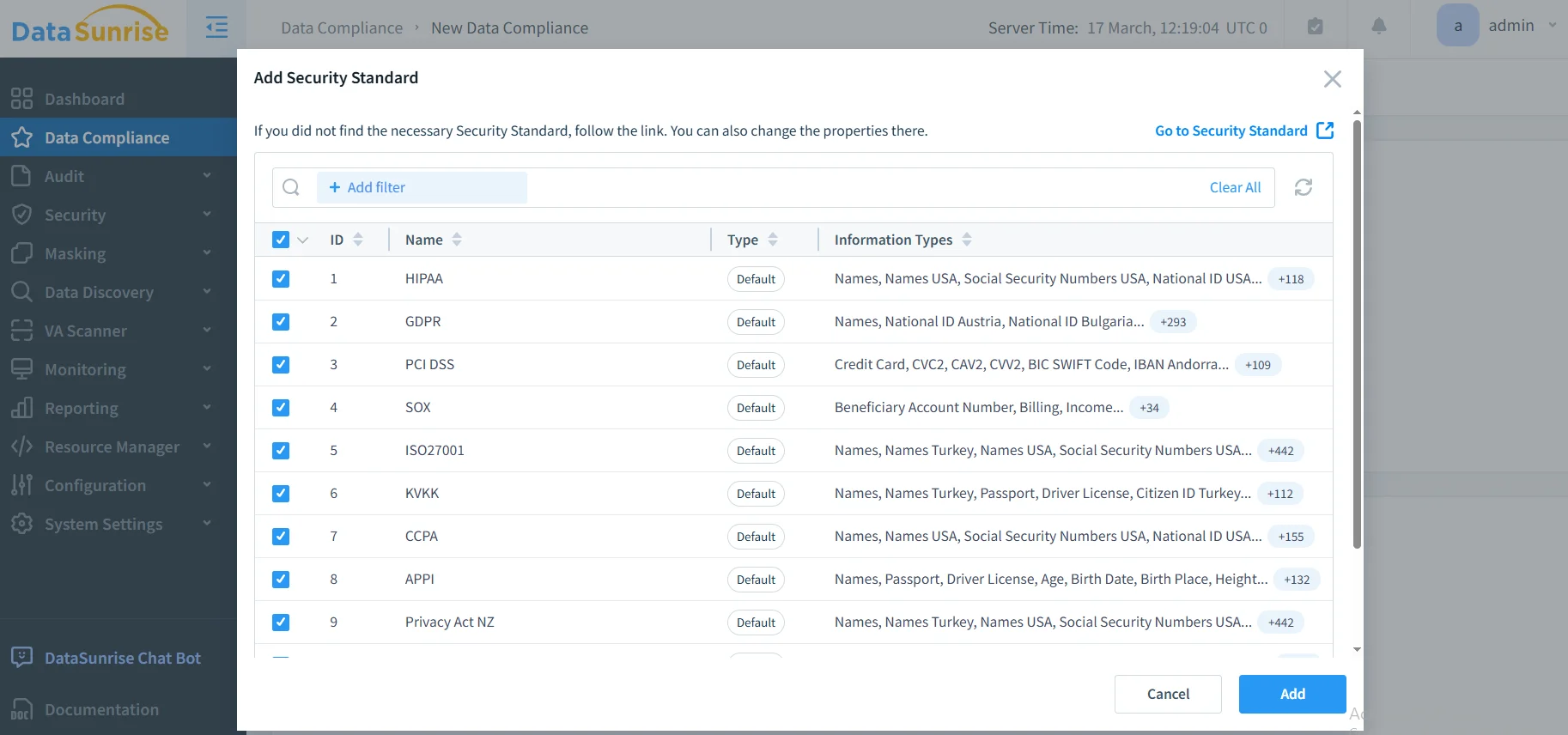
- Compliance Automation: Automated compliance reporting for GDPR, HIPAA, PCI DSS, and SOX
Organizations achieve significant reduction in AI security incidents and substantial decrease in compliance effort with our Cost-Effective, Scalable platform backed by comprehensive capabilities.
Conclusion: Building Secure AI Foundations
AI security represents a fundamental requirement for successful artificial intelligence deployment. Organizations implementing comprehensive security frameworks position themselves to leverage AI's transformative potential while maintaining stakeholder trust, operational resilience, and rigorous data audit practices.
Effective AI security transforms from technical challenge to competitive advantage. By implementing proven security frameworks with automated monitoring, organizations can confidently pursue AI innovations while protecting their assets.
Protect Your Data with DataSunrise
Secure your data across every layer with DataSunrise. Detect threats in real time with Activity Monitoring, Data Masking, and Database Firewall. Enforce Data Compliance, discover sensitive data, and protect workloads across 50+ supported cloud, on-prem, and AI system data source integrations.
Start protecting your critical data today
Request a Demo Download Now