Amazon DynamoDB Data Compliance Automation
Automating data compliance for Amazon DynamoDB requires a shift away from assumptions rooted in relational databases. DynamoDB uses a schema-flexible, serverless model and integrates tightly with AWS identity, encryption, and logging layers. Therefore, compliance controls rely on coordinated infrastructure-level mechanisms rather than database-native audit trails or SQL logs, aligning naturally with broader data security practices.
For organizations that handle regulated or sensitive data, this architecture brings both advantages and challenges. Although AWS provides strong default security, compliance does not appear automatically. Instead, teams must actively design, automate, and continuously validate controls across identity policies, encryption settings, operational telemetry, and external monitoring systems to maintain consistent data compliance.
This article explains how data compliance automation works in DynamoDB. It outlines which native AWS components support compliance, highlights where gaps still exist, and shows how centralized platforms such as DataSunrise close those gaps without rewriting applications. In addition, it demonstrates how unified database activity monitoring and policy-driven controls simplify governance at scale.
What Data Compliance Means for DynamoDB
In DynamoDB, data compliance is not a single feature or switch. Instead, it follows a distributed control model built from several independent layers that together support a unified data compliance strategy. First, identity and access enforcement occurs before any request reaches the service and depends on strict access controls. At the same time, encryption protects data both at rest and in transit as part of broader database encryption practices. In addition, activity evidence is collected outside the database engine, while continuous database activity monitoring connects these layers by detecting policy drift and anomalous behavior as environments evolve.
Because DynamoDB does not generate query-level audit logs, compliance automation relies on AWS service telemetry rather than internal database artifacts. As a result, organizations must rethink how they approach auditability, accountability, and regulatory reporting. The focus shifts toward centralized evidence collection and structured data audit trails derived from infrastructure-level signals.
In practice, DynamoDB compliance objectives emphasize least-privilege access to tables and indexes. They also require verifiable evidence of data access and modification, clear encryption ownership with proper key governance, and reliable support for regulatory audits without manual log reconstruction or ad hoc analysis.
Compliance Enforcement Layers in DynamoDB
In DynamoDB environments, compliance is enforced through a combination of tightly coupled but independently managed control layers. No single service is responsible for governance outcomes. Instead, compliance emerges from the coordinated operation of identity controls, encryption mechanisms, and operational telemetry generated across the AWS control plane. Each layer contributes a specific type of assurance, and only their combined operation produces auditability that regulators and security teams can rely on. Understanding how these layers interact is essential for designing automated compliance workflows that remain effective as architectures scale and evolve.
Identity-Driven Access Control as a Compliance Foundation
Every request to DynamoDB is evaluated by AWS Identity and Access Management before execution. IAM policies determine which principals are allowed to perform actions such as GetItem, PutItem, or Query on specific tables, indexes, or global secondary indexes. From a compliance perspective, this makes IAM the primary enforcement layer rather than the database itself.
A typical least-privilege IAM policy for DynamoDB access looks like this:
{
  "Version": "2012-10-17",
  "Statement": [
    {
      "Effect": "Allow",
      "Action": [
        "dynamodb:GetItem",
        "dynamodb:Query"
      ],
      "Resource": "arn:aws:dynamodb:us-east-1:123456789012:table/Orders"
    }
  ]
}
Automated compliance in DynamoDB environments depends on the consistent application of role-based access policies aligned with business functions, fine-grained permissions scoped precisely to required resources and actions, and clear separation of duties enforced through distinct IAM roles. Misconfigured or overly permissive IAM policies remain one of the most common sources of compliance failures. As a result, automation efforts focus on policy consistency, drift detection, and continuous validation instead of static, one-time configuration reviews.
Encryption and Key Governance Automation
DynamoDB encrypts all data at rest by default using AWS-managed keys, which satisfies baseline security requirements. However, regulated environments typically require customer-managed KMS keys to establish clear ownership, enforce rotation schedules, and retain the ability to revoke access when necessary.
When customer-managed encryption is used, DynamoDB tables are explicitly bound to a specific KMS key:
{
  "SSESpecification": {
    "Enabled": true,
    "SSEType": "KMS",
    "KMSMasterKeyId": "arn:aws:kms:us-east-1:123456789012:key/abcd1234-5678-90ef-ghij-1234567890ab"
  }
}
From a compliance automation standpoint, encryption extends beyond simply enabling a default setting. It involves ensuring that all tables consistently use approved KMS keys, verifying that key rotation and lifecycle policies remain intact over time, and detecting unauthorized or unexpected key changes. These controls are usually enforced through automated infrastructure policies and continuous configuration monitoring rather than periodic manual audits.
Operational Logging as Compliance Evidence
Because DynamoDB does not expose SQL-style audit trails, AWS CloudTrail becomes the primary source of activity evidence. CloudTrail records API-level operations such as table creation, item access, and permission changes, providing visibility into how DynamoDB resources are used.
A CloudTrail event capturing a DynamoDB GetItem operation typically resembles the following:
{
  "eventSource": "dynamodb.amazonaws.com",
  "eventName": "GetItem",
  "awsRegion": "us-east-1",
  "userIdentity": {
    "type": "AssumedRole",
    "arn": "arn:aws:sts::123456789012:assumed-role/AppRole/session123"
  },
  "requestParameters": {
    "tableName": "Orders"
  },
  "eventTime": "2026-01-27T10:42:31Z"
}
However, raw CloudTrail logs are not compliance-ready by default. They are high-volume, infrastructure-centric, and lack direct business context. To make them suitable for audits, automated compliance workflows centralize log collection, filter for data-relevant operations, correlate events with IAM identities and roles, and retain records according to regulatory requirements. Without automation, these steps quickly turn into operational bottlenecks during audits and incident investigations.
Automating DynamoDB Compliance with DataSunrise
Automating data compliance for DynamoDB requires moving beyond reactive log collection toward centralized, policy-driven control. In practice, this means introducing a platform that can normalize infrastructure-level telemetry, apply compliance logic consistently, and produce audit-ready evidence without embedding security rules into application code. This role is fulfilled by DataSunrise, which operates outside the DynamoDB engine while integrating directly with AWS identity, encryption, and logging layers.
By decoupling compliance logic from the database itself, DataSunrise enables proactive automation that scales with DynamoDB environments and remains stable as architectures evolve. Instead of parsing raw logs manually, organizations define compliance policies once and rely on the platform to enforce, validate, and document them continuously.
Compliance-Aware Activity Monitoring
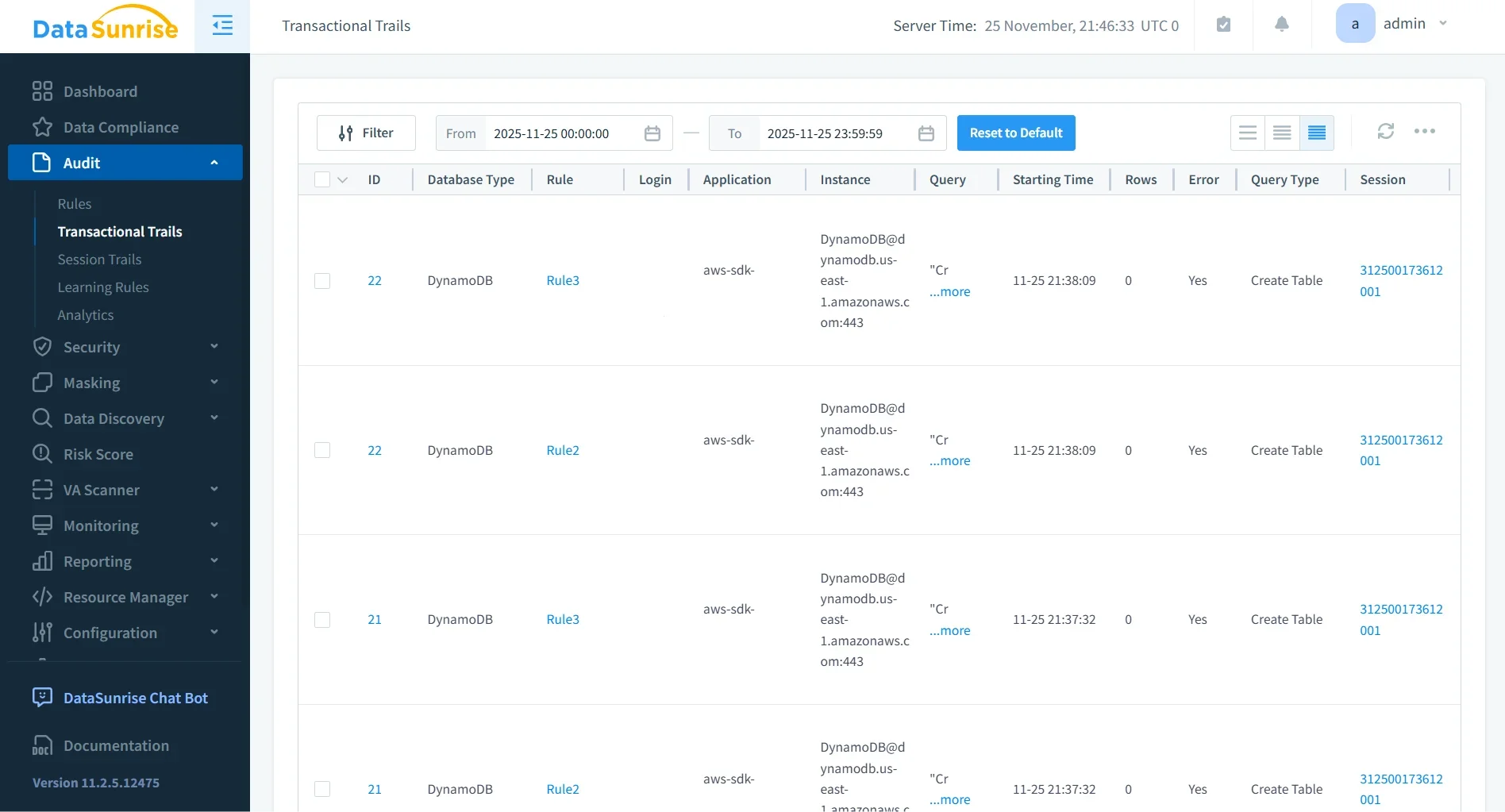
DataSunrise transforms low-level AWS telemetry into compliance-aware audit records. Rather than storing raw API events, activity is evaluated in context, taking into account the calling identity, the type of operation performed, and the scope of affected data. This produces structured audit trails that auditors can interpret directly, without reconstructing intent or correlating events across multiple services. As a result, DynamoDB activity becomes traceable at a compliance level rather than remaining buried in infrastructure logs.
- Normalization of CloudTrail and IAM telemetry into structured audit events
- Correlation of API actions with user roles, assumed identities, and sessions
- Contextual classification of operations (read, write, admin, permission changes)
- Reduction of audit noise by filtering non-compliance-relevant events
- Centralized visibility into DynamoDB access across accounts and regions
Policy-Driven Enforcement Across Environments
In DynamoDB-centric architectures, identical data models are often deployed across development, staging, and production environments, frequently spanning multiple AWS accounts or regions. DataSunrise enforces compliance policies centrally and applies them consistently across all environments. This prevents governance drift, eliminates reliance on application-level enforcement, and ensures that the same access, audit, and monitoring logic follows the data regardless of where it is deployed.
- Central definition of compliance and audit policies independent of environment
- Consistent enforcement across development, staging, and production workloads
- Elimination of configuration drift caused by manual policy replication
- Reduced dependency on application code for compliance enforcement
- Predictable compliance posture as DynamoDB environments scale
Automated Compliance Reporting
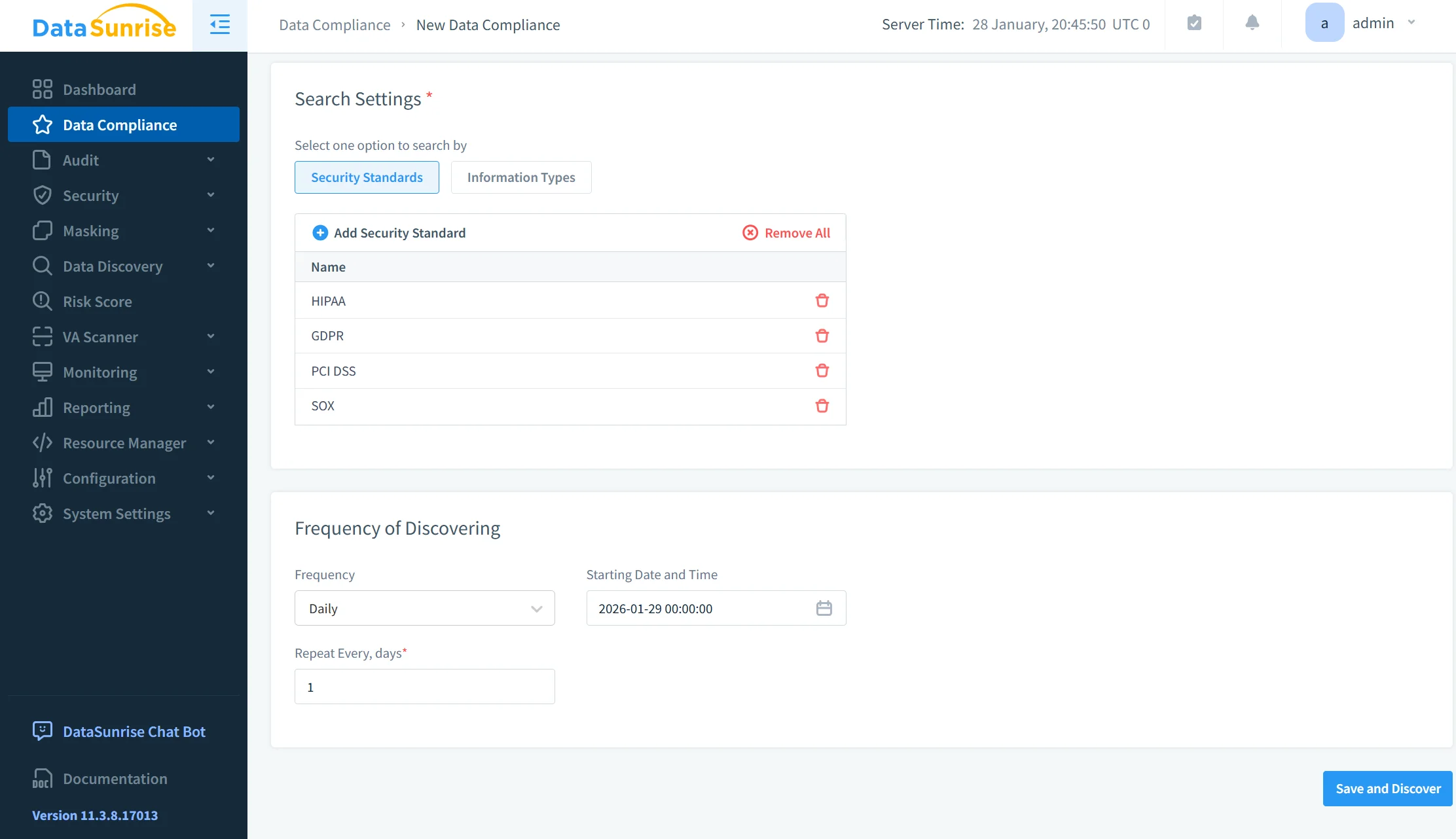
DataSunrise automatically generates compliance reports aligned with regulatory frameworks such as GDPR, HIPAA, PCI DSS, and SOX using normalized audit data. Because reporting logic is derived from centralized policies rather than environment-specific configurations, evidence remains consistent even as DynamoDB usage scales. This allows organizations to support audits, internal reviews, and investigations without manual log reconstruction or ad hoc data preparation.
- Prebuilt report templates aligned with major regulatory frameworks
- Automated evidence collection from normalized audit records
- Consistent reporting format across multiple AWS accounts and regions
- Reduced audit preparation time through one-click report generation
- Audit-ready documentation without manual log parsing or correlation
Business Impact of Compliance Automation
| Business Area | Impact of Compliance Automation |
|---|---|
| Audit Preparation | Significantly reduced audit preparation time through automated evidence collection and reporting |
| Access Governance | Lower risk of access misconfiguration due to centralized policy enforcement and continuous validation |
| Scalability | Predictable compliance posture maintained as DynamoDB environments scale across accounts and regions |
| Operational Ownership | Clear ownership of security and governance controls without reliance on application teams |
| Compliance Model | Shift from periodic audit-driven checks to continuous, operational compliance |
Conclusion
Amazon DynamoDB provides a secure, scalable foundation, but compliance does not emerge automatically from infrastructure security alone. In DynamoDB architectures, compliance must be enforced through identity governance, encryption controls, and operational telemetry rather than database-native mechanisms, forming a cohesive data security and data compliance strategy.
Automated compliance platforms bridge this gap by transforming AWS-level signals into policy-driven controls and audit-ready evidence. By automating monitoring, reporting, and enforcement through centralized access controls and continuous database activity monitoring, organizations achieve durable compliance without sacrificing DynamoDB’s performance or flexibility.
To see how centralized automation simplifies DynamoDB compliance at scale, explore the DataSunrise Overview.
Protect Your Data with DataSunrise
Secure your data across every layer with DataSunrise. Detect threats in real time with Activity Monitoring, Data Masking, and Database Firewall. Enforce Data Compliance, discover sensitive data, and protect workloads across 50+ supported cloud, on-prem, and AI system data source integrations.
Start protecting your critical data today
Request a Demo Download Now