Amazon DynamoDB Database Activity History
Amazon DynamoDB is widely used for high-performance workloads such as personalization engines, transactional platforms, session stores, and telemetry ingestion. These systems require both performance and traceability. An Amazon DynamoDB Database Activity History framework provides the visibility needed to understand who accessed data, how items changed over time, and how the database behaved across operations.
DynamoDB exposes telemetry through AWS CloudTrail, DynamoDB Streams, and Amazon CloudWatch. While these services provide detailed observations individually, they do not deliver a unified, chronologically consistent view suitable for long-term tracking or investigations. Organizations therefore use DataSunrise to consolidate these signals, normalize them, and build a coherent and searchable activity history. This aligns closely with the broader concept of database activity monitoring, which centralizes operational visibility across diverse database technologies.
This article describes how DynamoDB’s native logging contributes to activity visibility and how DataSunrise enhances that visibility by building a complete, correlated activity history timeline. For additional reference, you may consult the pages on data compliance and the regulatory compliance knowledge center. This article complements the existing Amazon DynamoDB Data Audit Trail article by focusing specifically on continuous database activity history.
What Is Amazon DynamoDB Database Activity History?
Database activity history is a consolidated timeline of all interactions involving a data platform. In DynamoDB, this includes API calls, item modifications, administrative actions, and performance-related events. These records help reconstruct complete operational sequences and support investigations and historical reviews. DataSunrise aligns this information with the concepts described in data activity history and database activity history to provide a unified historical record across different platforms.
The historical timeline produced is comparable to traditional audit trails, but adapted to the operational and event-driven nature of NoSQL environments.
Native Tools for Tracking DynamoDB Activity History
1. CloudTrail — API-Level Activity History
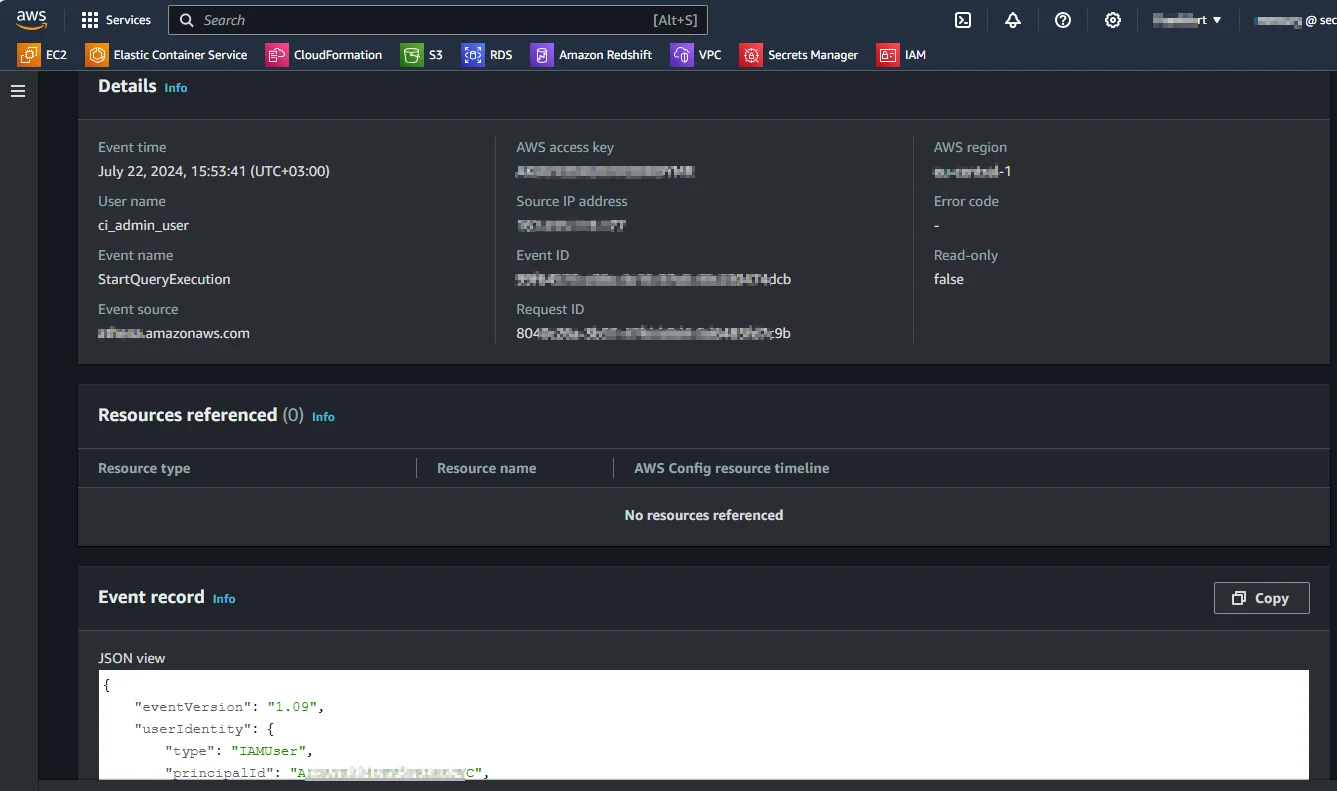
AWS CloudTrail records DynamoDB API calls such as PutItem, Query, BatchWriteItem, and others. Each event includes identity information, timestamps, table names, request parameters, IP addresses, and regions. This creates a chronological record of who performed which operation and when.
2. DynamoDB Streams — Item-Level Change History
DynamoDB Streams provide item-level write events such as INSERT, MODIFY, and REMOVE. These include snapshots of the old and new item states, enabling reconstruction of how specific records evolved over time.
{
  "eventName": "MODIFY",
  "eventSource": "aws:dynamodb",
  "dynamodb": {
    "Keys": {
      "OrderID": { "S": "O92219" }
    },
    "OldImage": {
      "Status": { "S": "PENDING" }
    },
    "NewImage": {
      "Status": { "S": "FULFILLED" }
    },
    "ApproximateCreationDateTime": 1736700000
  }
}
3. CloudWatch Metrics and Logs — Operational Context
Amazon CloudWatch provides operational metrics such as throttled requests, read and write capacity usage, latency measurements, and error rates. When combined with CloudTrail and Streams data, CloudWatch helps establish a broader historical context around events, such as whether performance issues accompanied certain API patterns.
aws cloudwatch get-metric-statistics \
  --namespace AWS/DynamoDB \
  --metric-name SuccessfulRequestLatency \
  --dimensions Name=TableName,Value=CustomerRecords \
  --start-time 2025-01-12T00:00:00Z \
  --end-time 2025-01-12T23:59:59Z \
  --period 300 \
  --statistics Average
Multi-Mode Integration: How DataSunrise Builds DynamoDB Activity History
1. Proxy-Based Monitoring
In proxy-based monitoring, DataSunrise observes DynamoDB operations in real time by receiving the same requests that applications send to AWS. The proxy verifies SigV4 signatures, identifies the DynamoDB API action, and normalizes both request and response structures into the database activity history model. Since the proxy has full visibility, it can apply sensitive-field masking comparable to the mechanisms described in dynamic data masking. This mode provides highly granular event detail, including table names, key attributes, request payload structures, and latency measurements.
2. Native Log Trailing
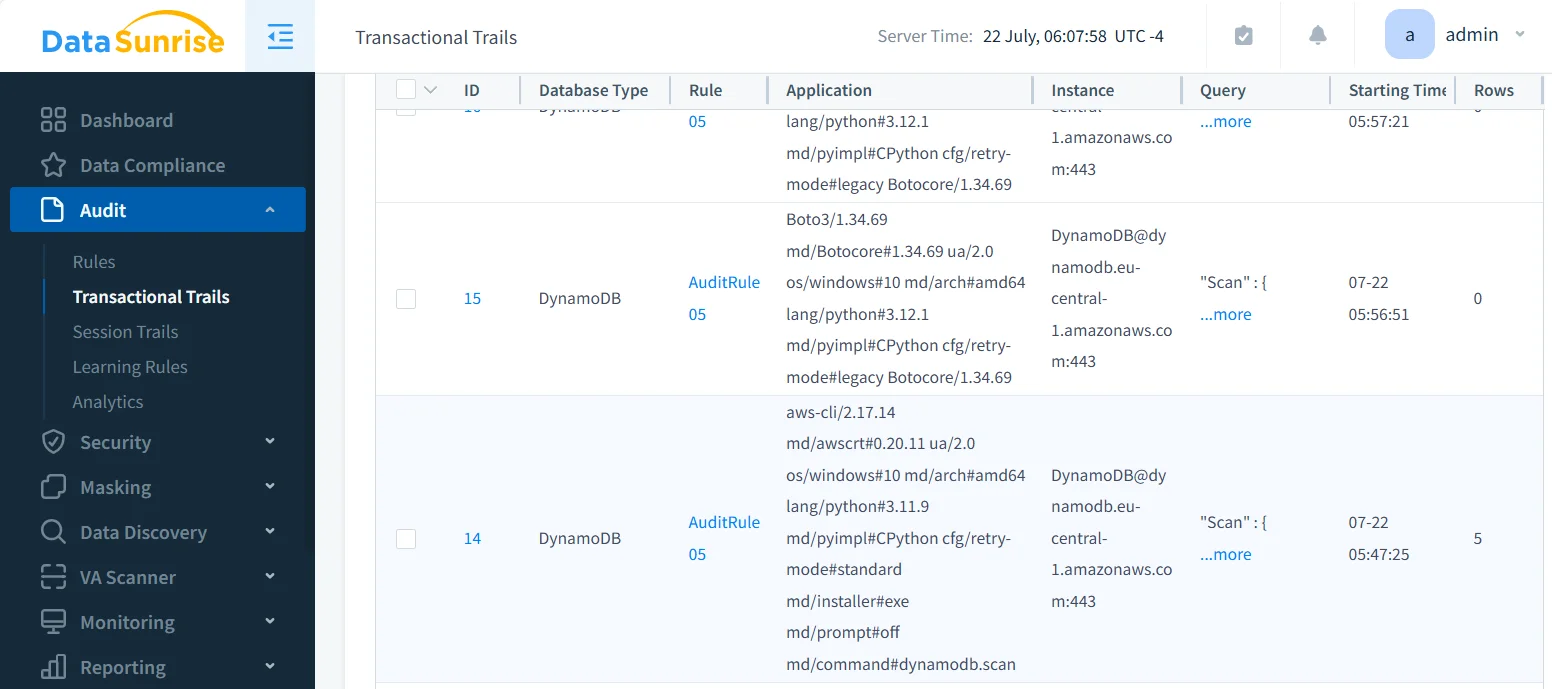
Native log trailing uses CloudTrail, DynamoDB Streams, and optionally CloudWatch logs to reconstruct activity history without modifying traffic paths. Log files from Amazon S3, Amazon Kinesis, or CloudTrail Lake are parsed and converted into standardized historical records. When CloudTrail entries, Stream records, and operational logs refer to the same request, DataSunrise correlates them into unified events and aligns timestamps to generate accurate historical timelines. Sensitive values may be masked according to DataSunrise rules. This mode is essential for aggregating multi-region or multi-account activity, and it parallels the log-handling mechanisms outlined in audit logs.
3. Sniffer / Traffic Mirroring
When AWS VPC Traffic Mirroring is enabled, DataSunrise receives mirrored network packets. If traffic is mirrored prior to encryption, DataSunrise can decode API operations and reconstruct historical events. If traffic is encrypted post-TLS, decoding depends on available keys. This approach provides passive visibility into request flows and supports historical reconstruction where proxy-based routing is not possible.
4. Real-Time Activity Correlation Across Sources
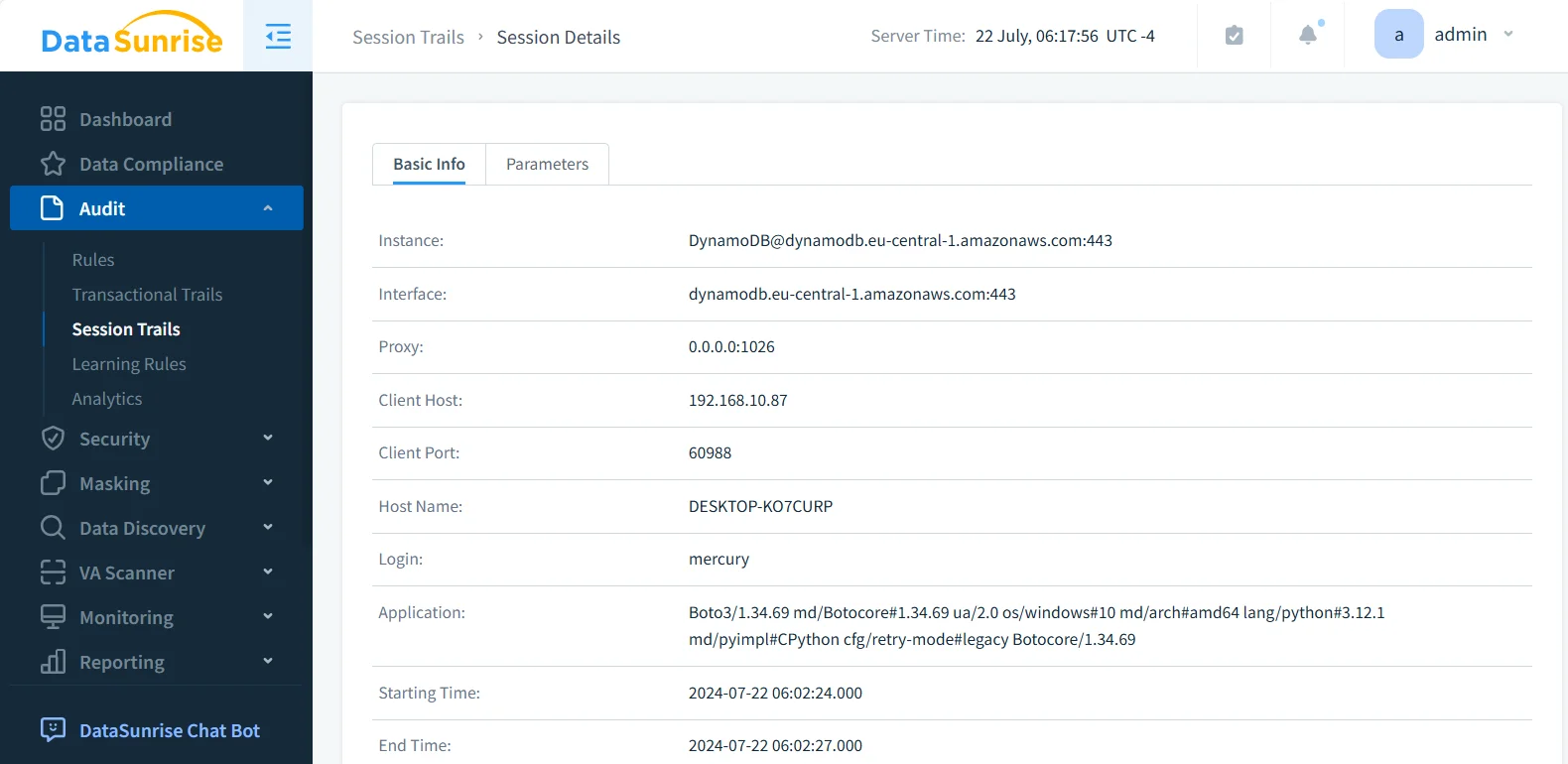
This mode synthesizes historical records from all available telemetry sources—CloudTrail logs, DynamoDB Streams, proxy observations, and traffic-mirroring data—into coherent database activity entries. By merging, deduplicating, and chronologically aligning events, DataSunrise restores the full logical sequence of operations. This ensures consistency across sources and strengthens historical traceability. Activities are supplemented with contextual metadata such as behavioral patterns derived from user behavior analysis.
5. Activity Archival and Historical Record Preservation
After normalization, DataSunrise stores the resulting activity history in formats optimized for long-term retention. The historical dataset is preserved in chronological order and remains searchable for retrospective audits, operational reviews, and forensic analysis. Masking and minimization rules remain intact to ensure data privacy over the long term.
Business Impact of Centralized DynamoDB Database Activity History
| Benefit | What It Actually Means |
|---|---|
| Regulatory readiness | Provides verifiable, chronological access and modification history. |
| Faster investigations | Consolidates data into a single historical view instead of multiple AWS logs. |
| Reduced manual effort | Eliminates custom correlation workflows and manual parsing. |
| Data minimization | Enables masking while preserving historical continuity. |
| Cross-platform consistency | Ensures uniform activity history across different database technologies. |
| Holistic security posture | Complements broader data security programs with consistent historical analysis. |
Conclusion
AWS native telemetry offers foundations for DynamoDB activity history but does not automatically correlate, normalize, or preserve these signals across services, regions, and accounts. DataSunrise reconstructs a complete and continuous database activity history through proxy visibility, native log ingestion, traffic mirroring, correlation, and long-term archival.
This unified dataset supports operational reviews, audit procedures, and retrospective analysis across DynamoDB workloads. Organizations integrating DataSunrise gain a consistent, long-term view of data interactions. To evaluate these capabilities with real workloads, you may request a DataSunrise demo.
Protect Your Data with DataSunrise
Secure your data across every layer with DataSunrise. Detect threats in real time with Activity Monitoring, Data Masking, and Database Firewall. Enforce Data Compliance, discover sensitive data, and protect workloads across 50+ supported cloud, on-prem, and AI system data source integrations.
Start protecting your critical data today
Request a Demo Download Now