How to Apply Data Governance for PostgreSQL
In today's data-driven landscape, implementing comprehensive data governance for PostgreSQL has become a strategic necessity. According to Gartner's 2024 Data Governance Survey, organizations with robust governance frameworks detect compliance violations 88% faster and reduce data-related risks by up to 75%.
PostgreSQL, one of the world's most advanced open-source databases, powers critical applications across industries. With comprehensive documentation and enterprise-grade features, PostgreSQL deployments scale and handle increasingly sensitive data, making proper data governance essential for maintaining data quality, regulatory compliance, and asset protection.
With data breach costs averaging $4.88 million in 2024 and regulations like GDPR, HIPAA, and SOX imposing strict requirements, manual governance approaches cannot keep pace. This article explores implementing effective PostgreSQL data governance using native capabilities and enhanced solutions.
Understanding Data Governance for PostgreSQL
Data governance for PostgreSQL encompasses the comprehensive framework of policies, procedures, and technologies that ensure data is managed as a strategic asset throughout its lifecycle. This systematic approach addresses data security, compliance, and accessibility while maintaining operational efficiency and regulatory adherence.
Effective PostgreSQL data governance requires addressing several key dimensions: Data Quality Management through validation rules and constraint enforcement, Access Control Implementation via user permissions and role-based controls, Compliance Framework Integration with regulatory requirements, Data Lifecycle Management from creation through disposal, and Audit Trail Maintenance for accountability and forensic analysis.
Native PostgreSQL Data Governance Capabilities
PostgreSQL includes several built-in features that provide the foundation for implementing robust data governance. These native capabilities offer essential functionality for access control, data integrity, and operational monitoring.
1. Role-Based Access Control (RBAC)
PostgreSQL's comprehensive RBAC system enables granular permission management:
-- Create data governance roles
CREATE ROLE data_steward;
CREATE ROLE data_analyst;
CREATE ROLE data_viewer;

-- Grant specific permissions
GRANT SELECT, INSERT, UPDATE ON sensitive_data TO data_steward;
GRANT SELECT ON reporting_views TO data_analyst;
2. Row-Level Security (RLS)
Implement fine-grained access control with PostgreSQL's RLS feature:
-- Enable row-level security
ALTER TABLE customer_data ENABLE ROW LEVEL SECURITY;

-- Create security policies
CREATE POLICY customer_isolation ON customer_data
    FOR SELECT
    USING (customer_id = current_setting('app.current_customer_id')::int);
3. Data Integrity Constraints
Ensure data quality through comprehensive constraint implementation:
-- Primary key constraints
ALTER TABLE customers ADD CONSTRAINT pk_customers PRIMARY KEY (customer_id);

-- Check constraints for data validation
ALTER TABLE customer_data ADD CONSTRAINT valid_email
    CHECK (email ~* '^[A-Za-z0-9._%-]+@[A-Za-z0-9.-]+[.][A-Za-z]+$');
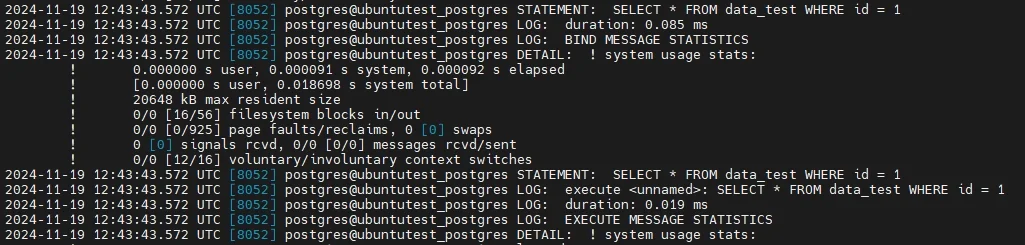
While PostgreSQL's native features provide essential data governance functionality, they have limitations including manual policy management, limited data discovery capabilities, basic monitoring without behavioral analysis, and compliance gaps requiring manual effort to map activities to regulatory requirements.
Enhanced Data Governance with DataSunrise
DataSunrise transforms PostgreSQL data governance through Autonomous Compliance Orchestration and intelligent security policies designed specifically for enterprise database environments. Unlike manual approaches, DataSunrise delivers Zero-Touch Data Protection with sophisticated automation that scales across distributed PostgreSQL deployments.
Setting Up DataSunrise for PostgreSQL Data Governance
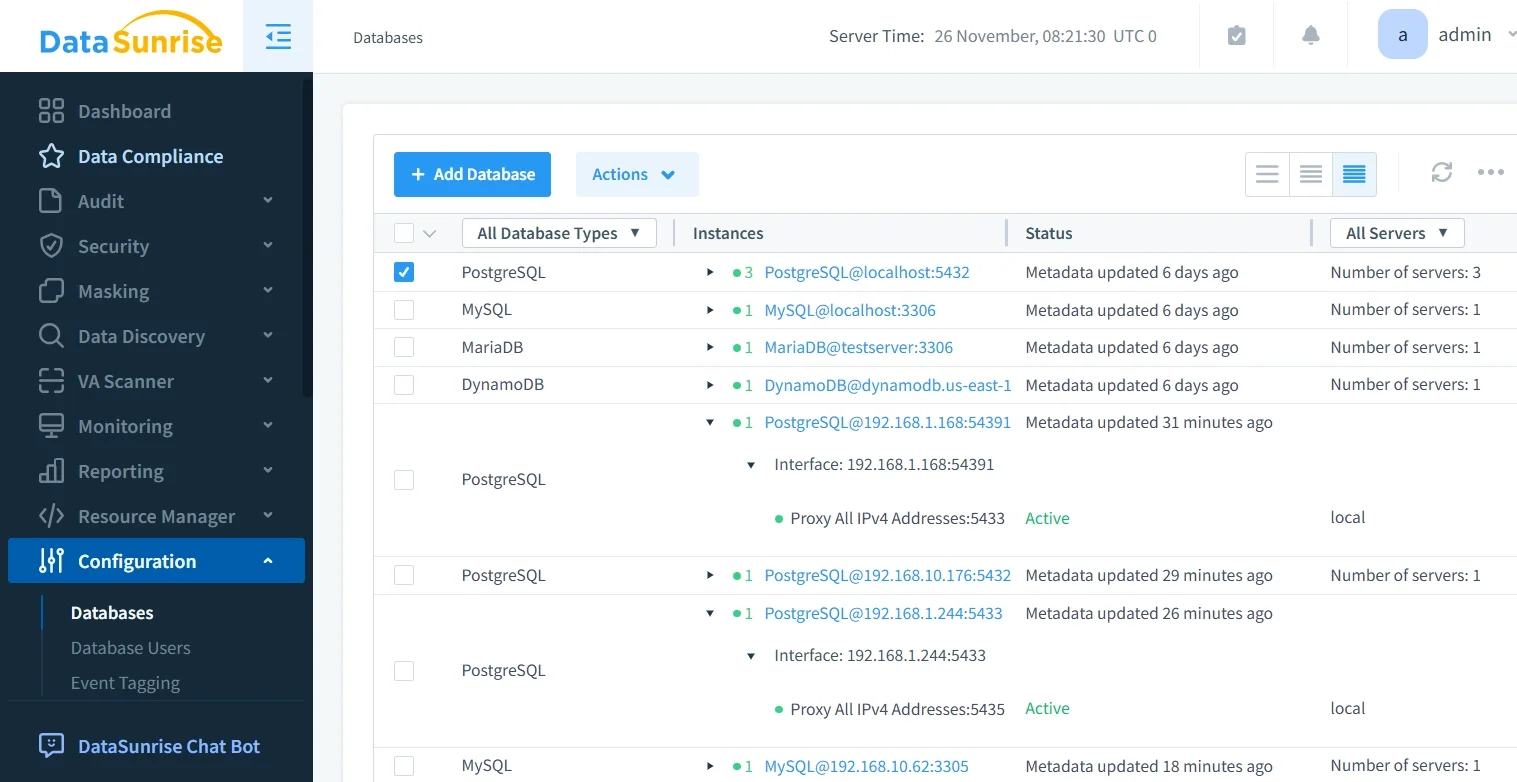
1. Connect PostgreSQL Instance: Begin by connecting your PostgreSQL database to DataSunrise through the intuitive interface, establishing secure monitoring without performance degradation.
2. Implement Auto-Discovery and Classification: DataSunrise's machine learning algorithms automatically identify sensitive data across PostgreSQL schemas, ensuring comprehensive coverage without manual configuration overhead.
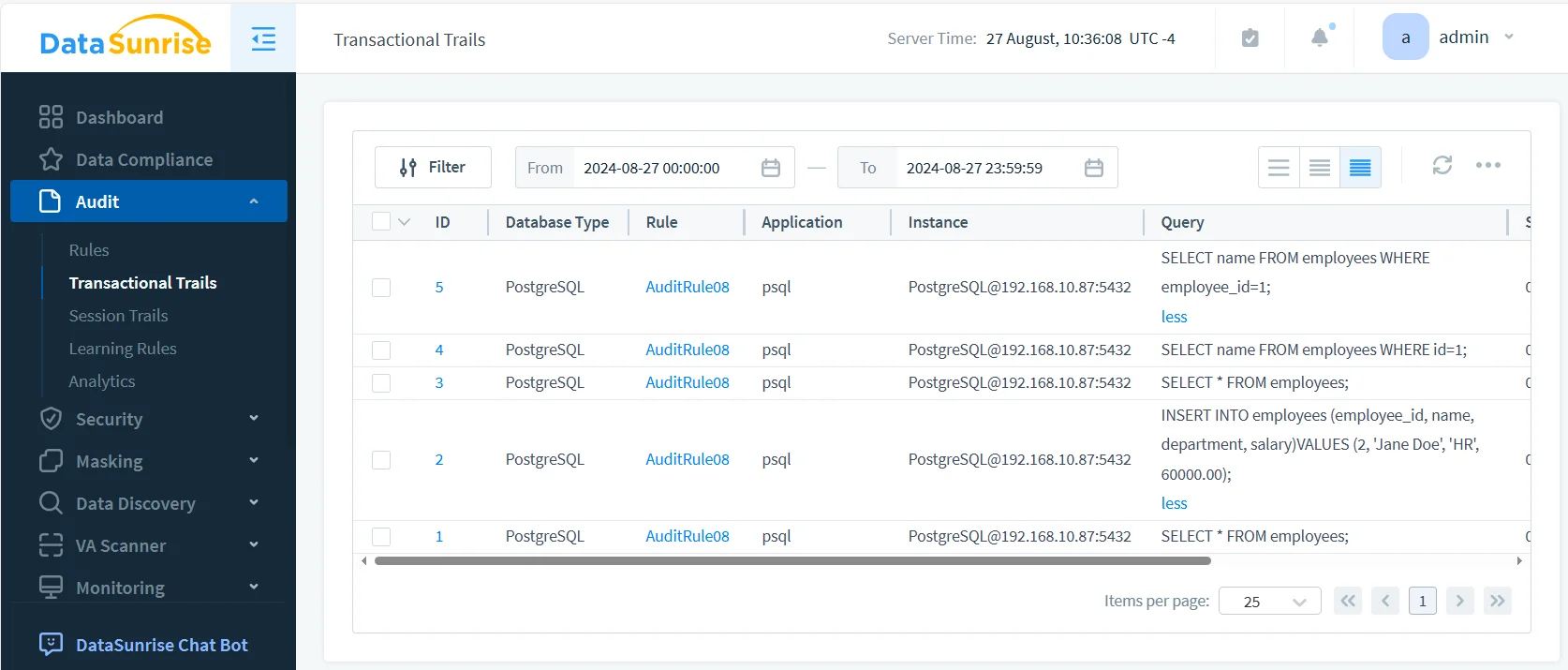
3. Configure Data Governance Policies: Create sophisticated governance rules through DataSunrise's No-Code Policy Automation interface, enabling rapid deployment of enterprise-grade controls.
DataSunrise: Advanced Data Governance for PostgreSQL
DataSunrise delivers comprehensive data governance capabilities that significantly enhance PostgreSQL's native functionality through enterprise-grade automation and intelligent monitoring.
Key Data Governance Features
| Feature | Description | Business Impact |
|---|---|---|
| Comprehensive Data Discovery | Automatically identify and classify sensitive data across PostgreSQL schemas using NLP algorithms and machine learning | 95% greater coverage than manual approaches with zero-touch implementation |
| No-Code Policy Automation | Create sophisticated governance policies through an intuitive interface without writing complex code | Reduces implementation time from weeks to hours |
| Real-Time Monitoring | Receive immediate alerts for governance violations with contextual information and recommended response actions | Enables rapid incident response and policy enforcement |
| Dynamic Data Masking | Protect sensitive PostgreSQL data in real-time while maintaining application functionality | Ensures security across development, testing, and production environments |
| Automated Compliance Reporting | Generate pre-configured reports for GDPR, HIPAA, PCI DSS, and SOX with automated compliance mapping | Transforms weeks of manual work into automated processes |
| User Behavior Analytics | Establish baselines for normal database access patterns and automatically detect anomalies using ML algorithms | Proactive threat detection and adaptive security policies |
Best Practices for PostgreSQL Data Governance Implementation
To maximize the effectiveness of your PostgreSQL data governance implementation, consider these strategic best practices:
1. Data Classification Strategy
Leverage DataSunrise's Auto-Discover & Classify capabilities to identify sensitive data automatically. Focus comprehensive governance on high-risk data containing PII, financial information, or regulated content while applying standard controls to operational data.
2. Access Control Optimization
Implement the principle of least privilege, create granular roles aligned with organizational structure, and establish time-based access controls for sensitive operations.
3. Compliance Framework Integration
Align governance policies with specific compliance requirements, implement real-time compliance validation with automated alerts, and maintain tamper-evident audit logs with appropriate encryption.
4. Enhanced Implementation with DataSunrise
Deploy DataSunrise's comprehensive data governance suite to extend beyond native PostgreSQL capabilities with intelligent automation, leverage advanced analytics for behavioral monitoring, and ensure cross-platform consistency across SQL and NoSQL databases with role-based access controls.
Conclusion
As PostgreSQL deployments continue to scale, implementing robust data governance has become essential for security, compliance, and operational excellence. While PostgreSQL offers solid native capabilities, organizations with complex requirements benefit significantly from enhanced solutions like DataSunrise.
DataSunrise provides Zero-Touch Data Protection with comprehensive governance automation specifically designed for PostgreSQL environments. Through Auto-Discover & Mask capabilities, No-Code Policy Automation, and Continuous Compliance Alignment, DataSunrise transforms data governance from a resource-intensive challenge into an efficient, adaptable framework.
Protect Your Data with DataSunrise
Secure your data across every layer with DataSunrise. Detect threats in real time with Activity Monitoring, Data Masking, and Database Firewall. Enforce Data Compliance, discover sensitive data, and protect workloads across 50+ supported cloud, on-prem, and AI system data source integrations.
Start protecting your critical data today
Request a Demo Download Now