How to Ensure Compliance for PostgreSQL

In today's regulatory landscape, ensuring compliance for PostgreSQL databases has become a critical business requirement. According to IBM's 2024 Data Breach Report, organizations with comprehensive compliance frameworks detect security threats 87% faster and reduce breach-related costs by up to $1.62 million. With GDPR penalties exceeding €2.92 billion in 2023, implementing robust PostgreSQL compliance measures has transformed from a technical consideration into a strategic business imperative.
PostgreSQL, one of the world's most advanced open-source relational database systems, powers mission-critical applications across industries. As organizations increasingly rely on PostgreSQL for storing sensitive data, ensuring compliance regulations like GDPR, HIPAA, PCI DSS, and SOX has become essential for maintaining customer trust and avoiding costly penalties.
Native PostgreSQL Compliance Capabilities
PostgreSQL provides several built-in features that form the foundation of effective compliance implementation. These native capabilities offer essential tools for data protection, access controls, and audit trails maintenance.
1. PostgreSQL Audit Extension (pgAudit)
The pgAudit extension provides detailed session and object audit logging:
-- Enable pgAudit extension
CREATE EXTENSION pgaudit;

-- Configure audit settings in postgresql.conf
shared_preload_libraries = 'pgaudit'
pgaudit.log = 'all'
pgaudit.log_parameter = on
pgaudit.log_level = log
2. Testing Compliance Monitoring
Execute sample operations to generate audit logs:
-- Create sample table with sensitive data
CREATE TABLE customer_data (
    customer_id SERIAL PRIMARY KEY,
    full_name VARCHAR(100),
    ssn VARCHAR(11),
    account_balance DECIMAL(12,2)
);

-- Insert and query test data
INSERT INTO customer_data (full_name, ssn, account_balance)
VALUES ('John Anderson', '123-45-6789', 25000.00);

SELECT * FROM customer_data WHERE account_balance > 20000;
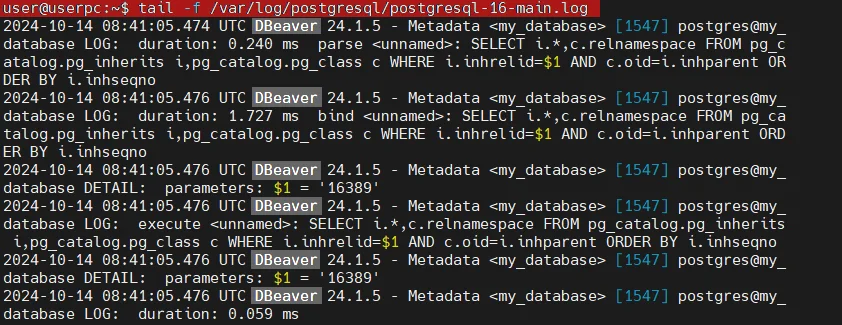
3. Reviewing PostgreSQL Audit Logs
# View PostgreSQL audit logs
tail -f /var/log/postgresql/postgresql-15-main.log

# Filter audit entries
grep "AUDIT:" /var/log/postgresql/postgresql-15-main.log
Limitations of Native PostgreSQL Compliance
While PostgreSQL's built-in features provide essential compliance functionality, organizations with complex regulatory requirements face several limitations:
- Manual Configuration Complexity: Extensive setup required for comprehensive compliance
- Limited Behavioral Analytics: Basic logging without intelligent threat detection
- Storage Management Overhead: Rapidly growing audit logs require careful planning
- Compliance Reporting Gaps: No automated regulatory report generation
- Real-Time Alert Limitations: Basic notification capabilities for violations
Enhanced PostgreSQL Compliance with DataSunrise
DataSunrise significantly enhances PostgreSQL compliance through Autonomous Compliance Orchestration and sophisticated monitoring designed specifically for enterprise database security. Unlike basic audit logging, DataSunrise delivers Zero-Touch Compliance Automation with comprehensive regulatory alignment.
Setting Up DataSunrise for PostgreSQL Compliance
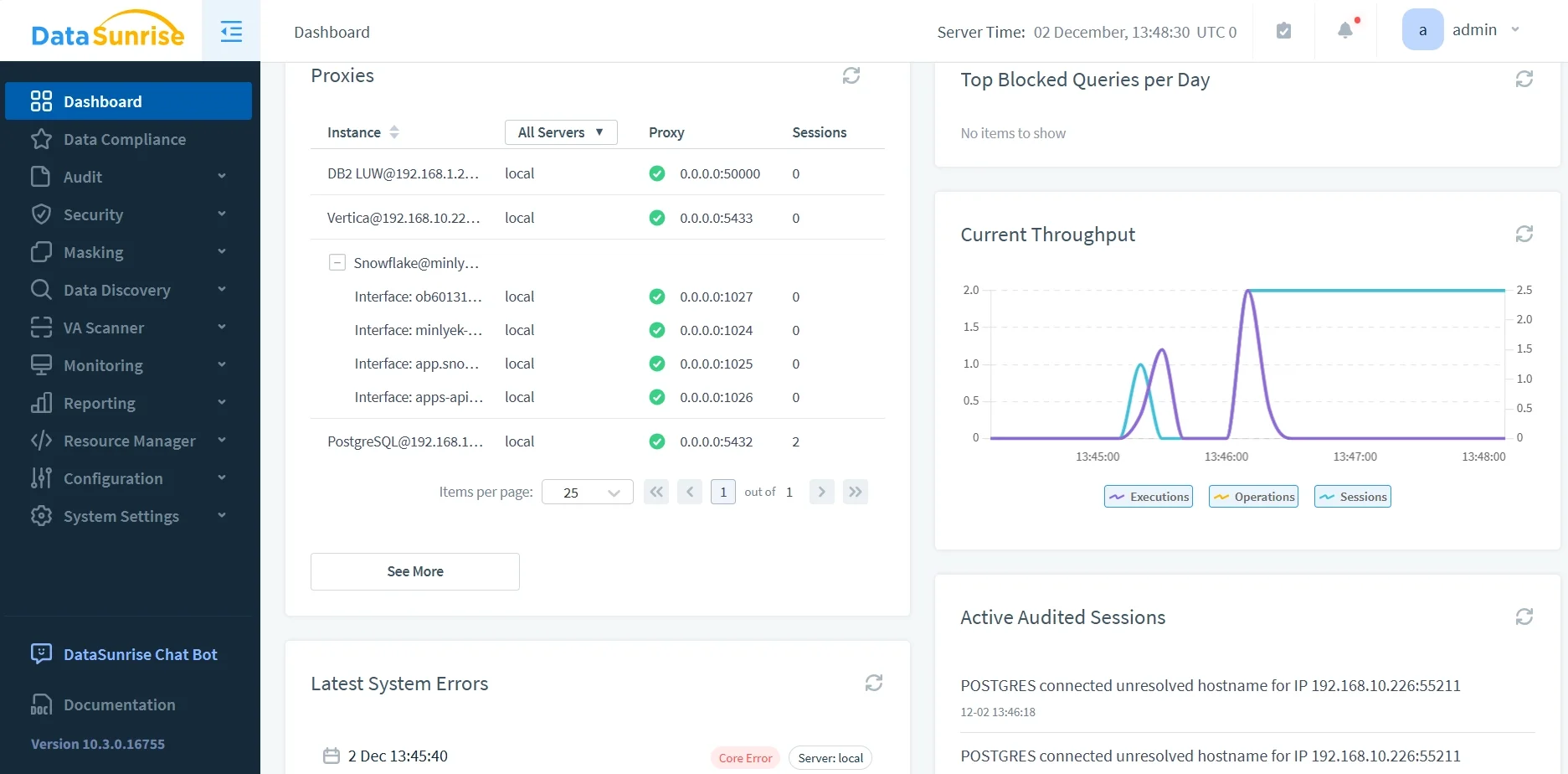
1. Connect to PostgreSQL Instance: Establish secure connection through DataSunrise's intuitive interface with support for all PostgreSQL versions and deployment modes.
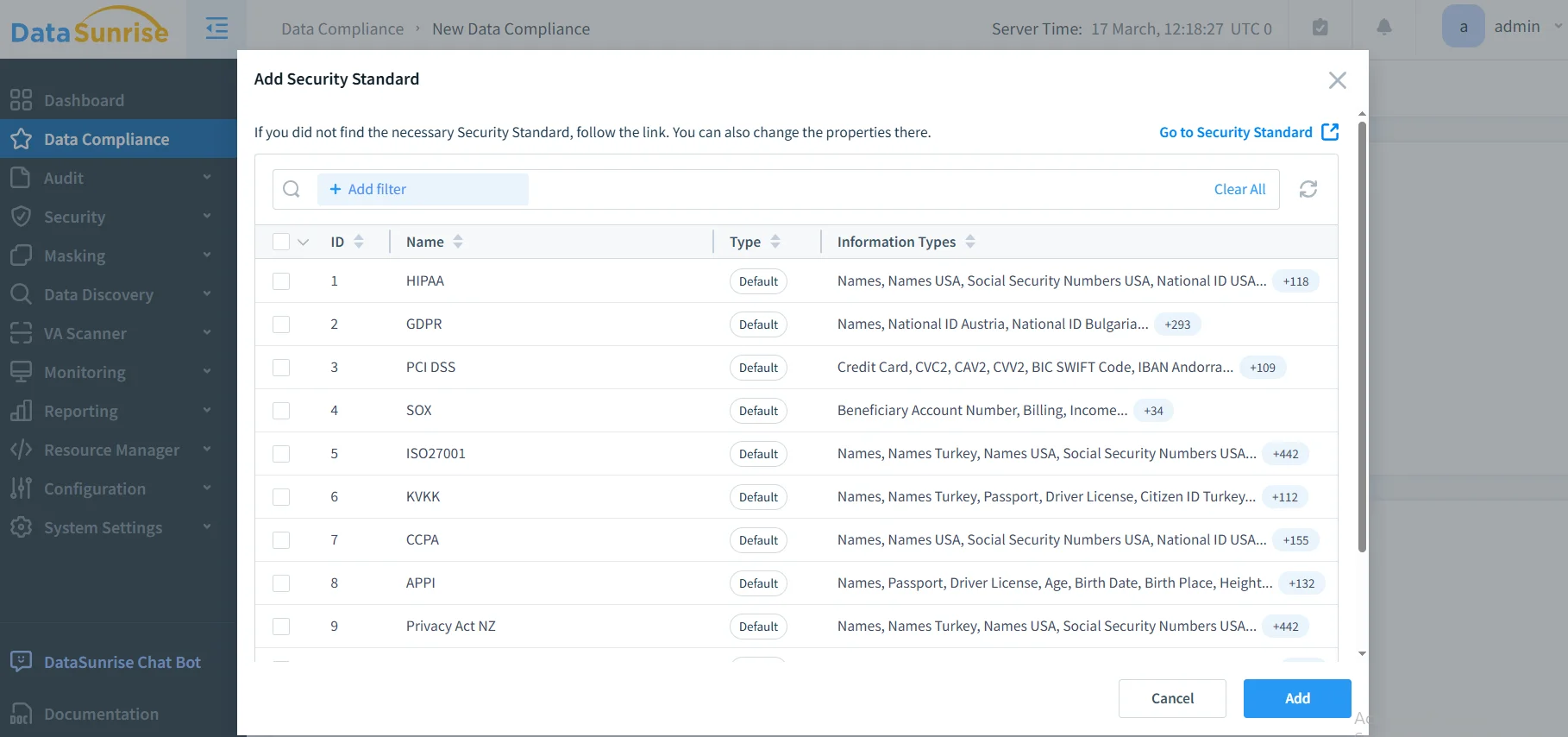
2. Configure Compliance Rules: Create sophisticated compliance policies using No-Code Policy Automation without writing complex code.
3. Implement Auto-Discovery & Classification: Automatically scan and classify sensitive data according to regulatory frameworks using intelligent algorithms.
4. Review Compliance Status: Access real-time compliance dashboards with automated reporting and violation alerts.
Key Advantages of DataSunrise for PostgreSQL Compliance
- Auto-Discover & Mask: Automatically identify and protect sensitive data using NLP algorithms and machine learning, ensuring comprehensive coverage without manual classification
- No-Code Policy Automation: Create compliance policies through intuitive interface, reducing implementation time from weeks to hours
- Continuous Regulatory Calibration: Automatically adapt policies as regulatory frameworks evolve, maintaining compliance without manual updates
- Real-Time Notifications: Immediate real-time alerts for compliance violations with recommended actions for rapid incident response
- Automated Compliance Reporting: Generate pre-configured reports for GDPR, HIPAA, PCI DSS, SOX to streamline audit preparation
- User Behavior Analytics: Detect anomalies that might indicate compliance violations through proactive behavior analytics
- Cross-Platform Consistency: Monitor PostgreSQL alongside 40+ other database platforms with unified policies
Comprehensive Compliance Framework Implementation
| Regulation | Key Features | Implementation Benefits |
|---|---|---|
| GDPR | Data Subject Rights Management, automated breach notification, Data Protection Impact Assessments | Streamlined privacy compliance and automated regulatory reporting |
| HIPAA | Automatic PHI discovery, role-based access controls, comprehensive audit trails | Healthcare data protection with minimum necessary access standards |
| PCI DSS | Automated cardholder data discovery, network segmentation, continuous vulnerability management | Payment industry compliance with automated security testing |
| SOX | Financial data controls, change management tracking, segregation of duties enforcement | Financial reporting compliance with detailed internal control assessments |
Best Practices for PostgreSQL Compliance Implementation
1. Data-Centric Compliance Strategy
Focus comprehensive monitoring on tables containing regulated information. Apply risk-based compliance controls based on data sensitivity levels and implement proper data lifecycle management.
2. Performance-Optimized Configuration
Apply selective monitoring to critical operations while using sampling for high-volume activities. Ensure compliance queries don't impact database performance through proper indexing.
3. Automated Compliance Processes
Utilize DataSunrise's automated policy enforcement for consistent compliance across PostgreSQL instances. Implement real-time monitoring with automated alerting and leverage automated reporting for audit preparation.
4. Enhanced Implementation with DataSunrise
Deploy DataSunrise's Database Regulatory Compliance Manager to extend beyond native capabilities. Leverage machine learning for behavioral analytics and centralized management across multiple instances.
Conclusion
While PostgreSQL offers foundational compliance capabilities through extensions like pgAudit, organizations with complex regulatory requirements benefit significantly from enhanced solutions like DataSunrise. DataSunrise provides comprehensive compliance management specifically designed for PostgreSQL environments, offering Zero-Touch Compliance Automation, Continuous Regulatory Calibration, and automated reporting capabilities.
With Flexible Deployment Modes and support for heterogeneous database environments, DataSunrise transforms PostgreSQL compliance from a manual, resource-intensive process into an automated strategic asset that protects sensitive information while ensuring regulatory adherence.
Protect Your Data with DataSunrise
Secure your data across every layer with DataSunrise. Detect threats in real time with Activity Monitoring, Data Masking, and Database Firewall. Enforce Data Compliance, discover sensitive data, and protect workloads across 50+ supported cloud, on-prem, and AI system data source integrations.
Start protecting your critical data today
Request a Demo Download Now