NLP, LLM, ML Data Compliance Tools for MongoDB
MongoDB has become a cornerstone for modern applications due to its flexibility and ability to manage unstructured and semi-structured data. However, when organizations store sensitive workloads—such as personal identifiers, healthcare data, or payment details—compliance becomes a major challenge. Regulations like GDPR, HIPAA, PCI DSS, and SOX demand rigorous controls, continuous monitoring, and automated reporting.
This article explores how NLP, LLM, and ML tools can be applied to MongoDB compliance. We review native options, highlight their limitations, and demonstrate how DataSunrise extends MongoDB compliance with intelligent, AI-driven features.
Native MongoDB Compliance Tools
MongoDB provides a baseline of compliance-related features. These include audit logs, RBAC, encryption, and field-level redaction. Below is a detailed breakdown of each feature.
Audit Logs
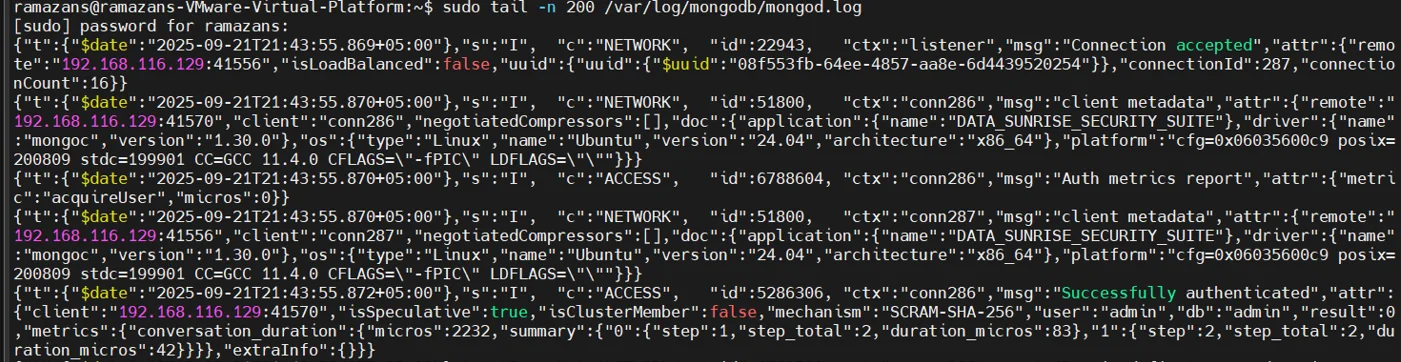
MongoDB supports audit logging to track critical security events such as authentication attempts, schema modifications, and role management. These logs are essential for reconstructing user activity and meeting regulatory requirements.
# Example configuration in mongod.conf
auditLog:
  destination: file
  format: BSON
  path: /var/log/mongodb/auditLog.bson
With this setup, MongoDB generates BSON-formatted audit records that can later be converted to JSON for easier analysis and integration into SIEM systems.
Role-Based Access Control (RBAC)
RBAC ensures that users and applications only have the privileges necessary to perform their tasks. This enforces the principle of least privilege and limits potential exposure of sensitive data.
// Create a custom read-only role for sensitive customer data
db.createRole({
   role: "readSensitive",
   privileges: [
      { resource: { db: "sales", collection: "customers" }, actions: [ "find" ] }
   ],
   roles: []
})

// Assign the role to a specific user
db.grantRolesToUser("analystUser", [{ role: "readSensitive", db: "sales" }])
This configuration allows analysts to query customer information without being able to alter it or escalate privileges.
Encryption
MongoDB provides both in-transit and at-rest encryption to protect data from unauthorized access. TLS/SSL secures communication channels, while storage encryption ensures disk-level protection.
# Example: start mongod with TLS enabled
mongod --tlsMode requireTLS \
       --tlsCertificateKeyFile /etc/ssl/mongodb.pem \
       --tlsCAFile /etc/ssl/ca.pem
At-rest encryption can be enabled using the WiredTiger storage engine’s encryption options. This ensures compliance with frameworks requiring cryptographic safeguards, such as HIPAA and PCI DSS.
Field-Level Redaction
MongoDB allows administrators to mask or exclude sensitive fields when returning query results. This helps minimize unnecessary exposure of personal identifiers.
// Example aggregation pipeline with redacted field
db.customers.aggregate([
  { $project: { name: 1, email: 1, ssn: "***REDACTED***" } }
])
This method ensures that while authorized staff can access general data, fields such as Social Security numbers remain hidden unless explicitly required.
While these features are helpful, they remain manual-heavy and lack intelligent discovery. MongoDB alone does not include machine learning–based drift detection, NLP-driven discovery of unstructured data, or automated compliance evidence generation.
Extending MongoDB Compliance with NLP, LLM & ML
NLP Data Discovery
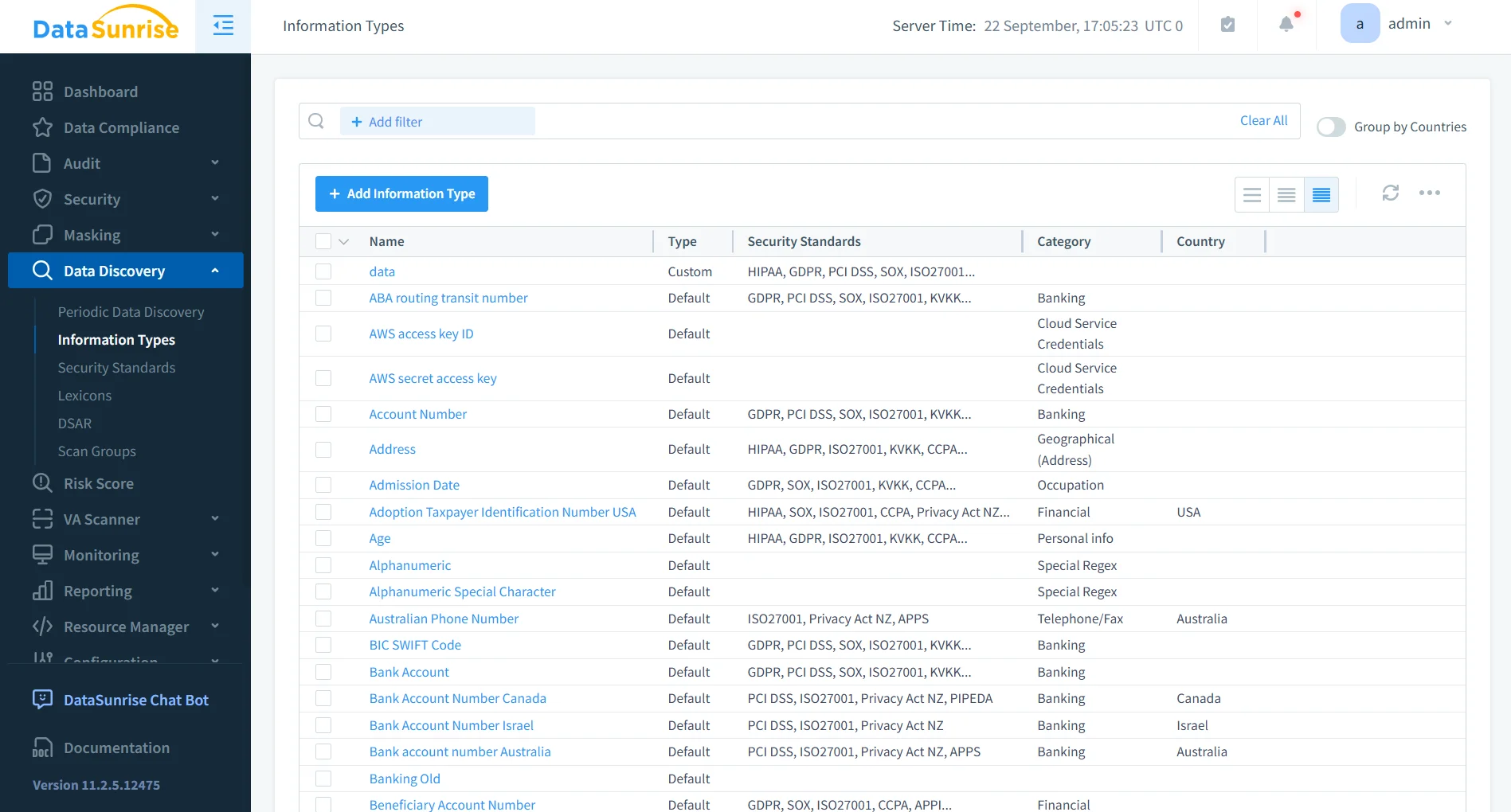
MongoDB often contains text-heavy fields, JSON documents, or logs where sensitive data is embedded. DataSunrise uses data discovery enhanced with natural language processing (NLP) to automatically locate sensitive elements such as PII or PHI within unstructured text. This extends compliance monitoring beyond schema-defined fields, ensuring organizations identify risks even in free-text entries. OCR capabilities expand this discovery to scanned documents and images associated with MongoDB collections.
- Identifies sensitive information (PII, PHI, financial data) in text and documents.
- Applies OCR to images and scanned files stored in MongoDB collections.
- Ensures compliance checks include unstructured and semi-structured data.
LLM and ML Audit Tools
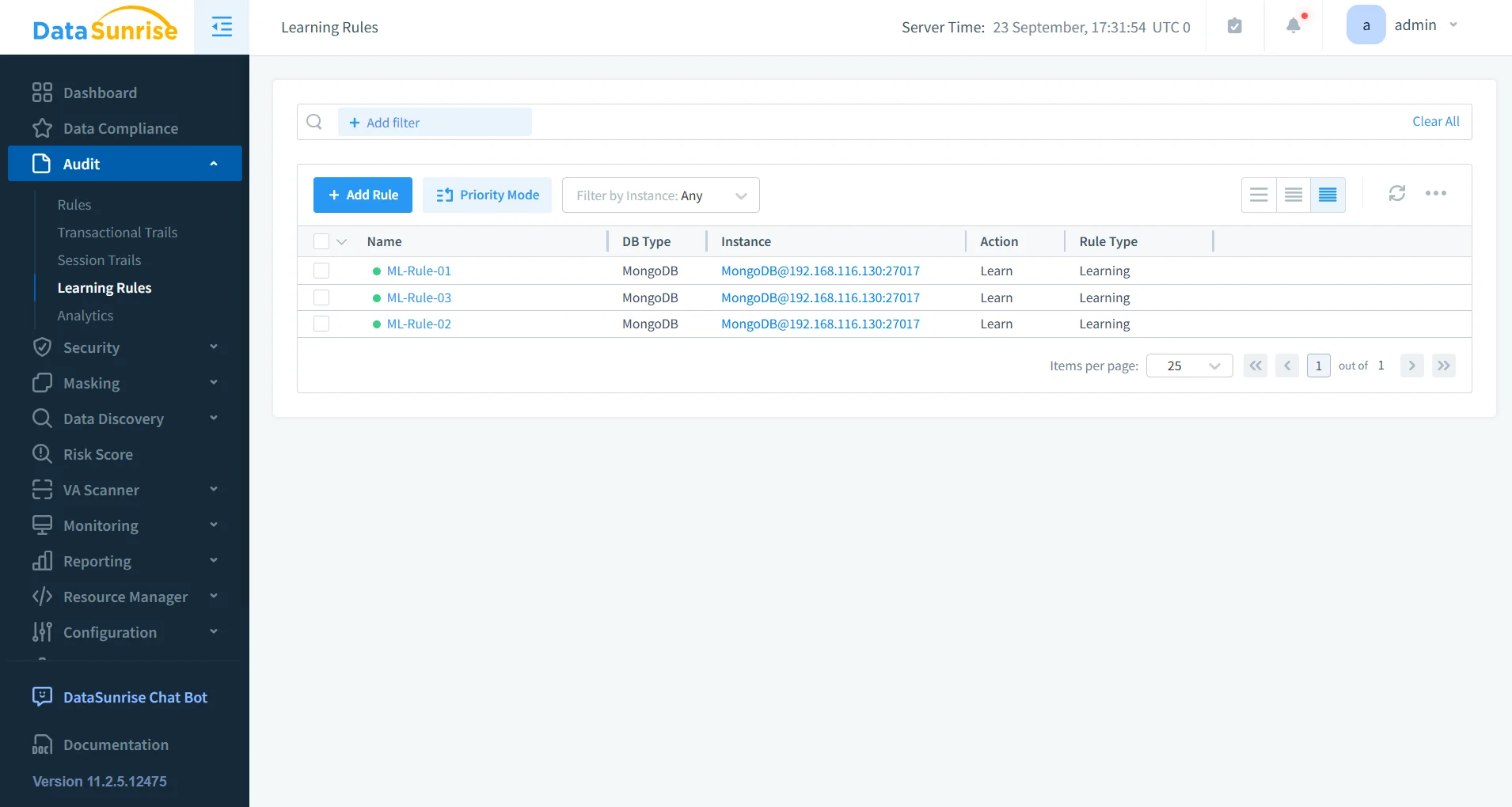
DataSunrise integrates LLM and ML tools to provide adaptive auditing capabilities. Large language models generate context-aware explanations of compliance events, while machine learning algorithms learn from query history to flag anomalies.
- Detects unusual query behavior compared to established baselines.
- Identifies unauthorized privilege escalations or suspicious user activity.
- Produces natural language summaries for compliance reports and auditors.
Compliance Autopilot
The Compliance Manager functions as a compliance autopilot for MongoDB environments. It automatically enforces regulatory requirements (GDPR, HIPAA, PCI DSS, SOX) without manual intervention. When new collections, users, or roles are created, ML-driven audit rules are applied in real time.
- Applies prebuilt regulatory templates across MongoDB deployments.
- Detects compliance drift caused by schema or privilege changes.
- Recalibrates enforcement rules dynamically to prevent policy gaps.
Behavior Analytics
AI-driven behavior analysis adds another layer of protection by continuously monitoring user and query behavior. By evaluating metrics such as query frequency, data access locations, and export patterns, the system can detect insider threats and compromised accounts.
- Flags abnormal query volume, unusual login times, or geographic anomalies.
- Detects suspicious data exports that may indicate exfiltration attempts.
- Provides real-time alerts so administrators can act before risks escalate.
Business Benefits of AI-Enhanced Compliance
| Benefit | Description |
|---|---|
| Efficiency | Automates compliance reporting, eliminating manual log reviews. |
| Accuracy | Reduces false positives by analyzing user and query behavior in context. |
| Scalability | Works across multi-cluster and hybrid MongoDB deployments. |
| Audit-Readiness | Provides audit trails and compliance evidence for regulators on demand. |
| Future-Proofing | Aligns with emerging frameworks like ISO/IEC 27001 and NIST via continuous calibration. |
Conclusion
While MongoDB’s native tools establish a foundation for compliance, they fall short in managing unstructured data and detecting advanced risks. By leveraging NLP-driven discovery, LLM-generated compliance insights, and ML-powered audit rules, organizations can significantly strengthen compliance posture.
DataSunrise delivers this unified approach, enabling enterprises to monitor, protect, and audit MongoDB with zero-touch automation. The result is faster compliance alignment, reduced manual effort, and stronger resilience against insider and external threats.
Protect Your Data with DataSunrise
Secure your data across every layer with DataSunrise. Detect threats in real time with Activity Monitoring, Data Masking, and Database Firewall. Enforce Data Compliance, discover sensitive data, and protect workloads across 50+ supported cloud, on-prem, and AI system data source integrations.
Start protecting your critical data today
Request a Demo Download Now