Static Data Masking in Vertica
Static data masking in Vertica plays a critical role in protecting sensitive analytics data used for high-performance reporting, data science, and large-scale analytical workloads. Vertica environments frequently rely on production-grade datasets containing personally identifiable information, financial records, and other regulated data types. When teams copy this data outside tightly controlled production systems, the overall risk profile increases immediately.
This approach addresses the exposure by permanently transforming sensitive values before teams reuse the data for development, testing, analytics, or sharing workflows. Unlike runtime controls, irreversible masking removes original values entirely, ensuring sensitive information never leaves protected boundaries.
This article explains how irreversible masking applies to Vertica workloads, where native SQL-based techniques fall short, and how DataSunrise delivers centralized, auditable masking controls at scale.
Why Data Masking Matters in Vertica Analytics
Vertica deployments commonly support multiple downstream consumers, including BI tools, data scientists, external contractors, and automated pipelines. Even when administrators configure access controls correctly, copying raw analytical data into non-production systems introduces unavoidable exposure risks.
Irreversible masking mitigates these risks by ensuring exported or cloned datasets contain no real sensitive values. Regulated environments governed by GDPR, HIPAA, or PCI DSS often require permanent transformation as a compliance control rather than a recommendation.
Vertica focuses on analytical performance, not row-level transformation logic. As a result, native approaches typically rely on custom SQL scripts, manual rewrites, and fragile operational processes.
Native Data Transformation Techniques and Their Limits
Vertica does not provide built-in primitives for irreversible masking. Teams usually rely on SQL-based updates or export pipelines to replace sensitive values manually.
Common native approaches include:
- Updating columns with transformed values using
UPDATEstatements - Creating anonymized copies of tables for non-production use
- Applying irreversible hashing or string substitution functions
Although these techniques work in small environments, they introduce consistent operational issues:
- No centralized visibility into transformed columns
- No reusable policies across schemas or environments
- No audit trail showing when transformations occurred or who initiated them
- High operational overhead during schema changes
At scale, manual transformation workflows become difficult to control and even harder to audit.
How DataSunrise Applies Irreversible Masking for Vertica
DataSunrise adds an external control layer that applies permanent transformations without modifying Vertica schemas or application logic. Administrators define masking rules centrally and apply them consistently during controlled workflows such as data copying, cloning, or export.
This model aligns data transformation with broader data security and database security strategies.
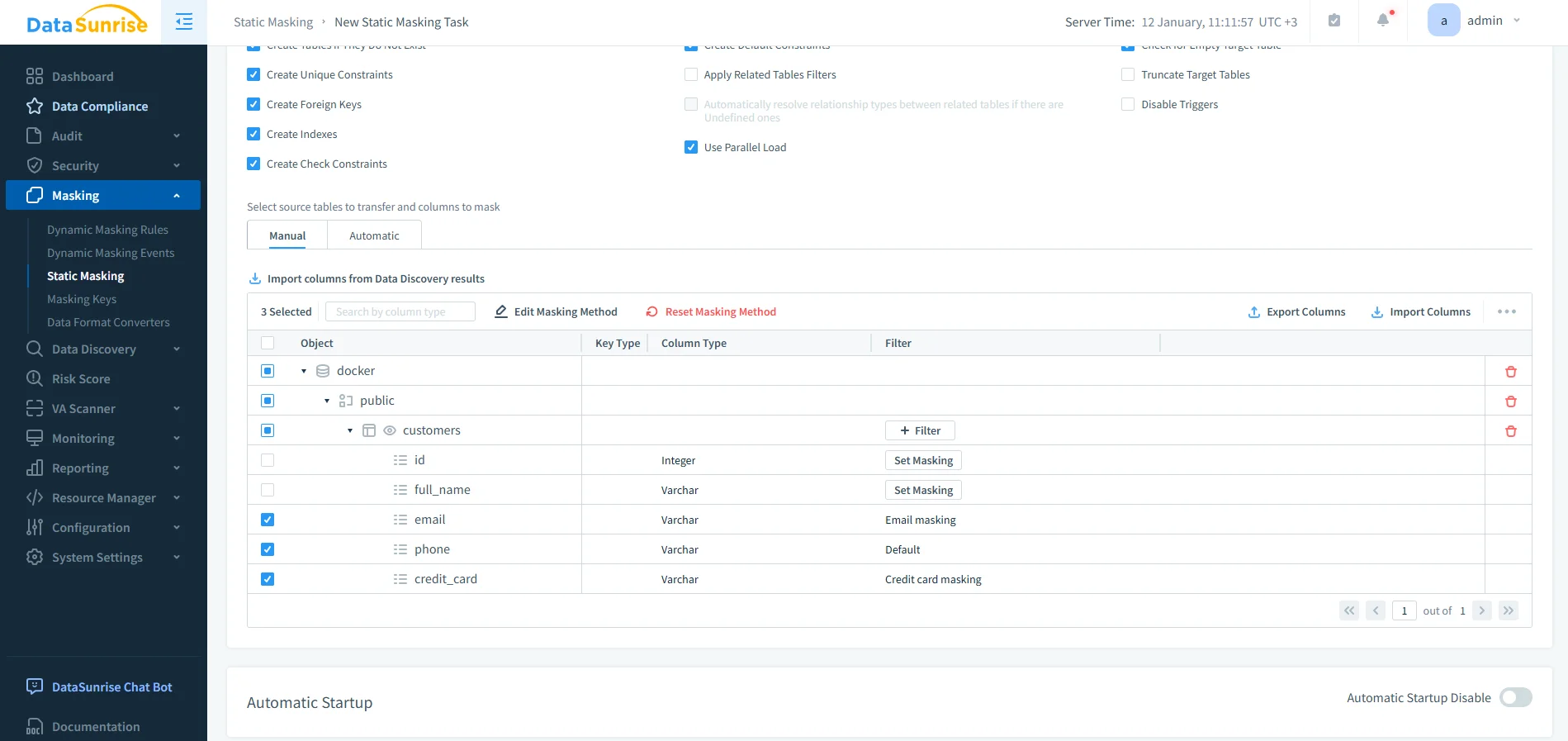
Policy-Based Column Identification
Instead of selecting individual fields manually, DataSunrise integrates with data discovery to identify sensitive Vertica columns automatically. After classification, transformation rules apply consistently across schemas.
This approach removes dependency on naming conventions and reduces the risk of leaving newly introduced columns unprotected.
Format-Preserving and Synthetic Transformations
Permanent transformations support multiple methods depending on data type and analytical requirements:
- Email substitution using valid synthetic addresses
- Phone number tokenization
- Irreversible hashing for identifiers
- Credit card masking with preserved length and structure
These transformations preserve analytical usability while eliminating exposure of real data.
Controlled Execution and Performance Safety
Transformation tasks execute as controlled operations with optional parallel processing. This design allows teams to process large Vertica datasets efficiently without impacting production analytics workloads.
Always execute irreversible transformations against snapshots or controlled copies of Vertica production data. Avoid applying permanent changes to live analytical datasets unless rollback is explicitly unnecessary.
Validated Results After Data Transformation
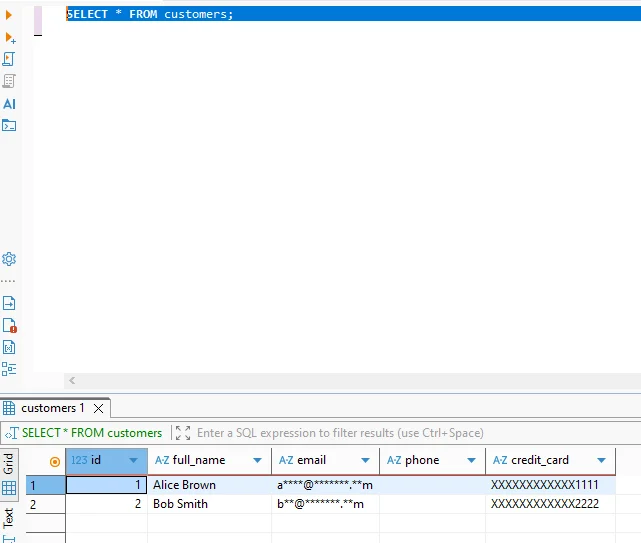
After processing completes, Vertica stores all sensitive fields in transformed form. Queries against the resulting dataset return no original values, even for privileged users.
The following query demonstrates how masked data appears when querying a Vertica table after irreversible transformation:
SELECT * FROM customers;
Because the transformation is irreversible, these datasets remain safe for analytics, QA environments, and external data sharing.
Auditing and Operational Transparency
Every transformation operation generates audit records. These records capture:
- Which tables and columns were processed
- Which transformation methods were applied
- When the task ran
- Who initiated the operation
This visibility integrates directly with database activity monitoring and audit logs, making data transformation defensible during audits.
Permanent Transformation vs Runtime Masking in Vertica
Teams often confuse irreversible transformation with runtime masking, yet each serves a different purpose.
Permanent masking alters stored values, while runtime masking applies transformations at query time.
Irreversible techniques fit best when:
- Data leaves production environments
- Compliance requires anonymization
- High-performance analytics must avoid runtime overhead
Compliance Alignment for Vertica Environments
| Regulation | Requirement | Transformation Role |
|---|---|---|
| GDPR | Irreversible anonymization of personal data | Permanent removal of identifiers |
| HIPAA | De-identification of PHI | Safe reuse of healthcare datasets |
| PCI DSS | Protection of cardholder data | Masked analytics and testing data |
| SOX | Controlled access to financial records | Safe non-production reporting |
These controls integrate naturally with workflows supported by the DataSunrise Compliance Manager.
Conclusion: Treating Irreversible Masking as a Core Control
Irreversible data masking in Vertica is not an optional enhancement. It is a foundational control for secure analytics operations. Manual SQL scripts may work temporarily, but they fail under scale, audit scrutiny, and evolving compliance requirements.
By centralizing transformation workflows with DataSunrise, organizations achieve consistent enforcement, clear auditability, and alignment with modern data compliance regulations. Masking becomes a governed process instead of a fragile collection of scripts.
If your Vertica environment supports multiple downstream consumers, permanent masking should already be part of your architecture. If it is not, that is not bravery — it is unmanaged risk.
Protect Your Data with DataSunrise
Secure your data across every layer with DataSunrise. Detect threats in real time with Activity Monitoring, Data Masking, and Database Firewall. Enforce Data Compliance, discover sensitive data, and protect workloads across 50+ supported cloud, on-prem, and AI system data source integrations.
Start protecting your critical data today
Request a Demo Download Now