Amazon Redshift Data Activity History
Amazon Redshift processes analytical workloads through massively parallel execution, distributing scans, joins, and compute workloads across multiple nodes. This architecture delivers high performance but disperses telemetry across many internal system logs. Without proper correlation, organizations lose visibility into how queries behave, how users access data, and how workloads evolve — a challenge emphasized in the official AWS guidance on Redshift monitoring (source).
A unified Redshift data activity history consolidates SQL events, structural changes, authentication details, and performance indicators into a chronological flow. Platforms like Data Audit, Data Activity History, and the broader Database Activity History framework in DataSunrise enhance this process by transforming fragmented Redshift logs into a connected, compliance-ready activity storyline that simplifies audits, investigations, and governance.
Importance of Data Activity History
A complete activity history provides not only transparency but operational and security assurance. It enables teams to reconstruct events with forensic precision, detect abnormal patterns and suspicious behavior, and diagnose slowdowns or inefficient workloads. It also produces audit artifacts required by SOX, GDPR, HIPAA, and PCI DSS, significantly reducing compliance burden and eliminating critical visibility gaps.
- A unified activity record strengthens oversight by combining SQL operations, metadata changes, and session insights into a single traceable flow, fully aligning with centralized enterprise monitoring frameworks such as Database Activity Monitoring.
- Continuous visibility supports proactive detection of misuse, leveraging analytical layers like Behavior Analytics that identify deviations before they escalate into incidents.
- Activity history enhances the accuracy of regulatory reporting by integrating consistently with Data Compliance workflows required for security audits and certification reviews.
- Detailed event lineage ensures integrity during investigations, connecting structural and operational signals that feed into broader Data Audit Trails used for forensic validation.
Native Redshift Components for Data Activity History
Amazon Redshift exposes its internal operations through system logs (STL) and virtual views (SVL). Below is a structured overview of essential components grouped into four concise categories.
1. Query Lifecycle & Execution Flow
These components describe how a query begins, transforms, and executes across the cluster.
STL Query Lifecycle
Tracks core query metadata — start time, end time, user, session, and status.
SELECT
    query,
    userid,
    starttime,
    endtime,
    substring,
    aborted
FROM stl_query
ORDER BY starttime DESC
LIMIT 40;
However, each node logs its portion separately, making native reconstruction incomplete.
SVL_STATEMENTTEXT
Shows the optimized version of the SQL statement.
SELECT query, sequence, text
FROM svl_statementtext
ORDER BY query DESC, sequence ASC;
Reveals rewritten SQL and optimizer transformations.
SVL_QUERY_METRICS
Provides high-level execution indicators.
SELECT
    query,
    cpu_time,
    exec_time,
    rows,
    temp_blocks_to_disk,
    query_queue_time
FROM svl_query_metrics
ORDER BY query DESC;
Useful for identifying CPU pressure, memory spills, and inefficiencies.
STL_WLM_QUERY / STL_WLM_QUERY_DESC
Reflect query placement inside workload queues.
SELECT
    service_class,
    query,
    queue_start_time,
    exec_start_time,
    queue_end_time
FROM stl_wlm_query;
Important for concurrency and queue latency analysis.
Together, these logs create the backbone of query-level analysis.
2. Scan, Metrics & Performance Diagnostics
These views illuminate how Redshift reads, processes, and distributes data during query execution.
SVL Scan Operations
SELECT
    q.query,
    s.tbl,
    s.rows,
    s.bytes,
    s.is_rrscan
FROM svl_qlog q
JOIN svl_scan s ON q.query = s.query
ORDER BY q.starttime DESC
LIMIT 40;
Reveals:
- Volume scanned
- Rows processed
- Zone-map usage
- Distribution behavior
Often producing multiple fragments per query.
SVL_QUERY_METRICS
(also relevant here)
SELECT
    query,
    cpu_time,
    blocks_read,
    blocks_written,
    spill_count
FROM svl_query_metrics
ORDER BY query DESC;
Provides insight into I/O, CPU pressure, and temp usage — key for diagnosing performance issues.
Together these logs support deep performance diagnostics.
3. DDL / DML Change Footprint
These logs reveal how users modify structures and data.
STL_DDLTEXT
Records DDL statements executed.
SELECT
    query,
    ddltext,
    starttime
FROM stl_ddltext
ORDER BY starttime DESC;
Useful for schema lineage and compliance.
STL_INSERT / STL_DELETE / STL_UPDATE
Detailed DML footprints.
SELECT *
FROM stl_insert
ORDER BY query DESC
LIMIT 20;
SELECT *
FROM stl_delete
ORDER BY query DESC
LIMIT 20;
SELECT *
FROM stl_update
ORDER BY query DESC
LIMIT 20;
Essential for forensics around data changes.
4. Authentication & Session Context
This group captures how users connect and interact with the cluster.
STL_CONNECTION_LOG & STL_USERLOG
SELECT
    recordtime,
    pid,
    userid,
    db,
    remotehost,
    event
FROM stl_connection_log
ORDER BY recordtime DESC;
Includes:
- Successful & failed logins
- Session identifiers
- Client application info
Critical for identity-based tracking.
Unified Redshift Data Activity History with DataSunrise
DataSunrise consolidates all Redshift telemetry into a unified chronological activity record using its Reverse Proxy Architecture. Instead of stitching fragments across STL and SVL manually, DataSunrise captures SQL events in real time and enriches them with context unavailable in native logs. It correlates SQL text, execution behavior, table interactions, identity data, structural changes, and behavioral indicators into a single, coherent audit storyline.
1. Centralized Activity Timeline
Combines Redshift’s fragmented log records into a single, readable history. It reconstructs query flow across nodes, sessions, and workload queues, producing an uninterrupted execution narrative. This unified timeline dramatically reduces forensic investigation time and improves operational clarity.
- Centralization eliminates the need to manually correlate STL and SVL logs, providing immediate clarity across the full query lifecycle through Data Activity History.
- Consolidated records feed directly into higher-level governance workflows, synchronizing seamlessly with Database Activity History modules used by security and compliance teams.
- The unified timeline also enhances analytical accuracy by integrating execution context and user behavior insights available through Behavior Analytics.
2. Granular Rule-Based Monitoring
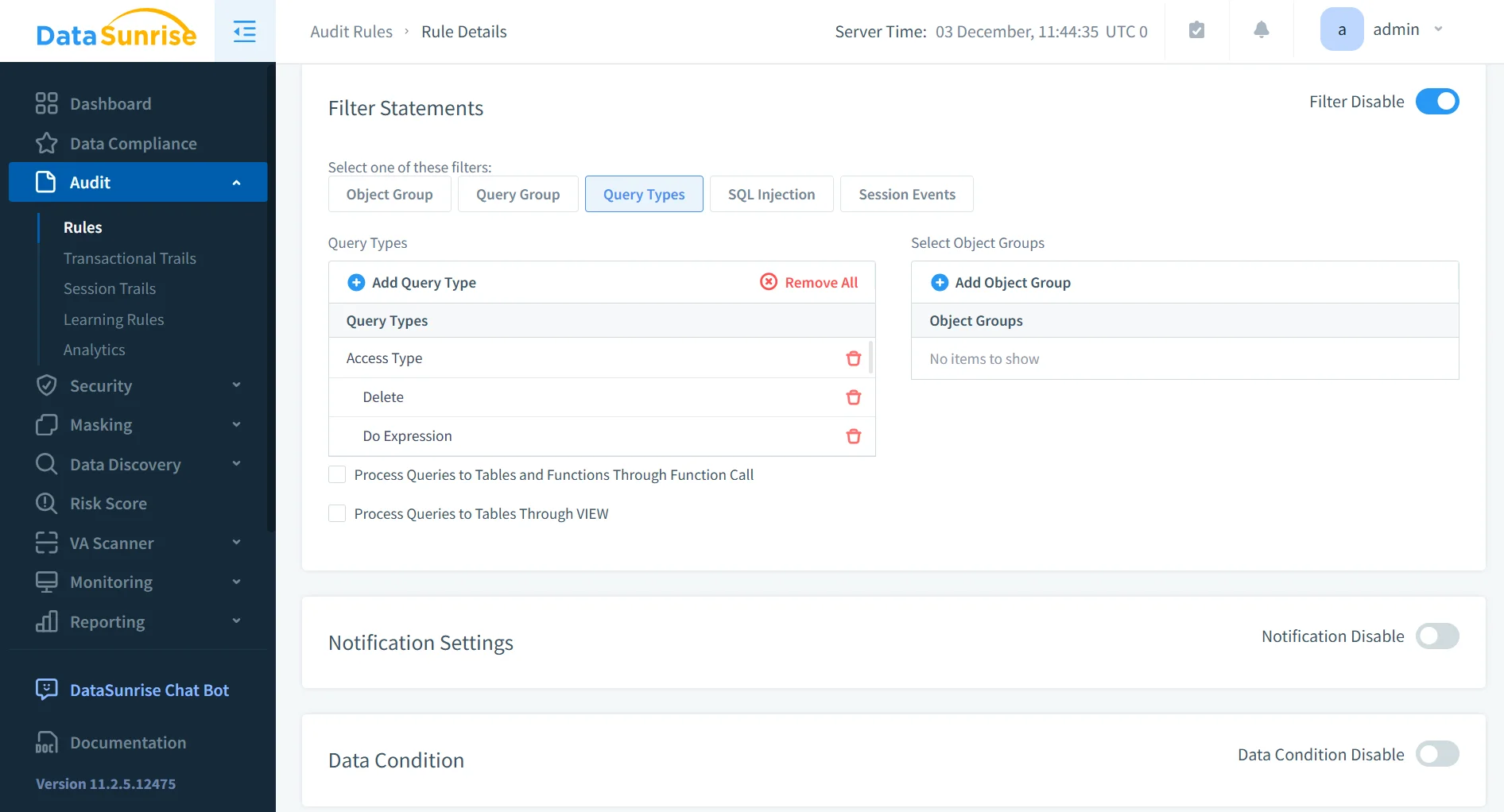
Allows selective auditing based on objects, users, operations, or compliance frameworks. Administrators can define precise policies that isolate sensitive assets or privileged roles for deeper oversight. Such targeted monitoring minimizes noise while ensuring every critical event is captured.
- Each audit rule can be aligned with predefined compliance templates in Data Compliance, ensuring consistent enforcement across the environment.
- Fine-grained monitoring allows prioritization of high-risk actions such as DDL, DML, or privileged access attempts.
- Rule-based auditing reduces storage overhead by capturing only meaningful and high-value activity signals.
3. Real-Time Threat Insight
Detects anomalies such as abnormal query patterns, privilege misuse, or SQL exploitation. Machine-learning–driven behavior analysis highlights deviations from established user and workload baselines. This enables proactive detection of insider threats, compromised credentials, and malicious access patterns.
- Threat signatures are enriched with contextual metadata, allowing accurate detection even in high-volume analytical workloads.
- Real-time alerts integrate with existing monitoring ecosystems, complementing defensive layers described in Database Security.
- Continuous behavioral learning improves precision over time, reducing false positives and operational noise.
4. Compliance-Ready History Across Clusters
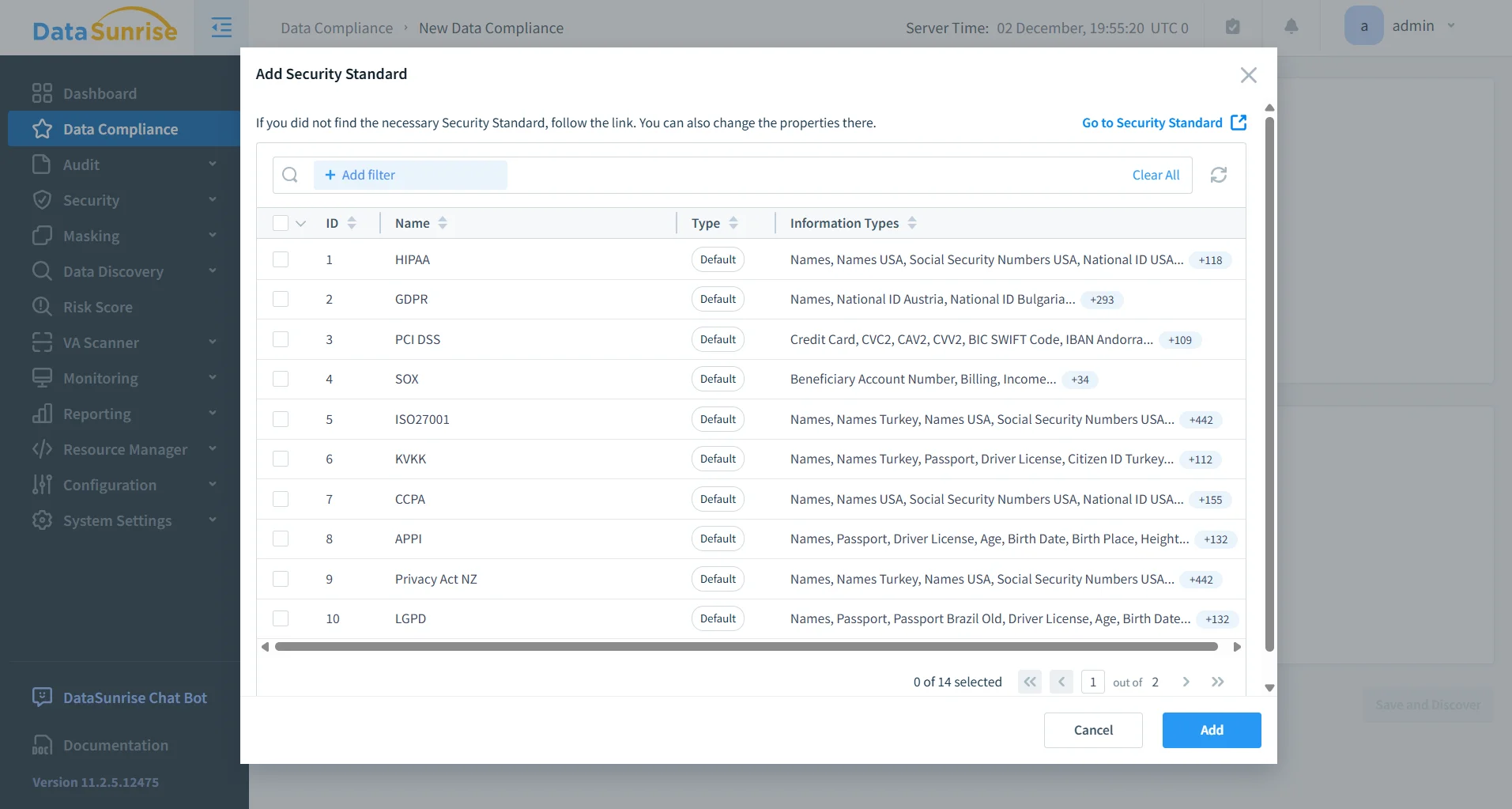
Creates consistent audit trails aligned with SOX, GDPR, HIPAA, PCI DSS, and internal governance controls. DataSunrise standardizes logs across environments, eliminating manual stitching and interpretation work. This makes audit preparation significantly faster while ensuring evidence integrity for regulatory assessments.
- Compliance automation ensures that every required event type is captured, classified, and retained according to policy.
- Regulators benefit from predictable, audit-ready outputs, such as those generated using Audit Logs.
- Cross-cluster normalization guarantees that multi-region and hybrid deployments maintain consistent audit fidelity.
Key Advantages of Using DataSunrise with Amazon Redshift
| Capability | Description |
|---|---|
| Cohesive SQL Visibility | Combines native STL/SVL fragments into a complete, correlated activity view. |
| Real-Time Threat Detection | Leverages behavioral analytics to surface anomalies and risky actions. |
| Cross-Node Correlation | Unifies multi-node execution fragments into meaningful timelines. |
| Automated Compliance Alignment | Generates audit histories suitable for PCI DSS, HIPAA, GDPR, SOX. |
| Behavioral Intelligence | Highlights deviations from normal access or query behavior. |
| Centralized Governance Layer | Turns Redshift into a fully monitored and policy-controlled platform. |
Conclusion
Redshift’s native logs provide fragments — DataSunrise provides the complete, contextualized narrative. A unified Redshift data activity history enables security monitoring, governance, forensic reconstruction, audit readiness, and regulatory compliance. DataSunrise transforms Redshift from a cluster of isolated logs into a governed analytical ecosystem with continuous visibility and control.
By aligning Redshift telemetry with structured audit frameworks such as Audit Logs, organizations gain traceability that meets internal and external oversight standards. The platform’s ability to merge behavioral insights from Behavior Analytics with SQL-layer events dramatically improves threat detection accuracy. Compliance workflows are strengthened through seamless integration with Data Compliance controls, ensuring that evidence is complete, consistent, and audit-ready. Finally, long-term retention and traceability supported by Data Activity History give teams the operational continuity needed to maintain secure, well-governed Redshift environments at scale.
Protect Your Data with DataSunrise
Secure your data across every layer with DataSunrise. Detect threats in real time with Activity Monitoring, Data Masking, and Database Firewall. Enforce Data Compliance, discover sensitive data, and protect workloads across 50+ supported cloud, on-prem, and AI system data source integrations.
Start protecting your critical data today
Request a Demo Download Now