Data Anonymization in Microsoft SQL Server
Data anonymization in Microsoft SQL Server has become a critical requirement for organizations handling sensitive information across production systems, analytics environments, cloud workloads, development pipelines, and AI-driven platforms.
Modern SQL Server infrastructures often process personally identifiable information (PII), payment records, healthcare data, operational metadata, customer analytics, authentication credentials, and regulated business information. While encryption and access controls remain important, they do not fully solve the problem of exposing sensitive data during reporting, testing, analytics, third-party sharing, or machine learning operations.
Organizations increasingly require techniques that permanently or dynamically anonymize data while preserving usability for developers, analysts, auditors, and applications. This challenge becomes significantly more complex in hybrid infrastructures spanning on-premise SQL Server deployments, Azure SQL environments, cloud storage platforms, data lakes, and distributed analytics systems.
Meanwhile, regulatory frameworks such as GDPR, HIPAA, PCI DSS, SOX, ISO 27001, SOC 2, and CCPA continue tightening requirements around privacy protection, access visibility, and exposure minimization.
Microsoft SQL Server includes several native capabilities that help reduce data exposure. However, maintaining consistent anonymization policies across multiple environments often requires centralized governance, automation, and continuous compliance alignment.
This article explores native Microsoft SQL Server anonymization capabilities and demonstrates how DataSunrise extends them through autonomous policy orchestration, Zero-Touch Data Masking, Compliance Autopilot, and centralized compliance governance.
Organizations also increasingly combine anonymization with database activity monitoring and automated compliance workflows to reduce operational risk across modern SQL Server infrastructures.
What Is Data Anonymization in Microsoft SQL Server?
Data anonymization is the process of transforming sensitive information into non-identifiable values while preserving operational usability.
Unlike encryption, anonymization prevents users from reconstructing original values without authorized access to protected datasets. Organizations commonly use anonymization in Microsoft SQL Server for development environments, analytics platforms, AI and ML training datasets, compliance reporting, and third-party data sharing.
SQL Server infrastructures frequently anonymize personal information, financial records, healthcare data, authentication credentials, employee records, and customer analytics datasets before allowing broader access. These processes are often combined with dynamic data masking, data security, database activity monitoring, and sensitive data discovery to improve protection across SQL Server infrastructures.
Without proper anonymization, copied production databases can expose organizations to regulatory violations, insider threats, and major operational risks. Because handing raw customer data to every testing environment has always been a truly breathtaking security philosophy.
Native Data Anonymization Features in Microsoft SQL Server
Microsoft SQL Server includes several native mechanisms that help organizations anonymize or partially obfuscate sensitive information across operational and non-production environments.
Dynamic Data Masking
Dynamic Data Masking (DDM) hides sensitive values in query results for non-privileged users without modifying the original stored data.
Creating a Masked Table
CREATE TABLE Employees (
    EmployeeID INT PRIMARY KEY,
    FullName NVARCHAR(100),
    Email NVARCHAR(255) MASKED WITH (FUNCTION = 'email()'),
    PhoneNumber NVARCHAR(30) MASKED WITH (FUNCTION = 'partial(2,"XXXXXXX",2)'),
    Salary DECIMAL(10,2) MASKED WITH (FUNCTION = 'default()')
);
Example Query
SELECT * FROM Employees;
Users without elevated permissions may see partially hidden results where email addresses, phone numbers, and salaries are masked during query execution.
Dynamic Data Masking is useful for reducing exposure during runtime access, reporting, and support operations. However, it does not permanently anonymize the stored data itself.
Static Data Anonymization Using UPDATE Operations
Organizations often create anonymized copies of production databases for development, testing, analytics, or third-party access.
Example Static Anonymization
UPDATE Customers
SET
    FullName = CONCAT('User_', CustomerID),
    Email = CONCAT('user', CustomerID, '@example.com'),
    Phone = '000-000-0000';
This approach permanently modifies copied datasets by replacing original values with anonymized content.
Although static anonymization can work effectively in isolated environments, maintaining these transformations manually across multiple SQL Server instances quickly becomes operationally painful. Because apparently maintaining 47 slightly different masking scripts across environments sounded manageable during the planning meeting.
Row-Level Security with Anonymization Logic
SQL Server Row-Level Security can reduce sensitive data exposure by limiting visibility to specific records based on user context.
Example Predicate Function
CREATE FUNCTION dbo.SecurityPredicate(@Department AS NVARCHAR(50))
RETURNS TABLE
WITH SCHEMABINDING
AS
RETURN SELECT 1 AS Result
WHERE @Department = USER_NAME();
Applying the Security Policy
CREATE SECURITY POLICY DepartmentFilter
ADD FILTER PREDICATE dbo.SecurityPredicate(Department)
ON dbo.EmployeeData;
This approach helps restrict dataset visibility and reduce unauthorized access exposure. However, it does not fully anonymize the underlying sensitive fields returned to authorized users.
Autonomous Data Anonymization with DataSunrise
DataSunrise deploys Autonomous Compliance Orchestration to deliver centralized data anonymization for Microsoft SQL Server with zero-touch implementation.
Unlike fragmented native workflows that require constant scripting adjustments, manual synchronization, and environment-specific rule maintenance, DataSunrise provides Continuous Compliance Calibration across cloud, hybrid, and on-premise SQL Server infrastructures.
The platform combines autonomous policy management, intelligent discovery engines, centralized governance, and adaptive masking technologies to reduce operational complexity while improving regulatory alignment.
Zero-Touch Data Masking
DataSunrise enables organizations to apply anonymization policies without manually rewriting database logic or modifying applications.
The platform supports:
- Dynamic masking
- Static masking
- Conditional anonymization
- Role-based masking
- Context-aware protection
- Real-time masking enforcement
Policies can automatically adapt based on user roles, source applications, IP ranges, geolocation, query behavior, or compliance requirements.
This allows organizations to anonymize sensitive SQL Server data consistently across development, analytics, reporting, and third-party environments without maintaining dozens of disconnected masking scripts. Which, shockingly, turns out to be more sustainable than “Steve from DevOps remembers how the masking cron job works.”
Compliance Autopilot
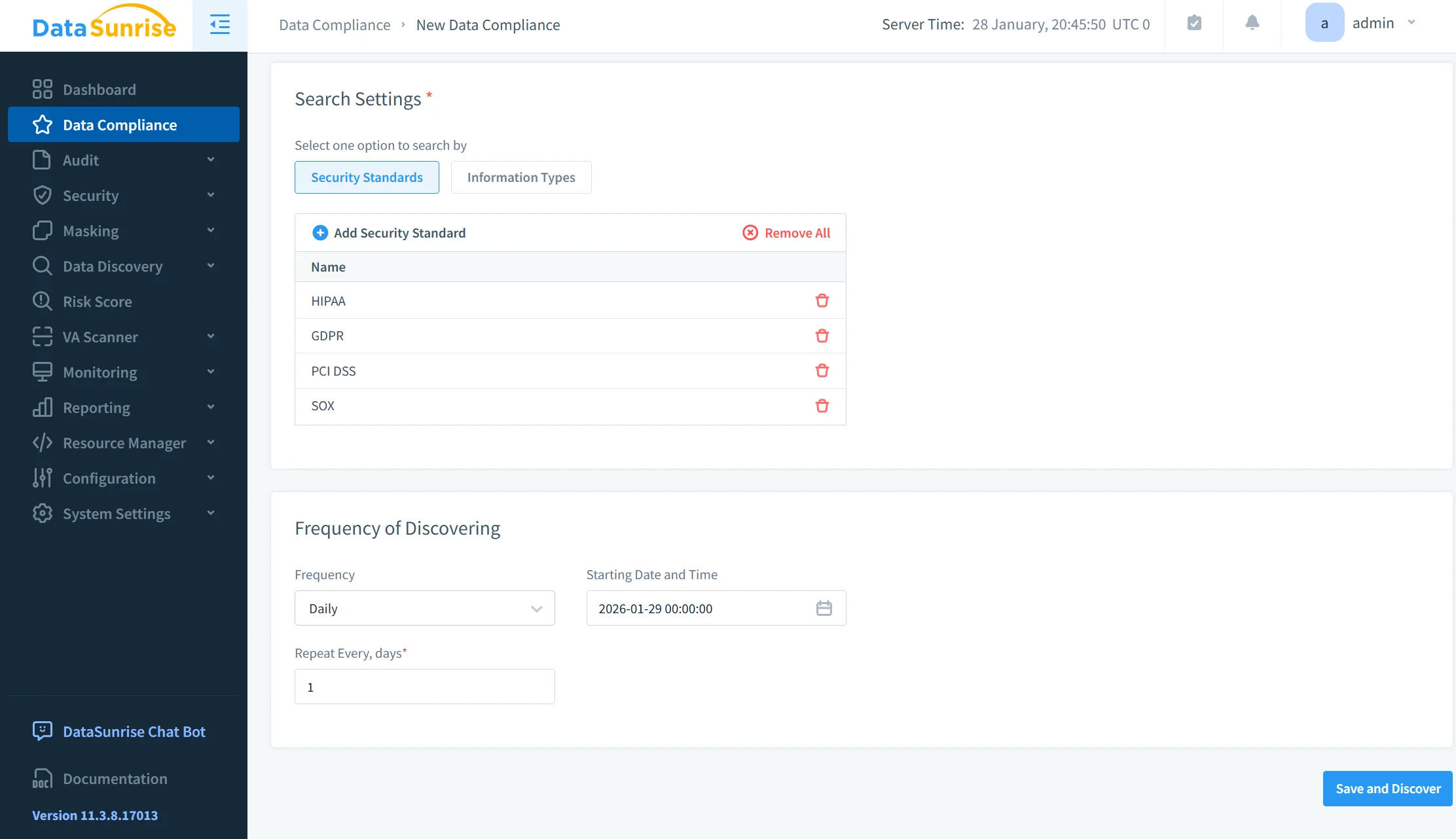
DataSunrise continuously monitors SQL Server environments for compliance gaps and sensitive data exposure risks.
Compliance Autopilot helps automate alignment with frameworks including:
- GDPR
- HIPAA
- PCI DSS
- SOX
- ISO 27001
- SOC 2
- CCPA
The platform automatically generates audit-ready reporting, tracks policy violations, and simplifies evidence collection for regulatory reviews.
Instead of manually preparing compliance documentation every quarter like medieval monks preserving forbidden manuscripts, organizations can centralize reporting and automate much of the verification process.
ML Audit Rules and Behavioral Analytics
DataSunrise uses ML Audit Rules and behavioral analysis engines to identify suspicious access patterns and anomalous database activity.
The system can detect:
- Unusual query behavior
- Excessive sensitive data access
- Privilege misuse
- Suspicious login activity
- Abnormal export operations
- Unauthorized access attempts
This helps organizations strengthen insider threat detection while improving visibility into how anonymized datasets are accessed across SQL Server infrastructures.
NLP Data Discovery and OCR Image Scanning
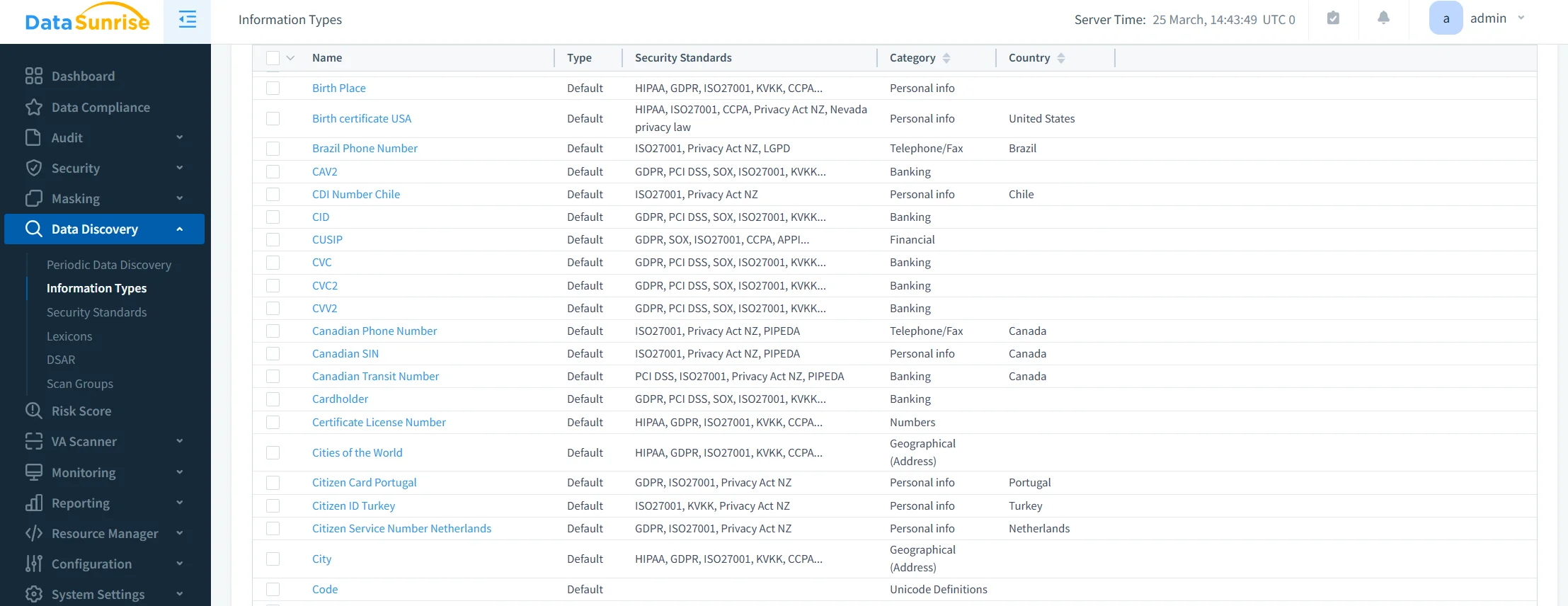
DataSunrise extends anonymization beyond traditional relational tables.
The platform supports automated discovery of:
- Structured data
- Semi-structured data
- Unstructured files
- Cloud storage repositories
- OCR-extracted image content
Using NLP Data Discovery and OCR Image Scanning, DataSunrise can identify sensitive information inside:
- Text documents
- Logs
- PDFs
- Images
- File storage systems
- Cloud object storage
This significantly expands regulatory coverage compared to traditional database-only anonymization solutions.
Centralized Policy Management
DataSunrise provides a Unified Security Framework that centralizes anonymization policies across heterogeneous environments.
Organizations can manage policies consistently across:
- Microsoft SQL Server
- Azure SQL
- Hybrid infrastructures
- Cloud-native environments
- Multi-region deployments
- Development and QA systems
Centralized management reduces administrative overhead while improving policy consistency and compliance alignment across environments.
Real-Time Regulatory Alignment
DataSunrise continuously evaluates anonymization policies and database activity against evolving compliance requirements.
Continuous Compliance Calibration helps organizations:
- Detect policy drift
- Identify exposure gaps
- Maintain audit readiness
- Simplify compliance operations
- Reduce manual oversight
Unlike traditional solutions that require constant rule tuning and manual adjustments, DataSunrise delivers adaptive anonymization management with significantly reduced operational friction.
Because spending half the week manually comparing masking policies between production and QA environments is not actually a personality trait.
Business Impact of Data Anonymization
| Benefit | Business Impact |
|---|---|
| Reduced Exposure Risk | Limits sensitive data leakage and strengthens data security across SQL Server environments |
| Faster Compliance Audits | Simplifies regulatory reporting through centralized automated compliance reporting |
| Safer Development Pipelines | Protects non-production environments using static data masking and anonymized datasets |
| Lower Insider Threat Risk | Restricts unauthorized visibility with access controls and policy enforcement |
| Improved Third-Party Sharing | Enables safer collaboration through dynamic data masking technologies |
| AI Dataset Protection | Secures training environments and sensitive analytics workflows with LLM and ML security tools |
| Centralized Governance | Reduces operational fragmentation through unified policy management |
| Automated Compliance Alignment | Minimizes manual oversight and improves continuous regulatory alignment |
Conclusion
Data anonymization in Microsoft SQL Server is no longer limited to isolated masking functions or manually maintained scripts. Modern infrastructures require scalable protection strategies capable of securing sensitive information across cloud, hybrid, analytics, AI, and operational environments.
Native SQL Server capabilities provide a useful foundation for reducing data exposure. However, maintaining consistent anonymization policies, centralized governance, and regulatory alignment across distributed infrastructures rapidly becomes operationally complex.
DataSunrise transforms anonymization into a centralized autonomous compliance framework through Zero-Touch Data Masking, Compliance Autopilot, Intelligent Policy Orchestration, ML Audit Rules, and Unified Security Framework integration.
Unlike fragmented anonymization workflows requiring constant maintenance, DataSunrise delivers Continuous Compliance Alignment across Microsoft SQL Server ecosystems while minimizing administrative effort and reducing operational risk.
The platform combines enterprise-grade automation with the fine-grained controls technical teams require, enabling organizations to secure sensitive SQL Server data while accelerating compliance operations and reducing exposure risk.
To further strengthen Microsoft SQL Server protection strategies, organizations commonly combine anonymization with database activity monitoring, sensitive data discovery, data security policies, and centralized compliance management.
Protect Your Data with DataSunrise
Secure your data across every layer with DataSunrise. Detect threats in real time with Activity Monitoring, Data Masking, and Database Firewall. Enforce Data Compliance, discover sensitive data, and protect workloads across 50+ supported cloud, on-prem, and AI system data source integrations.
Start protecting your critical data today
Request a Demo Download Now