Amazon DocumentDB Data Governance
As organizations store growing volumes of sensitive information in cloud databases, maintaining consistent governance becomes increasingly important. Amazon DocumentDB Data Governance helps organizations establish policies that control how data is stored, accessed, monitored, and protected throughout its lifecycle. Effective governance reduces operational risk, improves accountability, and supports regulatory requirements while ensuring data remains available for business operations.
Amazon DocumentDB provides several native AWS services that contribute to governance, including AWS Identity and Access Management (IAM), automated backups, AWS Key Management Service (KMS), Amazon CloudWatch, AWS CloudTrail, AWS Config, Virtual Private Cloud (VPC), and resource tagging. Together, these capabilities help administrators manage access, monitor activity, and enforce organizational policies.
However, enterprise data governance extends beyond infrastructure management. Organizations also need continuous visibility into sensitive information, automated policy enforcement, centralized governance across heterogeneous environments, and simplified compliance reporting. This article explores Amazon DocumentDB's native governance capabilities and demonstrates how DataSunrise enhances governance through intelligent automation, centralized policy management, and comprehensive data compliance across modern database environments.
What is Amazon DocumentDB Data Governance?
Amazon DocumentDB Data Governance is the collection of policies, technologies, and operational practices used to manage data securely throughout its lifecycle. Governance defines who can access information, how sensitive data is protected, how administrative actions are monitored, and how organizations demonstrate compliance with internal policies and external regulations.
Unlike basic security controls that primarily prevent unauthorized access, data governance establishes an organization-wide framework for maintaining data quality, accountability, transparency, and regulatory compliance. Governance also helps ensure that security controls remain consistent as databases, applications, and users evolve through centralized data security policies and continuous oversight.
For Amazon DocumentDB environments, governance typically includes:
- Identity and access management through AWS IAM
- Encryption using AWS KMS
- Network isolation with Amazon VPC
- Activity monitoring through CloudTrail and CloudWatch
- Automated backup and recovery policies
- Resource tagging for operational management
- Configuration monitoring with AWS Config
- Continuous review of security posture
These native AWS capabilities provide a strong governance foundation. Organizations can further strengthen governance by combining them with database activity monitoring, sensitive data discovery, automated compliance management, and centralized security policies across multiple database platforms.
As regulatory requirements such as GDPR, HIPAA, PCI DSS, SOX, and CCPA continue to evolve, modern governance programs increasingly rely on automation to reduce administrative overhead while maintaining consistent security and compliance across cloud environments. Organizations also benefit from implementing comprehensive data management practices that align governance with business objectives and long-term operational resilience.
Native Amazon DocumentDB Data Governance
Amazon DocumentDB relies on AWS security and management services to establish governance controls across authentication, encryption, monitoring, backup, and configuration management. Although governance capabilities are distributed across multiple AWS services rather than managed from a single console, they provide a solid framework for securing database environments.
Identity and Access Management
Governance begins with controlling administrative access. Amazon DocumentDB integrates with AWS Identity and Access Management (IAM), allowing administrators to define granular permissions for creating, modifying, deleting, and managing database clusters.
Organizations should follow the principle of least privilege by assigning only the permissions required for each administrator or automation service.
Example IAM policy allowing read-only access to Amazon DocumentDB:
{
  "Version": "2012-10-17",
  "Statement": [
    {
      "Effect": "Allow",
      "Action": [
        "docdb:DescribeDBClusters",
        "docdb:DescribeDBInstances"
      ],
      "Resource": "*"
    }
  ]
}
IAM also supports role-based authentication for AWS services that interact with DocumentDB, simplifying secure automation while reducing long-term credential management.
Encryption with AWS KMS
Protecting stored information is another essential governance requirement. Amazon DocumentDB encrypts data at rest using AWS Key Management Service (KMS). Encryption secures database storage, automated backups, snapshots, and storage volumes without requiring application changes.
Encryption is enabled when creating a cluster.
Example using AWS CLI:
aws docdb create-db-cluster \
  --db-cluster-identifier governance-cluster \
  --engine docdb \
  --master-username admin \
  --master-user-password StrongPassword123 \
  --kms-key-id arn:aws:kms:region:account:key/key-id \
  --storage-encrypted
Using customer-managed KMS keys provides greater control over key rotation, auditing, and access policies.
Network Governance with Amazon VPC
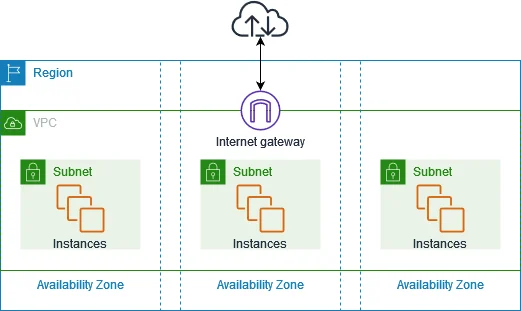
Amazon DocumentDB clusters operate inside Amazon Virtual Private Cloud (VPC), allowing organizations to isolate database infrastructure from public networks.
Governance best practices include deploying clusters inside private subnets, restricting inbound traffic with Security Groups, using Network ACLs for additional filtering, and limiting administrative access through VPN or AWS Direct Connect. Together, these controls reduce the attack surface while supporting internal governance requirements.
Monitoring Administrative Activity
Governance depends on visibility into administrative operations.
AWS CloudTrail records management events such as cluster creation, cluster deletion, snapshot operations, parameter modifications, security group changes, and IAM policy usage.
CloudWatch complements CloudTrail by monitoring operational metrics including CPU utilization, database connections, freeable memory, storage utilization, and replica lag. Administrators can configure CloudWatch alarms to notify security teams whenever operational thresholds are exceeded, helping them respond to potential issues before they affect production workloads.
Automated Backup Governance
A comprehensive governance strategy includes reliable recovery procedures.
Amazon DocumentDB provides automated backups with configurable retention periods and supports manual snapshots for long-term preservation.
Example CLI configuration:
aws docdb modify-db-cluster \
  --db-cluster-identifier governance-cluster \
  --backup-retention-period 14 \
  --apply-immediately
Organizations should regularly validate backup restoration procedures to ensure business continuity requirements are met and recovery objectives can be achieved during an incident.
Configuration Monitoring with AWS Config
AWS Config continuously evaluates Amazon DocumentDB resources against organizational policies.
For example, administrators can verify that encryption remains enabled, backup retention meets company standards, security groups follow approved configurations, clusters remain inside authorized VPCs, and required resource tags are present.
By maintaining a complete history of configuration changes, AWS Config simplifies auditing, helps detect configuration drift, and enables organizations to demonstrate compliance with internal governance policies and external regulatory requirements.
Enhancing Amazon DocumentDB Data Governance with DataSunrise
Native AWS services establish a solid governance foundation for Amazon DocumentDB. However, enterprise governance requires continuous visibility into sensitive information, automated policy enforcement, centralized administration, and ongoing compliance validation. As database environments grow across multiple AWS accounts and cloud platforms, manual governance quickly becomes difficult to maintain.
DataSunrise extends Amazon DocumentDB with intelligent governance capabilities that automate security administration, simplify regulatory compliance, and provide centralized oversight across heterogeneous environments through a unified data compliance platform.
Zero-Touch Governance Deployment
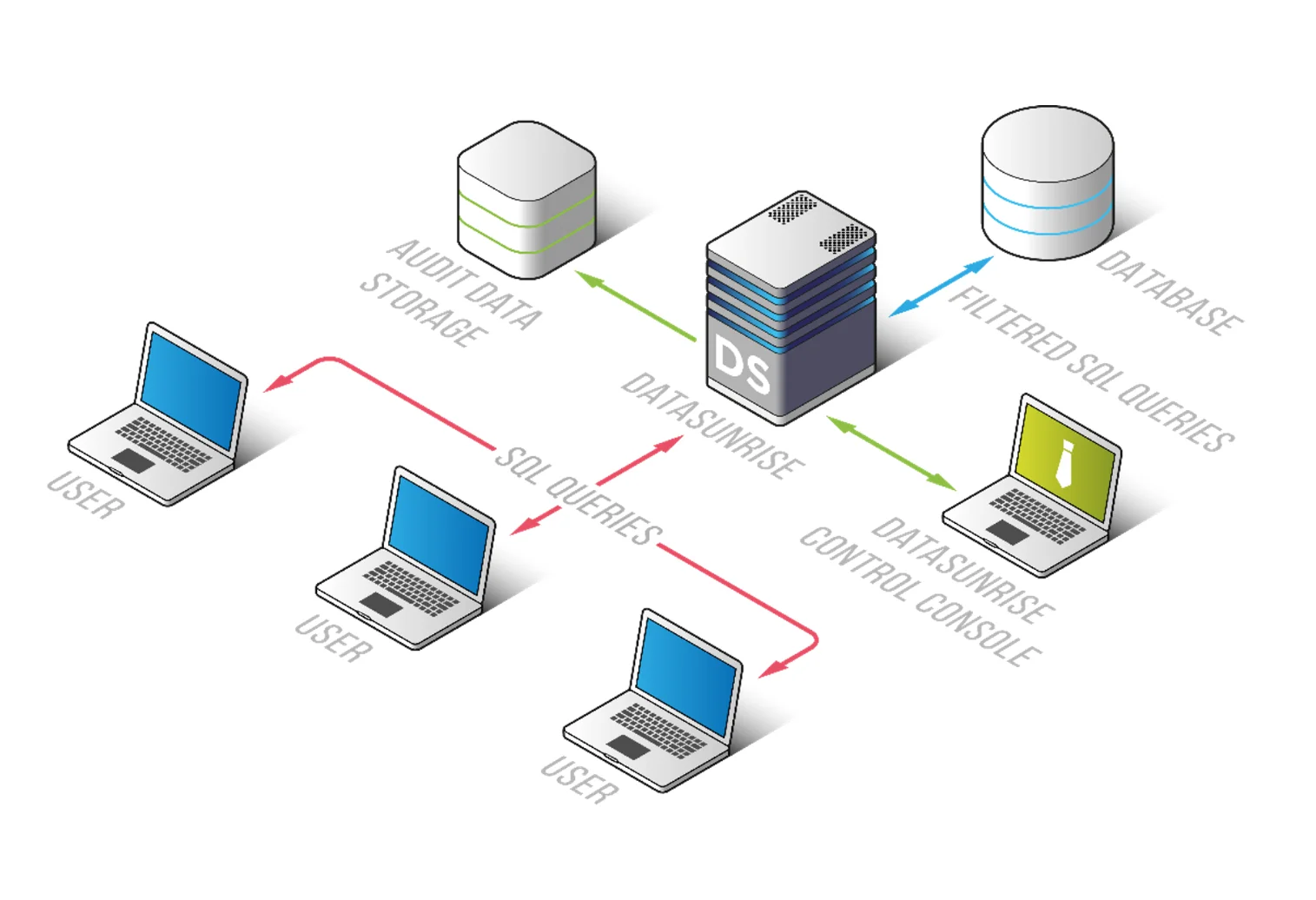
DataSunrise deploys a centralized governance layer that integrates with Amazon DocumentDB without requiring modifications to existing applications. Flexible deployment modes, including Proxy, Native Log Trailing, and Sniffer modes, allow organizations to choose the implementation that best fits their infrastructure while minimizing operational disruption.
After connecting an Amazon DocumentDB cluster, administrators can immediately begin applying governance policies from a unified management console.
Sensitive Data Discovery
Effective governance begins with understanding where sensitive information resides.
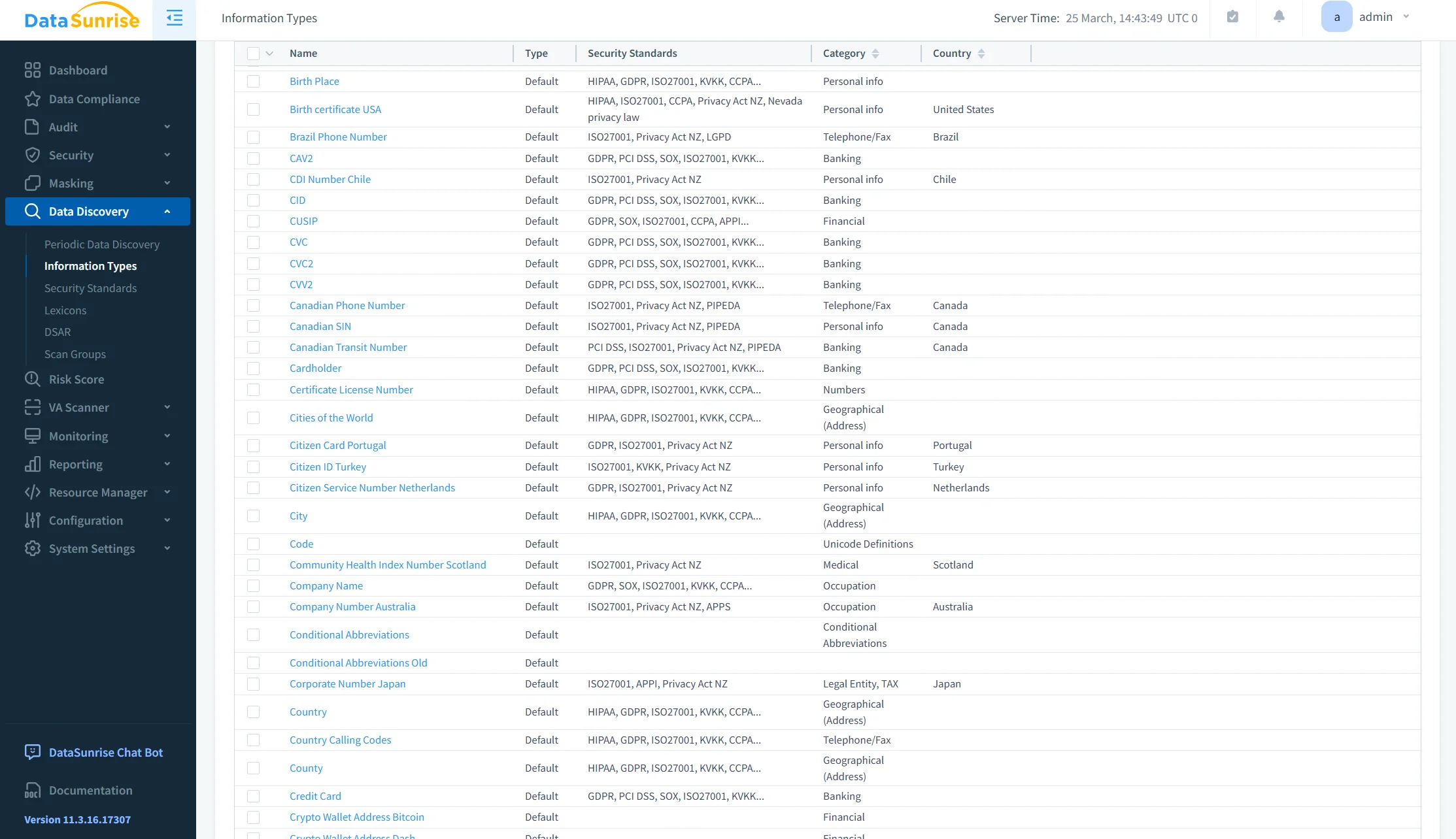
DataSunrise automatically performs Sensitive Data Discovery across Amazon DocumentDB collections. The platform can identify personally identifiable information, financial records, healthcare information, payment card data, and custom business-sensitive information.
Automatic classification provides organizations with complete visibility into sensitive assets before governance policies are applied. This helps administrators determine which collections require stronger controls and reduces the risk of leaving regulated information unprotected.
Automatic Policy Generation
Once sensitive information is identified, DataSunrise can automatically generate governance policies based on discovered data classifications.
Rather than manually defining rules for every collection, administrators can create policies that protect regulated information consistently across environments. This significantly reduces administrative effort while ensuring governance controls remain aligned with evolving database structures.
Automatic Policy Generation also helps organizations respond faster when new collections or sensitive fields appear. Instead of waiting for a manual review, the platform can use discovery results to recommend or create appropriate protection rules.
Compliance Autopilot
Maintaining compliance manually becomes increasingly difficult as regulations evolve.
DataSunrise Compliance Autopilot continuously maps governance controls to regulatory frameworks such as GDPR, HIPAA, PCI DSS, SOX, and CCPA.
Instead of relying on periodic manual reviews, Compliance Autopilot evaluates governance posture and recommends policy improvements whenever compliance gaps are detected. This approach accelerates audit preparation, reduces manual oversight, and lowers the risk of inconsistent policy enforcement.
Continuous Regulatory Calibration
Regulatory requirements change over time, while databases continue to grow and evolve.
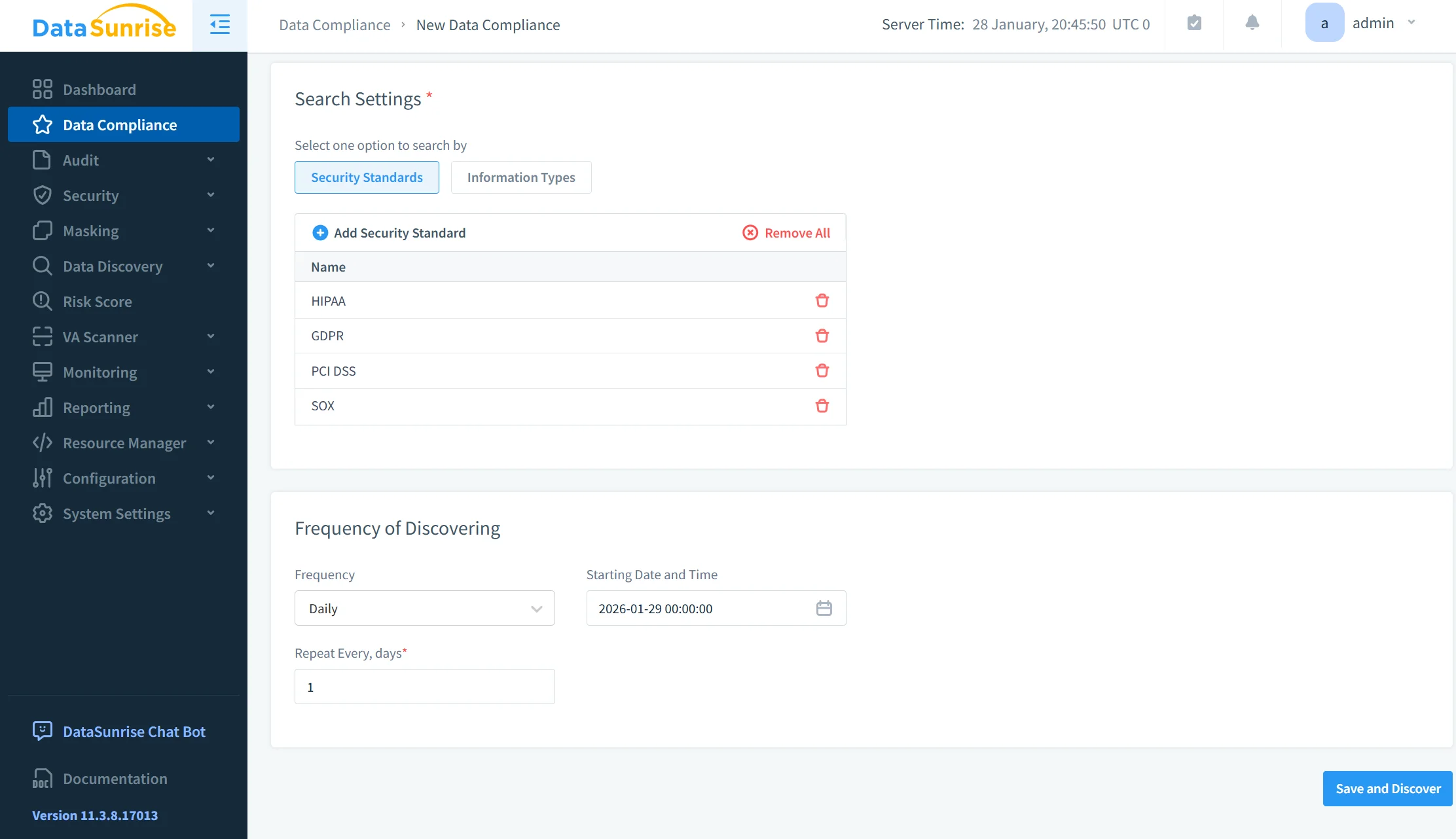
Continuous Regulatory Calibration periodically evaluates Amazon DocumentDB environments for newly discovered sensitive information, configuration changes, missing governance policies, compliance gaps, and newly created collections requiring protection.
This continuous validation helps organizations maintain governance without constant manual reviews. It also supports a more adaptive compliance strategy by keeping protection controls aligned with database growth and regulatory changes.
Centralized Database Activity Monitoring
Infrastructure monitoring alone cannot provide complete governance visibility.
DataSunrise delivers comprehensive Database Activity Monitoring by recording detailed database activity. This includes user authentication, read operations, insert, update, and delete statements, administrative actions, failed access attempts, and privileged user activity.
Unlike infrastructure logs that primarily capture AWS management events, DataSunrise provides detailed visibility into database interactions. These records support forensic investigations, governance reporting, incident response, and internal reviews.
Centralized monitoring also helps security teams detect unauthorized access and understand how users interact with regulated information over time.
Machine Learning Audit Rules
Modern governance increasingly relies on intelligent detection rather than static rule sets.
Machine Learning Audit Rules analyze database behavior to identify unusual access patterns that may indicate privilege misuse, abnormal query behavior, insider threats, suspicious administrative activity, or unexpected access to regulated information.
Combined with User Behavior Analysis (UBA), this behavioral analysis strengthens governance by identifying risks that traditional rule-based monitoring may overlook.
Machine learning also helps reduce unnecessary alert noise by highlighting behavior that differs from established usage patterns. This allows security teams to focus on events that present a higher governance or compliance risk.
Centralized Governance Across Multiple Platforms
Many organizations operate far beyond a single Amazon DocumentDB deployment.
DataSunrise provides a unified governance platform for Amazon DocumentDB alongside relational databases, NoSQL platforms, cloud databases, data warehouses, file systems, and cloud storage services. With support for more than 50 supported data storage platforms, organizations can enforce consistent governance policies across hybrid and multi-cloud infrastructures.
Administrators manage governance policies from one interface instead of maintaining separate configurations across multiple environments. This centralized approach improves consistency, strengthens security governance, reduces policy fragmentation, and significantly lowers operational complexity.
Business Benefits of DataSunrise for Amazon DocumentDB Data Governance
| Benefit | Business Impact |
|---|---|
| Centralized governance | Applies consistent security and governance policies across Amazon DocumentDB and heterogeneous data environments |
| Automated policy management | Reduces manual administration through Automatic Policy Generation and Compliance Autopilot |
| Complete data visibility | Identifies sensitive information before it becomes a compliance risk |
| Continuous compliance | Continuously validates governance posture against evolving regulations |
| Improved audit readiness | Produces comprehensive reports for regulatory audits and internal assessments |
| Real-time monitoring | Detects suspicious database activity as it occurs |
| Lower operational overhead | Automates repetitive governance and compliance tasks |
| Flexible deployment | Supports cloud, hybrid, and on-premises infrastructures without disrupting existing workflows |
| Stronger risk management | Reduces the likelihood of unauthorized access, policy violations, and compliance failures |
Modern governance requires far more than protecting infrastructure. Organizations must continuously identify sensitive data, enforce access policies, monitor user activity, maintain audit evidence, and demonstrate compliance across increasingly complex environments. DataSunrise automates these responsibilities through centralized database activity monitoring and policy-driven controls, allowing security teams to focus on risk management rather than repetitive administrative work.
Its centralized governance platform improves visibility across Amazon DocumentDB while maintaining consistent security controls for relational databases, NoSQL platforms, cloud storage, data warehouses, and hybrid infrastructures. Automated workflows and automated compliance reporting help reduce compliance gaps while improving operational efficiency.
Conclusion
Amazon DocumentDB provides a strong foundation for data governance through AWS IAM, KMS encryption, Amazon VPC, CloudTrail, CloudWatch, AWS Config, automated backups, and resource tagging. These native services help organizations secure infrastructure, control administrative access, monitor configuration changes, and maintain reliable recovery procedures.
However, comprehensive data governance extends well beyond infrastructure management. Organizations must continuously discover sensitive information, automate governance policies, monitor database activity, detect abnormal behavior, validate regulatory compliance, and maintain centralized oversight across multiple environments.
DataSunrise enhances Amazon DocumentDB Data Governance through Zero-Touch deployment, Sensitive Data Discovery, Compliance Autopilot, Automatic Policy Generation, Continuous Regulatory Calibration, Machine Learning Audit Rules, centralized Database Activity Monitoring, and unified policy management. These capabilities significantly reduce manual governance efforts while improving visibility, regulatory readiness, and overall security posture.
The result is a comprehensive governance framework that strengthens data protection, accelerates compliance, simplifies audits, and provides consistent governance across Amazon DocumentDB and heterogeneous enterprise data environments.
Protect Your Data with DataSunrise
Secure your data across every layer with DataSunrise. Detect threats in real time with Activity Monitoring, Data Masking, and Database Firewall. Enforce Data Compliance, discover sensitive data, and protect workloads across 50+ supported cloud, on-prem, and AI system data source integrations.
Start protecting your critical data today
Request a Demo Download Now