How to Ensure Compliance for Amazon Redshift
Organizations increasingly use Amazon Redshift to consolidate analytics involving customer, financial, operational, and other sensitive information. Consequently, maintaining data compliance requires more than securing the warehouse during initial deployment. Teams must continuously verify who can access regulated information, determine where sensitive data resides, retain appropriate activity evidence, and adapt controls as the environment changes.
How to Ensure Compliance for Amazon Redshift therefore involves combining native AWS security controls with continuous monitoring and policy management. Amazon Redshift provides role-based access control, row-level security, Dynamic Data Masking, database audit logging, encryption, and integration with AWS compliance services. Responsibility for configuring these controls according to applicable requirements remains with the organization.
This article explains a practical approach to validating Amazon Redshift compliance controls and shows how DataSunrise can extend this process with sensitive data discovery, automated policy management, continuous monitoring, and audit-ready reporting.
Importance of Compliance for Amazon Redshift
Amazon Redshift often stores consolidated analytical data from multiple business systems, which can include personal, financial, healthcare, and payment-related information. As a result, compliance controls must protect not only individual tables but also the broader data warehouse environment where sensitive datasets are combined and analyzed.
Maintaining compliance for Amazon Redshift is important for several reasons:
- Protecting Sensitive Data: Organizations must prevent unnecessary exposure of regulated information through appropriate access controls, masking, encryption, and monitoring.
- Meeting Regulatory Requirements: Frameworks such as GDPR, HIPAA, PCI DSS, and SOX require organizations to apply suitable safeguards and maintain evidence of their effectiveness.
- Maintaining Access Accountability: Detailed monitoring helps establish who accessed sensitive information, which objects were queried, and what actions were performed.
- Reducing Compliance Drift: Changes to schemas, users, roles, and workloads can gradually create gaps between established policies and the current Redshift environment.
- Supporting Audit Readiness: Retaining reliable activity records, access configurations, and policy evidence simplifies internal reviews and external regulatory assessments.
For Amazon Redshift environments that change frequently, compliance should therefore be treated as a continuous process rather than a periodic configuration exercise. Regular validation of access privileges, sensitive data locations, monitoring coverage, and protection policies helps organizations maintain a consistent compliance posture as workloads evolve.
Native Amazon Redshift Compliance Controls
Amazon Redshift provides several built-in mechanisms that organizations can combine to establish and maintain a compliance baseline. These controls help administrators manage access, restrict exposure to sensitive information, retain activity evidence, and review configuration changes. Rather than treating them as isolated security features, organizations can use them together as part of a continuous compliance process.
1. Verify Roles and Database Privileges
Access control is one of the first areas organizations should validate when reviewing Amazon Redshift compliance. Role-Based Access Control allows administrators to assign permissions through roles instead of managing privileges independently for every user. This makes it easier to separate responsibilities between analysts, application accounts, auditors, and security administrators.
For example, administrators can create a dedicated compliance role:
CREATE ROLE compliance_analyst;

GRANT USAGE ON SCHEMA reporting
TO ROLE compliance_analyst;

GRANT SELECT ON ALL TABLES IN SCHEMA reporting
TO ROLE compliance_analyst;
Administrators should periodically review role relationships and inherited privileges to ensure that access remains appropriate as users and workloads change.
SELECT
    role_name,
    grantee_name,
    grantee_type,
    admin_option
FROM SVV_ROLE_GRANTS
ORDER BY role_name;
Regular reviews reinforce the principle of least privilege and help identify accounts that have accumulated unnecessary permissions.
2. Validate Row-Level Security Policies
Database privileges determine whether users can access specific objects, but compliance requirements may also require restrictions within those objects. Amazon Redshift Row-Level Security allows administrators to control which records users can retrieve from protected relations.
RLS policies can restrict access according to attributes such as department, geographic region, tenant, or account ownership.
CREATE RLS POLICY region_policy
WITH (region VARCHAR(20))
USING (sales_region = region);

ALTER TABLE sales
ROW LEVEL SECURITY ON;
Administrators can review configured policies through Redshift system views:
SELECT *
FROM SVV_RLS_POLICY;
Applied policies can also be inspected:
SELECT *
FROM SVV_RLS_ATTACHED_POLICY;
Regular validation helps ensure that row-level restrictions remain aligned with current users, roles, and data structures.
3. Limit Exposure of Sensitive Values
Some users require access to a table without needing unrestricted visibility into every sensitive field. Amazon Redshift Dynamic Data Masking helps address this requirement by transforming query results according to configured masking policies.
For example, an organization can define a policy that partially hides email addresses:
CREATE MASKING POLICY mask_email
WITH (email VARCHAR(256))
USING (
    CONCAT(
        LEFT(email, 2),
        '***@***'
    )
);
The policy can then be assigned to a specific role:
ATTACH MASKING POLICY mask_email
ON customers(email)
TO ROLE support_user;
Administrators can review configured security policies with:
SHOW POLICIES;
Dynamic Data Masking complements Row-Level Security. RLS controls which records users can retrieve, while masking controls how sensitive values inside those records appear.
4. Preserve Database Activity Evidence
Compliance also requires organizations to retain evidence showing how protected data has been accessed and used. Amazon Redshift database audit logging records connection activity, user activity, and database operations that can support investigations and compliance reviews.
Administrators can verify audit logging configuration for a provisioned cluster with the AWS CLI:
aws redshift describe-logging-status \
    --cluster-identifier production-redshift
Connection activity can also be reviewed directly through Redshift system views:
SELECT
    event,
    record_time,
    remote_host,
    user_name,
    database_name
FROM SYS_CONNECTION_LOG
ORDER BY record_time DESC
LIMIT 50;
Query activity can be examined through SYS_QUERY_HISTORY:
SELECT
    query_id,
    user_id,
    start_time,
    end_time,
    status,
    query_text
FROM SYS_QUERY_HISTORY
ORDER BY start_time DESC
LIMIT 50;
Audit information can be exported to Amazon CloudWatch and, for provisioned clusters, Amazon S3. Organizations should define suitable retention periods and restrict access to stored audit evidence according to internal and regulatory requirements.
5. Track Administrative Changes Separately
Database activity and infrastructure-level activity provide different types of compliance evidence. Amazon Redshift audit logs focus on operations performed inside the database, while AWS CloudTrail records API activity involving Redshift resources.
Administrators can retrieve recent Redshift-related CloudTrail events with:
aws cloudtrail lookup-events \
    --lookup-attributes \
    AttributeKey=EventSource,AttributeValue=redshift.amazonaws.com \
    --max-results 20
A specific administrative operation can also be investigated:
aws cloudtrail lookup-events \
    --lookup-attributes \
    AttributeKey=EventName,AttributeValue=ModifyCluster
CloudTrail can help identify configuration changes performed by users, IAM roles, or AWS services. Combining these records with Redshift database activity provides broader context during compliance investigations.
6. Validate AWS Compliance Documentation
Organizations should distinguish between AWS infrastructure compliance and their own responsibility for protecting information stored in Amazon Redshift.
Amazon Redshift participates in multiple AWS compliance programs, while customers remain responsible for configuring the service according to their regulatory obligations and internal security requirements.
Administrators can review several relevant cluster properties with the AWS CLI:
aws redshift describe-clusters \
    --cluster-identifier production-redshift \
    --query "Clusters[0].{
        Encrypted:Encrypted,
        KmsKeyId:KmsKeyId,
        PubliclyAccessible:PubliclyAccessible,
        VpcId:VpcId,
        ClusterStatus:ClusterStatus
    }"
This provides a concise view of encryption, network exposure, and cluster status that can support configuration reviews.
AWS Artifact provides access to AWS certifications, compliance reports, and related documentation. These materials can support vendor assessment and audit preparation, but organizations must still maintain their own evidence showing that permissions, logging, masking, access restrictions, encryption, and other Redshift controls are configured correctly.
How to Ensure Compliance for Amazon Redshift with DataSunrise
Native Amazon Redshift controls provide an important compliance foundation, but maintaining that foundation becomes more difficult as data environments change. New schemas, users, applications, and sensitive fields can gradually create gaps between established policies and the actual state of the warehouse. DataSunrise addresses this challenge by centralizing discovery, monitoring, masking, compliance management, and reporting within a single platform.
1. Connect the Amazon Redshift Environment
The first step is to add the Amazon Redshift instance to DataSunrise. Once connected, administrators can manage auditing, security, discovery, masking, risk scoring, and compliance controls from one interface.
DataSunrise supports Amazon Redshift authentication and can also work with native audit-log trailing. Depending on the selected configuration, Redshift audit information can be collected through Amazon S3, CloudWatch, or Redshift Spectrum.
This centralized connection simplifies further compliance operations because administrators do not need to configure separate tools for each security task.
2. Discover Regulated Information
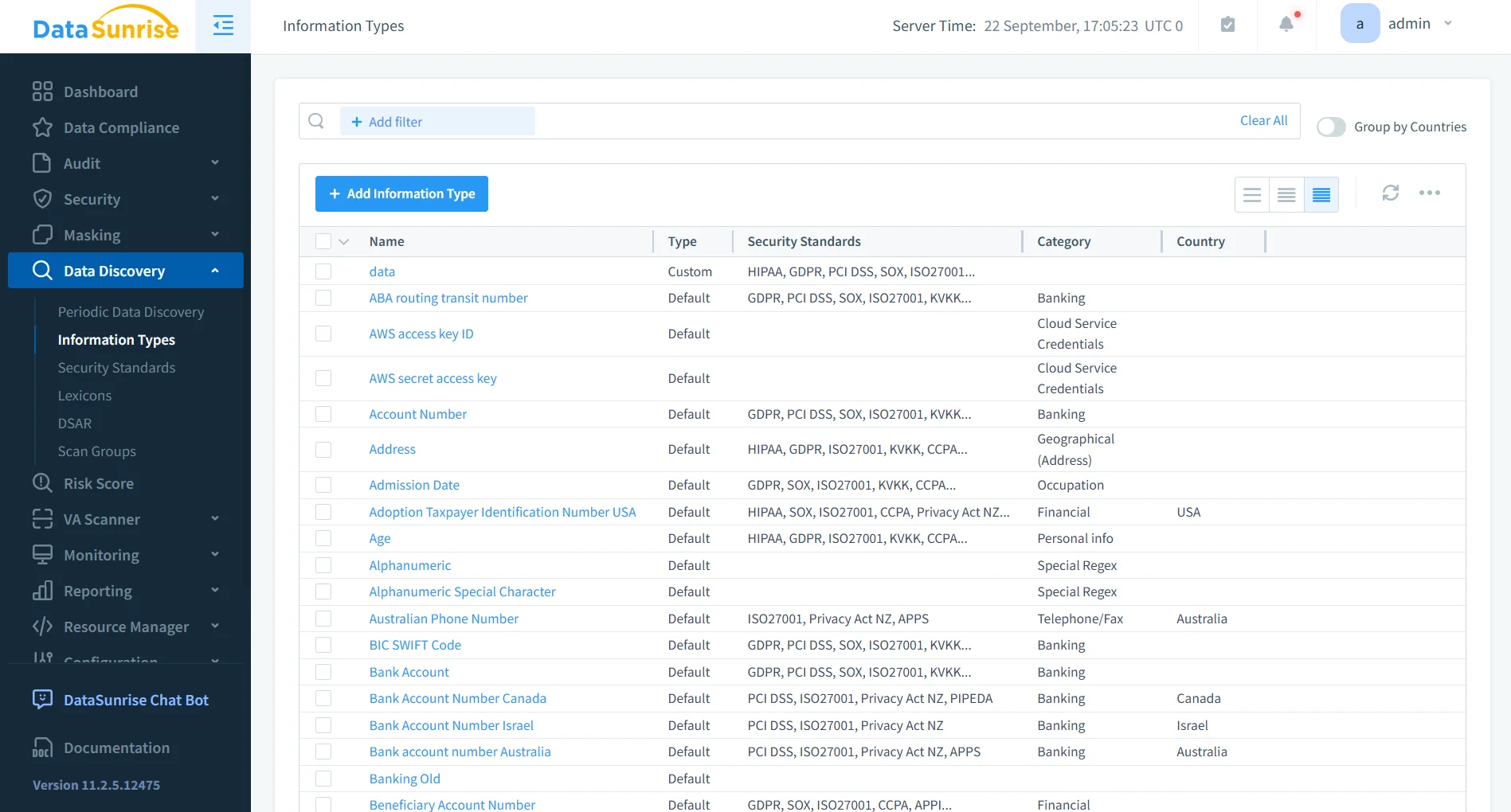
Before applying compliance policies, organizations need to understand where regulated information is stored. Data Discovery scans Amazon Redshift schemas, tables, and columns to identify sensitive information without relying entirely on manually maintained data inventories.
The discovery process can detect personal identifiers, contact details, financial information, authentication data, payment records, healthcare-related information, and organization-specific sensitive values.
Periodic discovery is particularly important in Redshift environments because warehouse structures frequently evolve. ETL pipelines may introduce new columns, development teams may add new datasets, and external schemas can expose additional data sources. Repeated discovery helps identify these changes before newly introduced sensitive information remains outside existing protection policies.
3. Build Compliance Policies Around Discovered Data
Once sensitive objects have been identified, DataSunrise can use this information as the basis for compliance-oriented protection policies.
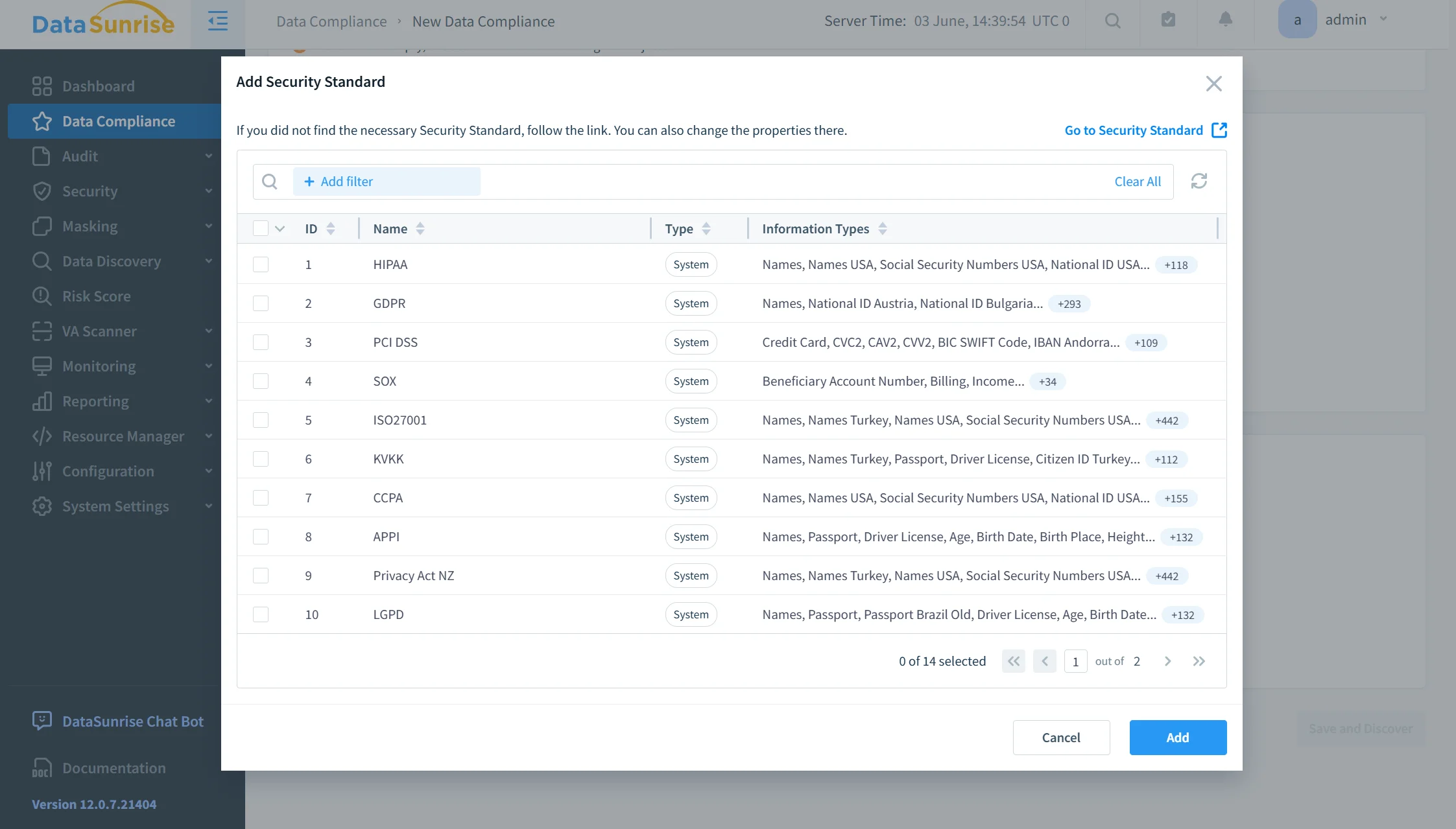
Data Compliance capabilities can support regulatory requirements associated with frameworks such as GDPR, HIPAA, PCI DSS, and SOX. Administrators can associate discovered sensitive objects with appropriate auditing, security, and masking controls.
This approach reduces the need to locate sensitive tables manually and create similar policies for each object individually. No-Code Policy Automation and Automatic Policy Generation help streamline repetitive configuration while maintaining more consistent protection across the Redshift environment.
4. Maintain Continuous Regulatory Alignment
Compliance requirements do not remain static when the database environment changes. New schemas, sensitive columns, application accounts, and user roles can create compliance gaps even when the original configuration was properly reviewed.
DataSunrise supports periodic Data Discovery and compliance tasks that help identify newly introduced sensitive information. Continuous Regulatory Calibration extends this approach by helping organizations reassess whether established policies still cover the current data environment.
As a result, teams can move from occasional compliance reviews toward a Continuous Compliance Posture. Instead of checking only whether Redshift satisfied requirements during the previous assessment, administrators can regularly verify whether sensitive objects have changed, existing policies remain applicable, user activity remains appropriate, required events are still recorded, and regulated information continues to receive the expected protection.
5. Monitor Access to Regulated Data
Sensitive Data Discovery identifies where regulated information resides, while Database Activity Monitoring provides visibility into how that information is accessed and used.
DataSunrise audit rules can monitor selected users, database objects, query types, applications, hosts, and other conditions. Transactional Trails then provide centralized records of captured Redshift activity, helping administrators investigate access to sensitive information and verify whether established compliance controls are being followed.
Machine Learning Audit Rules and behavior analytics can add another layer of analysis by detecting deviations from normal usage patterns. Examples include an application account accessing an unfamiliar sensitive schema, a user querying protected tables outside normal working patterns, an unexpected increase in access volume, or an inactive account suddenly interacting with high-risk objects.
This behavioral context complements predefined compliance policies and helps highlight activity that may require further investigation.
6. Reduce Unnecessary Sensitive Data Exposure
Compliance also involves limiting how much sensitive information users can see. Dynamic Data Masking allows DataSunrise to modify query results so that authorized users can continue working with Redshift data without receiving unrestricted access to original sensitive values.
Masking policies can protect personal identifiers, payment information, contact details, financial records, and other regulated attributes while preserving the structure required by applications and analytical workflows.
For development, testing, and other non-production environments, Static Data Masking can create protected copies of production information. This reduces the need to distribute real sensitive values into environments where full production-level access is unnecessary.
7. Generate Compliance Evidence
Compliance teams eventually need evidence showing that established controls exist and continue to operate as expected.
DataSunrise centralizes information collected through auditing, discovery, security controls, masking, and compliance tasks. Report Generation can then transform this information into structured documentation for internal assessments, regulatory reviews, and external audits.
Audit-Ready Reporting reduces the need to manually reconstruct evidence from separate Redshift system views, CloudWatch log groups, S3 objects, and security configurations. By maintaining compliance information in a centralized platform, organizations can simplify audit preparation and reduce the administrative effort required to demonstrate ongoing Amazon Redshift compliance.
Business Benefits of Continuous Amazon Redshift Compliance
| Benefit | Business Impact |
|---|---|
| Continuous sensitive data discovery | Identifies regulated information as warehouse schemas evolve |
| Least-privilege validation | Reduces unnecessary access to critical datasets |
| Policy-based protection | Applies controls according to data sensitivity and access context |
| Compliance drift detection | Exposes gaps created by changing users, schemas, and datasets |
| Centralized monitoring | Simplifies investigation across Amazon Redshift activity |
| Automated policy workflows | Reduces repetitive administrative configuration |
| Dynamic and static masking | Limits unnecessary exposure in production and non-production environments |
| Behavioral analysis | Identifies activity that deterministic policies may not highlight |
| Audit-ready evidence | Reduces manual work during internal and external assessments |
| Unified compliance management | Supports consistent controls across heterogeneous data environments |
Conclusion
Ensuring compliance for Amazon Redshift requires an ongoing process rather than a one-time security configuration. Native Redshift capabilities such as RBAC, Row-Level Security, Dynamic Data Masking, system views, database audit logging, CloudTrail integration, and AWS compliance documentation provide organizations with essential building blocks for protecting and validating their environment.
The larger challenge is keeping those controls aligned as data, identities, applications, and regulatory requirements evolve.
DataSunrise extends this foundation with Sensitive Data Discovery, No-Code Policy Automation, Automatic Policy Generation, Continuous Regulatory Calibration, centralized activity monitoring, Machine Learning Audit Rules, Dynamic and Static Data Masking, and Audit-Ready Reporting.
Together, these capabilities create a continuous compliance framework that can identify regulated information, apply appropriate protections, monitor its use, detect emerging gaps, and preserve evidence for auditors.
Organizations can schedule a live demo to explore how DataSunrise can simplify Amazon Redshift compliance management while reducing manual oversight and regulatory risk.
Protect Your Data with DataSunrise
Secure your data across every layer with DataSunrise. Detect threats in real time with Activity Monitoring, Data Masking, and Database Firewall. Enforce Data Compliance, discover sensitive data, and protect workloads across 50+ supported cloud, on-prem, and AI system data source integrations.
Start protecting your critical data today
Request a Demo Download Now