Amazon Redshift Regulatory Compliance
Organizations increasingly use Amazon Redshift to consolidate large volumes of operational, financial, customer, and analytical data. As these environments grow, maintaining Amazon Redshift Regulatory Compliance becomes essential for protecting sensitive information and demonstrating that access remains consistent with internal and external requirements.
Regulations and standards such as GDPR, HIPAA, PCI DSS, and SOX establish different requirements for access control, data protection, accountability, and audit evidence. AWS provides compliance resources for Amazon Redshift covering programs including SOC, PCI, FedRAMP, and HIPAA. However, customers remain responsible for configuring their workloads appropriately under the AWS shared responsibility model. ([AWS Documentation][1])
Amazon Redshift provides native mechanisms for identity management, encryption, database auditing, row-level security, and data masking. DataSunrise complements these capabilities with centralized data compliance management, Sensitive Data Discovery, automated policy generation, continuous monitoring, and compliance reporting.
This article examines native Amazon Redshift compliance capabilities and demonstrates how DataSunrise can extend them into a more automated compliance framework.
Understanding Regulatory Compliance in Amazon Redshift
Regulatory compliance for a data warehouse extends beyond enabling encryption or collecting logs. Organizations need coordinated controls covering several layers of the environment:
- Sensitive data identification: Determine where PII, financial information, healthcare records, and other regulated data resides.
- Access governance: Restrict users and applications according to their legitimate responsibilities.
- Data protection: Limit exposure through encryption, masking, and granular authorization.
- Activity accountability: Maintain records of authentication, queries, administrative operations, and access to protected data.
- Compliance evidence: Preserve reports and historical records that demonstrate how controls operate.
- Continuous assessment: Detect changes that may introduce new compliance gaps.
Consequently, effective Amazon Redshift compliance requires both preventive controls and reliable evidence of how sensitive information is accessed.
Native Amazon Redshift Regulatory Compliance Capabilities
Amazon Redshift includes several native security mechanisms that support regulatory compliance across data access, protection, auditing, and governance. These controls can help organizations meet requirements associated with GDPR, HIPAA, PCI DSS, SOX, and other standards. However, each mechanism addresses a specific part of the compliance lifecycle, so organizations typically need to combine multiple controls to establish a complete compliance framework.
1. Role-Based and Granular Access Control
Amazon Redshift provides role-based access control to simplify permission management and support the separation of responsibilities. Roles can represent analysts, administrators, auditors, application services, or other business functions, while permissions can be assigned according to operational requirements.
For example, administrators can create a dedicated role and grant access only to the required schema and table:
CREATE ROLE compliance_analyst;

GRANT USAGE ON SCHEMA reporting TO ROLE compliance_analyst;
GRANT SELECT ON TABLE reporting.transactions TO ROLE compliance_analyst;

GRANT ROLE compliance_analyst TO compliance_user;
In addition to role-based access, Amazon Redshift supports column-level permissions and row-level security. Row-level security policies restrict which records individual users can retrieve from the same table. This allows organizations to apply different access conditions without maintaining separate copies of the underlying data.
A simple row-level security policy can look like this:
CREATE RLS POLICY region_access
WITH (region VARCHAR(50))
USING (region = 'EU');

ATTACH RLS POLICY region_access
ON reporting.transactions
TO ROLE compliance_analyst;

ALTER TABLE reporting.transactions
ROW LEVEL SECURITY ON;
Together, these controls support the principle of least privilege by limiting users to the data and database operations required for their responsibilities. This reduces unnecessary exposure of regulated information and strengthens access governance.
2. Encryption and Data Protection
Encryption is another important component of Amazon Redshift regulatory compliance. Amazon Redshift supports encryption at rest and can integrate with AWS Key Management Service to control encryption keys and related access policies.
Administrators can verify whether a cluster is encrypted and identify the associated KMS key:
aws redshift describe-clusters \
    --cluster-identifier compliance-cluster \
    --query "Clusters[0].{Encrypted:Encrypted,KmsKeyId:KmsKeyId}"
Organizations can strengthen this protection by combining encryption with network isolation, TLS connections, IAM policies, and database-level permissions. This creates multiple security layers around sensitive analytical workloads and helps protect regulated information both during storage and transmission.
Basic cluster security settings can also be reviewed through the AWS CLI:
aws redshift describe-clusters \
    --cluster-identifier compliance-cluster \
    --query "Clusters[0].{Encrypted:Encrypted,PubliclyAccessible:PubliclyAccessible,EnhancedVPCRouting:EnhancedVpcRouting}"
However, encryption alone does not determine whether an authenticated user should be able to view specific sensitive values. Once data is decrypted for legitimate database processing, authorization, masking, and other access controls remain necessary to restrict unnecessary disclosure.
3. Database Audit Logging
Amazon Redshift provides native database audit logging for recording database connections, user activity, and administrative changes. Audit records can be delivered to Amazon CloudWatch or Amazon S3, allowing organizations to retain database activity for monitoring, investigation, and compliance evidence.
Redshift audit logging includes several categories of information. Connection logs record authentication attempts, connections, and disconnections. User logs capture modifications to database user definitions, while user activity logs provide visibility into database operations performed during user sessions.
Administrators can verify the current logging configuration with:
aws redshift describe-logging-status \
    --cluster-identifier compliance-cluster
For more complete activity tracking, administrators can enable the enable_user_activity_logging parameter. Its current value can be checked with:
aws redshift describe-cluster-parameters \
    --parameter-group-name compliance-redshift-params \
    --query "Parameters[?ParameterName=='enable_user_activity_logging']"
If necessary, it can be enabled through the cluster parameter group:
aws redshift modify-cluster-parameter-group \
    --parameter-group-name compliance-redshift-params \
    --parameters \
    "ParameterName=enable_user_activity_logging,ParameterValue=true"
CloudWatch can then be used for centralized filtering, searching, visualization, and monitoring, while Amazon S3 can support longer-term retention and archival requirements.
These records can help organizations demonstrate accountability, investigate suspicious operations, and maintain historical evidence required during security and regulatory reviews.
4. Native Dynamic Data Masking
Amazon Redshift also provides Dynamic Data Masking to reduce exposure of sensitive information during query execution. Masking policies can transform returned values according to users, roles, and configured conditions without modifying the original data stored in the warehouse.
For example, authorized financial personnel can receive complete payment information while analysts working with the same table receive only masked values.
A basic masking policy can be configured as follows:
CREATE MASKING POLICY mask_card_number
WITH (card_number VARCHAR(19))
USING (
    '****-****-****-' || RIGHT(card_number, 4)
);

ATTACH MASKING POLICY mask_card_number
ON reporting.payments(card_number)
TO ROLE compliance_analyst;
Administrators can review configured policies with:
SHOW POLICIES;
Conditional masking can provide even more granular control when different rows or data values require different protection rules.
Dynamic Data Masking can be combined with row-level security and column-level permissions to create multiple layers of access protection. This helps organizations preserve analytical functionality while reducing unnecessary disclosure of personally identifiable, financial, healthcare, or other regulated information.
5. AWS Compliance Validation
AWS maintains compliance programs, certifications, and supporting documentation that organizations can use when evaluating Amazon Redshift environments. Available compliance resources cover standards and programs such as HIPAA, PCI DSS, FedRAMP, SOC, and ISO-related frameworks.
From a technical perspective, administrators can periodically inspect critical Redshift security settings:
aws redshift describe-clusters \
    --cluster-identifier compliance-cluster \
    --query "Clusters[0].{
        Encryption:Encrypted,
        KMSKey:KmsKeyId,
        PublicAccess:PubliclyAccessible,
        EnhancedVPCRouting:EnhancedVpcRouting,
        VpcId:VpcId
    }"
Audit settings can be checked separately:
aws redshift describe-logging-status \
    --cluster-identifier compliance-cluster
Database-level masking and row-level security policies can also be reviewed:
SHOW POLICIES;
These certifications provide important assurance regarding the underlying AWS infrastructure and service operations. However, the compliance status of AWS does not automatically make an individual Amazon Redshift deployment compliant.
Organizations remain responsible for configuring database permissions, encryption, audit logging, retention policies, network controls, data handling procedures, and operational processes according to their own regulatory obligations. Therefore, Amazon Redshift compliance depends not only on available AWS capabilities but also on how consistently those controls are configured and maintained.
Automated Amazon Redshift Regulatory Compliance with DataSunrise
Native Amazon Redshift controls provide an important foundation for protecting regulated data, but they still require organizations to coordinate multiple configurations, services, and operational processes. Compliance becomes more difficult as schemas change, sensitive information appears in new tables, access patterns evolve, and several database platforms must be managed under the same regulatory requirements.
DataSunrise extends Amazon Redshift with a centralized compliance layer that combines auditing, security, data discovery, risk scoring, dynamic masking, static masking, Data Compliance, and native log trailing capabilities. This allows organizations to manage regulatory controls through a unified workflow instead of maintaining separate processes for discovery, monitoring, masking, and reporting.
1. Connect Amazon Redshift to DataSunrise
The first step is to register the Amazon Redshift instance in DataSunrise. Once the connection is established, administrators can apply auditing, masking, security, discovery, and compliance features to the selected Redshift environment.
DataSunrise supports several deployment approaches for cloud, hybrid, and heterogeneous infrastructures. For Amazon Redshift, organizations can also use native audit-log trailing when direct traffic interception is not the preferred monitoring method.
The available Redshift integration supports database-user configuration, IAM authentication, and access to regular and external schemas. This provides deployment flexibility while allowing organizations to maintain centralized control over security and compliance policies.
2. Discover Sensitive Redshift Data
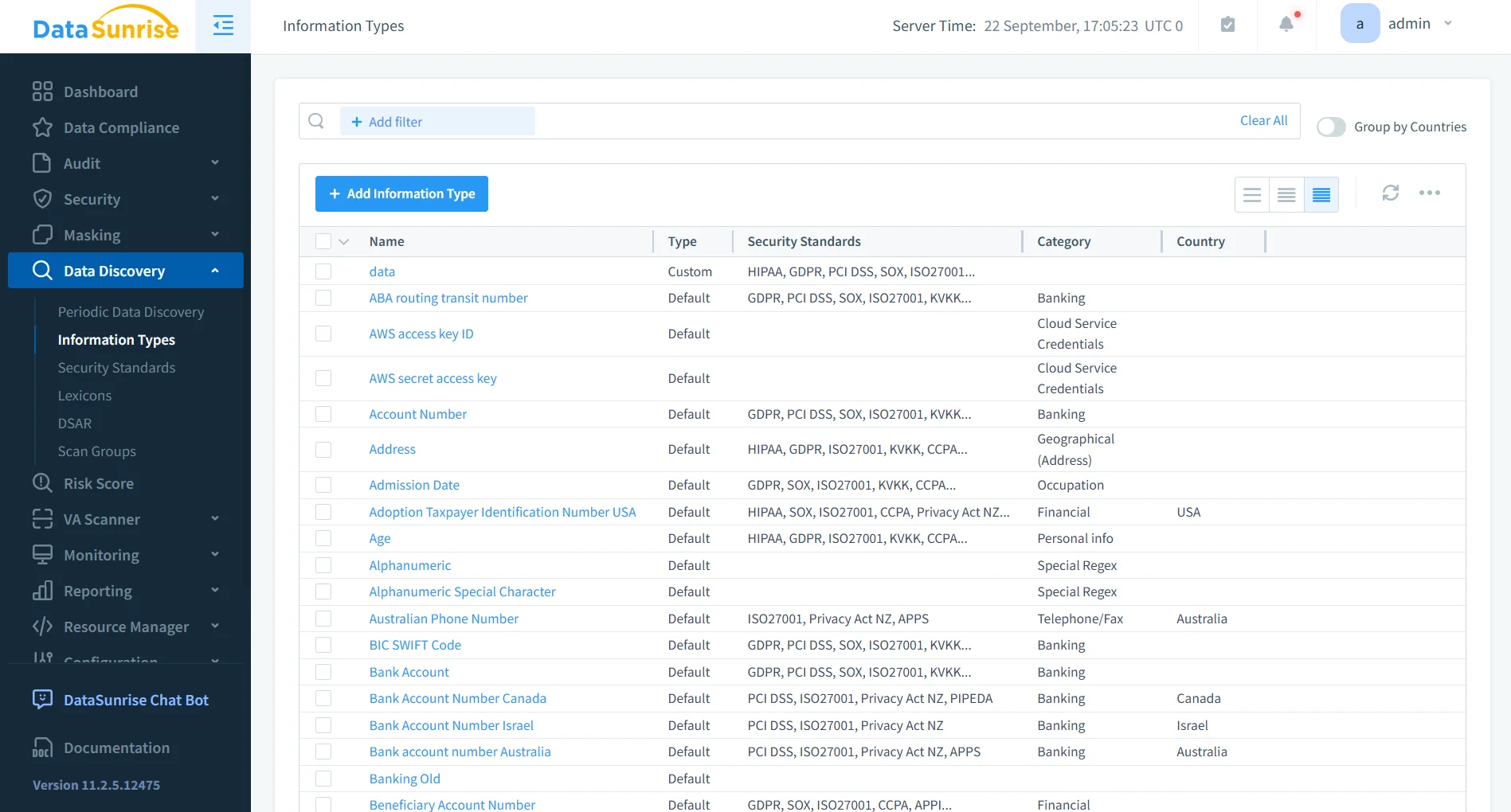
The next stage is Sensitive Data Discovery. Instead of manually inspecting tables and columns across a growing warehouse, DataSunrise can scan Amazon Redshift and identify information that requires additional protection.
Discovery can detect categories such as personal identifiers, payment information, healthcare-related records, authentication data, contact details, financial information, and organization-specific sensitive data.
The resulting inventory gives compliance teams a clearer understanding of where regulated information resides. This is especially important in analytical environments where new tables, imported datasets, and schema changes can continuously introduce additional sensitive fields.
3. Apply Compliance Autopilot and No-Code Policy Automation
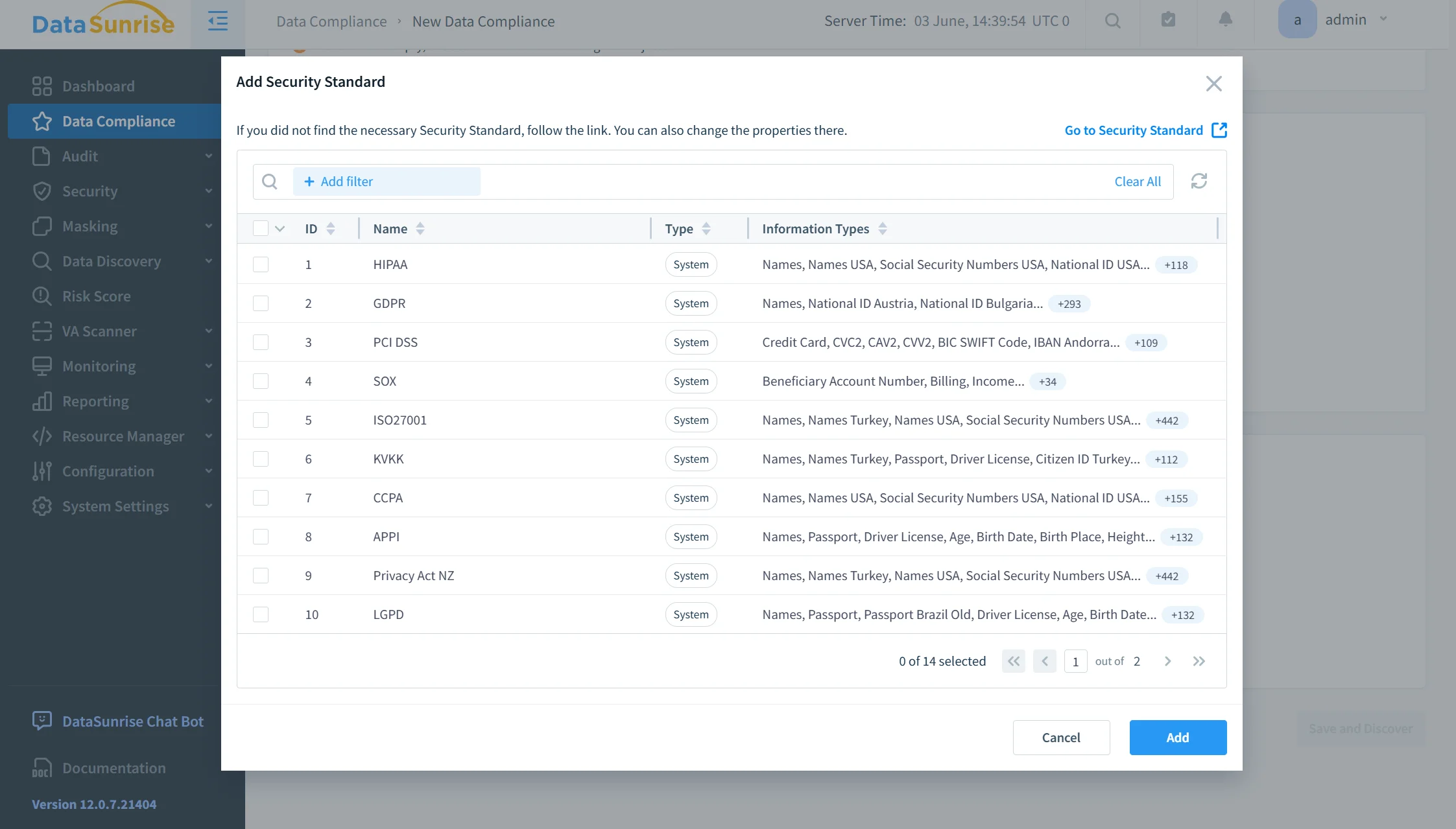
After sensitive information has been identified, DataSunrise can use the discovery results as a foundation for automated compliance workflows. Compliance Autopilot, Automatic Policy Generation, and No-Code Policy Automation reduce the need to manually create and maintain individual rules for each protected object.
Organizations can apply policies aligned with GDPR, HIPAA, PCI DSS, SOX, and other regulatory requirements through a centralized interface. Audit, security, and masking controls can then be associated with discovered sensitive information according to applicable compliance requirements.
Continuous Regulatory Calibration further supports this process by helping identify compliance drift as database structures, sensitive-data locations, and operational conditions change. Instead of relying exclusively on periodic manual reviews, organizations can maintain a more consistent compliance posture as their Redshift environments evolve.
4. Monitor Access to Regulated Data
DataSunrise provides centralized database activity monitoring for Amazon Redshift and other supported platforms. This allows security teams to observe access to regulated data through a single monitoring layer.
Audit policies can be configured according to database users and roles, schemas, tables, columns, query types, sensitive-data objects, client applications, source addresses, time conditions, and other contextual attributes.
For Amazon Redshift, DataSunrise can also process native audit records through S3, Redshift Spectrum, or CloudWatch log trailing. This gives organizations another way to collect activity information without requiring the same monitoring method for every deployment.
Centralized monitoring reduces the need to examine separate AWS log sources manually and provides a more consistent view of database activity across heterogeneous environments.
5. Protect Sensitive Information with Masking
DataSunrise combines discovery results with Dynamic Data Masking and static masking capabilities to reduce exposure of regulated information.
Dynamic masking modifies query results according to configured rules while leaving the original Redshift data unchanged. This allows authorized applications and users to continue working with the database while sensitive values remain hidden from users who do not require full access.
Static masking provides a different approach by permanently transforming sensitive values in copied or non-production datasets. This can be useful for development, testing, analytics, or data-sharing environments where realistic data structures are required but original regulated values should not be exposed.
By combining discovery and masking, organizations can move beyond simply recording access to sensitive information and actively reduce unnecessary exposure.
6. Maintain Audit-Ready Compliance Evidence
Compliance controls must remain verifiable after they are implemented. Organizations need historical evidence that demonstrates how regulated data was accessed, which policies were applied, and whether suspicious or non-compliant activity occurred.
DataSunrise provides centralized audit records and report generation to support internal reviews and external regulatory assessments. Collected activity can be transformed into structured compliance evidence instead of being reviewed manually across multiple disconnected sources.
Compliance Drift Detection, ML Audit Rules, and continuous monitoring further strengthen this process by helping identify changes in user behavior, access patterns, or policy conditions that may require additional attention.
Automated reporting therefore reduces the amount of manual evidence collection required for GDPR, HIPAA, PCI DSS, and SOX assessments while helping organizations maintain a more consistent and audit-ready compliance posture.
Native Amazon Redshift vs. DataSunrise Regulatory Compliance
Amazon Redshift provides strong database-level security controls, while DataSunrise extends them with centralized discovery, automation, monitoring, and compliance management.
| Capability | Native Amazon Redshift | DataSunrise |
|---|---|---|
| Access control | RBAC, RLS, database privileges | Centralized policy management |
| Sensitive data discovery | Limited native identification | Automated Sensitive Data Discovery |
| Data masking | Native Dynamic Data Masking | Dynamic and Static Data Masking |
| Activity monitoring | Native audit logs | Centralized audit and monitoring |
| Audit collection | S3 and CloudWatch | S3, CloudWatch, Spectrum, proxy monitoring |
| Policy automation | Manual AWS/database configuration | Compliance Autopilot and Automatic Policy Generation |
| Compliance drift | Requires separate controls | Continuous Regulatory Calibration |
| Compliance reporting | AWS logs and reporting services | Centralized Audit-Ready Reporting |
Conclusion
Amazon Redshift provides a strong native foundation for regulatory compliance through role-based access controls, row-level security, Dynamic Data Masking, encryption, CloudWatch and S3 audit logging, CloudTrail integration, and AWS compliance resources. Together, these capabilities help organizations control access, protect sensitive information, and retain essential security evidence.
However, regulatory compliance involves more than activating individual database controls. Organizations must continuously identify regulated information through Data Discovery, maintain appropriate policies, monitor sensitive data usage with Database Activity Monitoring, detect compliance drift, and produce defensible evidence.
DataSunrise extends Amazon Redshift Regulatory Compliance with Sensitive Data Discovery, Compliance Autopilot, No-Code Policy Automation, Automatic Policy Generation, Continuous Regulatory Calibration, ML Audit Rules, Dynamic Data Masking, centralized activity monitoring, and Audit-Ready Reporting.
The result is a unified compliance framework that reduces administrative effort, limits unnecessary sensitive-data exposure, and improves regulatory readiness across Amazon Redshift and heterogeneous data environments.
Protect Your Data with DataSunrise
Secure your data across every layer with DataSunrise. Detect threats in real time with Activity Monitoring, Data Masking, and Database Firewall. Enforce Data Compliance, discover sensitive data, and protect workloads across 50+ supported cloud, on-prem, and AI system data source integrations.
Start protecting your critical data today
Request a Demo Download Now