How to Apply Data Governance for AlloyDB for PostgreSQL
Implementing robust data governance for AlloyDB for PostgreSQL has become essential for organizations managing sensitive information in cloud environments. Recent cybersecurity research shows that organizations with comprehensive audit trail systems identify security threats faster and reduce breach-related costs substantially.
AlloyDB for PostgreSQL, Google Cloud's fully managed, PostgreSQL-compatible database service, offers native security features and monitoring capabilities. However, organizations in regulated industries often require more sophisticated solutions to satisfy compliance requirements and protect sensitive data effectively.
This guide explores AlloyDB's native data governance capabilities and demonstrates how DataSunrise enhances governance with Zero-Touch Compliance Automation.
Understanding Data Governance for AlloyDB for PostgreSQL
Data governance for AlloyDB for PostgreSQL encompasses the systematic management of data availability, usability, integrity, and data security within your cloud database environment. Effective governance ensures that data assets are properly cataloged, access is appropriately controlled, compliance requirements are satisfied, and data quality is maintained throughout its lifecycle.
The cloud-native architecture of AlloyDB introduces several unique considerations:
| Governance Challenge | Description | Impact on Implementation |
|---|---|---|
| Cloud-Native Security | Distributed access patterns across cloud networks | Requires sophisticated monitoring and access controls |
| High-Performance Requirements | Governance controls must not degrade performance | Need for non-intrusive monitoring solutions |
| Multi-Regional Compliance | Different regulatory frameworks across regions | Demands unified policy enforcement |
| Integration Complexity | Policies span multiple Google Cloud services | Requires seamless service integration |
| Scale Management | High-throughput environments generate massive data volumes | Necessitates efficient governance automation |
Native AlloyDB for PostgreSQL Data Governance Capabilities
AlloyDB for PostgreSQL includes several built-in features for implementing data governance that leverage PostgreSQL's robust security model enhanced with Google Cloud's enterprise capabilities. These native features provide the foundation for access control, audit logging, and security monitoring.
1. Identity and Access Management (IAM) Integration
AlloyDB integrates with Google Cloud IAM to provide role-based access control:
-- Grant specific database roles through Cloud IAM
GRANT cloudsqlsuperuser TO '[email protected]';

-- Create custom roles with fine-grained permissions
CREATE ROLE data_analyst;
GRANT SELECT ON sensitive_data TO data_analyst;

-- Implement row-level security
CREATE POLICY employee_policy ON employees
    FOR SELECT
    USING (department = current_setting('app.current_department'));

ALTER TABLE employees ENABLE ROW LEVEL SECURITY;
2. Cloud Logging for Audit Trail
AlloyDB automatically integrates with Google Cloud Logging to capture database activities:
# Enable audit logging via gcloud CLI
gcloud alloydb clusters update CLUSTER_NAME \
    --region=REGION \
    --enable-database-flags=log_connections=on,log_statement=all
3. AlloyDB Studio for Governance Management
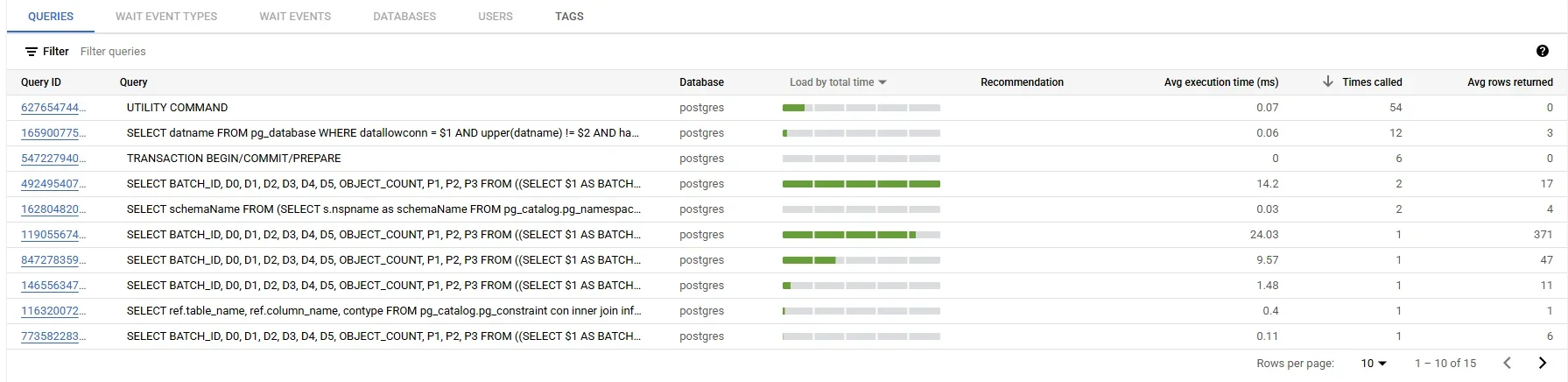
AlloyDB Studio provides an integrated development environment within the Google Cloud Console for managing database governance. The platform offers visual query building, schema browsing with sensitivity classification, and real-time query execution monitoring. Administrators can review and manage user permissions, execute governance-related queries, monitor active sessions, and analyze query patterns to identify potential security risks—all through an intuitive interface that integrates seamlessly with Cloud IAM and Cloud Logging.
Limitations of Native AlloyDB Data Governance
While AlloyDB provides robust native capabilities, organizations with advanced governance requirements often encounter limitations including manual policy configuration, basic logging without behavioral analysis, limited context-aware access decisions, no automated sensitive data discovery, manual compliance reporting, and isolated monitoring per instance. These challenges underscore the need for enhanced database security solutions.
Enhanced Data Governance with DataSunrise
DataSunrise significantly enhances data governance through Autonomous Compliance Orchestration and sophisticated automation designed specifically for cloud database environments. The platform delivers enterprise-grade database activity monitoring with comprehensive audit trail capabilities and intelligent threat detection.
Implementing DataSunrise for AlloyDB for PostgreSQL
1. Connect to AlloyDB for PostgreSQL Instance
Establish a secure connection between DataSunrise and your AlloyDB environment through the intuitive administrative interface, supporting various deployment modes including proxy and sniffer modes.
2. Automated Data Discovery and Classification
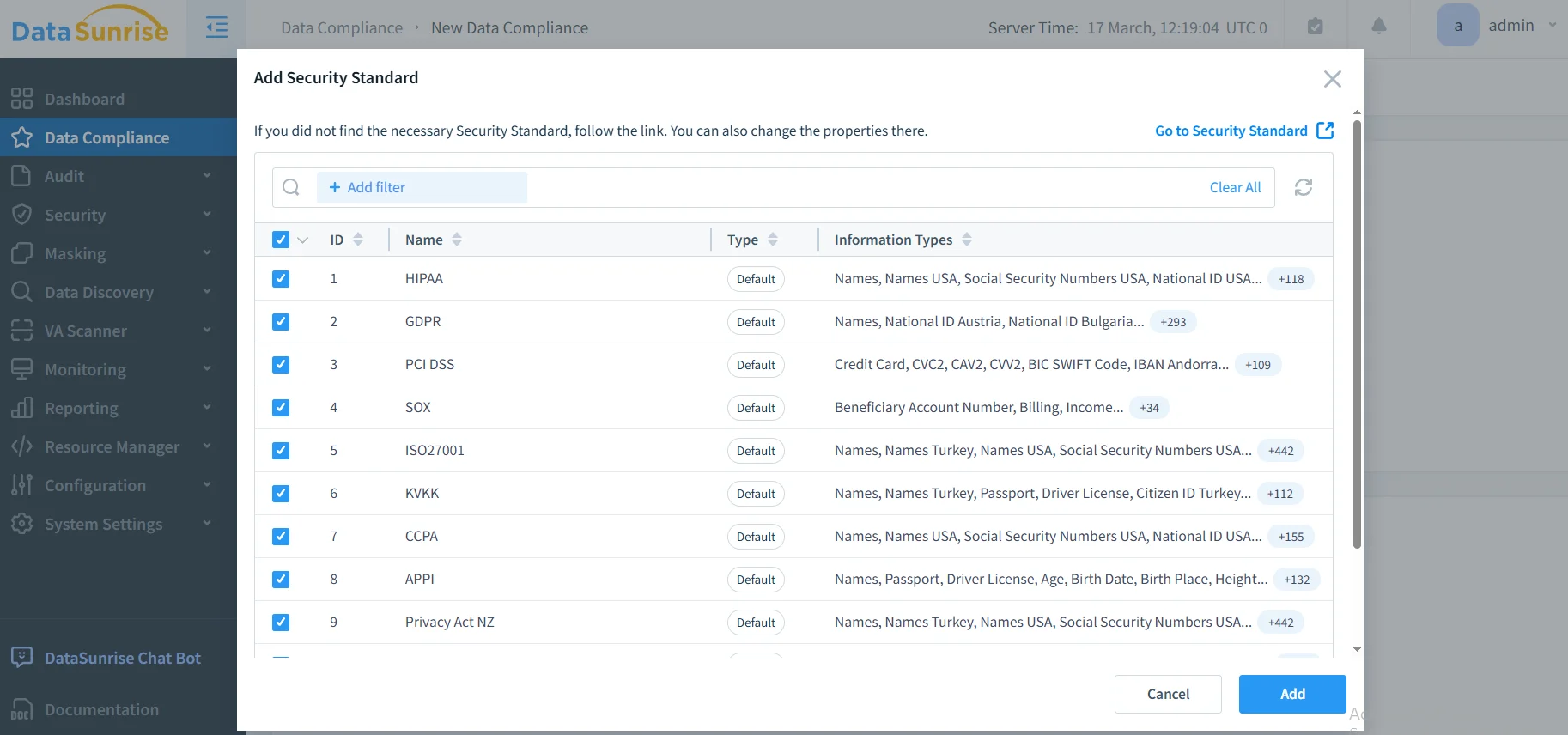
DataSunrise's Auto-Discover & Classify engine automatically scans your AlloyDB databases using NLP-driven discovery, OCR capabilities for images, regulatory mapping for GDPR/HIPAA/PCI DSS/SOX, and customizable patterns for business-specific data.
3. Create Comprehensive Governance Policies
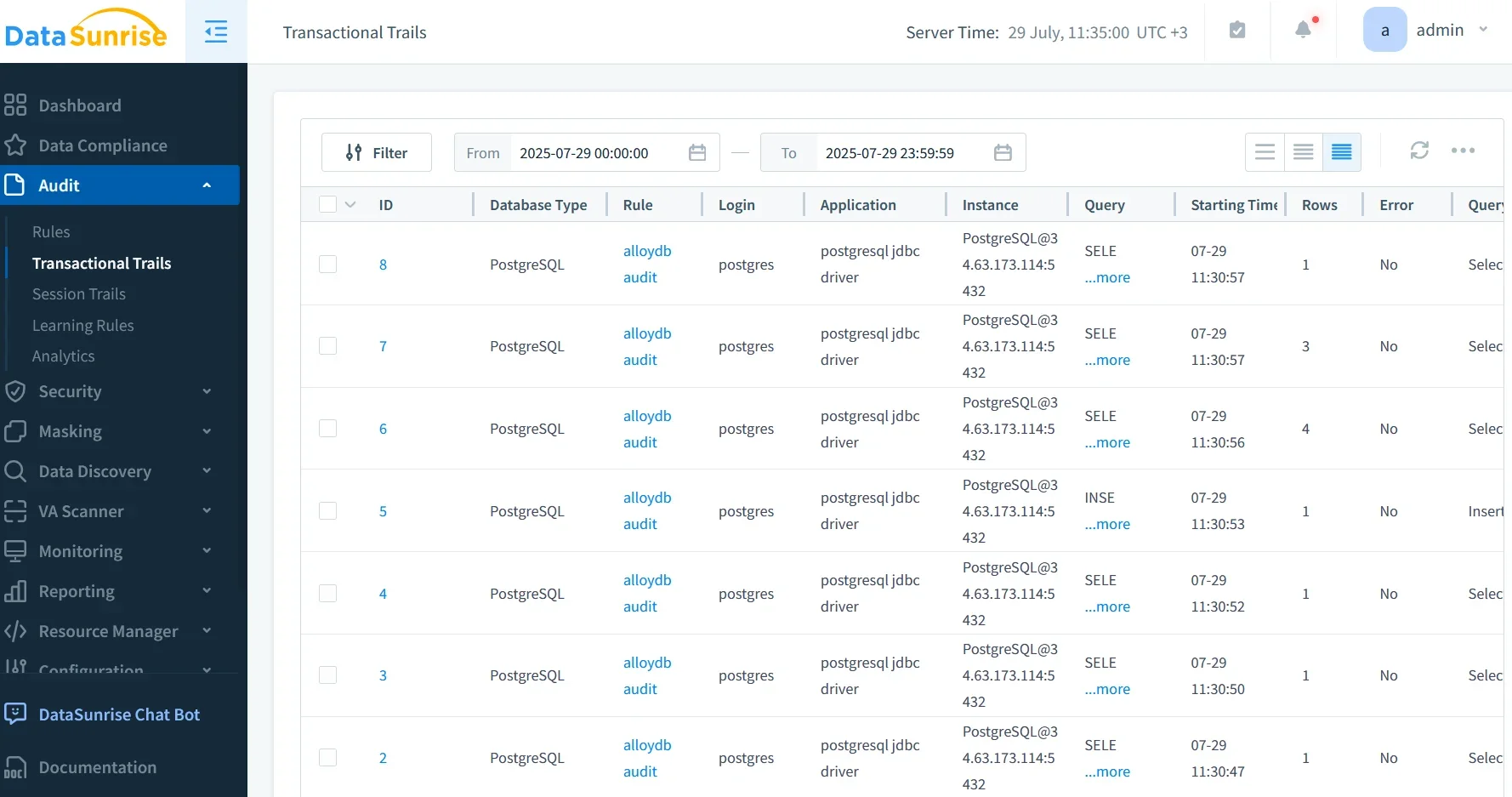
Configure granular governance rules using DataSunrise's No-Code Policy Automation interface for access control, data masking, security enforcement, and audit policies.
4. Monitor Data Governance Compliance
Access comprehensive governance insights through DataSunrise's unified dashboard with compliance posture views, policy effectiveness analytics, user activity tracking, and automated risk assessment.
Key Advantages of DataSunrise for AlloyDB for PostgreSQL
DataSunrise provides significant enhancements including:
- Auto-Discover & Mask: Automatically identifies and protects sensitive data with Zero-Touch Data Masking
- No-Code Policy Automation: Create policies without coding, reducing implementation time from weeks to hours
- Real-Time Notifications: Immediate alerts for policy violations through multiple channels
- User Behavior Analytics: ML-based anomaly detection adapting to usage patterns
- Automated Compliance Reporting: Pre-configured reports for GDPR, HIPAA, PCI DSS, and SOX frameworks
- Dynamic Data Masking: Real-time data protection maintaining application functionality
- Cross-Platform Visibility: Monitor 40+ data storage platforms from a unified console
Conclusion
As organizations rely on AlloyDB for PostgreSQL for business-critical data operations, comprehensive data governance has become essential for security and compliance. While AlloyDB offers robust native capabilities, organizations with complex requirements benefit significantly from enhanced solutions like DataSunrise.
DataSunrise provides a comprehensive governance framework for cloud databases, offering Zero-Touch Compliance Automation with advanced data discovery, intelligent policy orchestration, and automated reporting. With flexible deployment modes, DataSunrise transforms AlloyDB governance into strategic security assets.
Protect Your Data with DataSunrise
Secure your data across every layer with DataSunrise. Detect threats in real time with Activity Monitoring, Data Masking, and Database Firewall. Enforce Data Compliance, discover sensitive data, and protect workloads across 50+ supported cloud, on-prem, and AI system data source integrations.
Start protecting your critical data today
Request a Demo Download Now