How to Apply Data Governance for MongoDB
MongoDB has become a leading choice for managing semi-structured and unstructured data. However, the same flexibility that makes it popular also introduces challenges for maintaining control, visibility, and compliance. Organizations dealing with sensitive data must apply strong data governance strategies to ensure integrity, security, and accountability.
Recent cybersecurity research highlights the rising cost of breaches, particularly in environments where data governance is weak. For MongoDB, implementing governance goes beyond access controls—it requires detailed monitoring, audit rules, policy automation, and alignment with regulatory frameworks.
This article outlines native MongoDB governance features and demonstrates how DataSunrise extends these capabilities with centralized policies, automation, and real-time protection.
What is Data Governance?
Data governance refers to the framework of rules, processes, and technologies that ensure data is managed responsibly throughout its lifecycle. It combines access controls, data quality measures, and compliance oversight to provide transparency and accountability.
For MongoDB environments, data governance means:
- Defining who can access specific collections and fields.
- Ensuring sensitive information is identified and protected.
- Maintaining audit trails of queries, schema changes, and user actions.
- Aligning database operations with regulatory standards such as ISO/IEC 27001, GDPR, HIPAA, and PCI DSS.
By applying governance policies, organizations not only safeguard their data but also improve trust and operational efficiency.
Native MongoDB Governance Capabilities
MongoDB offers several built-in tools that form the foundation of database security:
Role-Based Access Control (RBAC)
MongoDB provides fine-grained role-based access control. Administrators can assign roles with specific privileges to users and applications, reducing the risk of unauthorized data access.
use admin
db.createUser({
    user: "auditUser",
    pwd: "SecurePass123",
    roles: [
        { role: "readWrite", db: "customerDB" },
        { role: "clusterMonitor", db: "admin" }
    ]
})
This configuration ensures that the auditUser has limited access to the customer database and monitoring privileges without administrative control.
Database Auditing
MongoDB Enterprise includes auditing functionality, allowing administrators to log access, configuration changes, and schema modifications. These audit logs provide accountability and support compliance reporting.
setParameter:
    auditAuthorizationSuccess: true
auditLog:
    destination: file
    format: BSON
    path: /var/log/mongodb/auditLog.bson
Encryption and Security
MongoDB supports encryption at rest and in transit. By enabling TLS/SSL and database encryption, organizations can protect sensitive data from interception or theft.
net:
    ssl:
        mode: requireSSL
        PEMKeyFile: /etc/ssl/mongodb.pem
While these features provide a baseline, enterprises often require more advanced governance capabilities for multi-database environments.
Applying Data Governance with DataSunrise
DataSunrise enhances MongoDB governance with automation, granular policies, and centralized monitoring across 40+ database platforms.
Sensitive Data Discovery
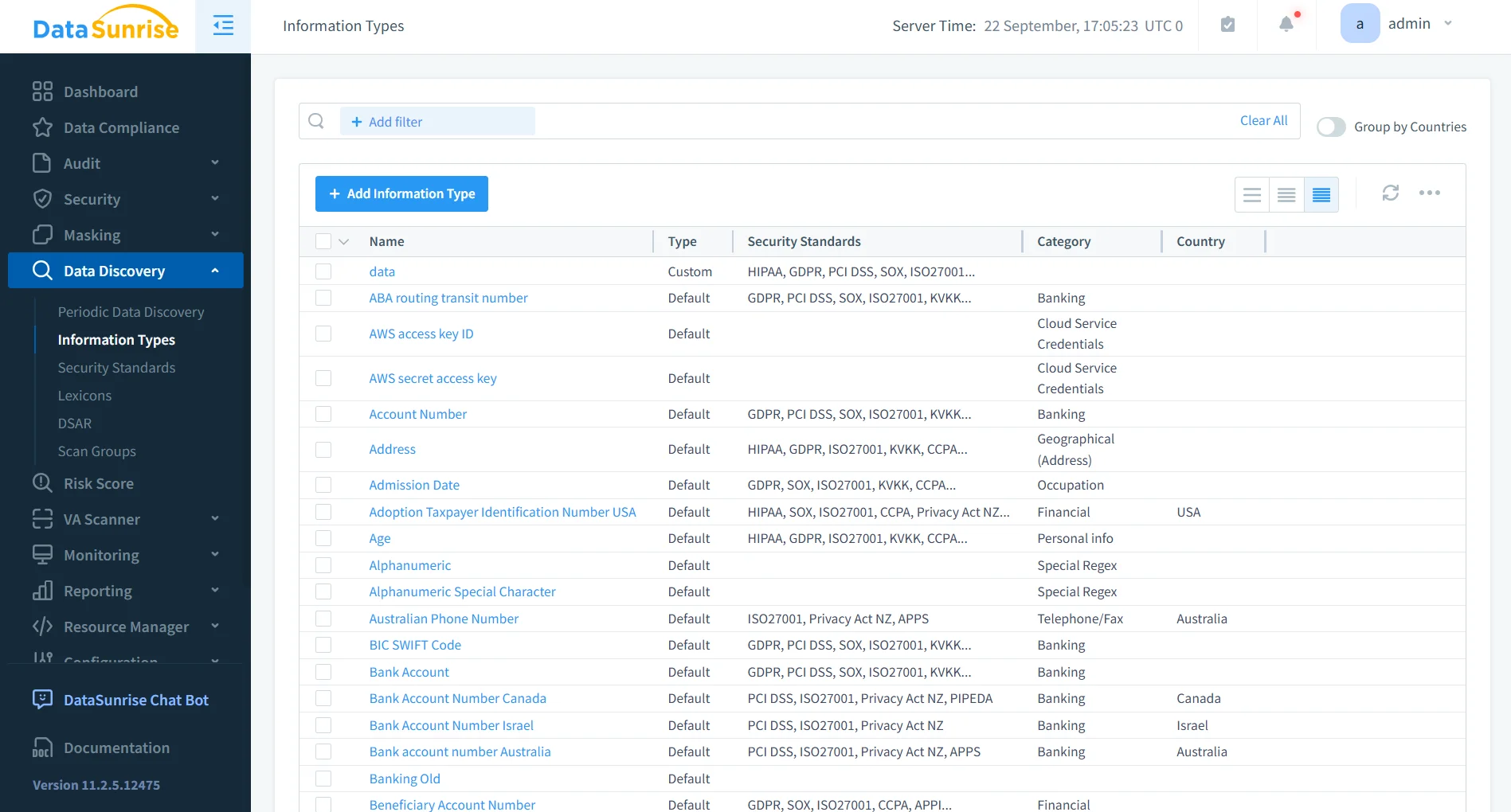
DataSunrise automatically identifies and classifies sensitive information, including PII and PHI. Unlike manual audits, discovery is continuous and adaptive, scanning both structured and semi-structured MongoDB collections. The system uses data discovery techniques, NLP models, and predefined templates to locate sensitive elements hidden in JSON documents or nested fields.
Key capabilities include:
- Detection of regulated information such as credit card numbers, healthcare records, or national IDs.
- OCR-based discovery for sensitive data embedded in images or unstructured documents.
- Automatic tagging of classified data, which simplifies compliance reporting and ensures alignment with GDPR, HIPAA, and PCI DSS.
Dynamic Data Masking
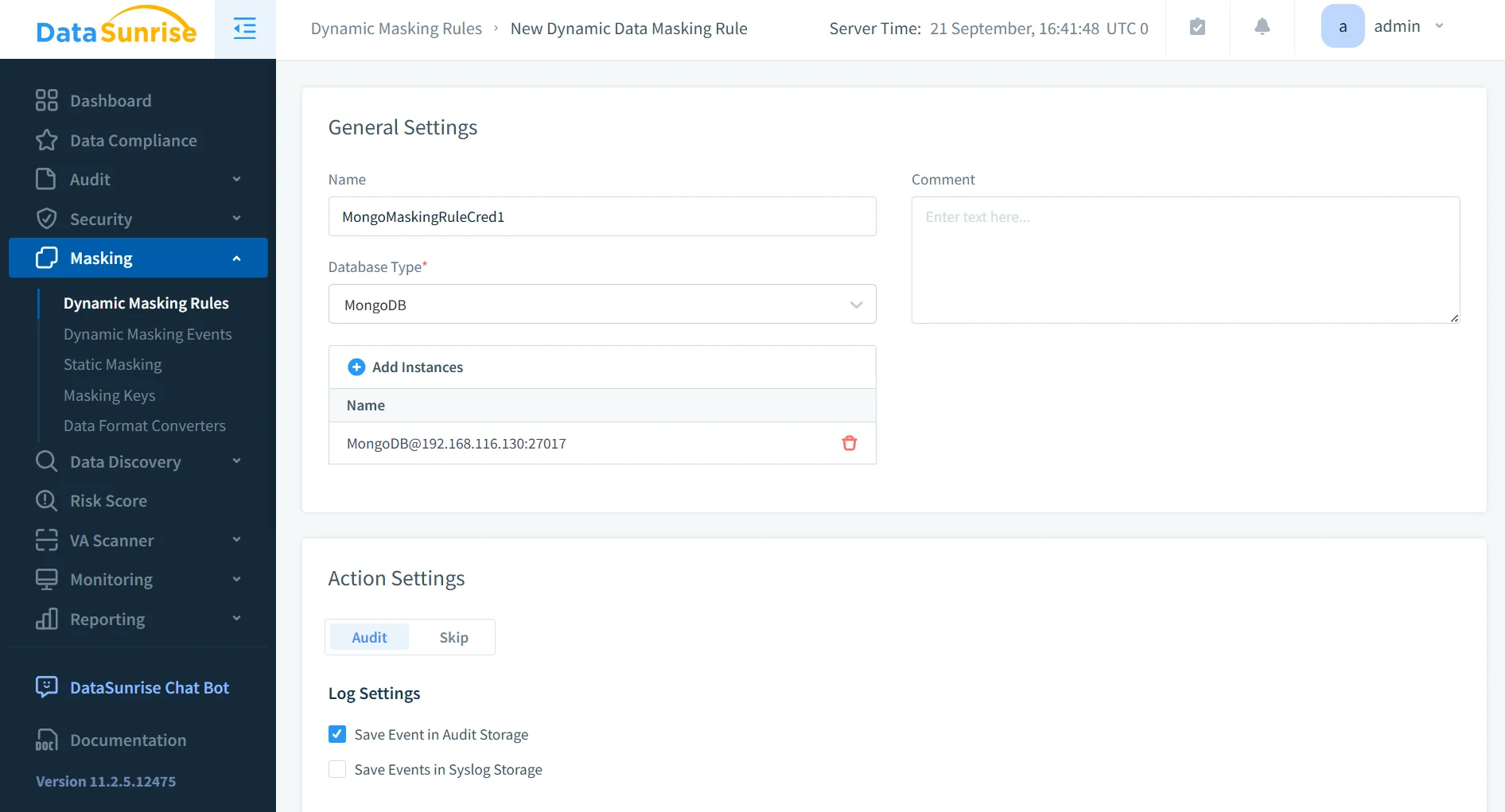
With dynamic data masking, MongoDB queries can return obfuscated values to unauthorized users in real time. Instead of creating duplicate datasets or restructuring applications, DataSunrise applies role-based rules directly to query responses.
For example:
- Analysts might see masked phone numbers as
XXX-XXX-7890. - Customer service staff could view partially revealed addresses.
- Administrators retain full access without restrictions.
This ensures sensitive information is protected without disrupting operational workflows. The flexibility of masking policies makes it possible to comply with multiple regulations simultaneously while keeping databases performant.
Centralized Monitoring
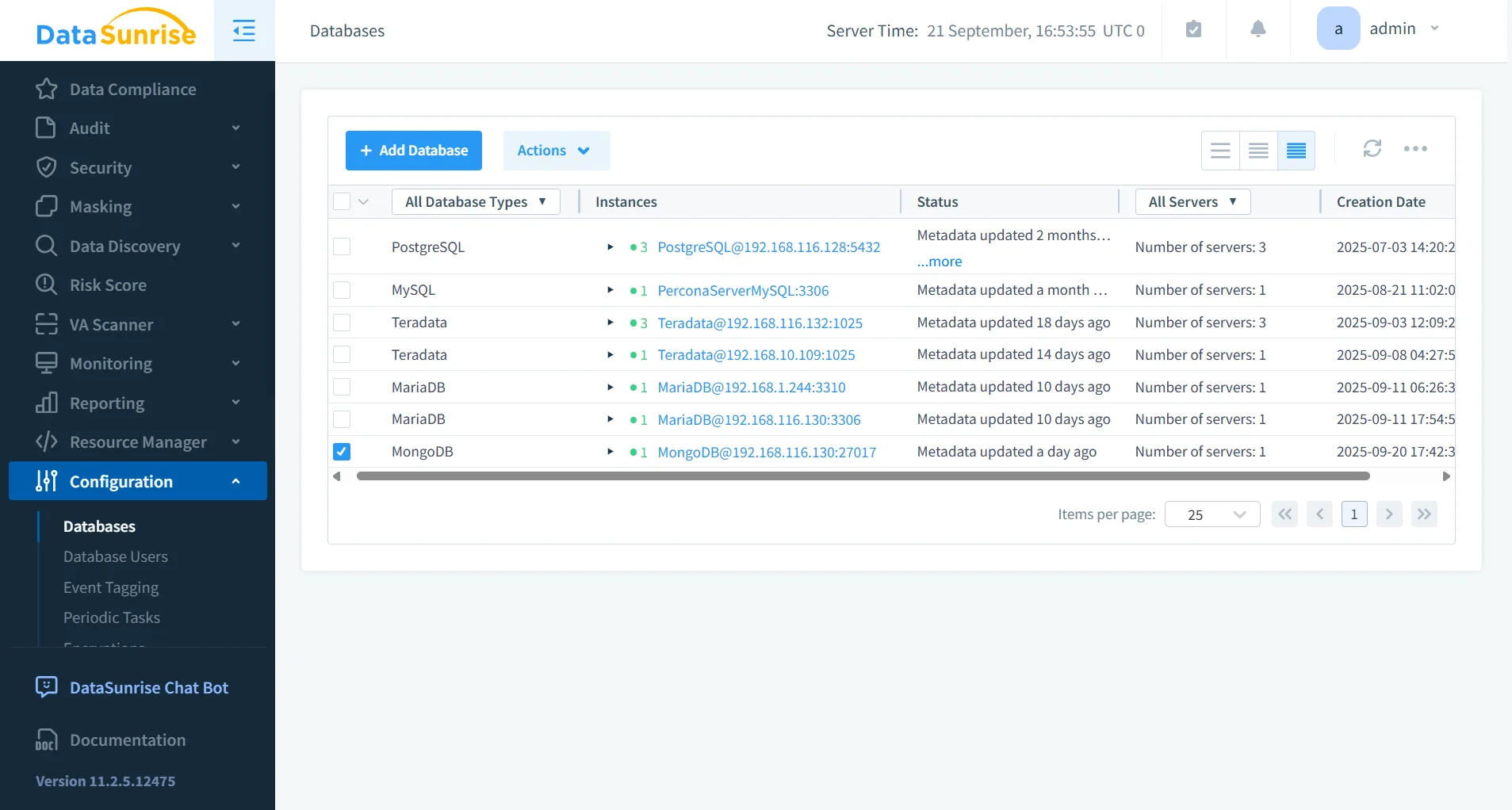
Instead of configuring governance separately for each MongoDB instance, DataSunrise consolidates database activity monitoring across all deployments. This unified approach allows security teams to:
- View logs and activity trails for MongoDB alongside other databases.
- Apply consistent governance policies across hybrid and multi-cloud environments.
- Detect suspicious queries in real time with behavior analytics.
- Send real-time notifications to Slack, Teams, or email for instant incident response.
Centralized monitoring ensures MongoDB governance is not isolated but integrated into the broader data compliance strategy.
Compliance Autopilot
The Compliance Autopilot continuously aligns MongoDB environments with evolving frameworks such as SOX, GDPR, and HIPAA. It goes beyond static templates by providing:
- Predefined Policy Templates: Out-of-the-box rules for GDPR, HIPAA, PCI DSS, and SOX.
- Drift Detection: Automatic alerts when MongoDB roles, collections, or schema changes create compliance gaps.
- Self-Adjusting Policies: The system enforces updated controls whenever new users, roles, or collections are created.
- Audit-Ready Reporting: One-click reports for regulators or auditors, saving significant preparation time.
This automation reduces manual oversight, ensuring MongoDB remains audit-ready at all times.
Comparison Table: Native MongoDB vs DataSunrise
| Feature | Native MongoDB | DataSunrise for MongoDB |
|---|---|---|
| Access Control | Role-Based Access Control (RBAC) with user-defined privileges | Granular rules with context-aware policies across hybrid environments |
| Auditing | Enterprise-only audit logs stored in BSON format | Detailed audit trails with filtering, reporting, and cross-database visibility |
| Encryption | TLS/SSL for data in transit, storage encryption at rest | Encryption + dynamic data masking to protect sensitive fields |
| Sensitive Data Discovery | Manual classification required | Automated discovery with OCR and NLP |
| Compliance Automation | Manual updates needed for regulation changes | Compliance Autopilot with drift detection and predefined templates |
| Monitoring | Instance-level monitoring only | Centralized database activity monitoring across 40+ platforms |
| Alerting | No built-in real-time alerts | Real-time notifications for incidents via Slack, Teams, or email |
| Scalability | Requires separate configuration per cluster | Unified governance with multi-cloud and on-premise support |
Conclusion
Native MongoDB tools establish a governance foundation with RBAC, auditing, and encryption. However, enterprises often require broader, automated solutions to handle compliance and security across distributed environments.
DataSunrise delivers this by offering centralized governance, sensitive data discovery, dynamic masking, and compliance automation. By integrating DataSunrise with MongoDB, organizations can strengthen data security, reduce compliance costs, and maintain full control over sensitive data.
Protect Your Data with DataSunrise
Secure your data across every layer with DataSunrise. Detect threats in real time with Activity Monitoring, Data Masking, and Database Firewall. Enforce Data Compliance, discover sensitive data, and protect workloads across 50+ supported cloud, on-prem, and AI system data source integrations.
Start protecting your critical data today
Request a Demo Download Now