How to Apply Data Governance for Oracle Database
In today's data-driven environment, implementing robust data governance for Oracle Database has become a strategic imperative. According to Gartner research, organizations with effective data governance frameworks can detect compliance violations significantly faster and reduce data-related risks substantially. With data breach costs averaging $4.88 million in 2024, establishing comprehensive data governance frameworks is essential for both security and compliance.
Oracle Database, a leading enterprise relational database management system, provides native capabilities for implementing data governance controls. However, organizations in regulated industries often require more sophisticated solutions to satisfy stringent compliance requirements. This guide explores Oracle's native data governance features and demonstrates how DataSunrise can enhance your governance strategy with Zero-Touch Compliance Automation.
Understanding Data Governance for Oracle Database
Data governance for Oracle Database encompasses the comprehensive framework of policies, procedures, and controls that ensure data quality, security, privacy, and compliance throughout the data lifecycle. This systematic approach defines who can access what data, when they can access it, how data should be protected, and what documentation must be maintained.
Key Components of Oracle Database Data Governance
| Component | Description |
|---|---|
| Data Quality Management | Ensuring accuracy, completeness, and consistency across database instances |
| Access Control Policies | Defining role-based permissions and privilege management |
| Data Classification | Identifying and categorizing sensitive data based on regulatory requirements |
| Compliance Monitoring | Tracking adherence to GDPR, HIPAA, PCI DSS, and SOX regulations |
| Audit Trail Maintenance | Creating comprehensive audit trails of all data access and modifications |
| Data Lifecycle Management | Implementing retention policies and secure disposal procedures |
Native Oracle Database Data Governance Capabilities
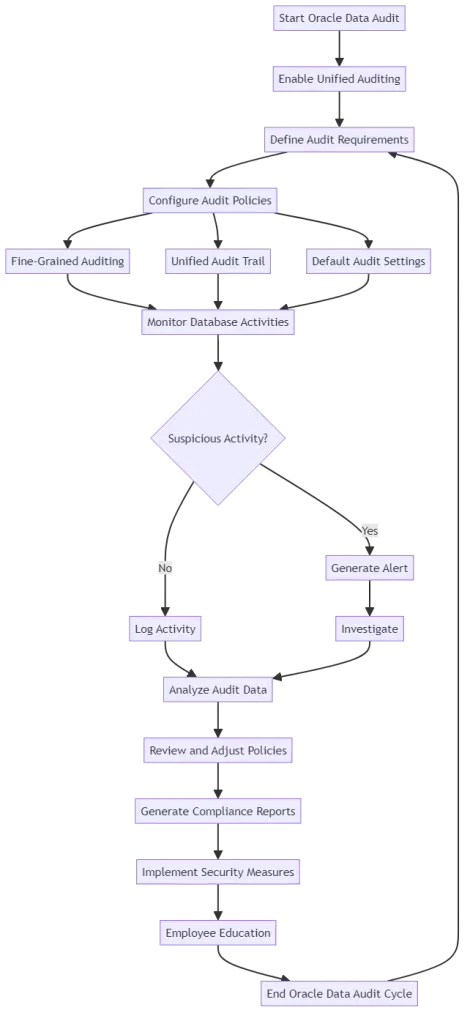
Oracle Database includes several built-in features for implementing data governance frameworks through integrated mechanisms.
1. Oracle Data Redaction
Oracle Data Redaction provides real-time data masking to protect sensitive information:
-- Implement data redaction for sensitive columns
BEGIN
    DBMS_REDACT.ADD_POLICY(
        object_schema => 'CUSTOMERS',
        object_name => 'CUSTOMER_DATA',
        policy_name => 'ssn_redaction_policy',
        column_name => 'SOCIAL_SECURITY_NUMBER',
        function_type => DBMS_REDACT.PARTIAL,
        function_parameters => 'VVVFVVVFVV99,VVV-VV-,X,1,5'
    );
END;
/
2. Oracle Unified Auditing
Oracle's unified auditing framework provides comprehensive activity monitoring:
-- Enable unified auditing
CREATE AUDIT POLICY sensitive_data_access_policy
ACTIONS SELECT ON CUSTOMERS.CUSTOMER_DATA,
        UPDATE ON CUSTOMERS.CUSTOMER_DATA
EVALUATE PER SESSION;

AUDIT POLICY sensitive_data_access_policy;

-- Query audit records
SELECT EVENT_TIMESTAMP, DBUSERNAME, SQL_TEXT, OBJECT_NAME
FROM UNIFIED_AUDIT_TRAIL
WHERE OBJECT_NAME = 'CUSTOMER_DATA'
  AND EVENT_TIMESTAMP >= SYSDATE - 7
ORDER BY EVENT_TIMESTAMP DESC;
Enhanced Data Governance with DataSunrise
DataSunrise significantly enhances Oracle's native capabilities through comprehensive automation and intelligent policy orchestration. Unlike manual approaches, DataSunrise delivers enterprise-grade data governance with sophisticated policy management and automated compliance reporting.
Implementing DataSunrise for Oracle Database Governance
Setting up DataSunrise for Oracle Database governance follows a streamlined process:
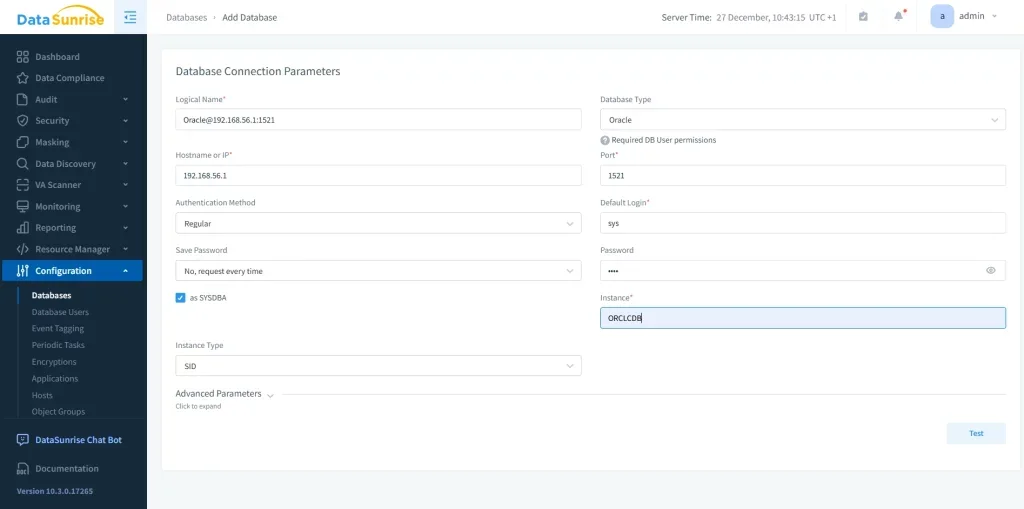
1. Connect to Oracle Database: Establish a secure connection to your Oracle instance through DataSunrise's interface. The platform supports on-premises, cloud (Oracle Cloud Infrastructure, AWS RDS, Azure Database), and hybrid deployments.
2. Auto-Discover Sensitive Data: DataSunrise automatically scans and classifies sensitive information using NLP algorithms, identifying PII, PHI, PCI data, and mapping it to regulatory frameworks like GDPR, HIPAA, PCI DSS, and SOX.
3. Create Governance Policies: Use the no-code interface to configure access controls, dynamic data masking, audit rules, security rules, and compliance policies without writing complex SQL.
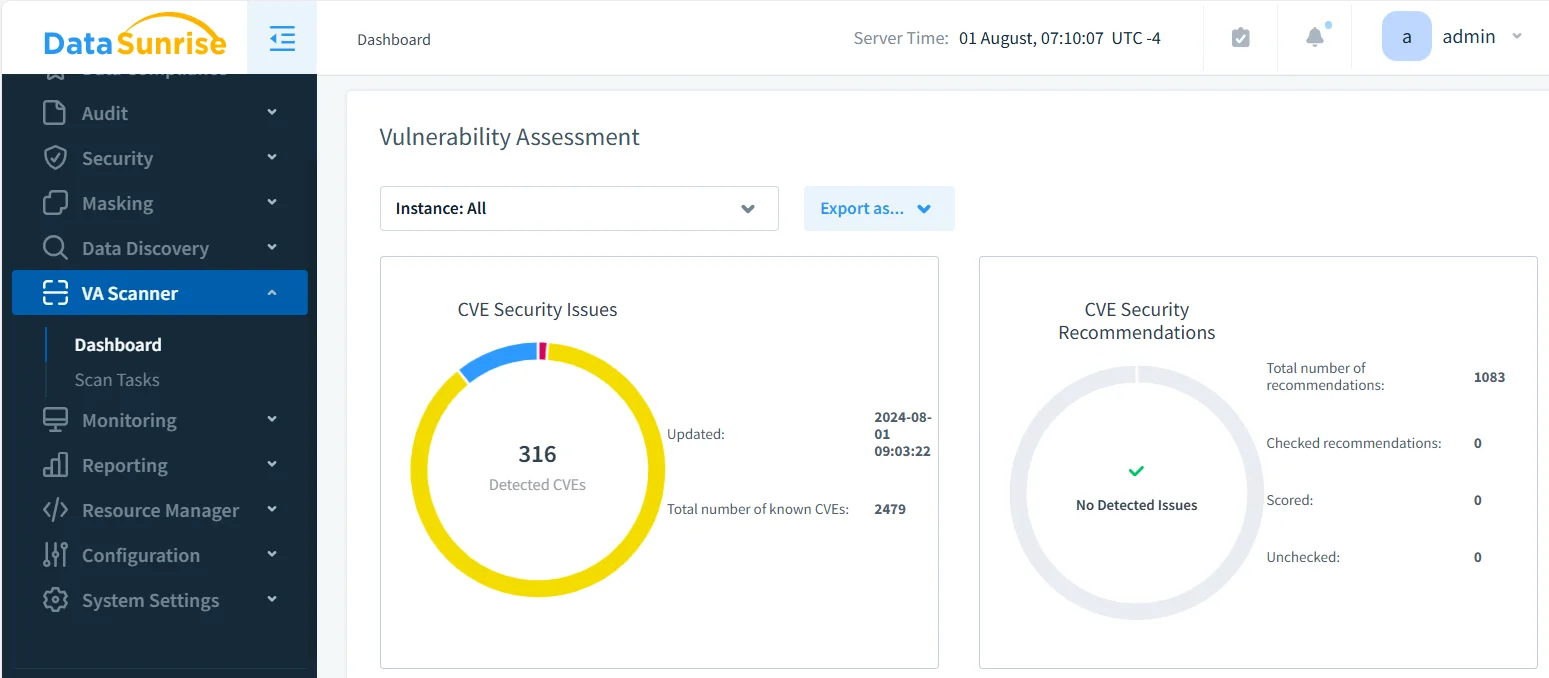
4. Monitor and Report: Access real-time governance monitoring, compliance tracking, and automated alerting through the unified dashboard.
Key Advantages of DataSunrise for Oracle Database
- Auto-Discover & Classify: Automatically identify sensitive data using NLP and machine learning algorithms
- No-Code Policy Automation: Create policies without complex PL/SQL, reducing implementation time from weeks to hours
- Real-Time Monitoring: Receive immediate alerts for policy violations with contextual information
- User Behavior Analysis: Establish baselines and detect anomalies using ML algorithms
- Automated Compliance Reporting: Generate pre-configured reports for GDPR, HIPAA, PCI DSS, and SOX
- Cross-Platform Consistency: Monitor Oracle alongside other platforms with support for over 40 data storage platforms
Best Practices for Oracle Database Data Governance
1. Establish a Governance Framework
Define clear objectives, document policies, and assign data stewards responsible for governance controls.
2. Implement Data Classification
Classify data based on sensitivity (Public, Internal, Confidential, Restricted) using automated discovery and continuous validation.
3. Configure Access Controls
Apply the Principle of Least Privilege, implement role-based access controls, and conduct regular access reviews.
4. Enable Comprehensive Monitoring
Implement detailed audit trails, leverage behavioral analytics, and configure real-time alerting for critical violations.
5. Maintain Compliance Documentation
Use automated reporting, preserve evidence with appropriate retention, and schedule periodic compliance assessments.
6. Deploy DataSunrise for Enhanced Governance
Implement DataSunrise's unified platform with cross-database visibility and flexible deployment modes.
Conclusion
Implementing robust data governance for Oracle Database has become essential for organizations managing sensitive information. While Oracle provides powerful native capabilities, organizations with complex requirements benefit significantly from enhanced solutions like DataSunrise.
DataSunrise provides comprehensive data governance specifically designed for Oracle environments, offering Zero-Touch Compliance Automation with Auto-Discover & Classify capabilities, No-Code Policy Automation, and real-time monitoring. With flexible deployment modes and support for heterogeneous database environments, DataSunrise transforms Oracle data governance into a strategic security asset.
Protect Your Data with DataSunrise
Secure your data across every layer with DataSunrise. Detect threats in real time with Activity Monitoring, Data Masking, and Database Firewall. Enforce Data Compliance, discover sensitive data, and protect workloads across 50+ supported cloud, on-prem, and AI system data source integrations.
Start protecting your critical data today
Request a Demo Download Now