Dynamic Data Masking
Dynamic data masking protects sensitive information by replacing selected values with masked equivalents whenever a database query is executed. The data presented depends on user permissions, session context, or predefined security policies, allowing authorized users to access original values while displaying masked information to all other users. Because the underlying data remains unchanged, organizations can safeguard credit card numbers, email addresses, personal identifiers, and other confidential information without modifying stored records or disrupting application functionality. This approach reduces unnecessary exposure of sensitive data while supporting security and regulatory compliance.
Organizations subject to regulations such as GDPR, HIPAA, and PCI DSS commonly implement dynamic data masking as part of a broader zero-trust security strategy. The NIST Privacy Framework also emphasizes restricting unnecessary access to sensitive information through policy-driven controls and continuous enforcement. This article compares dynamic and static data masking, explores the native masking capabilities of leading database platforms, and shows how DataSunrise provides real-time protection for sensitive information without requiring changes to database schemas or application code.
Static vs Dynamic Data Masking
What is Dynamic Data Masking?
Dynamic data masking is a security technique that hides sensitive information when users request it. Unlike static masking, it does not modify the original data stored in production systems. The platform masks query results in real time, allowing authorized users to view actual values while showing protected versions to users without sufficient access rights.
| Feature | Static Data Masking | Dynamic Data Masking |
|---|---|---|
| How it Works | Generates a masked copy of the database for non-production use | Masks query results in real time based on user or context |
| Original Data | Replaced permanently in the masked dataset | Remains unchanged in the source system |
| Primary Use Cases | Testing, development, vendor handoff | Live production environments, compliance, zero-trust |
| Flexibility | Hard to modify once applied | Policy-driven and easy to update |
| Compliance Fit | Good for data minimization | Excellent for access control and audit logging |
Why Dynamic Masking Is Better Suited for Live Environments
Static masking is effective for development, QA, and testing scenarios, but managing it in active multi-user environments can become cumbersome. Changes to masking policies often require masked datasets to be regenerated, tested, and redistributed, adding administrative effort and increasing the risk of inconsistencies or service disruption. Dynamic masking avoids this problem by applying protection rules in real time according to user roles, permissions, and query context. For example, developers can be shown partially obscured values, while support personnel receive fully masked data from the same production database without requiring separate copies or synchronization processes.
Since masking rules are enforced when queries are executed, dynamic masking helps limit risks caused by outdated datasets, manual processing errors, and unnecessary duplication of sensitive information. When combined with audit logging, contextual controls, and compliance reporting, it also provides detailed visibility and fine-grained management of data access. For this reason, dynamic masking is particularly suitable for production systems that process regulated or confidential information, especially where different teams require varying levels of access and continuous protection is necessary for compliance.
Built-in Support in Popular Databases
Several platforms provide native or plugin-based support for masking. For example:
- PostgreSQL: View-based masking or extensions like pg_maskdata
- Oracle: Data Redaction for role-based masking
- SQL Server: Built-in dynamic masking for certain fields
Here’s an example of PostgreSQL simulating masking with a view:
CREATE OR REPLACE VIEW masked_users AS
SELECT
  id,
  name,
  CASE
    WHEN current_user = 'auditor' THEN 'XXXX-XXXX-XXXX-' || RIGHT(card_number, 4)
    ELSE card_number
  END AS card_number,
  email
FROM users;
While effective in simple setups, this approach becomes difficult to scale across multiple databases or dynamic roles. That’s exactly where DataSunrise simplifies implementation—masking results across environments without altering SQL or schemas.
Dynamic Masking with DataSunrise
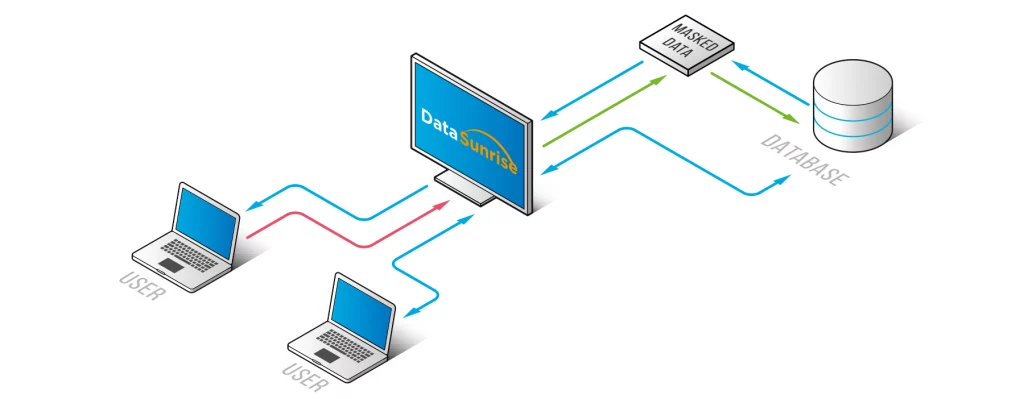
DataSunrise functions as a transparent proxy between applications and databases. As a result, it intercepts queries and enforces masking rules before the data is returned to the user. It supports:
The configuration process is handled entirely through a user-friendly interface. More importantly, no code rewrites or schema changes are required.
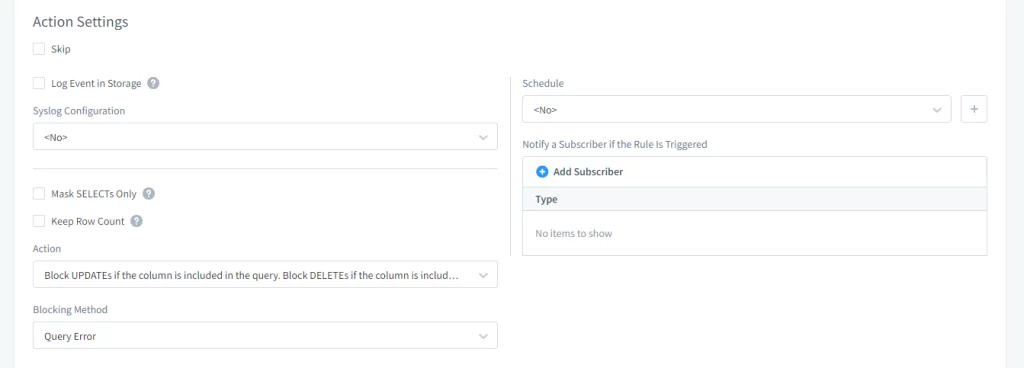
1. Action Settings
Admins can control whether masking events are logged, alerts are triggered, or update operations are blocked on masked fields.
2. Filter Settings
This section defines when and where masking should apply—based on user identity, IP range, source application, or even network routes. Therefore, it enables context-aware enforcement.

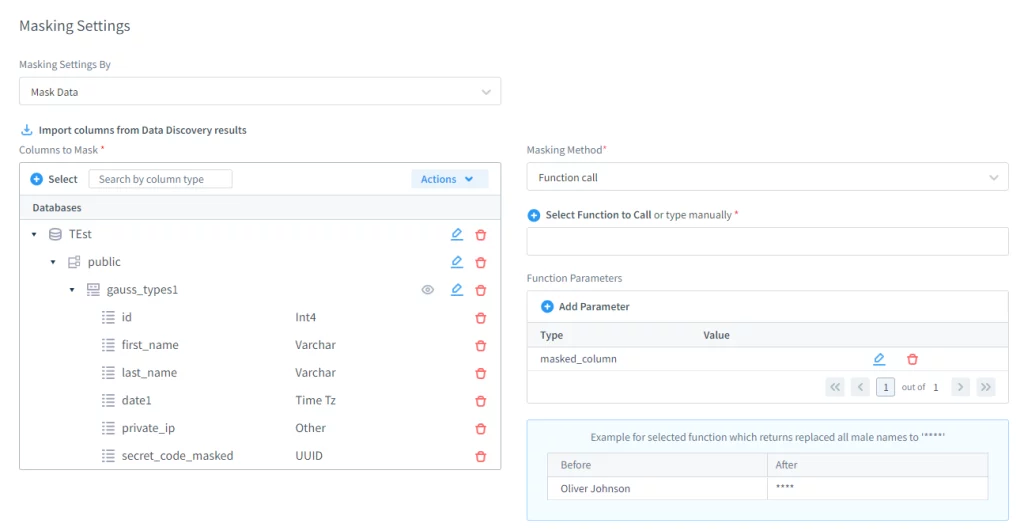
3. Masking Settings
Admins can select specific schemas, tables, and fields to protect. Additionally, they can define masking methods using built-in logic or custom Lua scripts.
4. Masking Logs
When logging is enabled, each masking event is recorded. As a result, organizations gain audit-ready insight into how and when masking was applied.
Common Challenges in Dynamic Masking Deployment
Dynamic data masking can be very effective, but it requires precise configuration. If deployed without proper planning, it may introduce security gaps or make data harder to use. Common issues include:
- Over-masking: Hiding too much information can prevent legitimate users, analysts, or support teams from completing their tasks when important context is no longer visible.
- Incorrectly scoped rules: Masking policies that are too broad or not based on user roles can cause inconsistent protection or expose data to the wrong users and applications.
- Incomplete coverage: Applying masking only at the database layer may leave other access paths unprotected, including BI tools, API responses, backups, and exported data.
DataSunrise addresses these challenges through fine-grained policy control, adaptive masking logic, and comprehensive audit visibility. Administrators can preview and validate masking rules in real time, ensuring the correct balance between security and usability. Additionally, integrated monitoring helps continuously verify that masking is enforced across all access paths, preventing accidental data leakage as systems or user roles evolve.
PostgreSQL Use Case with DataSunrise
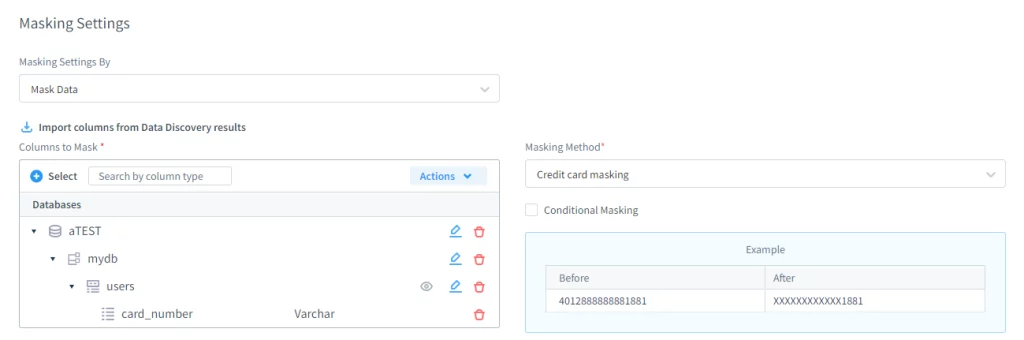
A typical use case might involve a users table containing credit card data. With DataSunrise configured, the card number is masked based on user permissions:

Admins define this behavior through the GUI instead of modifying the schema:
Consequently, users without elevated access see only masked values:

The event is also recorded in the audit logs automatically:

Benefits of Using DataSunrise for Masking
- Protects PII, credentials, and financial data at query time
- Supports cross-platform deployments without rewriting code
- Applies granular policies using roles, filters, and logic
- Provides audit trails for transparency and compliance
Practical Approaches to Dynamic Masking
| Approach | How It Works | Example Scenario |
|---|---|---|
| Role-Based | Mask or reveal fields based on user permissions | Support staff see partial card numbers, while fraud analysts see full values |
| Context-Aware | Adjust masking depending on location, device, or session type | Trusted corporate networks reveal more data than remote logins |
| Time-Limited | Grant temporary access with automatic expiry | Approved users view salary data for a set period, then masking reactivates |
Dynamic masking adapts protection to fit real business contexts instead of applying a single blanket rule.
Quick FAQ: Dynamic Masking
Does masking affect query performance?
Typically minimal when rules are scoped. DataSunrise applies policies at the proxy layer to avoid heavy database rewrites.
Can masking be bypassed via exports or BI tools?
Only if those paths aren’t in scope. Include APIs, exports, and analytics connectors in your masking rules to close gaps.
How do I choose fields to mask?
Start with data discovery to classify PII/PHI/PCI fields, then apply policies by sensitivity and role.
How do I prove compliance?
Use audit logs from masking events plus activity monitoring to show who saw what, when, and under which policy.
Can masking be applied dynamically based on user behavior?
Yes. Adaptive masking rules can tighten or relax visibility depending on risk signals such as unusual query volume, off-hours access, or privilege escalation attempts.
Does masking work with cloud-native databases and distributed systems?
Yes. DataSunrise supports dynamic masking across hybrid and multi-cloud infrastructures, including managed platforms such as Amazon RDS, Azure SQL, Google Cloud SQL, as well as distributed environments like Snowflake and BigQuery.
Conclusion
Dynamic Data Masking (DDM) plays an important role in protecting sensitive information across modern data infrastructures. By hiding confidential values in query results, it supports least-privilege access and reduces unnecessary exposure of protected data. Unlike approaches that modify source data or require separate sanitized copies, DDM applies masking dynamically according to user roles, permissions, session attributes, and other predefined conditions.
The effectiveness of DDM increases when it is integrated with automated data discovery, classification, and continuous activity monitoring. Applying consistent masking policies across cloud environments, on-premises databases, virtualized systems, and SaaS services helps organizations maintain reliable protection regardless of where sensitive data is stored. Centralized auditing and monitoring also provide greater visibility into user behavior, access activity, and interactions with confidential information.
DataSunrise extends Dynamic Data Masking with compliance automation, database activity monitoring, threat detection, and context-aware access controls. Comprehensive audit records increase operational visibility and help organizations meet regulatory requirements. As part of a broader data security framework, DDM enables businesses to minimize sensitive data exposure, improve compliance, and preserve consistent protection as their data environments expand.
Protect Your Data with DataSunrise
Secure your data across every layer with DataSunrise. Detect threats in real time with Activity Monitoring, Data Masking, and Database Firewall. Enforce Data Compliance, discover sensitive data, and protect workloads across 50+ supported cloud, on-prem, and AI system data source integrations.
Start protecting your critical data today
Request a Demo Download Now