AI Data Compliance Tools for Amazon Redshift
Organizations increasingly use Amazon Redshift to consolidate large volumes of analytical, customer, financial, and operational data. As these environments expand, maintaining data compliance becomes more difficult. Security teams must identify sensitive information, understand how it is accessed, detect unusual behavior, and maintain evidence for regulations such as GDPR, HIPAA, PCI DSS, and SOX.
NLP, LLM & ML Data Compliance Tools for Amazon Redshift can help reduce this workload. Natural Language Processing (NLP) improves sensitive-data classification, Machine Learning (ML) identifies behavioral patterns, and Large Language Models (LLMs) can assist with natural-language analysis and administrative workflows.
Amazon Redshift provides native machine learning and generative AI capabilities through integrations with AWS services. However, these technologies are primarily designed for analytics rather than end-to-end compliance management. DataSunrise complements them with compliance-focused discovery, monitoring, behavioral analysis, masking, and policy management.
Importance of Data Compliance Tools
Amazon Redshift environments often consolidate analytical data from multiple applications, departments, and business systems. As data volume and complexity increase, maintaining consistent compliance controls becomes harder. Organizations must continuously identify sensitive information, monitor access, detect policy violations, and preserve evidence for regulatory reviews.
Data compliance tools help reduce this operational burden by connecting discovery, monitoring, protection, and reporting. They are particularly important in Redshift environments where regulated information may be distributed across many schemas, tables, views, and analytical workloads.
Effective compliance tooling helps organizations:
- Identify regulated data: Detect PII, financial records, healthcare information, payment data, and other sensitive content.
- Monitor sensitive activity: Track how users, applications, and service accounts interact with protected Redshift objects.
- Detect unusual behavior: Highlight access patterns that differ from established usage or expected operational behavior.
- Reduce unnecessary exposure: Apply masking and other protection controls to limit access to sensitive values.
- Support regulatory requirements: Maintain evidence for frameworks such as GDPR, HIPAA, PCI DSS, and SOX.
- Improve audit readiness: Centralize activity records and compliance information so security teams can respond to audits more efficiently.
NLP, LLM, and ML technologies can further improve these processes by adding contextual analysis. NLP can help recognize sensitive information in less predictable textual fields, while ML can identify behavioral patterns that static rules may overlook. LLM-based assistance can simplify investigation and interpretation of complex security information.
However, intelligent analysis should complement—not replace—deterministic controls such as permissions, database auditing, masking rules, and documented compliance policies. The strongest approach combines automated analysis with explicit security controls and human oversight.
Intelligent Capabilities Available with Amazon Redshift
Amazon Redshift provides several technologies that organizations can incorporate into intelligent compliance workflows. These include Redshift ML, integration with Amazon Bedrock, Amazon Q generative SQL, and native database auditing. Each capability addresses a different part of the data analysis process, so organizations should distinguish analytical AI features from dedicated compliance controls.
Amazon Redshift ML for Compliance-Oriented Analysis
Amazon Redshift ML allows SQL users to create and apply machine learning models without moving analytical workflows into a separate environment. It can use Amazon SageMaker AI for model training and expose prediction functions directly inside Redshift.
For compliance-oriented use cases, organizations can analyze historical database activity and build models that classify behavior according to selected risk indicators. Typical input data may include query frequency, the number of rows accessed, failed operations, or other activity-related attributes.
A simplified activity dataset could be prepared as follows:
CREATE TABLE compliance_activity (
    user_name        VARCHAR(128),
    queries_per_hour INTEGER,
    rows_accessed    BIGINT,
    failed_queries   INTEGER,
    risk_label       VARCHAR(20)
);
Historical records stored in this table can then serve as training data for a model that distinguishes normal behavior from potentially risky activity.
A simplified Redshift ML workflow could look like this:
CREATE MODEL compliance_risk_model
FROM (
    SELECT
        queries_per_hour,
        rows_accessed,
        failed_queries,
        risk_label
    FROM compliance_activity
)
TARGET risk_label
FUNCTION predict_compliance_risk
IAM_ROLE default
AUTO ON;
Once the model is trained, analysts can apply its prediction function to current or historical activity:
SELECT
    user_name,
    predict_compliance_risk(
        queries_per_hour,
        rows_accessed,
        failed_queries
    ) AS predicted_risk
FROM compliance_activity;
This can help prioritize events that deserve additional investigation and support internal risk analysis.
However, Redshift ML does not automatically determine whether database activity violates GDPR, HIPAA, PCI DSS, SOX, or another regulatory framework. Administrators must still define appropriate training data, interpret model output, establish thresholds, and decide which controls or response procedures should follow.
LLM Access Through Amazon Bedrock
Amazon Redshift can also integrate with Amazon Bedrock foundation models. This gives Redshift workflows access to generative AI capabilities that can process and interpret natural-language information.
Such functionality can support tasks including text summarization, translation, sentiment analysis, semantic interpretation, and other operations involving textual data. In a compliance context, similar techniques may help security teams review large collections of textual information, summarize findings, or interpret descriptive data stored in analytical workloads.
A conceptual text-oriented query could analyze stored descriptions or comments before they are reviewed by compliance teams:
SELECT
    record_id,
    description
FROM compliance_notes
WHERE description IS NOT NULL;
The resulting text can then become part of an approved LLM-assisted workflow for summarization or classification.
These capabilities can improve the efficiency of analysis, but they must be used carefully. Sensitive database content should not be exposed to LLM-based workflows without appropriate access restrictions, data minimization, and organizational controls.
For example, administrators can first restrict access to sensitive source tables:
REVOKE ALL
ON TABLE compliance_notes
FROM PUBLIC;
Access can then be granted only to an approved role:
GRANT SELECT
ON TABLE compliance_notes
TO ROLE compliance_analyst;
LLM integration therefore complements rather than replaces established mechanisms such as access controls, auditing, masking, and regulatory policy enforcement.
Natural-Language SQL with Amazon Q
Amazon Q generative SQL in Redshift Query Editor v2 allows users to describe analytical requirements in natural language and receive suggested SQL queries.
For example, a compliance analyst could submit a request such as:
Find users that accessed the finance schema most frequently
during the previous seven days.
Amazon Q can translate this request into SQL, reducing the need to manually construct more complex queries.
A resulting query might conceptually resemble:
SELECT
    user_name,
    COUNT(*) AS access_count
FROM compliance_activity
WHERE schema_name = 'finance'
  AND event_time >= DATEADD(day, -7, GETDATE())
GROUP BY user_name
ORDER BY access_count DESC;
This can accelerate investigations and make Redshift easier to use for compliance specialists who may not work with advanced SQL every day. It can also help analysts explore audit-related information more efficiently when investigating unusual activity or reviewing access patterns.
Generated SQL should still be reviewed before execution. A generative model may select an incorrect database object, misunderstand the requested scope, or produce a query that does not fully match the intended compliance requirement. Human validation therefore remains important when AI-generated SQL is used in sensitive administrative workflows.
Connecting Intelligent Analysis with Redshift Audit Evidence
AI and ML capabilities become more useful when they operate on reliable activity evidence. Amazon Redshift database audit logging can capture connection activity, user information, and executed SQL statements. These records can be exported to Amazon CloudWatch or Amazon S3 and retained for investigation, reporting, and further analysis.
User activity logging can be enabled through the Redshift parameter group:
enable_user_activity_logging = true
Administrators can also review recent query activity through Redshift system views. For example:
SELECT
    userid,
    query,
    starttime,
    endtime,
    aborted
FROM STL_QUERY
ORDER BY starttime DESC
LIMIT 100;
User-related information can be combined with additional system metadata when investigating suspicious behavior:
SELECT
    userid,
    COUNT(*) AS query_count
FROM STL_QUERY
WHERE starttime >= DATEADD(day, -1, GETDATE())
GROUP BY userid
ORDER BY query_count DESC;
Organizations can use this historical activity to examine how users interact with Redshift resources, identify unusual access patterns, and prepare datasets for additional machine learning or compliance-oriented analysis.
Native Redshift capabilities therefore cover several complementary functions. Audit logging records database activity, Redshift ML supports predictive analysis, Amazon Bedrock integration provides access to foundation models, Amazon Q assists with natural-language SQL generation, and IAM together with database permissions restricts access to resources.
These technologies provide useful building blocks, but they do not form a complete compliance system on their own. Continuous compliance still requires coordination between data classification, activity monitoring, permissions, alerting, protection policies, model design, regulatory interpretation, and evidence retention.
NLP, LLM & ML Data Compliance for Redshift with DataSunrise
DataSunrise applies intelligent technologies to compliance-oriented tasks rather than using machine learning primarily for analytical predictions. Its capabilities focus on areas such as data discovery, database activity analysis, sensitive-data protection, and compliance management across monitored environments.
For Amazon Redshift, this approach helps connect data classification, behavior analysis, auditing, masking, and regulatory workflows within a centralized platform.
Connect Amazon Redshift
The first step is registering the Amazon Redshift environment in DataSunrise. Organizations can select an appropriate deployment and monitoring approach according to their infrastructure and operational requirements.
DataSunrise can monitor Redshift activity directly and can also work with native audit information through supported log-trailing workflows. For Amazon Redshift, these workflows can include Amazon S3, Amazon CloudWatch, and Redshift Spectrum.
Once connected, the Redshift instance becomes available for centralized auditing, discovery, masking, and compliance configuration. This creates a common control point for applying security policies and reviewing activity related to sensitive analytical data.
NLP-Enhanced Sensitive Data Discovery
Sensitive-data classification becomes more difficult when regulated information is stored in columns whose names do not clearly describe their contents. Conventional discovery methods based on predictable names, predefined patterns, and regular expressions remain useful for obvious fields such as email addresses, phone numbers, payment information, and government identifiers.
However, analytical environments frequently contain generic fields such as descriptions, comments, notes, payloads, or imported application data. These fields may contain personally identifiable or otherwise regulated information even when the schema provides little indication of what is stored inside them.
DataSunrise combines pattern-oriented detection with NLP-assisted analysis to improve recognition of sensitive information within textual content. This can help identify personally identifiable information, financial records, healthcare-related information, authentication data, and organization-specific sensitive values.
The resulting classification can then support additional security controls. Instead of treating discovery as a standalone inventory task, organizations can use discovered objects when configuring auditing, masking, security, and compliance policies.
Machine Learning for Behavioral Analysis
Traditional audit policies work well when administrators already know which users, objects, or operations require monitoring. They are less effective when risk depends on how current activity differs from a user's established behavior.
Machine-learning analysis adds behavioral context to database monitoring. Rather than evaluating every operation against the same static threshold, the system can analyze historical patterns and identify activity that differs from typical behavior.
Examples can include unusually frequent queries, access outside established working periods, repeated interaction with sensitive objects, unexpected retrieval volumes, or sudden changes in how a user normally works with Redshift data.
This capability complements conventional database activity monitoring. It does not eliminate the need for explicit audit rules, but it can help security teams focus on events that deserve closer attention.
For example, a large data retrieval operation may be expected for an ETL service account but unusual for an employee who normally executes small reporting queries. Behavioral context makes this distinction easier to identify than a single universal rule.
Machine Learning Audit Rules
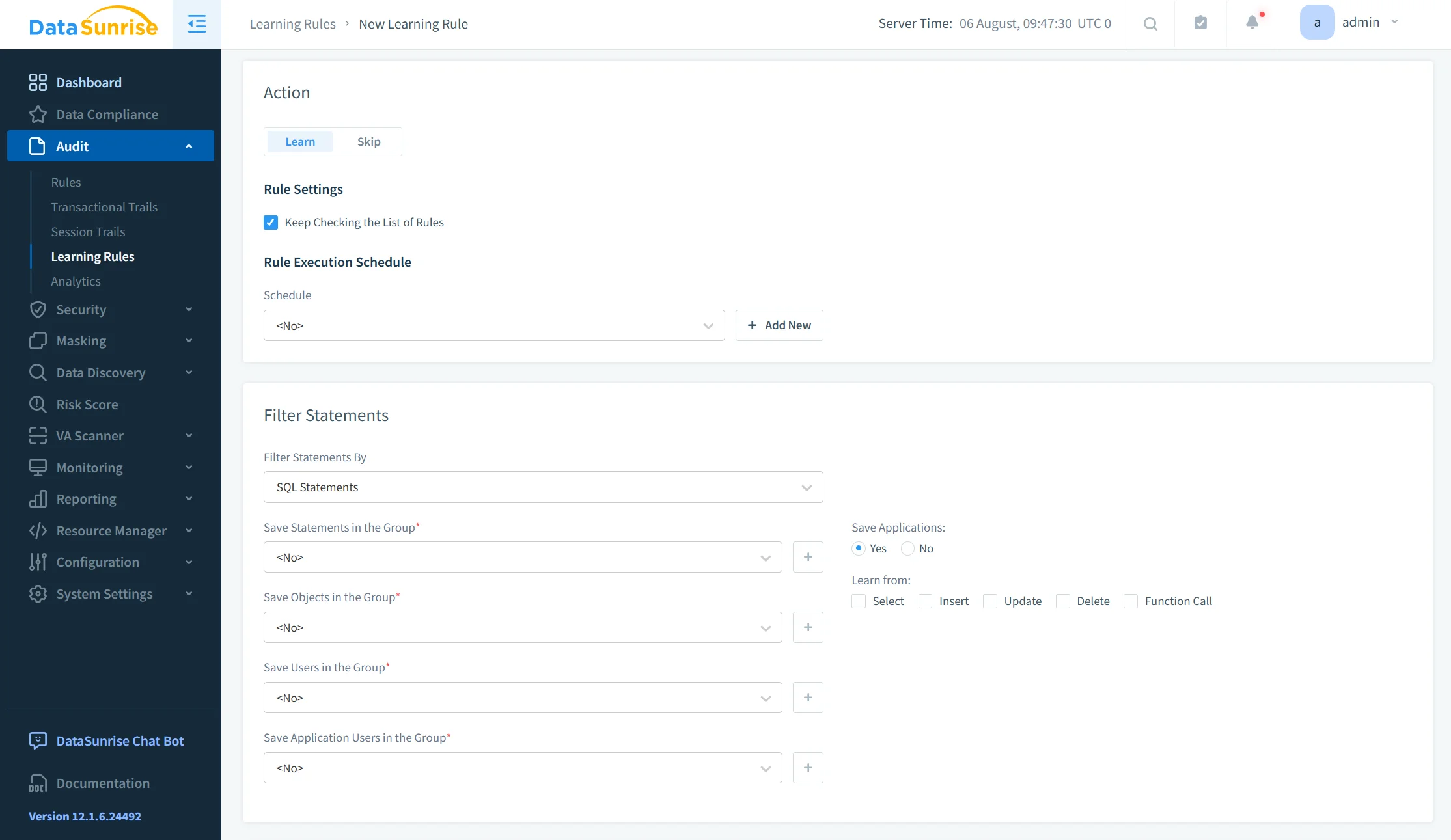
DataSunrise Machine Learning Audit Rules extend behavioral analysis into audit policy management.
In environments with many users, applications, schemas, and service accounts, manually describing every legitimate SQL pattern can become difficult to maintain. Learning-based workflows can analyze observed database activity and help establish rules around recurring behavior.
This makes it possible to create a more focused audit scope based on actual usage patterns rather than relying entirely on manually maintained filters.
For Amazon Redshift environments with varied analytical workloads, this approach can reduce unnecessary audit noise while preserving visibility into activity that differs from established behavior.
Machine Learning Audit Rules therefore complement traditional rule-based auditing. Administrators retain control over monitoring policies while using learned patterns to improve their accuracy and relevance.
LLM-Assisted Operations
Large Language Models can also help simplify interaction with complex security and compliance information.
DataSunrise provides LLM-assisted functionality that can support contextual guidance and natural-language interaction with technical information. This can help administrators understand configuration options, interpret platform functionality, and navigate compliance-related workflows more efficiently.
Such assistance is particularly useful in environments where database security involves many interconnected controls, including auditing, masking, discovery, and regulatory policy management.
LLMs should still remain an assistance layer rather than an independent compliance authority. Regulatory requirements depend on organizational context, data ownership, internal policies, and legal interpretation. These decisions require explicit controls and human oversight.
Dynamic and Static Data Masking
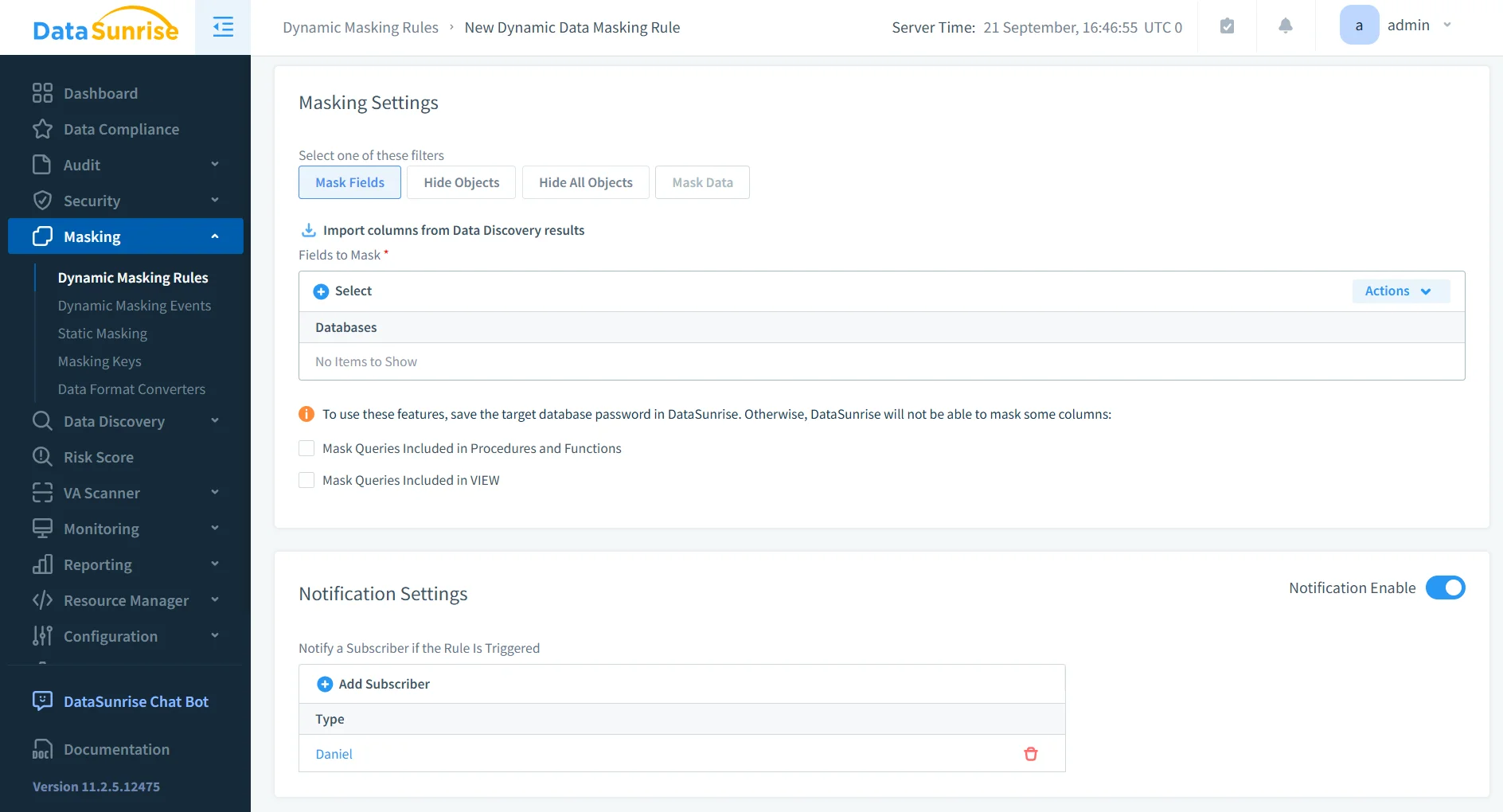
Dynamic Data Masking allows organizations to modify query results according to configured conditions while leaving the original production values unchanged.
This approach is useful when users or applications require access to a table but should not receive complete sensitive values. Masking policies can therefore help reduce unnecessary exposure while preserving application functionality.
Static Data Masking addresses a different requirement. It can create sanitized copies of sensitive information for development, testing, analytics, or other non-production use cases where real production values are unnecessary.
When NLP-assisted discovery identifies regulated columns in Amazon Redshift, organizations can use those findings to determine where masking should be applied. This creates a direct path from sensitive-data identification to protection.
Compliance-Oriented Monitoring
DataSunrise can combine captured Redshift activity with audit policies and sensitive-data context. This allows security teams to focus on interactions involving regulated information instead of treating every database query as equally important.
For example, activity involving discovered payment, healthcare, or personally identifiable information can receive greater attention than routine access to non-sensitive analytical objects.
This approach can support compliance workflows associated with GDPR, HIPAA, PCI DSS, SOX, and other regulatory requirements.
Centralized audit logs and reporting provide additional evidence for investigations and compliance reviews. By linking activity monitoring with data classification and protection policies, organizations can maintain clearer visibility into how sensitive Amazon Redshift data is accessed and used.
Native AI and DataSunrise Compliance Intelligence
| Area | Amazon Redshift and AWS | DataSunrise |
|---|---|---|
| Machine learning | Redshift ML with SageMaker AI | Behavioral and audit analysis |
| Generative AI | Amazon Bedrock integration | LLM-assisted security operations |
| Sensitive Data Discovery | Separate classification workflow | NLP-enhanced Sensitive Data Discovery |
| Behavioral analysis | Custom ML models | Machine Learning Audit Rules |
| Activity monitoring | Redshift logs in CloudWatch or S3 | Centralized monitoring and log trailing |
| Data protection | Native controls configured separately | Dynamic and Static Data Masking |
| Compliance workflows | Distributed across AWS services | Centralized compliance policies and reporting |
Redshift provides AI capabilities mainly for analytics and custom workflows. DataSunrise applies NLP, LLM, and ML technologies directly to database security, monitoring, and compliance tasks.
Conclusion
Amazon Redshift provides a strong foundation for intelligent data analysis. Redshift ML enables predictive modeling through SQL, Amazon Bedrock integration exposes foundation models to analytical workloads, and Amazon Q generative SQL simplifies interaction through natural language. Native audit logging supplies the historical activity evidence needed for security and compliance analysis.
However, these capabilities are general-purpose building blocks rather than a complete regulatory control system.
DataSunrise extends Amazon Redshift with NLP-enhanced Sensitive Data Discovery, Machine Learning Audit Rules, behavior analytics, centralized database activity monitoring, Dynamic and Static Data Masking, and automated compliance reporting.
By combining deterministic security controls with contextual NLP and ML analysis, organizations can identify sensitive information more accurately, prioritize unusual activity, reduce repetitive administrative work, and maintain stronger compliance evidence as Redshift environments evolve.
Protect Your Data with DataSunrise
Secure your data across every layer with DataSunrise. Detect threats in real time with Activity Monitoring, Data Masking, and Database Firewall. Enforce Data Compliance, discover sensitive data, and protect workloads across 50+ supported cloud, on-prem, and AI system data source integrations.
Start protecting your critical data today
Request a Demo Download Now