Amazon Redshift Data Governance
As organizations consolidate analytical workloads in Amazon Redshift, maintaining consistent control over data becomes increasingly important. Amazon Redshift Data Governance combines access management, sensitive data protection, activity oversight, and policy enforcement to ensure that information remains properly controlled throughout its lifecycle.
Data governance goes beyond granting database permissions. Organizations also need to understand where sensitive information resides, determine who should access it, monitor how it is used, and maintain reliable evidence of policy enforcement. These requirements become more difficult as Redshift environments expand across schemas, applications, departments, and shared analytics workloads.
Amazon Redshift provides native mechanisms including role-based access control, row-level security, Dynamic Data Masking, data sharing, system metadata views, and audit logging. DataSunrise complements these capabilities with centralized Sensitive Data Discovery, automated policy management, database activity monitoring, masking, risk scoring, and regulatory alignment.
Importance of Data Governance
Data governance establishes the policies, responsibilities, and technical controls that determine how information is accessed, protected, shared, and maintained. In Amazon Redshift environments, this becomes especially important because analytical warehouses often consolidate large volumes of business, customer, financial, and operational data in one location.
Without a defined governance framework, organizations can gradually accumulate excessive privileges, inconsistent access rules, undocumented sensitive data, and uncontrolled data sharing. These gaps increase both security risk and administrative complexity.
Effective Amazon Redshift Data Governance helps organizations:
- Maintain Data Ownership: Define who is responsible for specific schemas, tables, and sensitive datasets.
- Control Data Access: Apply role-based access controls, row-level policies, and least-privilege permissions.
- Identify Sensitive Information: Locate regulated and confidential data before applying protection policies.
- Reduce Unnecessary Exposure: Use masking and granular permissions to limit access to sensitive values.
- Monitor Data Usage: Maintain visibility into queries, sessions, administrative operations, and access to critical database objects.
- Support Regulatory Requirements: Align governance processes with GDPR, HIPAA, PCI DSS, SOX, and internal security policies.
- Improve Accountability: Preserve reliable activity records showing who accessed or modified governed resources.
- Control Data Sharing: Ensure that analytical datasets are distributed only to approved users, accounts, and workloads.
A mature governance model therefore connects data classification, access controls, monitoring, protection, and compliance instead of treating them as separate administrative tasks. This helps organizations maintain consistent control as Amazon Redshift schemas, users, and analytical workloads continue to evolve.
Native Amazon Redshift Data Governance Capabilities
Amazon Redshift provides several native controls that organizations can combine into a practical data governance framework. These capabilities help administrators establish ownership, define permitted access, reduce unnecessary exposure, control data distribution, and maintain evidence of how database resources are used.
1. Establish Role-Based Data Access
Role-Based Access Control allows administrators to organize permissions around job responsibilities rather than assigning privileges separately to every user. Roles can be created for analysts, data stewards, administrators, or other groups and then granted access to specific schemas, tables, and database objects.
For example, administrators can create separate roles for reporting users and data governance teams:
CREATE ROLE reporting_analyst;
CREATE ROLE data_steward;

GRANT USAGE ON SCHEMA analytics TO ROLE reporting_analyst;
GRANT SELECT ON ALL TABLES IN SCHEMA analytics TO ROLE reporting_analyst;

GRANT USAGE ON SCHEMA governance TO ROLE data_steward;
GRANT SELECT ON ALL TABLES IN SCHEMA governance TO ROLE data_steward;
This approach supports the principle of least privilege because users receive only the permissions required for their responsibilities. It also makes access management more consistent as teams grow or responsibilities change.
Amazon Redshift provides system views such as SVV_ROLE_GRANTS and SVV_RELATION_PRIVILEGES for reviewing existing assignments and object-level privileges.
SELECT
    role_name,
    user_name,
    granted_role_name
FROM SVV_ROLE_GRANTS
ORDER BY role_name, user_name;
Administrators can also inspect permissions assigned to database objects:
SELECT
    identity_name,
    namespace_name,
    relation_name,
    privilege_type
FROM SVV_RELATION_PRIVILEGES
ORDER BY namespace_name, relation_name;
Governance teams can use these views to identify excessive permissions, inherited access, outdated grants, and privileges that no longer correspond to current business responsibilities.
2. Apply Fine-Grained Data Policies
Database-level permissions alone are often insufficient when users require access to different portions of the same dataset. Amazon Redshift therefore provides several mechanisms for implementing more precise governance controls.
Row-level security restricts which records a user or role can retrieve. Organizations can apply these policies according to department, geography, customer ownership, business unit, or another governance attribute.
A simplified row-level security policy can be created as follows:
CREATE RLS POLICY region_access_policy
WITH (region VARCHAR(50))
USING (region = current_user);
The policy can then be attached to a selected table:
ATTACH RLS POLICY region_access_policy
ON sales.customer_orders
TO ROLE reporting_analyst;
Amazon Redshift also provides Dynamic Data Masking for situations where users need access to a column but should not see its original values. Masking policies can transform, partially hide, or redact sensitive information during query execution while leaving the stored data unchanged.
For example:
CREATE MASKING POLICY mask_email
WITH (email VARCHAR(256))
USING ('***@***');
The masking policy can then be associated with a sensitive column:
ATTACH MASKING POLICY mask_email
ON customers(email)
TO ROLE reporting_analyst;
Together, RBAC, row-level security, column-level permissions, and Dynamic Data Masking create multiple governance boundaries. Role-level controls determine which responsibilities receive access, object-level privileges regulate access to schemas and tables, row-level policies restrict individual records, and masking policies reduce exposure of sensitive values.
This layered approach provides more precise governance than relying only on broad schema or database permissions.
3. Govern Data Sharing
Modern Amazon Redshift environments often need to make analytical information available across warehouses, workgroups, AWS accounts, or Regions. Data governance must therefore address not only access inside one database, but also how information is distributed between consumers.
Amazon Redshift data sharing provides controlled access to live data without requiring organizations to manually copy or transfer datasets. A datashare acts as a logical container that defines which database objects are shared and which consumers can access them.
For example, administrators can create a datashare and add selected analytical objects:
CREATE DATASHARE governed_sales;

ALTER DATASHARE governed_sales
ADD SCHEMA analytics;

ALTER DATASHARE governed_sales
ADD TABLE analytics.monthly_sales;
Access can then be granted to an approved consumer:
GRANT USAGE
ON DATASHARE governed_sales
TO NAMESPACE 'consumer-namespace-id';
Governance teams can use datashares to separate data ownership from data consumption. The producer retains control over the underlying information, while approved consumers receive access only to explicitly shared objects.
Shared objects are not automatically writable. Additional permissions and authorization are required when write access is supported and needed. This helps organizations maintain clearer boundaries between data producers and consumers while reducing unnecessary duplication of governed datasets.
4. Maintain Governance Evidence with Audit Logging
Effective governance requires more than defining policies. Organizations also need evidence showing whether users and applications are operating within those policies.
Amazon Redshift database audit logging records database activity such as connections, user changes, and executed operations. Audit records can be exported to Amazon CloudWatch Logs or Amazon S3 for retention, investigation, and reporting.
Administrators can also inspect recent database activity directly through Amazon Redshift system views. For example:
SELECT
    userid,
    query,
    starttime,
    endtime,
    aborted
FROM STL_QUERY
ORDER BY starttime DESC
LIMIT 50;
Recent connection activity can also be reviewed:
SELECT
    recordtime,
    username,
    remotehost,
    event
FROM STL_CONNECTION_LOG
ORDER BY recordtime DESC
LIMIT 50;
These records allow governance teams to determine who accessed specific datasets, which accounts performed sensitive operations, when privileged activity occurred, and which database objects were involved. Reviewing this information helps verify whether actual usage remains consistent with approved access responsibilities.
AWS CloudTrail adds another layer by recording Redshift API operations performed through AWS. These records can be reviewed alongside database audit logs to connect database-level activity with administrative changes made by users, IAM roles, or AWS services.
Together, native Amazon Redshift controls provide a capable governance foundation. However, governance becomes more difficult when organizations must continuously classify sensitive information, correlate access policies with actual data usage, identify policy drift, and maintain consistent controls across multiple database and storage platforms.
DataSunrise for Amazon Redshift Data Governance
DataSunrise extends Amazon Redshift Data Governance with a centralized framework for discovering, monitoring, protecting, and evaluating sensitive data. The platform supports real-time auditing, Database Security, Data Discovery, Risk Scoring, Dynamic Data Masking, Static Data Masking, Data Compliance, and native audit-log trailing for Amazon Redshift. Depending on the selected configuration, native Redshift audit data can be collected through Amazon S3, CloudWatch, or Redshift Spectrum.
1. Connect the Amazon Redshift Environment
The governance process begins by adding the Amazon Redshift instance to DataSunrise. The platform retrieves the database metadata required for discovery, monitoring, and policy configuration and supports both regular database authentication and IAM-based authentication.
Organizations that already use native Amazon Redshift audit logging can also configure DataSunrise to consume native audit trails. This allows governance teams to centralize monitoring without requiring every scenario to rely exclusively on proxy traffic. As a result, administrators can select an operating mode that fits the existing architecture while maintaining centralized control over governance policies.
2. Discover and Classify Sensitive Data
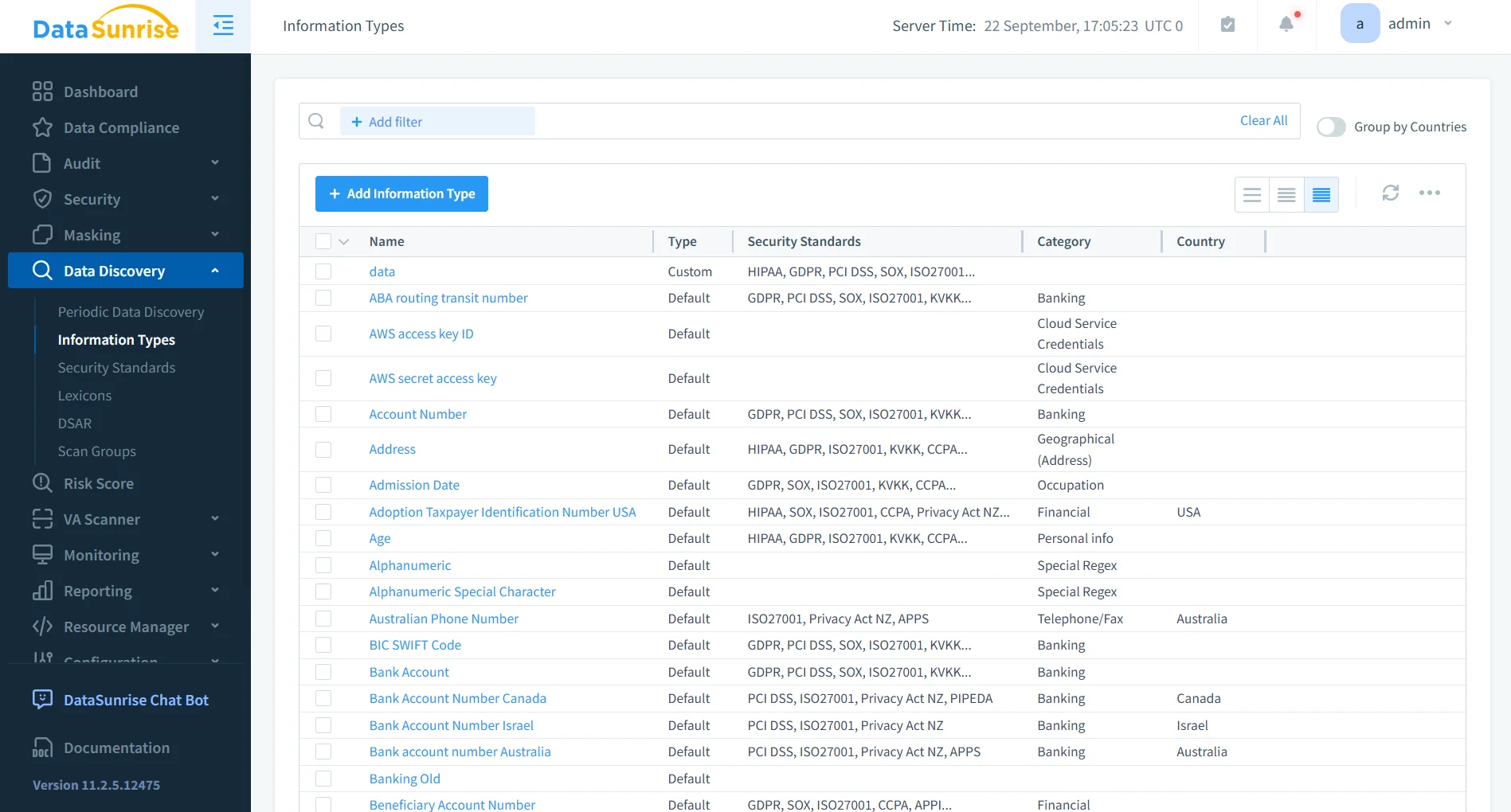
Effective governance depends on knowing where sensitive information is stored. DataSunrise Data Discovery inspects Amazon Redshift schemas and identifies data that may require additional protection or regulatory controls.
Discovery can classify personally identifiable information, contact details, financial records, payment information, authentication data, healthcare information, and organization-specific sensitive values. Instead of relying only on table names or manually maintained inventories, governance teams receive a data-centric view of sensitive information across the Redshift environment.
Periodic Data Discovery can repeat this process as schemas change. Newly created tables or columns containing sensitive values can therefore be identified after the initial assessment. DataSunrise also supports custom Information Types, allowing organizations to classify data according to internal governance requirements.
3. Convert Classification into Governance Policies
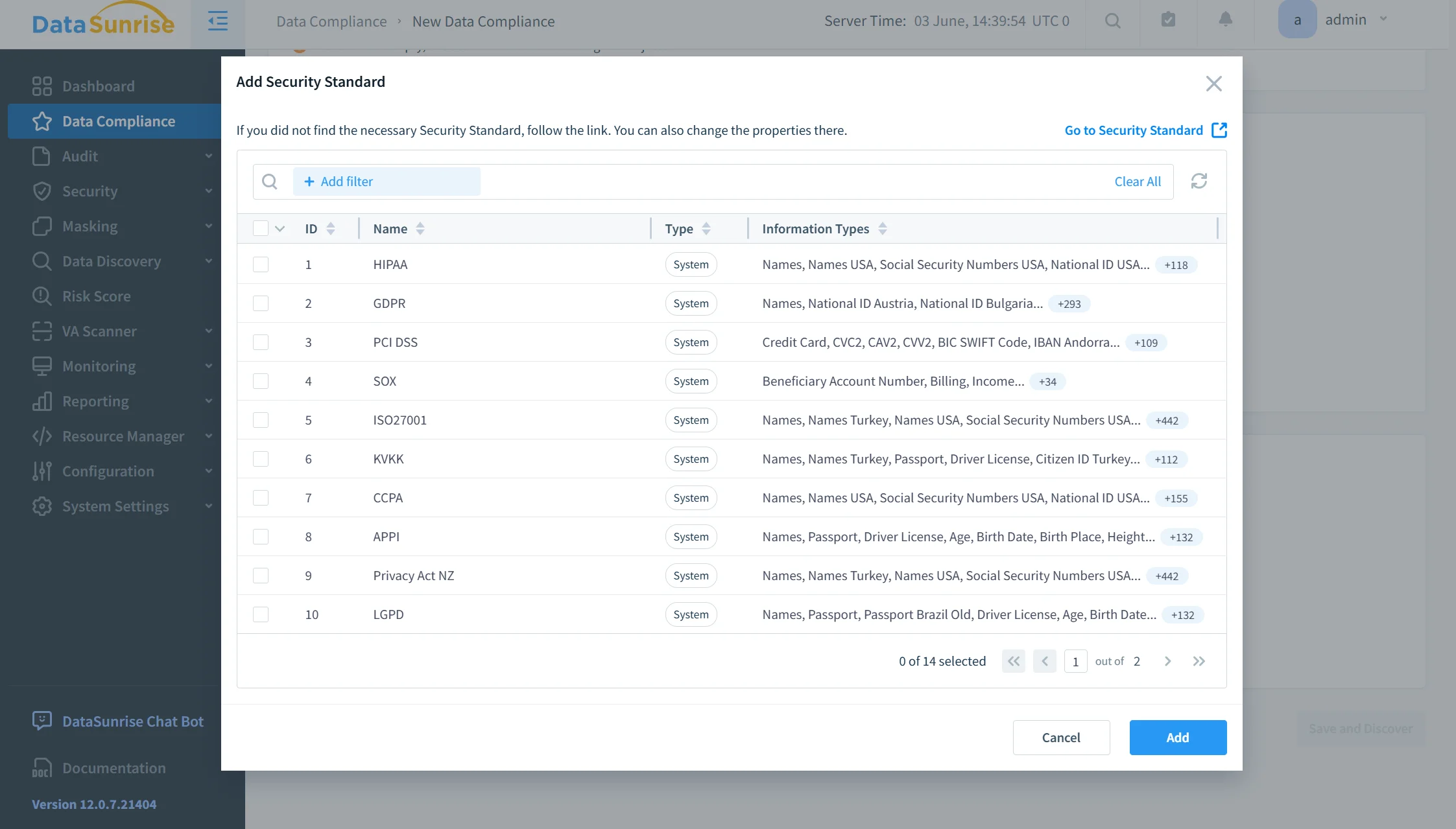
Sensitive data classification becomes more valuable when the results directly influence security and governance controls. DataSunrise can use discovered database objects and Information Types when administrators configure audit, security, and masking policies.
For example, organizations can audit access to financial or personal information, apply Dynamic Data Masking to sensitive columns, restrict suspicious operations against regulated tables, or enforce different controls for selected users, applications, and source addresses. Relevant database events can also be associated with detected Information Types to provide additional context during later analysis.
This approach connects discovery with policy enforcement instead of maintaining classification and protection as separate processes. It also supports No-Code Policy Automation and more consistent Context-Aware Protection as the governed Amazon Redshift environment evolves.
4. Monitor How Governed Data Is Used
Permissions describe what users are allowed to access, but governance also requires visibility into how those permissions are actually used. DataSunrise provides centralized Database Activity Monitoring for queries, sessions, users, database objects, applications, and other event context.
Audit rules can focus on selected objects, users, or query categories rather than capturing all database operations indiscriminately. Transactional Trails provide detailed information about recorded events and can be used during investigations, security reviews, and governance assessments.
Event Tagging can associate captured activity with Information Types identified in query results. This gives governance teams additional context by connecting database actions with the sensitivity of the information involved. In heterogeneous environments, centralized monitoring also avoids the need to maintain completely separate governance views for each database platform.
5. Reduce Exposure with Dynamic and Static Masking
Data governance should control not only whether users can reach sensitive information, but also how much of that information they are allowed to see.
Dynamic Data Masking protects sensitive query results without changing the original values stored in Amazon Redshift. Masking rules can be applied according to users, applications, database objects, or other policy conditions. This allows analysts, developers, contractors, or support personnel to work with required datasets without receiving unnecessary access to complete sensitive values.
Static Data Masking addresses data exposure in copied environments by replacing sensitive values before datasets are used for development, testing, or other non-production workloads. Together, dynamic and static masking help governance teams maintain consistent protection across production access and downstream data workflows.
6. Maintain Continuous Governance Alignment
Amazon Redshift environments continue to change after governance policies are introduced. New tables appear, roles are modified, users receive additional permissions, and sensitive information may be added to previously unclassified objects.
DataSunrise combines Sensitive Data Discovery, Automatic Policy Generation, Compliance Autopilot, Continuous Regulatory Calibration, Risk Scoring, and Audit-Ready Reporting to reduce the amount of manual review required as these changes occur. Compliance workflows can align discovered information with frameworks such as GDPR, HIPAA, PCI DSS, and SOX.
Machine Learning Audit Rules and behavior analytics provide an additional layer by evaluating database activity against established usage patterns. Instead of relying exclusively on predefined conditions, governance teams can use these capabilities to identify deviations that may require investigation.
The result is a Unified Security Framework in which data discovery, policy enforcement, activity monitoring, masking, risk evaluation, and compliance evidence operate through the same governance layer.
Native Amazon Redshift vs. DataSunrise Governance
| Governance Capability | Amazon Redshift Native | DataSunrise |
|---|---|---|
| Access control | RBAC and RLS policies | Centralized security and monitoring policies |
| Sensitive data discovery | Requires additional services or processes | Automated Sensitive Data Discovery |
| Data masking | Native Dynamic Data Masking | Dynamic and Static Data Masking |
| Activity monitoring | S3 and CloudWatch audit logs | Real-time audit and native-log trailing |
| Risk assessment | Requires additional analysis | Integrated Risk Scoring |
| Compliance automation | Requires multiple AWS controls | Compliance Autopilot and policy automation |
| Governance reporting | Native logs and AWS reporting tools | Centralized audit-ready reporting |
Conclusion
Amazon Redshift provides a strong native foundation for data governance through Role-Based Access Control, row-level security, Dynamic Data Masking, granular privileges, controlled data sharing, system metadata views, CloudWatch and S3 audit logging, and CloudTrail integration. Together, these capabilities allow organizations to establish access boundaries and maintain visibility into governed analytical workloads.
However, effective governance requires continuous understanding of the data itself. Organizations must identify sensitive information through Data Discovery, correlate classification with user activity, adapt policies as environments change, limit unnecessary exposure, and maintain evidence that governance requirements remain enforced.
DataSunrise extends Amazon Redshift Data Governance with Sensitive Data Discovery, centralized Database Activity Monitoring, Event Tagging, Risk Scoring, Dynamic and Static Data Masking, No-Code Policy Automation, Compliance Autopilot, Continuous Regulatory Calibration, and automated compliance reporting.
This unified approach helps organizations reduce manual governance effort, strengthen control over sensitive Redshift data, and maintain consistent protection as users, schemas, workloads, and regulatory requirements evolve.
Protect Your Data with DataSunrise
Secure your data across every layer with DataSunrise. Detect threats in real time with Activity Monitoring, Data Masking, and Database Firewall. Enforce Data Compliance, discover sensitive data, and protect workloads across 50+ supported cloud, on-prem, and AI system data source integrations.
Start protecting your critical data today
Request a Demo Download Now