Amazon S3 Compliance Management
In today's cloud-first landscape, implementing comprehensive compliance management for Amazon S3 has become essential for enterprises storing sensitive data. According to Gartner's 2024 Cloud Security Report, organizations with robust S3 compliance frameworks detect data exposure incidents 91% faster and reduce regulatory violation costs by up to 68%.
Amazon S3 serves as the backbone for cloud data storage, hosting everything from application data to sensitive customer information. With data breach costs averaging $4.88 million in 2024, implementing effective S3 compliance management has become a business necessity. Organizations can learn more about S3 security best practices in the official AWS documentation.
Organizations must navigate complex compliance regulations including GDPR, HIPAA, PCI DSS, and SOX while managing object-level permissions, bucket policies, and massive scale operations. The AWS Compliance Programs provide additional guidance for specific regulatory requirements.
Understanding Amazon S3 Compliance Management Challenges
Amazon S3 compliance management requires systematic implementation of security controls, monitoring mechanisms, and governance policies that ensure regulatory compliance while protecting sensitive data protection.
Unique S3 Compliance Considerations
Multi-Regional Data Sovereignty: Objects stored across AWS regions face varying data residency regulations and privacy laws.
Complex Permission Models: S3 combines bucket policies, IAM policies, ACLs, and access controls, creating intricate structures requiring sophisticated monitoring.
Object-Level Tracking: Compliance requires tracking individual object access across potentially billions of files.
Diverse Access Methods: Data access through Console, CLI, SDKs, and APIs requires comprehensive audit trails.
Unstructured Data Complexity: S3 stores documents, images, videos, and backups, making sensitive data discovery challenging.
Scale Dynamics: High-volume environments require intelligent monitoring without performance impact.
Native Amazon S3 Compliance Features
Amazon S3 includes several built-in compliance features that provide baseline regulatory controls. These native security policies help organizations establish foundational database security measures.
1. AWS CloudTrail for S3 Data Events
CloudTrail logs S3 API activity:
# Enable CloudTrail for S3 data events
aws cloudtrail create-trail \
  --name s3-compliance-trail \
  --s3-bucket-name compliance-logs-bucket

aws cloudtrail put-event-selectors \
  --trail-name s3-compliance-trail \
  --event-selectors '[{
    "ReadWriteType": "All",
    "DataResources": [{
      "Type": "AWS::S3::Object",
      "Values": ["arn:aws:s3:::sensitive-data-bucket/*"]
    }]
  }]'
2. S3 Server Access Logging
Server access logs provide detailed request records:
aws s3api put-bucket-logging \
  --bucket production-data-bucket \
  --bucket-logging-status '{
    "LoggingEnabled": {
      "TargetBucket": "compliance-logs-bucket",
      "TargetPrefix": "s3-access-logs/"
    }
  }'
3. S3 Object Lock for Compliance
Object Lock implements WORM protection:
aws s3api create-bucket \
  --bucket compliance-archive-bucket \
  --object-lock-enabled-for-bucket

aws s3api put-object-lock-configuration \
  --bucket compliance-archive-bucket \
  --object-lock-configuration '{
    "ObjectLockEnabled": "Enabled",
    "Rule": {"DefaultRetention": {"Mode": "GOVERNANCE", "Days": 2555}}
  }'
Limitations of Native S3 Compliance Tools
| Native Feature | Key Limitation | Business Impact |
|---|---|---|
| CloudTrail | No content inspection | Cannot identify sensitive data patterns |
| Access Logging | No real-time alerts | Delayed violation response |
| Object Lock | Retention only | Doesn't address broader compliance |
| Manual Classification | Extensive manual work | Critical data may remain unidentified |
| Alert Management | High volume, undifferentiated | Important violations lost in noise |
Enhanced S3 Compliance Management with DataSunrise
DataSunrise transforms Amazon S3 compliance through Autonomous Compliance Orchestration with Zero-Touch Data Protection specifically designed for cloud storage. This comprehensive data audit solution provides enterprise-grade protection.
Key DataSunrise Capabilities for S3 Compliance
Auto-Discover & Classify: Automatically identifies PII, PHI, PCI, and financial data using NLP algorithms and OCR Image Scanning. Continuous scanning detects new sensitive data with automatic tagging for GDPR, HIPAA, PCI DSS, and SOX compliance.
No-Code Policy Automation: Create compliance policies through visual interfaces without complex scripting. Pre-configured templates for major regulatory frameworks reduce implementation time from weeks to hours.
Real-Time Compliance Monitoring: Instant violation detection with contextual real-time notifications. Intelligent alert routing reduces fatigue with multi-channel integration.
Dynamic Data Masking: On-the-fly dynamic data masking based on user roles with surgical precision redaction and compliance-driven automatic masking.
User Behavior Analytics: Automatic baseline learning with anomaly detection using behavioral analytics. Risk scoring and predictive alerting for potential violations through advanced threat detection.
Automated Compliance Reporting: One-click automated reporting through DataSunrise Compliance Manager for major frameworks with audit-ready evidence and scheduled report generation.
Cross-Platform Visibility: Unified console for 40+ data storage platforms with correlated analysis and database firewall capabilities for comprehensive protection.
Implementing DataSunrise for Amazon S3 Compliance
Step 1: Connect to S3: Log into DataSunrise, navigate to "Data Sources" → "Add New Connection", select "Amazon S3", and provide AWS credentials using role-based access controls.
Step 2: Configure Data Discovery: Access "Data Discovery" module, select S3 buckets, choose regulatory frameworks, and set scanning schedule.
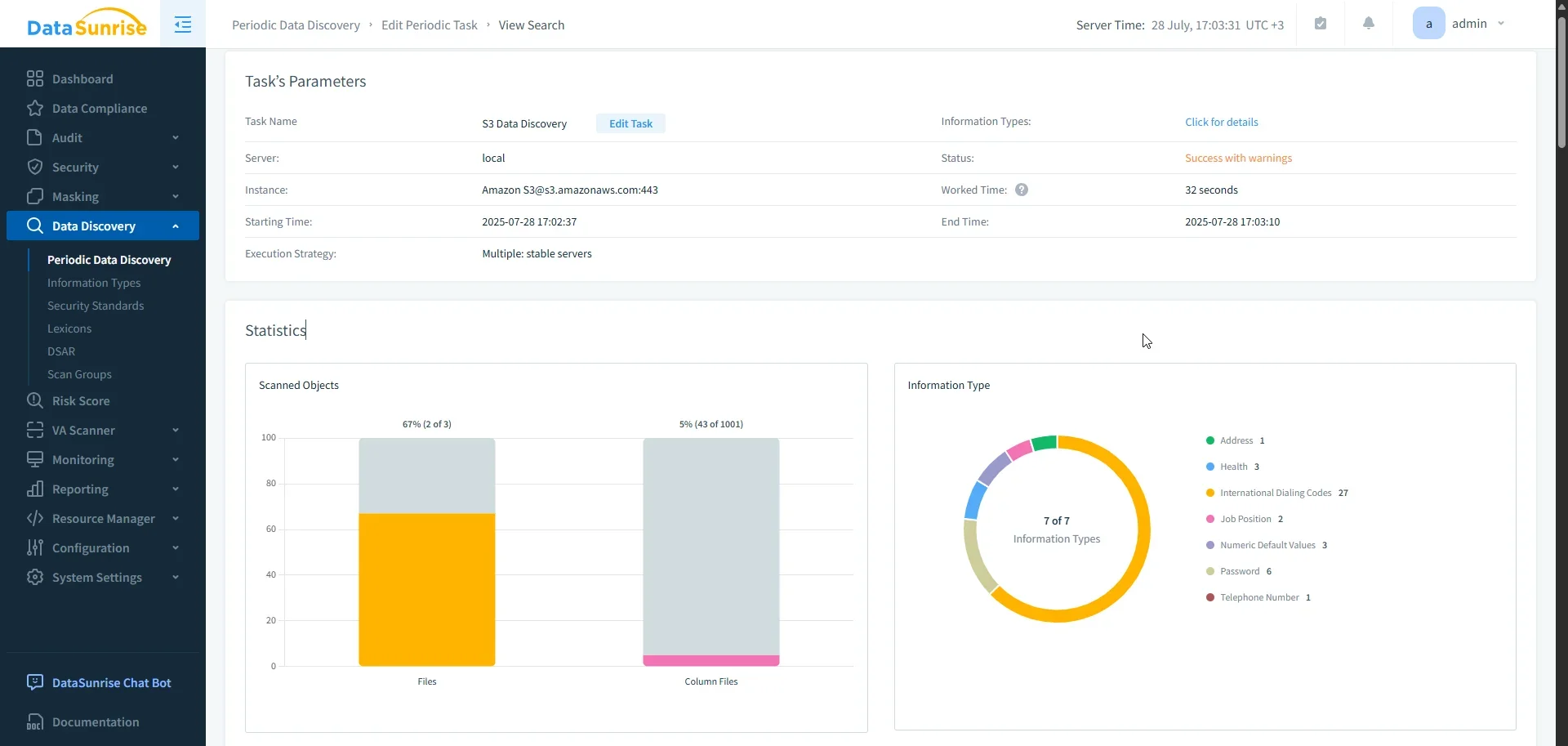
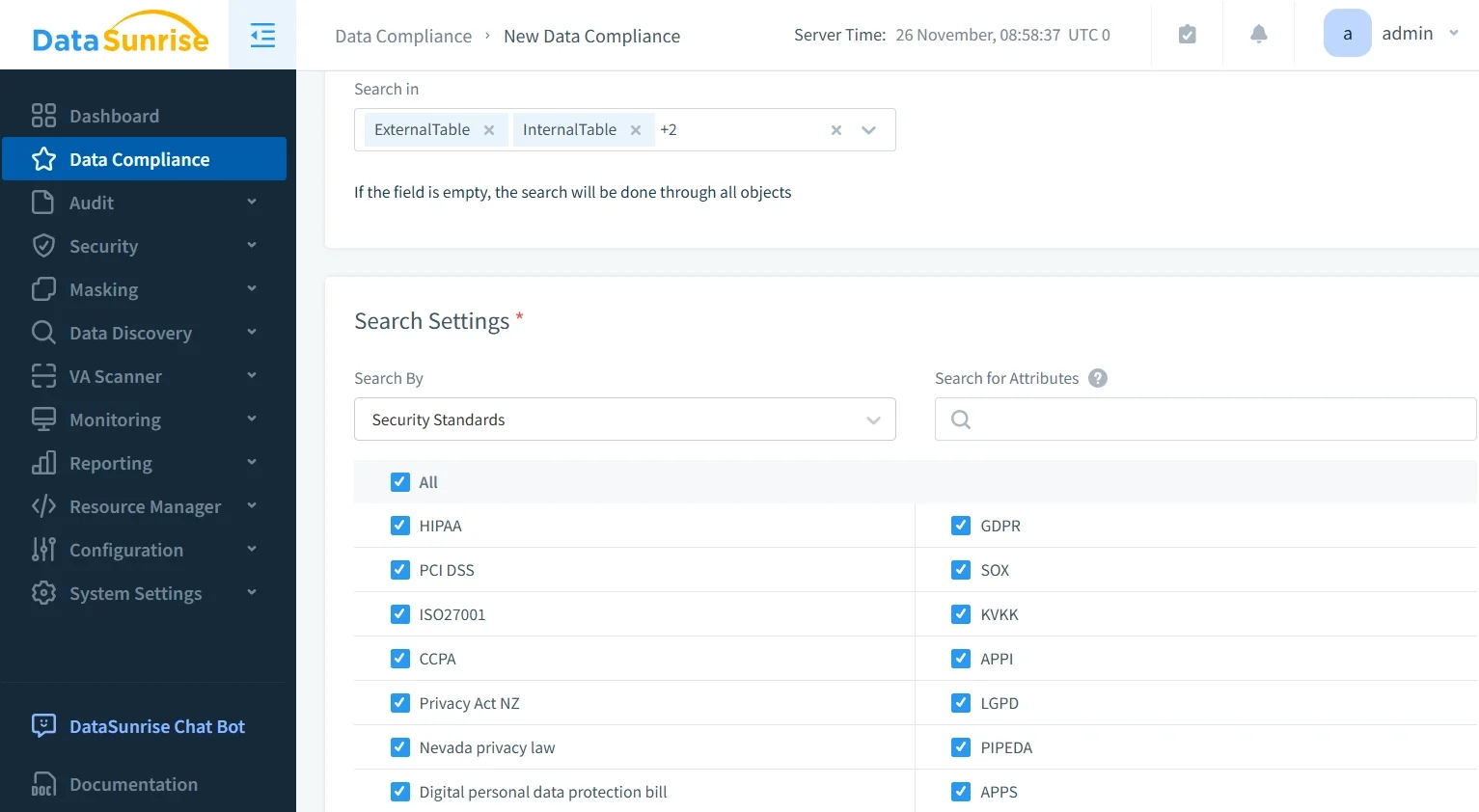
Step 3: Create Compliance Rules: Define compliance policies using templates or custom audit rules, set scope and conditions, and enable audit logging.
Step 4: Enable Monitoring: Configure real-time event tracking, set up alerts, and enable behavior analytics with SIEM integration.
Step 5: Set Up Reporting: Select regulatory templates, configure schedules, and enable automated report generation.
Conclusion
As organizations increasingly rely on Amazon S3 for sensitive data storage, comprehensive compliance management has become essential. While AWS provides foundational features through CloudTrail, Config, and Object Lock, organizations with complex regulatory requirements benefit significantly from enhanced solutions like DataSunrise.
DataSunrise transforms S3 compliance through Autonomous Compliance Orchestration that extends beyond native AWS capabilities. With Auto-Discover & Classify, No-Code Policy Automation, Real-Time Monitoring, and Automated Reporting, DataSunrise delivers enterprise-grade protection for GDPR, HIPAA, PCI DSS, SOX, and other regulatory frameworks.
The platform's Zero-Touch Data Protection eliminates manual compliance burdens while ensuring continuous regulatory alignment. Unlike solutions requiring constant intervention, DataSunrise adapts automatically to changing requirements, providing true Compliance Autopilot for cloud storage environments.
With flexible deployment modes including AWS marketplace availability and support for hybrid architectures, DataSunrise makes enterprise-grade compliance accessible to organizations of all sizes. The platform's comprehensive approach to data management ensures seamless integration with existing workflows.
Protect Your Data with DataSunrise
Secure your data across every layer with DataSunrise. Detect threats in real time with Activity Monitoring, Data Masking, and Database Firewall. Enforce Data Compliance, discover sensitive data, and protect workloads across 50+ supported cloud, on-prem, and AI system data source integrations.
Start protecting your critical data today
Request a Demo Download Now