Data Masking Tools and Techniques for Elasticsearch
Organizations increasingly rely on Elasticsearch to store and analyze operational logs, application telemetry, customer records, and security events. These datasets frequently contain personally identifiable information (PII), financial records, healthcare information, authentication credentials, and other sensitive content. As Elasticsearch becomes a central component of analytics platforms and observability stacks, protecting this information is critical for maintaining robust data compliance and effective regulatory compliance.
Although Elasticsearch includes several native access control mechanisms, organizations often need additional capabilities to enforce consistent masking policies across distributed environments. Regulations such as GDPR, HIPAA, PCI DSS, SOX, and CCPA require organizations to restrict unnecessary exposure of sensitive information while preserving operational usability. Elasticsearch supports security features including field- and document-level access controls, as described in the official Elastic security documentation, while the OWASP Top 10 continues to identify sensitive data exposure and broken access control among the most significant application security risks.
This article explores native Elasticsearch data masking techniques, discusses their limitations, and explains how DataSunrise delivers enterprise-grade masking through intelligent automation, centralized policy management, and continuous compliance enforcement.
Importance of Data Masking Tools and Techniques
Data masking has become an essential component of modern cybersecurity strategies as organizations process increasing volumes of sensitive information within Elasticsearch environments. Operational logs, customer records, application telemetry, and security events frequently contain confidential data that must remain protected while still being available for analytics, troubleshooting, and business operations. Effective masking techniques allow organizations to maintain data usability without exposing sensitive values to unauthorized users.
Beyond strengthening security, data masking plays a significant role in regulatory compliance. Standards such as GDPR, HIPAA, PCI DSS, SOX, and CCPA require organizations to implement appropriate safeguards that limit access to sensitive information. Combining masking with strong data security controls and comprehensive role-based access control (RBAC) helps organizations reduce compliance risks while simplifying audits and demonstrating adherence to regulatory requirements.
Native Data Masking Tools in Elasticsearch
Unlike many traditional relational databases, Elasticsearch does not provide a dedicated dynamic data masking engine. Instead, organizations implement data masking by combining several built-in security mechanisms that control access to documents and fields or transform data during indexing and query execution. Together, these features help reduce the exposure of confidential information while allowing authorized users to continue searching and analyzing data.
Field-Level Security
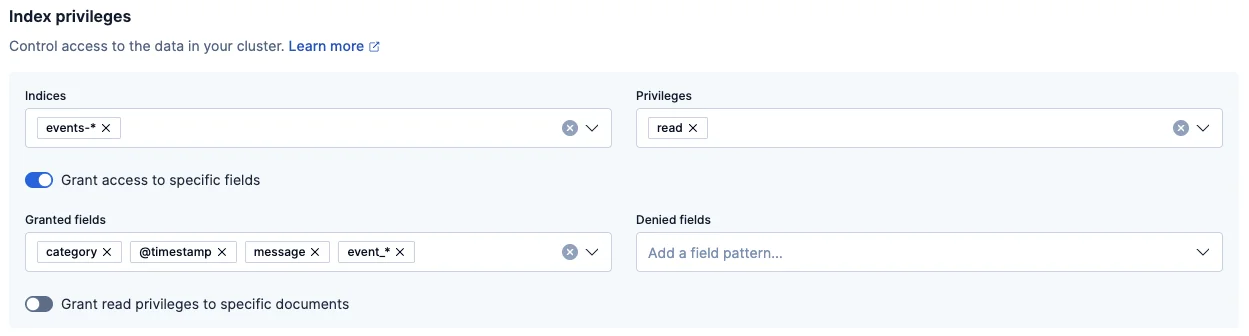
Field-Level Security (FLS) allows administrators to restrict access to specific fields within an index. Rather than modifying the stored documents, Elasticsearch filters the response according to the permissions assigned to a user's role. As a result, users can query the same documents while only viewing the fields they are authorized to access.
For example, a role can be configured to expose only customer names, transaction dates, and payment amounts while hiding sensitive fields such as credit card numbers, Social Security numbers, email addresses, and phone numbers.
POST /_security/role/finance_role
{
  "indices": [
    {
      "names": ["payments"],
      "field_security": {
        "grant": [
          "customer",
          "transaction_date",
          "amount"
        ]
      }
    }
  ]
}
Field-Level Security is particularly useful for dashboards, reporting applications, and search interfaces where users require access to business information without viewing confidential data.
Runtime Fields
Runtime Fields provide another method for limiting sensitive information by generating calculated values when a query is executed. Instead of changing indexed documents, administrators can return transformed or partially masked values during search operations.
The following example creates a runtime field that replaces email addresses with a masked value:
GET customers/_search
{
  "runtime_mappings": {
    "masked_email": {
      "type": "keyword",
      "script": {
        "source": """
emit("***@company.com");
"""
      }
    }
  }
}
Because Runtime Fields operate only during query execution, organizations can implement temporary masking without rebuilding indexes. This approach offers considerable flexibility and simplifies deployment, although it does not provide centralized masking policies or enterprise-wide governance.
Ingest Pipelines
Elasticsearch Ingest Pipelines allow organizations to modify data before it is indexed. This technique is commonly used when sensitive information should never be stored in its original form.
For example, an ingest pipeline can permanently obscure email addresses before they are written to an index:
PUT _ingest/pipeline/mask_email
{
  "processors": [
    {
      "gsub": {
        "field": "email",
        "pattern": "(.).*@",
        "replacement": "***@"
      }
    }
  ]
}
Every incoming document is automatically processed before indexing. Since the original values are replaced permanently, ingest pipelines are well suited for analytical environments where access to the original sensitive data is unnecessary.
Document-Level Security
Document-Level Security (DLS) controls which documents users are allowed to retrieve. Instead of masking individual fields, it filters entire documents according to predefined security rules.
The following example grants access only to documents associated with the Human Resources department:
POST /_security/role/hr_role
{
  "indices": [
    {
      "names": ["employees"],
      "query": {
        "term": {
          "department": "HR"
        }
      }
    }
  ]
}
Although Document-Level Security is not a masking feature by itself, it reduces sensitive data exposure by preventing unauthorized users from accessing confidential records altogether.
Role-Based Access Control
Role-Based Access Control (RBAC) forms the foundation of Elasticsearch's security model. Administrators assign permissions through roles that define which indices users may access, which APIs they may use, what cluster privileges they receive, which document sets they can search, and which fields remain visible.
When RBAC is combined with Field-Level Security and Document-Level Security, organizations can establish a layered access control strategy that significantly reduces the exposure of confidential information while maintaining efficient search and analytics capabilities.
Enterprise Data Masking with DataSunrise
While Elasticsearch provides several native mechanisms for restricting access to sensitive information, many organizations require a more centralized and automated approach to data masking. DataSunrise deploys Zero-Touch Data Masking to deliver seamless protection with minimal administrative effort. Through flexible deployment modes and non-intrusive integration, organizations can secure Elasticsearch environments without modifying applications, changing database schemas, or disrupting existing workflows.
Unlike traditional masking solutions that require continuous rule adjustments and manual maintenance, DataSunrise combines intelligent automation, centralized governance, and enterprise-grade policy management. The platform supports cloud, on-premises, hybrid, and multi-cloud deployments while protecting structured, semi-structured, and unstructured data within a unified security framework.
Step 1. Connect Elasticsearch
The first step is connecting the Elasticsearch cluster to DataSunrise. The platform supports multiple deployment models, allowing organizations to implement security consistently regardless of where their Elasticsearch infrastructure resides.
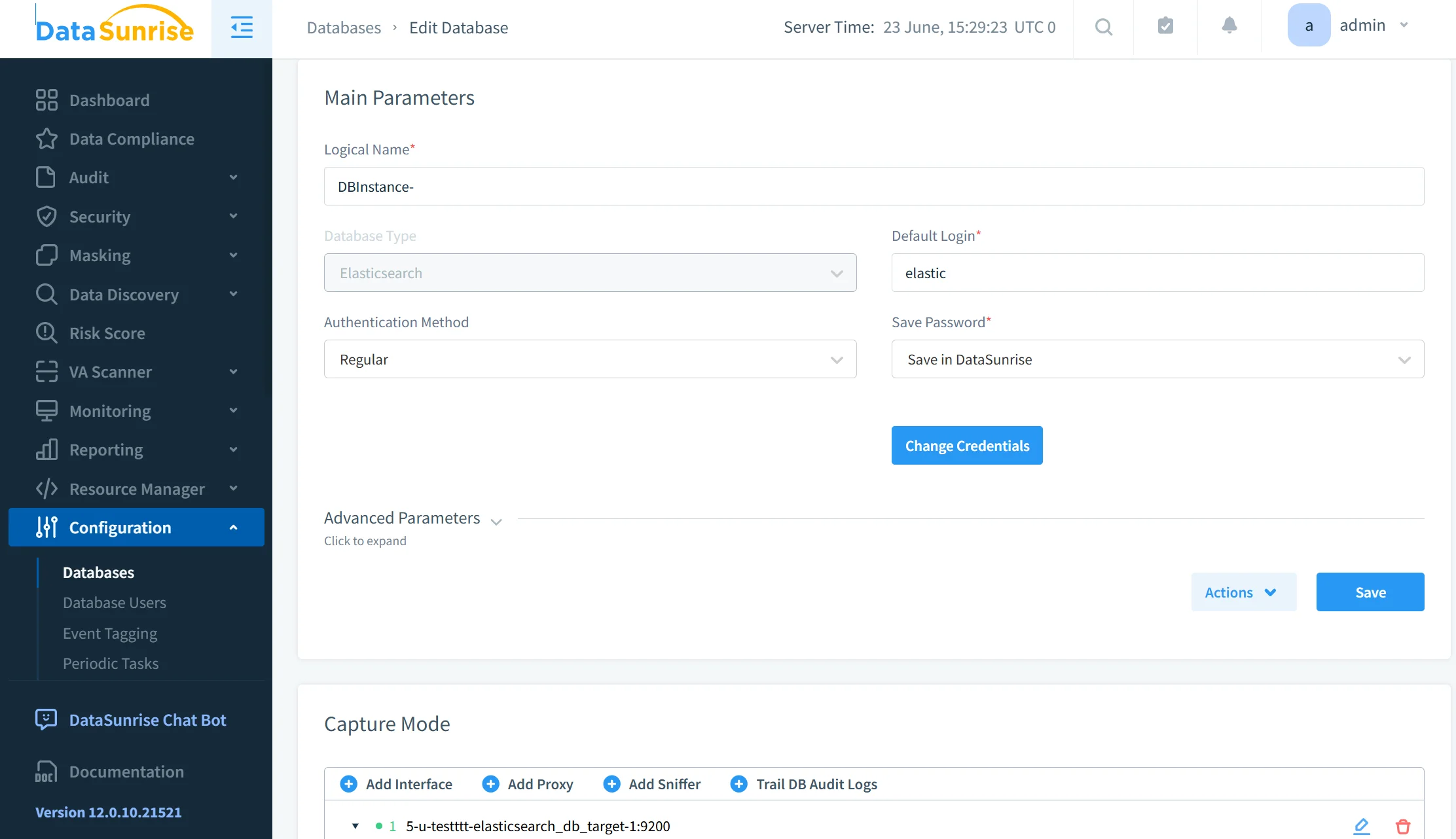
Once the connection is established, DataSunrise creates a centralized security layer that enables administrators to manage masking policies, audit rules, and compliance settings from a single interface.
Step 2. Discover Sensitive Information
Instead of manually reviewing thousands of indices and fields, DataSunrise automatically identifies confidential information through Sensitive Data Discovery. The discovery engine scans Elasticsearch data and classifies sensitive information based on predefined templates and customizable detection rules.
The platform can identify personally identifiable information (PII), financial records, healthcare data, authentication credentials, and organization-specific business identifiers. In addition to structured data, OCR-powered discovery analyzes images and unstructured files to locate sensitive information that traditional discovery tools may overlook.
This automated discovery process significantly reduces manual effort while ensuring that newly created data is included in future masking policies.
Step 3. Generate Masking Policies Automatically
After sensitive information has been identified, DataSunrise simplifies administration through Automatic Policy Generation. Instead of manually creating masking rules for individual indices or user roles, administrators can automatically generate policies based on discovered sensitive data, applicable compliance requirements, organizational departments, and user privileges.
Policies are managed centrally and can be applied consistently across multiple Elasticsearch environments. This approach eliminates much of the repetitive configuration associated with large-scale deployments while helping organizations maintain consistent security standards.
Step 4. Apply Dynamic Data Masking
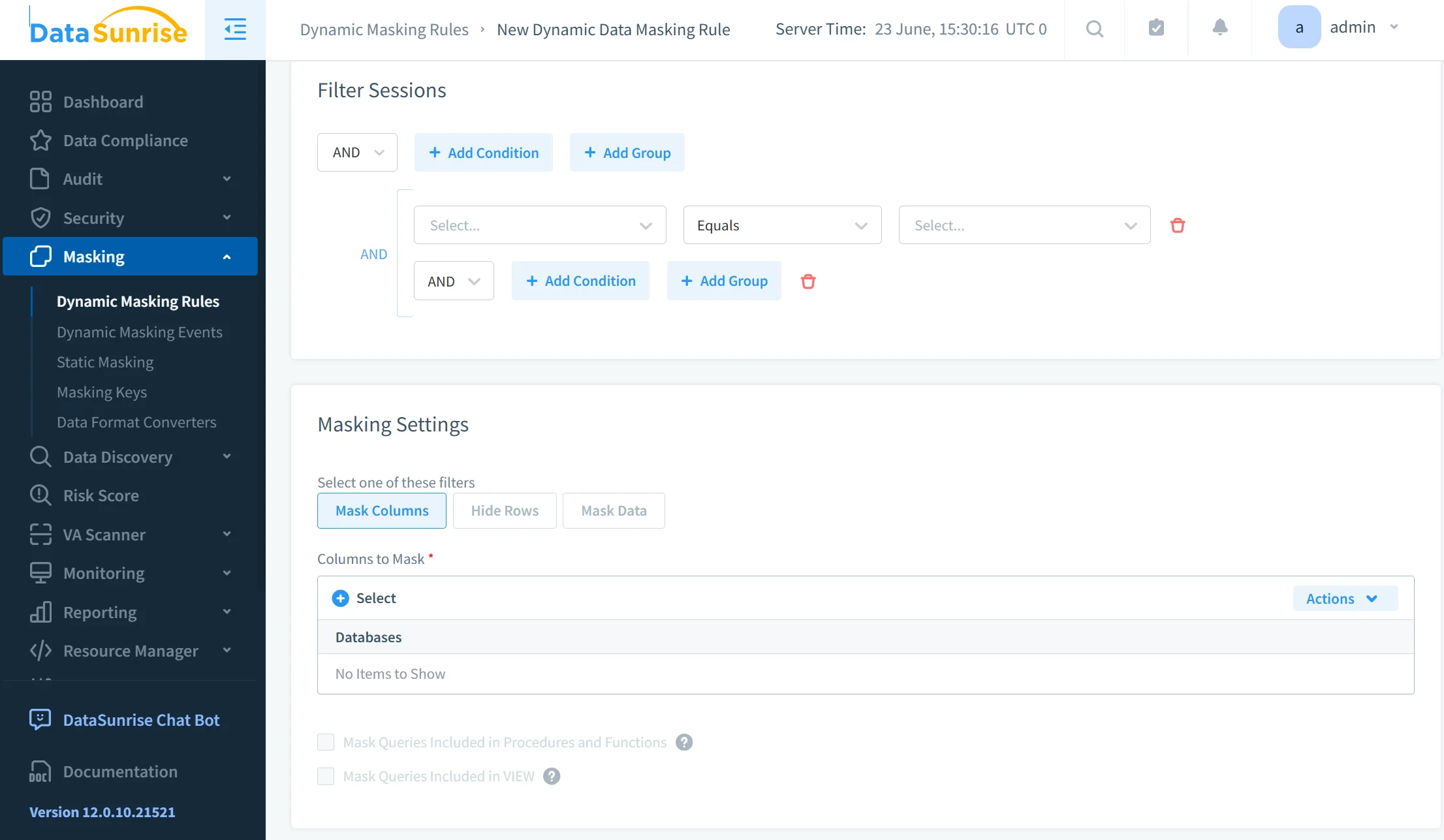
Once masking policies are deployed, DataSunrise enforces Zero-Touch Data Masking in real time. Sensitive values are dynamically transformed according to each user's permissions while the original data remains unchanged within Elasticsearch.
For example, authorized users may continue viewing complete information, whereas restricted users receive masked values such as partially hidden email addresses, obscured payment card numbers, or fully concealed personal information. Because masking occurs transparently during data access, applications, dashboards, and business processes continue operating without modification.
This approach enables organizations to protect confidential information without affecting application functionality, while ensuring unauthorized users never gain access to sensitive data.
Native Elasticsearch vs DataSunrise
Elasticsearch provides a solid foundation for protecting sensitive information through field-level permissions, document-level security, runtime fields, and role-based access control. These native capabilities are effective for implementing basic masking strategies in individual clusters.
However, enterprise environments often require broader functionality, including automated policy generation, centralized administration, sensitive data discovery, continuous compliance monitoring, and consistent protection across multiple platforms. The following comparison highlights the differences between Elasticsearch's native capabilities and the additional automation, governance, and compliance features provided by DataSunrise.
| Capability | Native Elasticsearch | DataSunrise |
|---|---|---|
| Field masking | Yes | Yes |
| Dynamic masking | Limited | Yes |
| Sensitive data discovery | No | Yes |
| OCR discovery | No | Yes |
| Automatic policy generation | No | Yes |
| Compliance automation | No | Yes |
| Centralized management | Limited | Yes |
| Machine Learning Audit Rules | No | Yes |
| Multi-platform masking | No | Yes |
| Hybrid deployment support | Limited | Yes |
Conclusion
Elasticsearch provides useful security mechanisms through field-level controls, runtime fields, ingest pipelines, and role-based access management. These capabilities establish a solid foundation for protecting sensitive information and limiting unnecessary data exposure.
However, modern compliance programs increasingly require centralized governance, automated policy generation, continuous monitoring, sensitive data discovery, and scalable masking across complex infrastructures.
DataSunrise enhances Elasticsearch masking through Zero-Touch Data Masking, Compliance Autopilot, Automatic Policy Generation, Continuous Regulatory Calibration, Machine Learning Audit Rules, Sensitive Data Discovery, and centralized policy management. The platform supports structured, semi-structured, and unstructured data while providing seamless protection across cloud, on-premises, and hybrid environments.
The result is an enterprise-ready security platform that strengthens privacy protection, minimizes compliance risk, reduces manual effort, and delivers scalable data masking for Elasticsearch deployments.
Learn more about DataSunrise's Data Masking, Dynamic Data Masking, Compliance Manager, Sensitive Data Discovery, and Database Activity Monitoring, or schedule a live demo to see DataSunrise protecting Elasticsearch environments in action.
Protect Your Data with DataSunrise
Secure your data across every layer with DataSunrise. Detect threats in real time with Activity Monitoring, Data Masking, and Database Firewall. Enforce Data Compliance, discover sensitive data, and protect workloads across 50+ supported cloud, on-prem, and AI system data source integrations.
Start protecting your critical data today
Request a Demo Download Now