Data Obfuscation in Elasticsearch
Organizations increasingly rely on Elasticsearch to index and search large volumes of operational, customer, financial, and security data. These datasets frequently contain personally identifiable information (PII), protected health information (PHI), payment details, API keys, and other confidential values that should not be visible to every user or application.
Data obfuscation in Elasticsearch helps reduce the risk of unauthorized disclosure by replacing sensitive values with masked or transformed representations while preserving the usability of search results. This approach enables developers, analysts, support teams, and third-party users to work with realistic information without exposing the original data. Combining effective data masking with comprehensive data compliance regulations helps organizations strengthen data protection while meeting evolving regulatory requirements.
Although Elasticsearch includes several native security capabilities that can partially obfuscate sensitive information, organizations with strict compliance requirements often need centralized policy management, automated discovery of sensitive data, and consistent protection across multiple environments. Elasticsearch provides native mechanisms such as field- and document-level security and runtime fields to help control access and transform sensitive values during query execution, but these capabilities often require significant manual configuration in enterprise deployments.
This article explores Elasticsearch's native data obfuscation capabilities, their strengths and limitations, and how DataSunrise delivers enterprise-grade automated data obfuscation for modern Elasticsearch deployments.
What is Data Obfuscation in Elasticsearch?
Data obfuscation is the process of transforming sensitive information into a non-sensitive representation while preserving enough structure for applications and users to continue working with the data. It is commonly used alongside dynamic data masking to minimize unnecessary exposure of confidential information while maintaining business productivity.
Unlike encryption, which requires decryption before data becomes usable, or static masking, which permanently replaces original values, data obfuscation focuses on presenting protected versions of information according to business rules and user permissions. When combined with automated sensitive data discovery, organizations can identify confidential information across Elasticsearch indices before applying appropriate protection policies.
Typical Elasticsearch data that organizations obfuscate includes:
- Customer names
- Email addresses
- Phone numbers
- National identification numbers
- Credit card numbers
- Healthcare records
- Financial information
- API tokens
- Authentication credentials
- Employee information
Proper obfuscation reduces accidental exposure of confidential information while supporting regulations such as GDPR, HIPAA, PCI DSS, SOX, and CCPA.
Native Elasticsearch Data Obfuscation
Elasticsearch does not provide a dedicated "data obfuscation" feature. Instead, administrators combine several security mechanisms to limit or transform the visibility of sensitive information. When integrated with broader database security strategies, these native controls help reduce the exposure of confidential data.
These native capabilities can provide basic protection for many workloads.
Field-Level Security
Field-Level Security (FLS) allows administrators to hide specific fields from users based on assigned roles.
For example, a customer service representative may access order information while being prevented from viewing payment card details or national identification numbers.
Example role configuration:
POST /_security/role/support_role
{
  "indices": [
    {
      "names": [ "customers" ],
      "privileges": [ "read" ],
      "field_security": {
        "grant": [
          "customer_name",
          "email",
          "city",
          "country"
        ],
        "except": [
          "credit_card",
          "ssn"
        ]
      }
    }
  ]
}
Instead of modifying the data itself, Elasticsearch simply prevents unauthorized users from retrieving protected fields. This approach complements broader role-based access control (RBAC) practices commonly used to secure enterprise databases.
Runtime Fields
Runtime fields can generate transformed values during query execution without modifying indexed documents.
For example, only the last four digits of a payment card can be displayed.
PUT customers/_mapping
{
  "runtime": {
    "masked_card": {
      "type": "keyword",
      "script": {
        "source": """
          String cc = doc['credit_card.keyword'].value;
          emit("**** **** **** " + cc.substring(cc.length()-4));
        """
      }
    }
  }
}
Applications can query the runtime field instead of exposing the original value.
Runtime fields are useful when lightweight transformations are sufficient but are not intended as a comprehensive masking framework. Organizations often combine these capabilities with data masking techniques to provide more consistent protection across multiple systems.
Ingest Pipelines
Ingest pipelines modify documents before indexing.
Organizations can permanently obfuscate selected fields using processors or Painless scripts.
Example:
PUT _ingest/pipeline/obfuscate_email
{
  "processors": [
    {
      "script": {
        "source": """
          if (ctx.email != null) {
            ctx.email = "[email protected]";
          }
        """
      }
    }
  ]
}
Documents processed through this pipeline will store only the transformed value.
Because the original information is replaced during ingestion, this method is best suited for non-production datasets or permanent anonymization. Similar approaches are widely used as part of static data masking strategies for development and testing environments.
Document-Level Security
Document-Level Security (DLS) restricts which documents users can access.
Instead of masking fields, Elasticsearch filters entire documents according to security queries.
Example:
POST /_security/role/regional_sales
{
  "indices": [
    {
      "names": ["sales"],
      "privileges": ["read"],
      "query": {
        "term": {
          "region": "EMEA"
        }
      }
    }
  ]
}
Although DLS does not obfuscate individual values, it helps minimize unnecessary exposure by restricting access to relevant records only, supporting organizations that follow the Principle of Least Privilege (PoLP).
Role-Based Access Control
Role-Based Access Control (RBAC) provides the foundation for all Elasticsearch security controls.
Permissions determine:
- Which indices users can access
- Which APIs they may execute
- Which documents become visible
- Which fields remain accessible
Combined with Field-Level Security and Document-Level Security, RBAC enables organizations to implement layered protection for sensitive information.
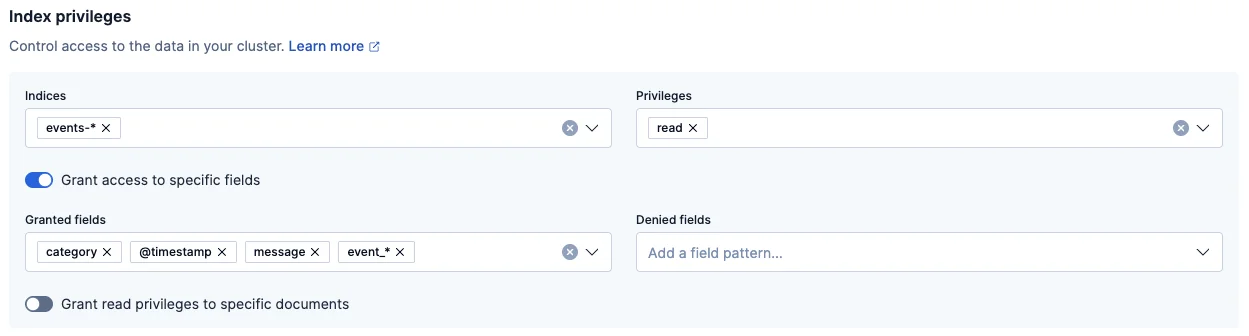
However, RBAC alone cannot dynamically transform data based on context or automatically discover sensitive information across large Elasticsearch deployments. As environments scale, organizations often require centralized access control management and automated protection policies that extend beyond Elasticsearch.
How DataSunrise Enhances Data Obfuscation in Elasticsearch
DataSunrise deploys Zero-Touch Data Obfuscation to deliver seamless protection with minimal administrative effort. Through flexible deployment modes and non-intrusive integration, organizations can protect Elasticsearch without modifying applications, changing client behavior, or redesigning existing workflows.
Unlike solutions that require constant manual tuning, DataSunrise combines Compliance Autopilot, Automatic Policy Generation, Sensitive Data Discovery, Continuous Regulatory Calibration, and Machine Learning Audit Rules into a centralized security platform that continuously adapts to evolving environments.
The platform protects structured, semi-structured, and unstructured information while extending governance beyond Elasticsearch to databases, data warehouses, cloud storage, enterprise file systems, and hybrid infrastructures.
Zero-Touch Data Obfuscation
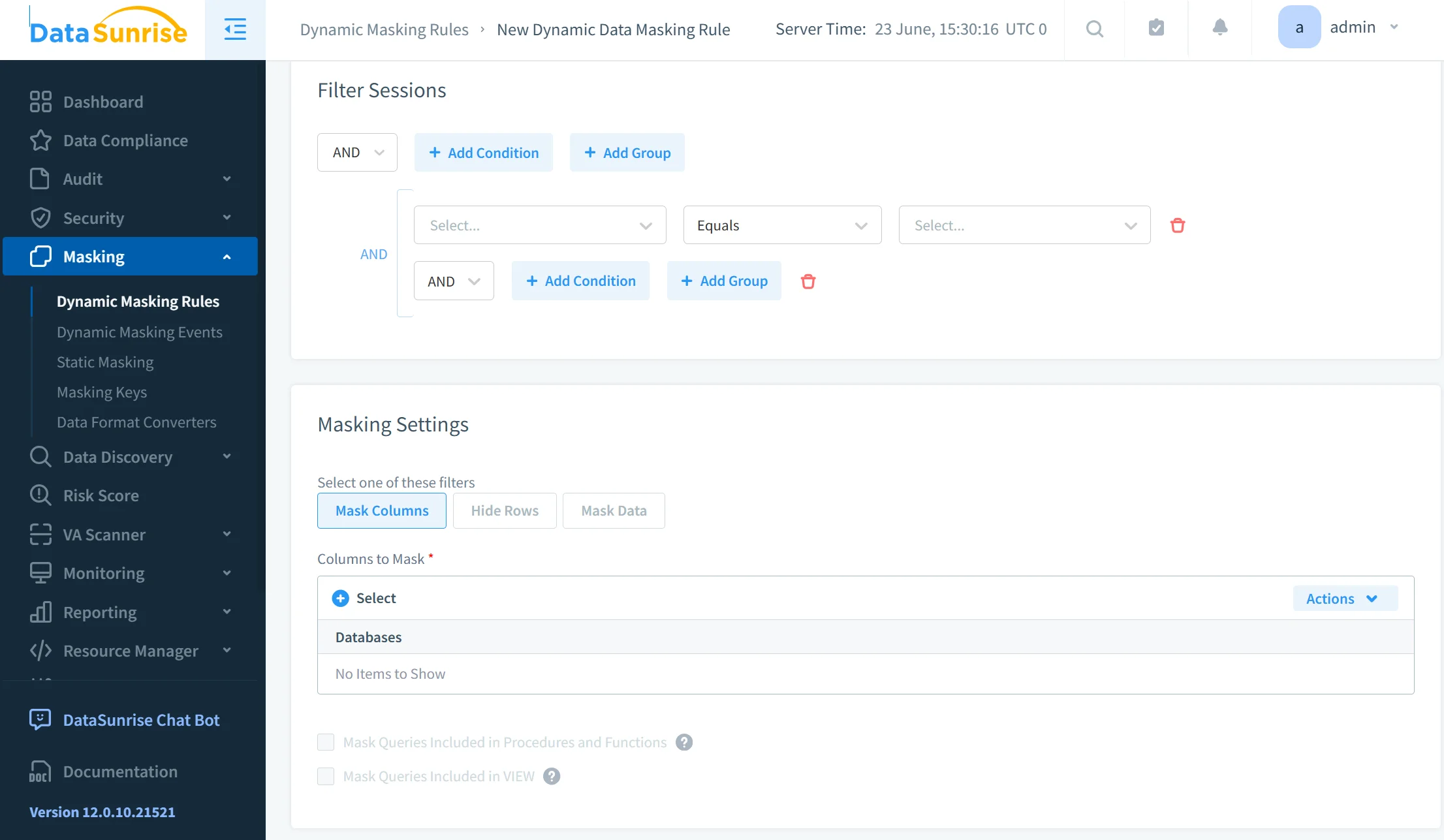
Instead of manually configuring individual runtime fields, ingest pipelines, or application-side transformations, DataSunrise applies centralized obfuscation policies that automatically protect sensitive information before it reaches unauthorized users.
Security teams define policies once, while DataSunrise consistently enforces them across Elasticsearch environments.
Key capabilities include:
- Dynamic data obfuscation
- Context-aware masking policies
- Role-based protection
- Fine-grained field controls
- Real-time policy enforcement
- Non-intrusive deployment
- Proxy, Sniffer, and Native Trail support
This approach dramatically reduces operational overhead while ensuring consistent protection across production environments through centralized dynamic data masking policies.
Sensitive Data Discovery
One of the largest challenges in Elasticsearch is identifying where sensitive information actually resides.
DataSunrise automatically scans Elasticsearch indices to discover:
- Personally identifiable information (PII)
- Financial records
- Healthcare information
- Authentication credentials
- National identifiers
- Custom business-sensitive data
Unlike manual classification efforts, Sensitive Data Discovery continuously analyzes newly indexed information and helps organizations maintain an accurate inventory of protected data.
The same discovery engine extends across relational databases, NoSQL platforms, cloud storage, file systems, and OCR-scanned documents.
Compliance Autopilot
Modern compliance programs require much more than simply hiding fields.
DataSunrise Compliance Autopilot automatically aligns protection policies with regulatory frameworks including:
- GDPR
- HIPAA
- PCI DSS
- SOX
- CCPA
- ISO 27001
- SOC 2
Instead of manually translating regulatory requirements into dozens of security rules, administrators can automatically generate compliance-ready protection policies that significantly reduce implementation effort using the Compliance Manager.
Automatic Policy Generation
Large Elasticsearch deployments often contain hundreds of indices and thousands of searchable fields.
Creating individual masking or obfuscation policies manually becomes difficult to maintain.
DataSunrise automatically generates protection policies based on:
- discovered sensitive data
- compliance requirements
- database metadata
- business rules
- existing security configurations
As new indices appear, policies can be automatically extended without requiring administrators to redesign existing protection strategies.
Continuous Regulatory Calibration
Compliance requirements evolve continuously.
DataSunrise periodically evaluates existing policies to identify:
- newly discovered sensitive information
- configuration drift
- regulatory gaps
- outdated protection rules
Continuous Regulatory Calibration helps eliminate compliance gaps while reducing manual oversight, allowing organizations to maintain a continuously protected Elasticsearch environment even as infrastructure changes over time.
Machine Learning Audit Rules
Data obfuscation becomes significantly more effective when combined with intelligent monitoring.
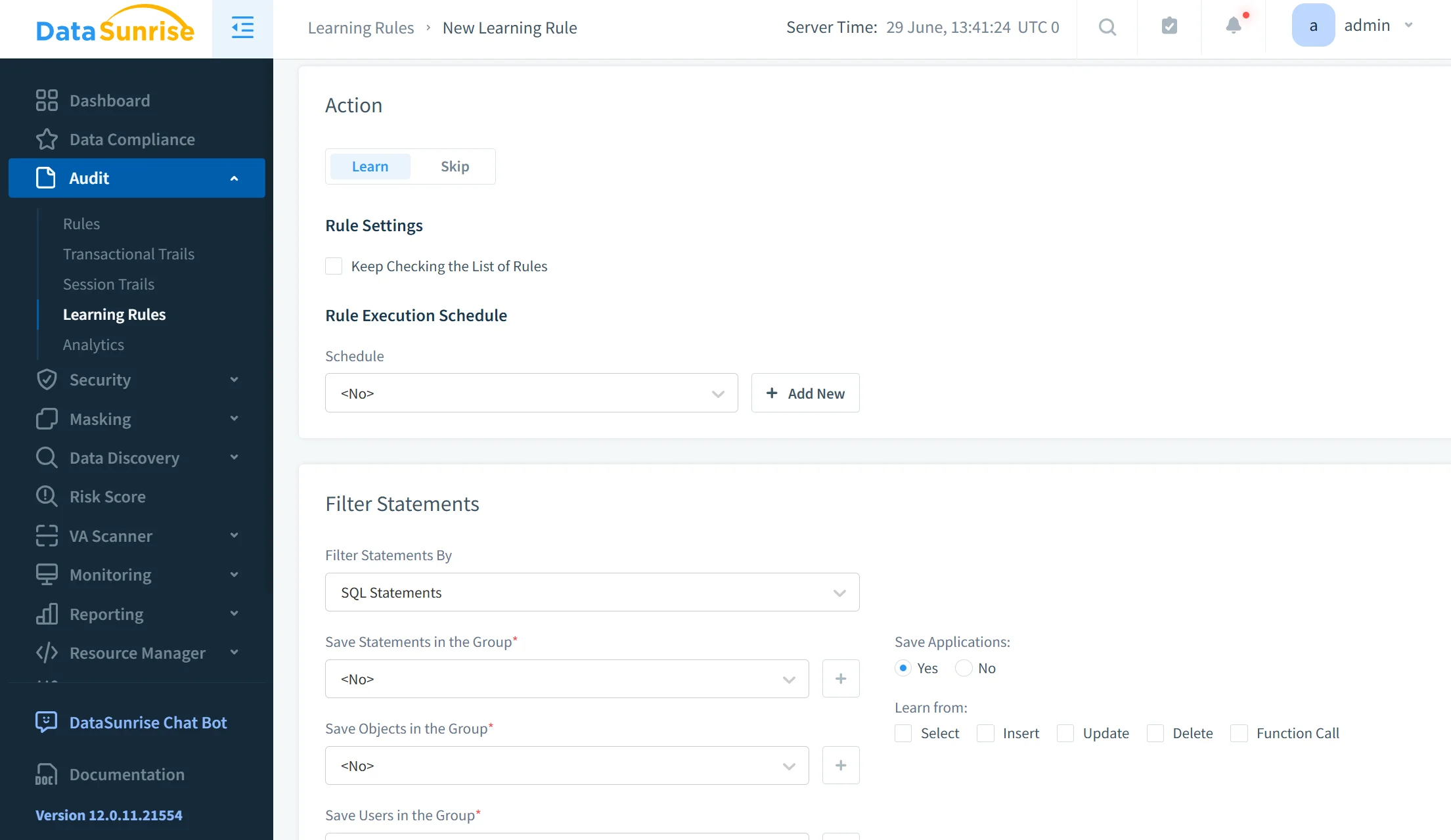
Machine Learning Audit Rules analyze database activity to identify patterns such as:
- unusual access to protected indices
- excessive searches involving confidential data
- abnormal user behavior
- privileged account misuse
- suspicious query execution
Rather than relying solely on static rules, machine learning continuously improves detection capabilities while helping security teams respond faster to potential threats using advanced behavior analytics.
Centralized Policy Management
Organizations rarely protect Elasticsearch alone.
DataSunrise provides a unified management interface for:
- Elasticsearch
- SQL databases
- NoSQL databases
- Data warehouses
- Cloud storage
- File systems
Administrators manage obfuscation policies from one console instead of maintaining separate configurations for every platform.
Centralized governance improves consistency while reducing operational complexity across enterprise environments while integrating seamlessly with database activity monitoring capabilities.
Cloud, On-Premises, and Hybrid Support
DataSunrise supports virtually every deployment architecture.
Organizations can deploy consistent obfuscation policies across:
- Self-managed Elasticsearch clusters
- Elastic Cloud
- AWS
- Microsoft Azure
- Google Cloud Platform
- Hybrid infrastructures
- Multi-cloud environments
Because deployment remains non-intrusive, existing applications continue operating without modification while DataSunrise transparently enforces centralized protection policies.
Business Benefits of Data Obfuscation
| Benefit | Business Impact |
|---|---|
| Reduced Data Exposure | Protects sensitive information from unauthorized users through centralized dynamic data masking without disrupting business operations. |
| Faster Compliance | Automates enforcement of GDPR, HIPAA, PCI DSS, SOX, and other regulatory requirements using the Compliance Manager. |
| Lower Administrative Effort | Eliminates repetitive manual configuration through automated policy generation and Sensitive Data Discovery. |
| Consistent Security | Applies centralized protection across Elasticsearch and other enterprise data platforms while integrating with Database Activity Monitoring. |
| Improved Risk Management | Reduces the likelihood of accidental disclosure and insider threats using intelligent monitoring and User Behavior Analytics. |
| Scalable Governance | Supports growing cloud, hybrid, and multi-cluster environments from a single platform. |
Conclusion
Elasticsearch provides useful native capabilities for limiting exposure of sensitive information through field-level security, runtime fields, ingest pipelines, document-level security, and role-based access control. These features establish a solid foundation for protecting confidential data in many environments.
However, modern organizations often require much more than isolated security controls. Enterprise compliance programs increasingly depend on centralized governance, automated Sensitive Data Discovery, intelligent policy generation, continuous regulatory alignment, and scalable protection across diverse infrastructures.
DataSunrise enhances Elasticsearch data obfuscation through Zero-Touch Data Obfuscation, Compliance Autopilot, Automatic Policy Generation, Continuous Regulatory Calibration, Machine Learning Audit Rules, Sensitive Data Discovery, and centralized policy management. The platform secures structured, semi-structured, and unstructured information while providing consistent protection across cloud, on-premises, and hybrid deployments using flexible deployment modes.
The result is an enterprise-ready security platform that minimizes compliance risk, reduces administrative overhead, strengthens data privacy, and delivers scalable data obfuscation for Elasticsearch environments while integrating with Database Activity Monitoring and enterprise-wide security controls.
Learn more about DataSunrise's Data Masking, Dynamic Data Masking, Sensitive Data Discovery, Compliance Manager, Database Activity Monitoring, and flexible deployment options, or schedule a live demo to see DataSunrise protecting Elasticsearch environments in action.
Protect Your Data with DataSunrise
Secure your data across every layer with DataSunrise. Detect threats in real time with Activity Monitoring, Data Masking, and Database Firewall. Enforce Data Compliance, discover sensitive data, and protect workloads across 50+ supported cloud, on-prem, and AI system data source integrations.
Start protecting your critical data today
Request a Demo Download Now