How to Apply Data Governance for Elasticsearch
Elasticsearch powers large-scale search, analytics, and observability platforms — but without proper data governance, visibility quickly fades into vulnerability.
The open architecture that makes Elasticsearch fast and flexible can also turn it into a compliance headache when sensitive data lands in the wrong index, field, or replica.
Data governance for Elasticsearch means far more than access control lists. It involves continuous discovery, classification, and policy orchestration that ensure data usage aligns with privacy, compliance, and business rules.
Importance of Data Governance
Modern enterprises depend on Elasticsearch not just for search, but for storing logs, metrics, transactions, and even customer data. Without governance, this data landscape can easily spiral into chaos.
Effective data governance ensures accountability, accuracy, and auditability of data across all indices and nodes — vital for both operational efficiency and compliance confidence.
1. Compliance and Regulatory Assurance
Governance provides the backbone for adhering to privacy and industry standards such as GDPR, HIPAA, and PCI DSS. It ensures every piece of sensitive data in Elasticsearch is properly classified, protected, and traceable.
By implementing centralized governance frameworks, organizations can demonstrate accountability and reduce penalties during audits. For more, visit Data Compliance Regulations.
2. Data Quality and Consistency
Poorly governed indices often contain redundant, inconsistent, or outdated data. Governance policies define validation rules and lifecycle management, preserving the integrity of analytical results.
This improves decision-making and guarantees that reports built on Elastic queries reflect accurate, verified information.
3. Security and Risk Mitigation
Governance enforces consistent access controls, masking, and audit policies, helping prevent unauthorized access or accidental exposure.
It also lays the groundwork for real-time Database Activity Monitoring, ensuring anomalies are detected and contained before escalation.
4. Operational Efficiency
Structured governance reduces redundant tasks, simplifies role management, and centralizes configuration across clusters.
Through automation and Compliance Autopilot, teams spend less time on manual configuration and more on innovation and optimization.
Understanding Native Governance in Elasticsearch
Elasticsearch provides several foundational mechanisms for maintaining governance and accountability over indexed data.
1. Role-Based Access and Index Privileges
Native role management defines which users can read, write, or administer indices.
Administrators configure roles within elasticsearch.yml or through the REST API:
POST /_security/role/data_analyst
{
  "indices": [
    {
      "names": [ "logs-*", "metrics-*" ],
      "privileges": [ "read", "view_index_metadata" ]
    }
  ]
}
This setup enforces granular access by index pattern, limiting exposure of sensitive documents to authorized personnel.
For broader control, Role-Based Access Controls (RBAC) help unify permissions across environments.
2. Audit and Data Retention Controls
Elasticsearch can track security-related events — logins, configuration changes, query access — through its Audit Logging module (available in Elastic Stack Security).
However, retention policies are often manually configured and lack centralized visibility across clusters.
xpack.security.audit.enabled: true
xpack.security.audit.outputs: [ index, logfile ]
xpack.security.audit.logfile.events.include: access_denied, authentication_success
Audit indices support basic traceability, but governance requires a holistic view that correlates audit data with classification and masking policies.
Database Activity Monitoring can extend this visibility to hybrid infrastructures.

3. Field-Level and Document-Level Security
Elasticsearch enables selective exposure of document fields to users.
Field-level security hides sensitive fields such as PII or credentials without removing them from the document source:
"field_security": {
  "grant": [ "user_id", "timestamp", "event_type" ],
  "except": [ "email", "credit_card" ]
}
While this supports minimal exposure, dynamic control and automated discovery are limited.
This gap is where DataSunrise’s dynamic masking and sensitive data discovery capabilities take over.
Extending Governance with DataSunrise
While Elasticsearch provides strong foundational controls, it lacks automation and centralized intelligence across distributed deployments.
DataSunrise bridges this gap by introducing autonomous policy orchestration, machine learning–driven discovery, and real-time compliance management.
By integrating DataSunrise, organizations move from reactive governance to proactive, zero-touch compliance orchestration, strengthening both visibility and resilience across all Elasticsearch environments.
Its features align with core DataSunrise tools such as Behavior Analytics, Database Firewall, and Data Protection, ensuring robust and automated policy enforcement across platforms.
Unified Governance Architecture
The DataSunrise Compliance Manager acts as a central governance hub for Elasticsearch and other connected systems.
It synchronizes access policies, masking rules, and compliance templates across distributed indices, ensuring consistent enforcement regardless of deployment topology.
Through machine learning-based discovery and auto-classification, DataSunrise identifies sensitive entities across JSON documents, index mappings, and log data — even within nested structures or keyword fields.
Its Compliance Autopilot continuously aligns Elasticsearch governance policies with frameworks such as GDPR, HIPAA, and PCI DSS.
Unlike manual Elastic role tuning, this autonomous orchestration provides zero-touch policy generation and continuous regulatory calibration, eliminating drift across hybrid environments.
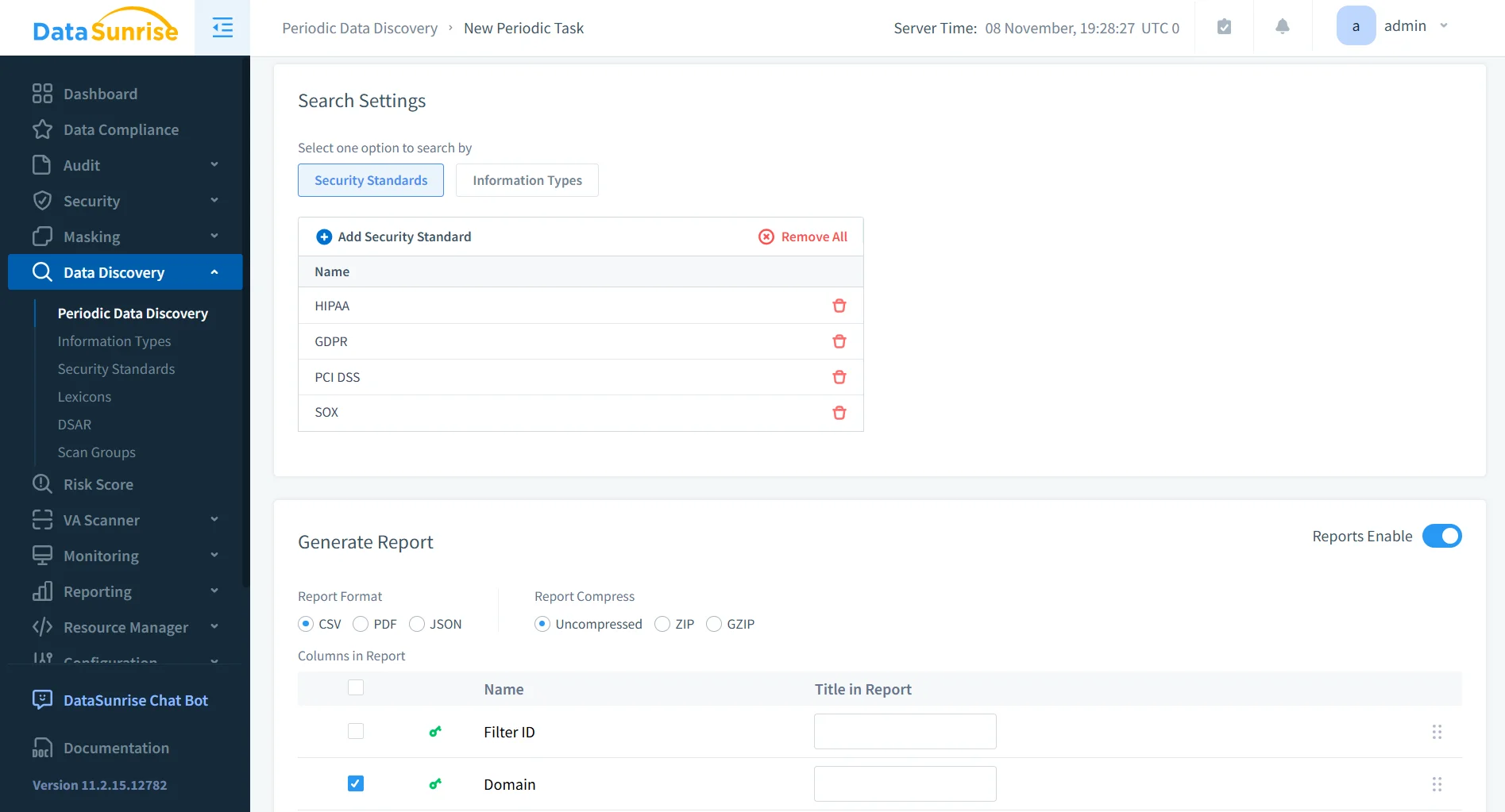
Sensitive Data Discovery and Classification
DataSunrise scans structured, semi-structured, and unstructured Elasticsearch indices to uncover PII, PHI, and financial identifiers.
Using NLP-assisted discovery and pattern-based scanning, it automatically tags sensitive fields and associates them with compliance categories.
Discovered fields can then be masked, monitored, or locked under compliance rules — ensuring continuous data protection and classification alignment across evolving schemas.
Learn more about Data Discovery and how it supports Data Masking workflows within governance strategies.
Dynamic Data Masking and Zero-Trust Access
With Elasticsearch frequently serving as a backend for dashboards and APIs, sensitive data exposure often occurs at query time.
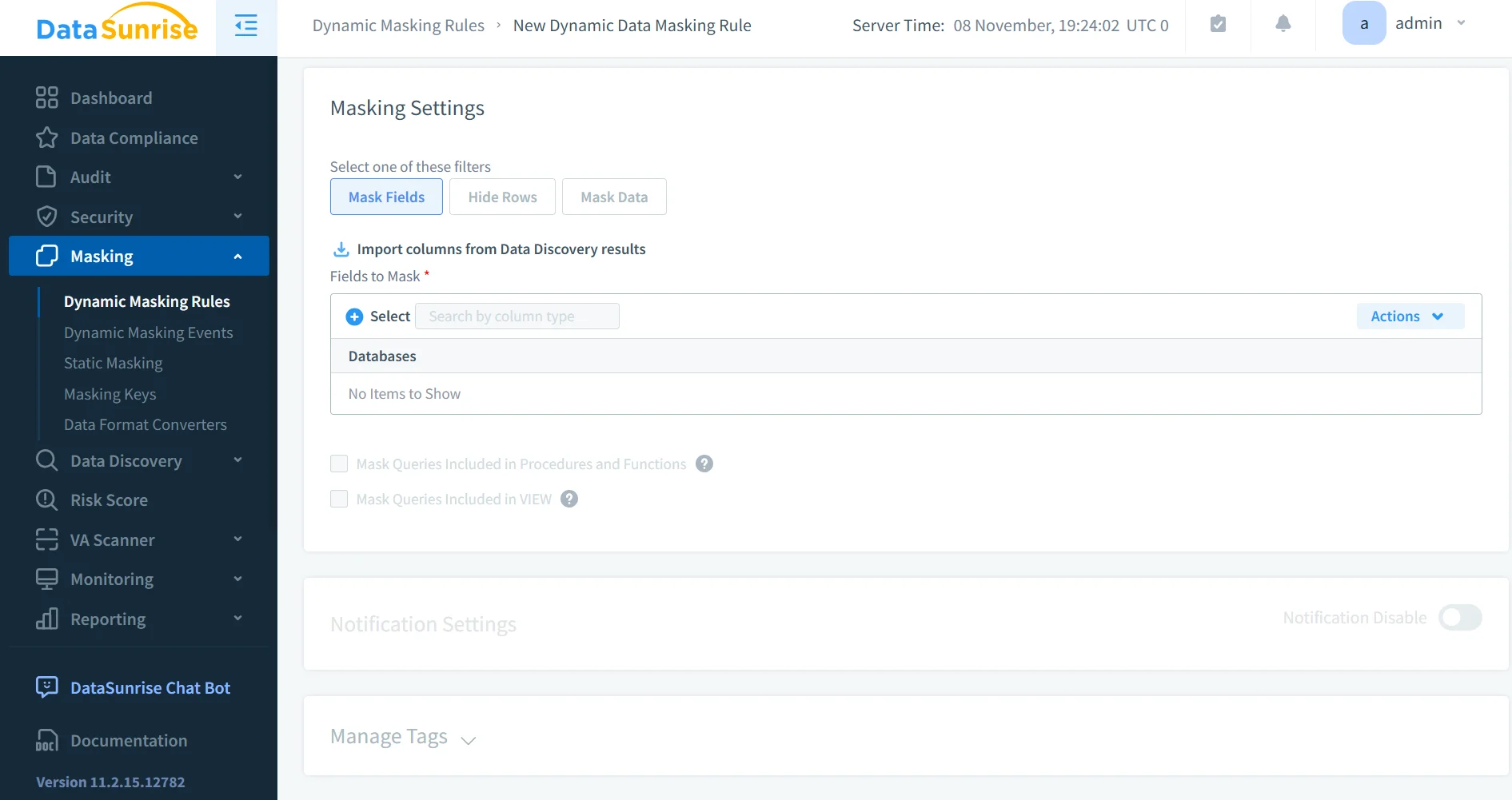
DataSunrise implements dynamic data masking directly at the proxy level, ensuring users only see what their role permits.
It integrates with existing access controls to maintain Zero-Trust principles, reinforcing Database Security across environments.
Masking rules adapt in real time based on user identity, request type, and compliance policy.
Combined with Zero-Trust access control, this approach prevents data leakage even if Elastic API tokens are compromised.
Automated Compliance Reporting
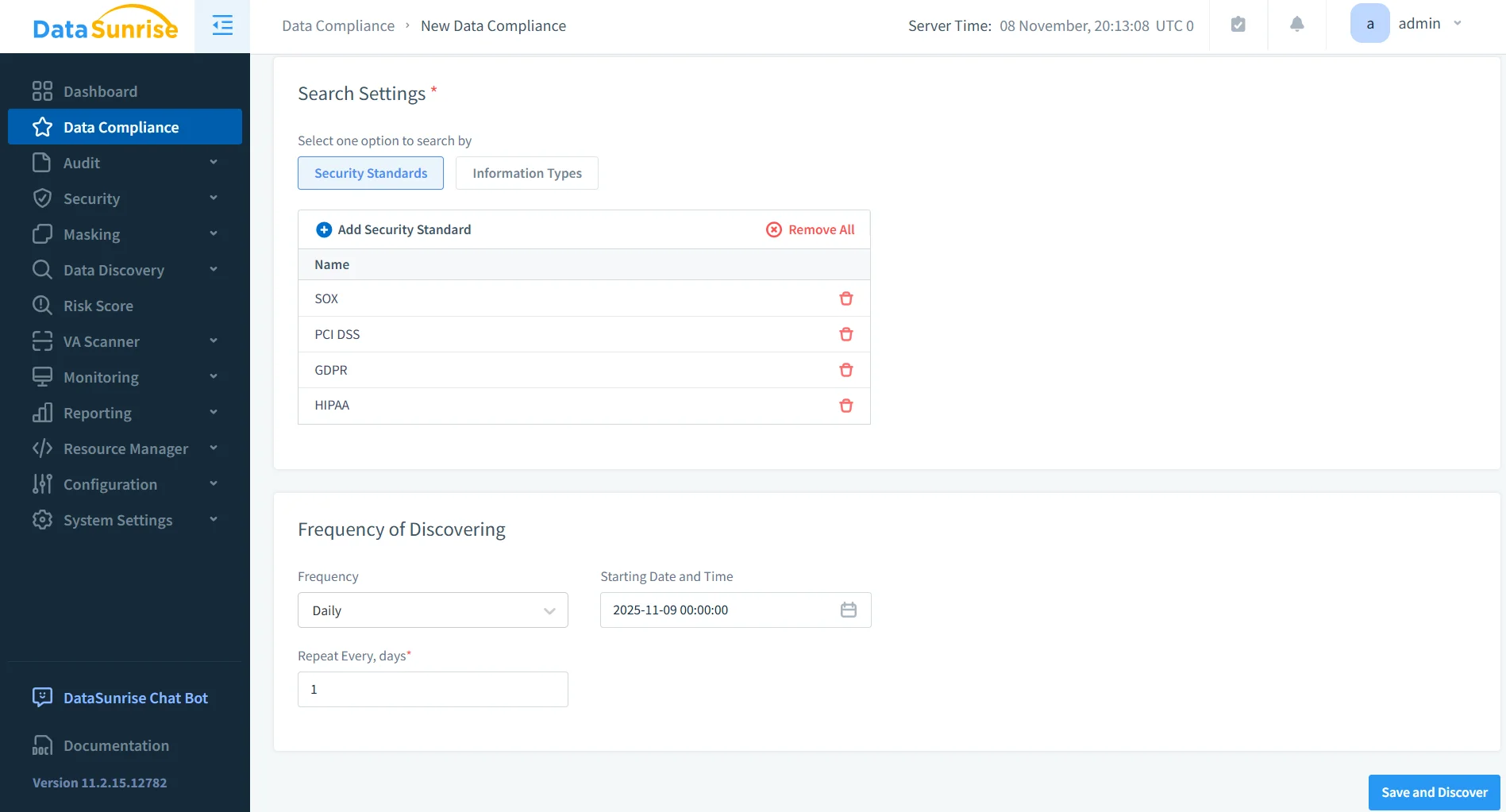
The Compliance Manager module consolidates governance data into standardized reports.
It automatically compiles activity summaries, masking policies, and audit evidence into exportable reports for auditors and regulators.
Compliance frameworks covered include:
- GDPR — Article 30 and 32 activity tracking
- HIPAA — audit readiness and PHI access control
- PCI DSS — continuous validation of sensitive data storage practices
Generated reports simplify certification renewals and demonstrate continuous governance enforcement.
For audit-specific evidence generation, refer to Audit Logs and Audit Trails.
Business Impact
| Objective | Governance Outcome |
|---|---|
| Regulatory Compliance | Continuous adherence to GDPR, HIPAA, and PCI DSS with automatic evidence generation |
| Operational Efficiency | Reduced manual review time via Compliance Autopilot |
| Risk Mitigation | Minimized unauthorized access and data leakage across clusters |
| Audit Readiness | One-click reporting with verifiable, timestamped records |
| Scalability | Seamless governance expansion to multi-node and multi-region Elastic deployments |
DataSunrise converts Elasticsearch from a raw analytics engine into a compliance-ready data governance platform, bridging the gap between high-speed indexing and long-term regulatory assurance.
To see similar governance use cases, explore Data Audit and Data Management capabilities in DataSunrise.
Conclusion
Effective governance in Elasticsearch isn’t just about monitoring access — it’s about understanding and controlling data wherever it resides.
By combining Elastic’s native capabilities with DataSunrise’s unified governance architecture, organizations gain a proactive, automated compliance layer that scales with their infrastructure.
Through continuous discovery, adaptive masking, and centralized policy orchestration, Elasticsearch becomes a governed, auditable, and regulation-aligned data platform — ready for the demands of modern compliance.
Protect Your Data with DataSunrise
Secure your data across every layer with DataSunrise. Detect threats in real time with Activity Monitoring, Data Masking, and Database Firewall. Enforce Data Compliance, discover sensitive data, and protect workloads across 50+ supported cloud, on-prem, and AI system data source integrations.
Start protecting your critical data today
Request a Demo Download Now