How to Manage Data Compliance for AlloyDB for PostgreSQL
Managing data compliance for AlloyDB for PostgreSQL has become critical for organizations handling sensitive information. According to IBM's 2024 Cost of a Data Breach Report, organizations with comprehensive compliance management systems reduce breach-related costs significantly and satisfy audit requirements much faster than those relying on manual processes.
AlloyDB for PostgreSQL, Google Cloud's fully managed PostgreSQL-compatible database service, offers enterprise-grade performance with built-in compliance features. However, organizations operating in regulated industries often require more sophisticated compliance solutions to satisfy stringent requirements across multiple regulatory frameworks simultaneously.
This guide explores AlloyDB's native compliance capabilities and demonstrates how DataSunrise can enhance your compliance posture with Zero-Touch Compliance Automation and intelligent policy orchestration.
Understanding Data Compliance for AlloyDB for PostgreSQL
Data compliance for AlloyDB encompasses the systematic implementation of policies, controls, and monitoring mechanisms that ensure database operations adhere to regulatory requirements such as GDPR, HIPAA, PCI DSS, and SOX. This involves tracking data access, protecting sensitive information, maintaining audit trails, and demonstrating regulatory adherence through comprehensive documentation.
The cloud-native architecture of AlloyDB introduces unique compliance considerations including multi-regional data residency requirements, high availability configuration complexities, automated backup management, integration challenges, and regulatory overlap across multiple frameworks.
Native AlloyDB Compliance Capabilities
AlloyDB for PostgreSQL includes several built-in features that provide a foundation for compliance management through PostgreSQL-compatible mechanisms.
1. Cloud Audit Logs Integration
AlloyDB integrates with Google Cloud's audit logging infrastructure to capture administrative activities:
# Enable Cloud Audit Logs for AlloyDB instance
gcloud logging read "resource.type=alloydb.googleapis.com/Instance
  AND resource.labels.instance_id=YOUR_INSTANCE_ID
  AND timestamp>=\"2024-01-01T00:00:00Z\"" \
  --limit 50 \
  --format json
2. Reviewing Compliance Audit Logs
Examine captured audit logs through Google Cloud Logging:
# Query audit logs for the past 24 hours
gcloud logging read "
  resource.type=alloydb.googleapis.com/Instance
  AND jsonPayload.audit_type=\"pgaudit\"
  AND timestamp>=\"$(date -u -d '24 hours ago' '+%Y-%m-%dT%H:%M:%SZ')\"
" --format json --limit 100
3. AlloyDB Studio for Compliance Monitoring
AlloyDB Studio provides a web-based interface for database management and compliance monitoring directly within the Google Cloud Console. This integrated environment enables administrators to execute queries, review database activities, and monitor compliance-related operations without requiring additional tools.
Key compliance features in AlloyDB Studio include:
- Query History Tracking: View and analyze all executed queries with detailed execution metrics
- User Activity Monitoring: Track database connections and user sessions in real-time
- Schema Management: Monitor and audit DDL operations and structural changes
- Performance Insights: Identify resource-intensive queries that may indicate data extraction attempts
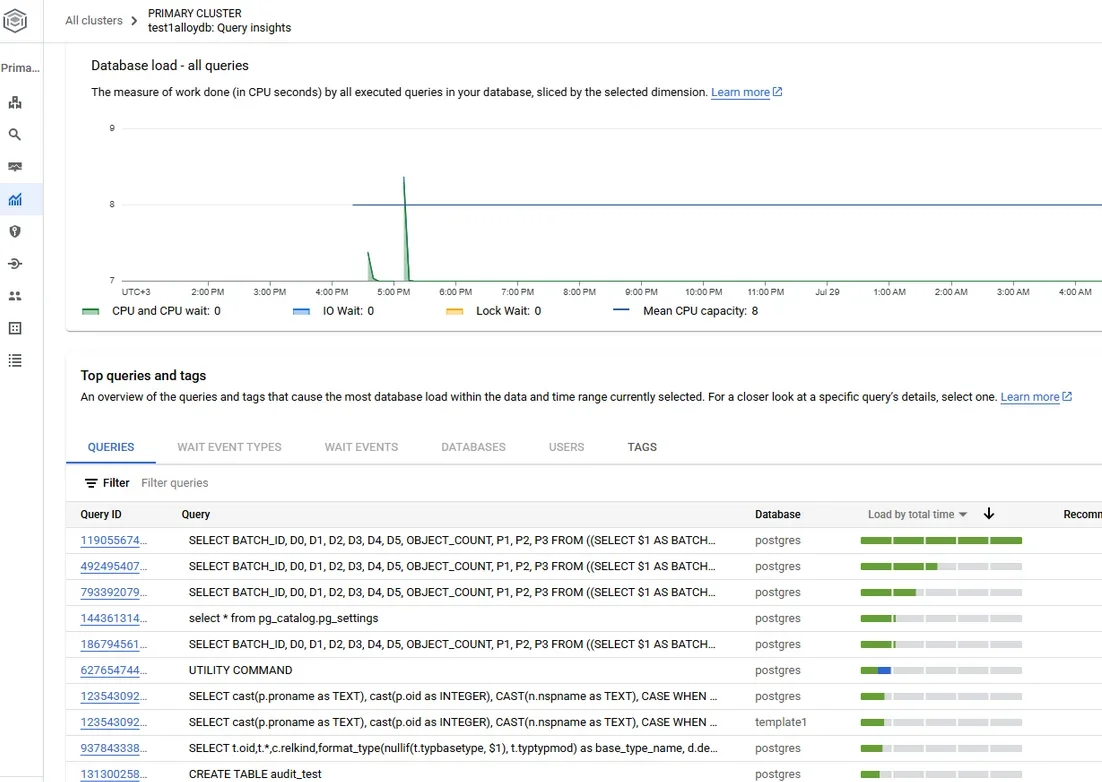
Through AlloyDB Studio, compliance teams can quickly investigate suspicious activities, generate ad-hoc compliance reports, and maintain visibility into database operations through an intuitive graphical interface.
Enhanced Compliance Management with DataSunrise
DataSunrise significantly enhances data compliance management through Autonomous Compliance Orchestration and sophisticated automation designed for PostgreSQL-compatible environments. The platform provides comprehensive database security with intelligent data protection mechanisms.
Implementing DataSunrise for AlloyDB Compliance
1. Connect to AlloyDB Instance
Establish a secure connection between DataSunrise and your AlloyDB environment through the administrative interface, supporting both direct connections and proxy mode deployments.
2. Automated Sensitive Data Discovery
DataSunrise's Auto-Discover & Classify engine automatically identifies sensitive data according to regulatory frameworks, including PII detection, financial data classification, healthcare information, and custom pattern recognition.
3. Create Compliance-Driven Audit Rules
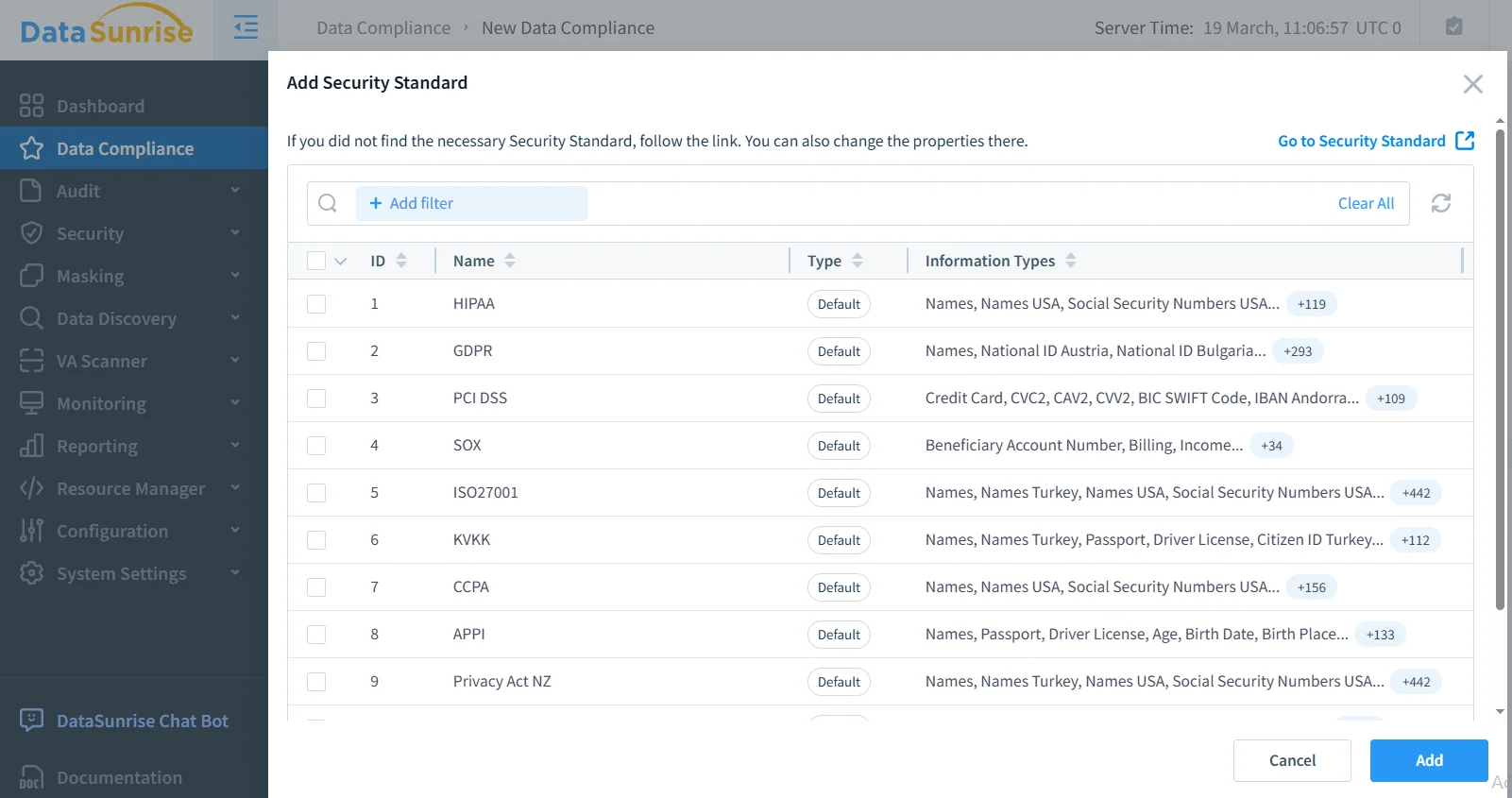
Configure granular audit rules using No-Code Policy Automation for GDPR compliance rules, HIPAA monitoring, PCI DSS controls, and SOX requirements.
4. Implement Dynamic Data Masking
Protect sensitive data in real-time through dynamic data masking with role-based masking, context-aware protection, format-preserving masking, and conditional masking.
5. Review Comprehensive Compliance Dashboard
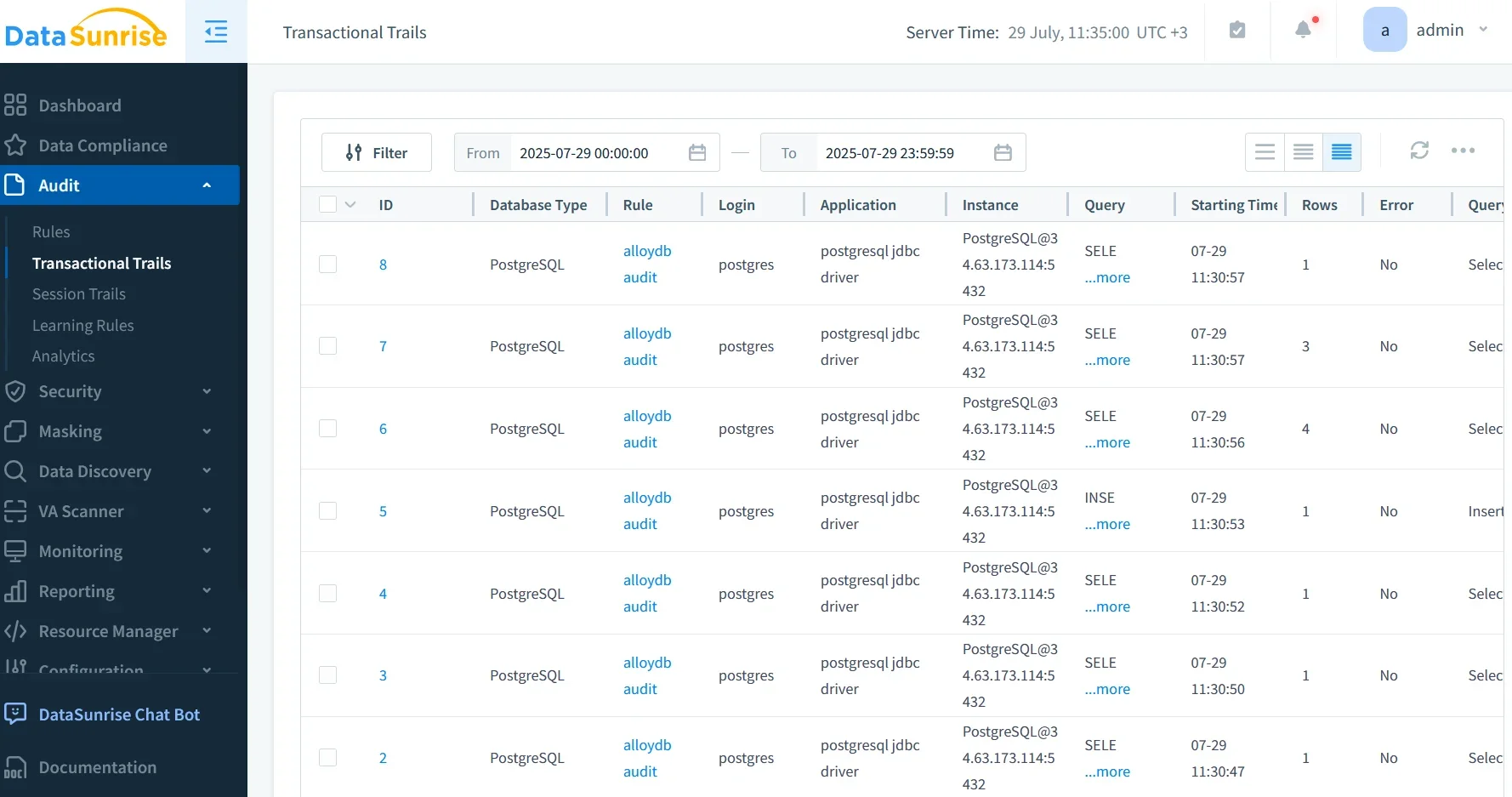
Access detailed compliance information through DataSunrise's unified interface with real-time database activity monitoring and automated reporting capabilities.
Key Advantages of DataSunrise for AlloyDB Compliance
DataSunrise provides significant enhancements over AlloyDB's native compliance capabilities:
| Feature | Key Benefit |
|---|---|
| Compliance Autopilot | Automatically adapts to regulatory changes, eliminating manual updates |
| No-Code Policy Automation | Reduces implementation time from weeks to hours |
| Automated Compliance Reporting | Generates GDPR, HIPAA, PCI DSS, and SOX reports instantly |
| Real-Time Monitoring | Provides immediate alerts for violations and anomalies |
| Cross-Platform Management | Unified compliance across 40+ data storage platforms |
| User Behavior Analytics | Proactively identifies compliance violations and threats |
Best Practices for AlloyDB Compliance Management
1. Data-Centric Compliance Strategy
Focus comprehensive controls on regulated information, implement tiered compliance approaches based on data sensitivity, and schedule periodic classification reviews.
2. Performance-Optimized Compliance
Apply selective monitoring, optimize compliance queries, and allocate appropriate resources for compliance operations.
3. Compliance Framework Integration
Create multi-regulation mapping, implement tamper-evident evidence preservation, and align retention policies with regulatory requirements.
4. Enhanced Security Implementation
Deploy DataSunrise for Intelligent Policy Orchestration, establish behavioral baselines using user behavior analysis, and integrate with existing security operations.
5. Documentation and Training
Maintain compliance documentation, ensure team training, and conduct regular validation assessments.
Conclusion
As organizations increasingly rely on AlloyDB for PostgreSQL to manage business-critical and regulated data, implementing robust compliance management has become essential. While AlloyDB offers foundational native capabilities through Cloud Audit Logs and pgAudit integration, organizations with complex compliance requirements benefit significantly from enhanced solutions like DataSunrise.
DataSunrise provides a comprehensive compliance framework specifically designed for PostgreSQL-compatible environments, offering Zero-Touch Data Protection with advanced audit capabilities, real-time monitoring, Continuous Compliance Alignment, and automated reporting capabilities. With flexible deployment modes and intuitive management interfaces, DataSunrise transforms AlloyDB compliance management from manual, time-consuming processes into strategic security assets.
Protect Your Data with DataSunrise
Secure your data across every layer with DataSunrise. Detect threats in real time with Activity Monitoring, Data Masking, and Database Firewall. Enforce Data Compliance, discover sensitive data, and protect workloads across 50+ supported cloud, on-prem, and AI system data source integrations.
Start protecting your critical data today
Request a Demo Download Now