NLP, LLM, ML Data Compliance Tools for MariaDB
Organizations using MariaDB increasingly rely on natural language processing (NLP), large language models (LLM), and machine learning (ML) to enhance security, automate compliance, and improve visibility into sensitive data. These technologies allow compliance teams to move from manual log reviews toward automated intelligence-driven approaches. As regulations like GDPR, HIPAA, and PCI DSS demand more rigorous oversight, advanced tools are required to address compliance at scale.
By combining AI-driven capabilities with database-native controls, MariaDB administrators can ensure accountability, reduce risks, and strengthen audit readiness. Recent studies, such as the Verizon Data Breach Investigations Report, show that compliance automation significantly lowers exposure to insider threats and operational errors.
For organizations adopting modern compliance strategies, integrating NLP, LLM, and ML within data audit workflows provides the adaptive intelligence that native MariaDB tools alone cannot deliver.
What is NLP, LLM & ML Data Compliance?
NLP, LLM, and ML data compliance refers to the use of artificial intelligence technologies to interpret, monitor, and enforce regulatory requirements directly within data environments like MariaDB. Unlike traditional compliance methods, which rely on static configurations, AI-driven compliance continuously adapts to evolving threats and regulatory changes.
- NLP (Natural Language Processing) allows systems to scan and classify sensitive data, including free-text fields or documents stored in MariaDB. This helps identify personal or regulated information that might otherwise go unnoticed.
- LLMs (Large Language Models) assist compliance officers by generating human-readable summaries of complex logs, drafting policy recommendations, and detecting suspicious query intent expressed in natural language.
- ML (Machine Learning) creates adaptive rules that learn from user behavior, identifying anomalies and automatically flagging compliance risks.
According to Gartner, organizations using AI-driven compliance technologies report faster audit preparation and reduced regulatory penalties. Similarly, IBM Security highlights that AI-enhanced monitoring reduces the average breach lifecycle by over 100 days.
In MariaDB environments, these AI tools work in tandem with native features to bridge compliance gaps. They complement database audit plugins by enabling database activity monitoring, enriching data discovery, and supporting dynamic data masking.
Native MariaDB Compliance Capabilities
MariaDB includes several built-in features that allow administrators to implement baseline compliance and auditing. While these provide a useful foundation, they require manual configuration and ongoing oversight.
1. Audit Plugin
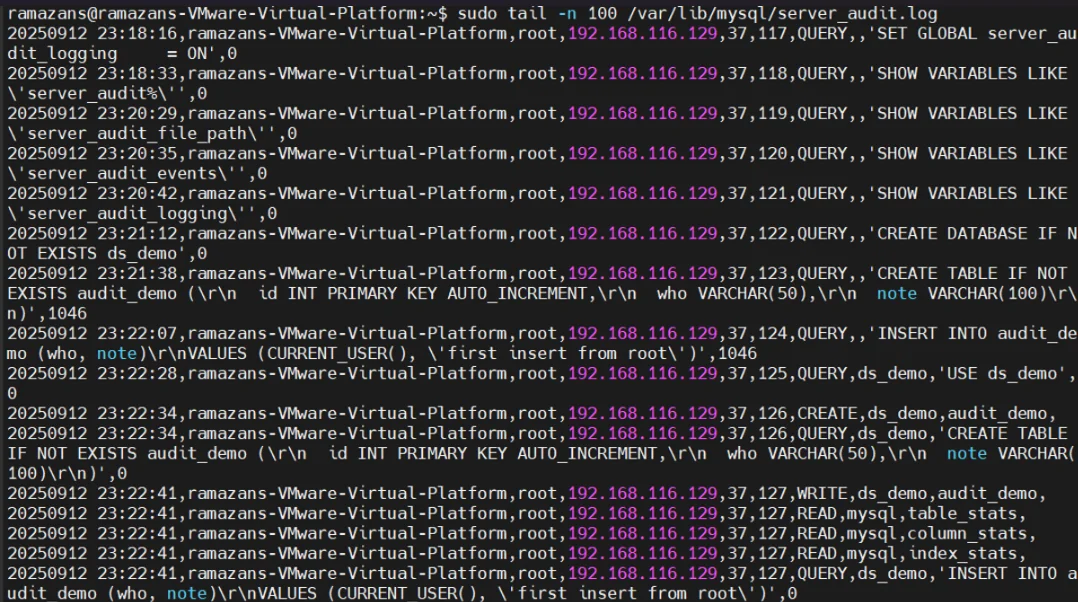
The MariaDB Audit Plugin can capture logins, executed queries, and schema modifications. It provides administrators with a chronological trail of database events, essential for demonstrating compliance.
Installation and Activation:
-- Install the audit plugin
INSTALL SONAME 'server_audit';

-- Enable audit logging
SET GLOBAL server_audit_logging = ON;

-- Configure which events to log
SET GLOBAL server_audit_events = 'CONNECT,QUERY';
Customizing the Log Output:
-- Define where audit logs are written
SET GLOBAL server_audit_output_type = 'FILE';

-- Set the log file path
SET GLOBAL server_audit_file_path = '/var/log/mariadb_audit.log';
These logs can then be reviewed manually or forwarded into external SIEM solutions for centralized analysis. Learn more in audit trails and audit logs.
2. Role-Based Access Control (RBAC)
Role-based access controls allow administrators to apply the principle of least privilege by grouping permissions into roles and assigning them to users.
Creating a Role and Assigning Privileges:
-- Create a new role
CREATE ROLE compliance_auditor;

-- Grant read-only permissions
GRANT SELECT ON compliance_db.* TO compliance_auditor;

-- Assign the role to a user
GRANT compliance_auditor TO 'audit_user'@'localhost';

-- Activate the role by default for the user
SET DEFAULT ROLE compliance_auditor TO 'audit_user'@'localhost';
RBAC simplifies compliance reviews by ensuring that access privileges can be managed consistently across large environments. It also integrates well with access controls and least privilege principle policies.
3. Encryption Support
MariaDB also provides support for data encryption, both in-transit and at-rest. This ensures sensitive information cannot be intercepted or read without authorization.
TLS for Data-in-Transit:
# In the MariaDB configuration file (my.cnf)
[mysqld]
ssl-cert=/etc/mysql/ssl/server-cert.pem
ssl-key=/etc/mysql/ssl/server-key.pem
ssl-ca=/etc/mysql/ssl/ca-cert.pem
Encrypting Tables at Rest:
-- Create an encrypted table
CREATE TABLE secure_table (
    id INT PRIMARY KEY,
    confidential_data VARCHAR(255)
) ENCRYPTED=YES;
Encryption ensures that even if data files are accessed directly, they remain unreadable without proper decryption keys. Combined with database encryption, this provides a stronger compliance foundation.
Enhanced Compliance with DataSunrise
DataSunrise extends MariaDB’s native features with intelligent compliance automation powered by NLP, LLM, and ML.
NLP Data Discovery
Using data discovery enhanced by NLP, DataSunrise scans structured and unstructured MariaDB data for PII, PHI, and financial records. It can even apply OCR-driven analysis to locate sensitive information hidden in images or semi-structured formats. The discovery engine supports continuous scans, ensuring that newly added tables or imported datasets are automatically classified and protected. This reduces the chance of sensitive fields remaining unmonitored and ensures compliance teams always have an up-to-date inventory of critical assets.
- Integration with compliance frameworks ensures classification aligns with GDPR, HIPAA, and PCI DSS.
- Automated mapping of sensitive data to audit and masking rules simplifies policy enforcement.
- Discovery results can be exported for use in compliance reporting and third-party security tools.
This process directly supports sensitive data discovery and complements static data masking.
LLM-Assisted Security
LLMs improve compliance management by interpreting logs, generating human-readable summaries, and assisting administrators in creating policies. They can automatically highlight non-compliant behavior, correlate user actions with regulatory requirements, and even suggest corrective actions for detected anomalies. This reduces the workload of compliance teams and ensures consistency across large MariaDB deployments.
- Automated plain-language compliance reports.
- Real-time query analysis to detect suspicious intent.
- Behavior analytics that connects user actions with natural language explanations for auditors.
Beyond reporting, LLMs act as intelligent assistants for compliance teams—helping draft new security policies and recommending rule updates when emerging threats are detected in MariaDB environments.
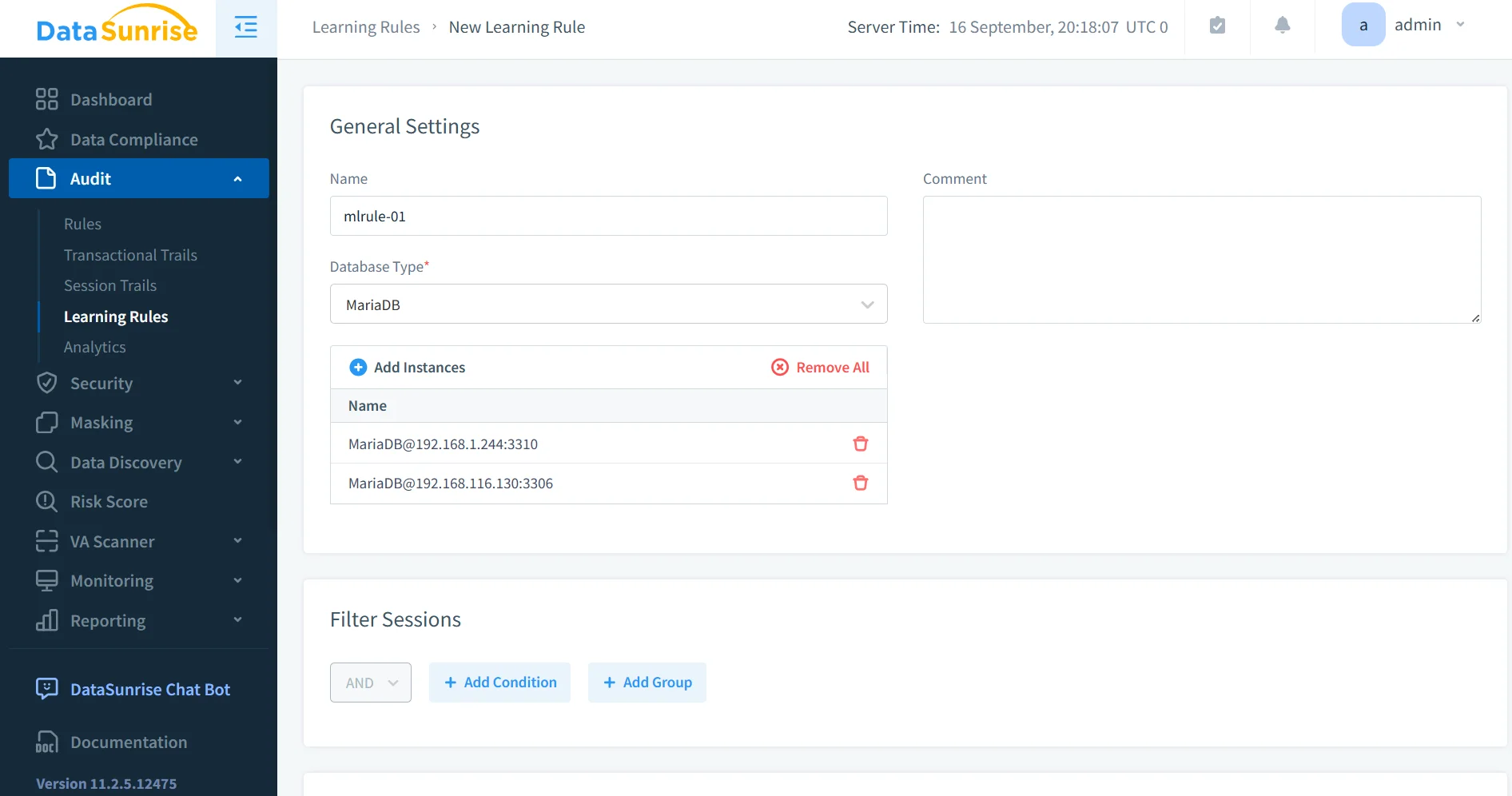
ML Audit Rules
Machine learning transforms static compliance checks into adaptive controls:
- Behavioral Baselines – Models learn normal query patterns in MariaDB and flag anomalies in real time.
- Dynamic Policies – Audit rules adjust automatically when new compliance requirements emerge.
- Continuous Regulatory Calibration – Aligns MariaDB environments with SOX, GDPR, HIPAA, PCI DSS.
In addition, ML-based rules minimize false positives by distinguishing between legitimate business queries and suspicious activity. Over time, they refine detection accuracy, improving both security outcomes and compliance assurance. Integration with security rules enhances MariaDB’s resilience against exploits.
Centralized Monitoring
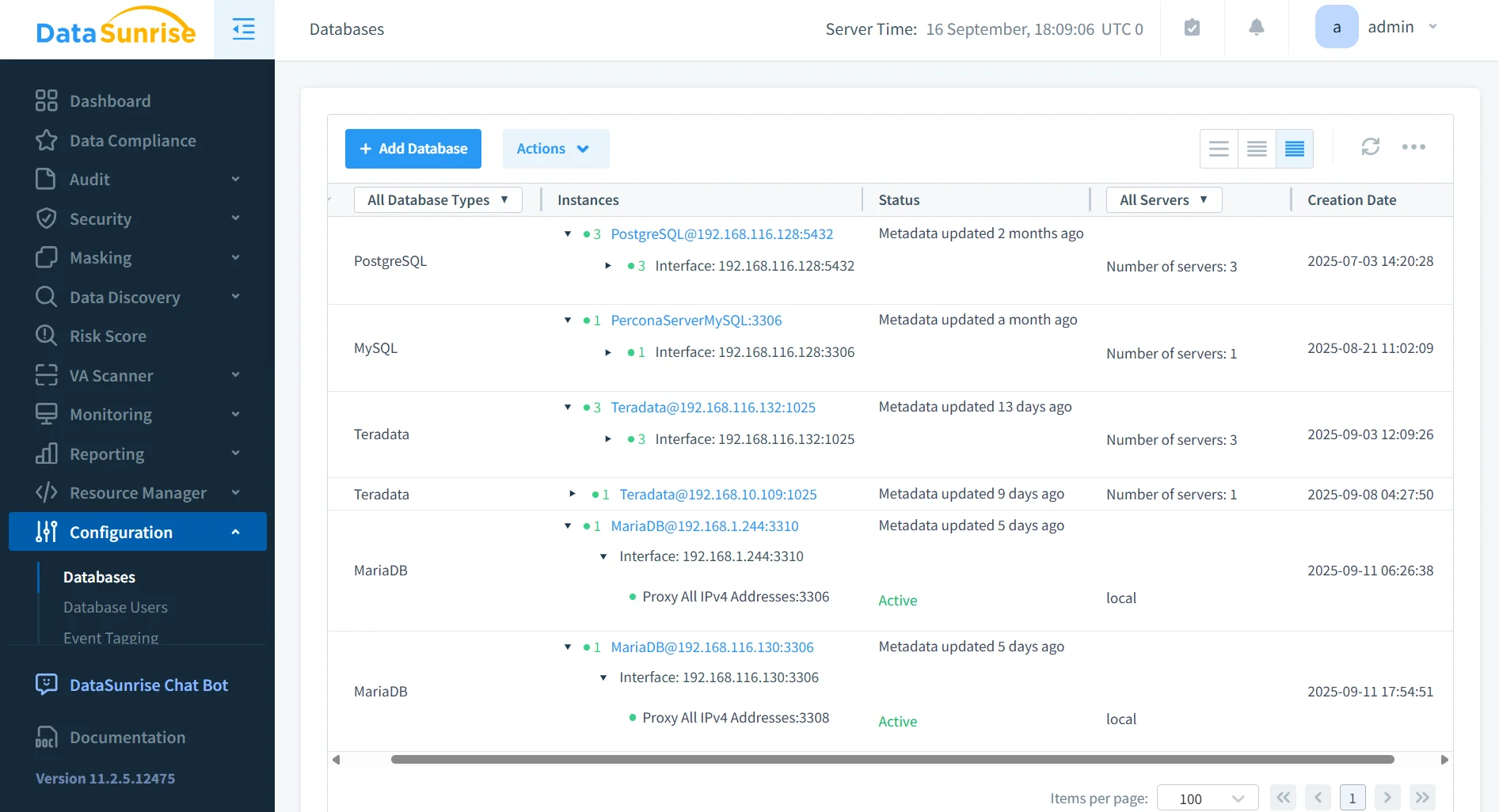
Instead of managing each MariaDB instance separately, DataSunrise consolidates compliance operations across hybrid and multi-cloud infrastructures:
- Unified database activity monitoring for MariaDB and 40+ platforms.
- Intelligent alerting via email, Slack, or MS Teams.
- Cross-database policy orchestration for consistent compliance enforcement.
This centralization eliminates blind spots, enabling administrators to enforce compliance uniformly whether databases run on-premises, in public cloud services, or across geographically distributed clusters. It also aligns with continuous data protection strategies.
Automated Compliance Reporting
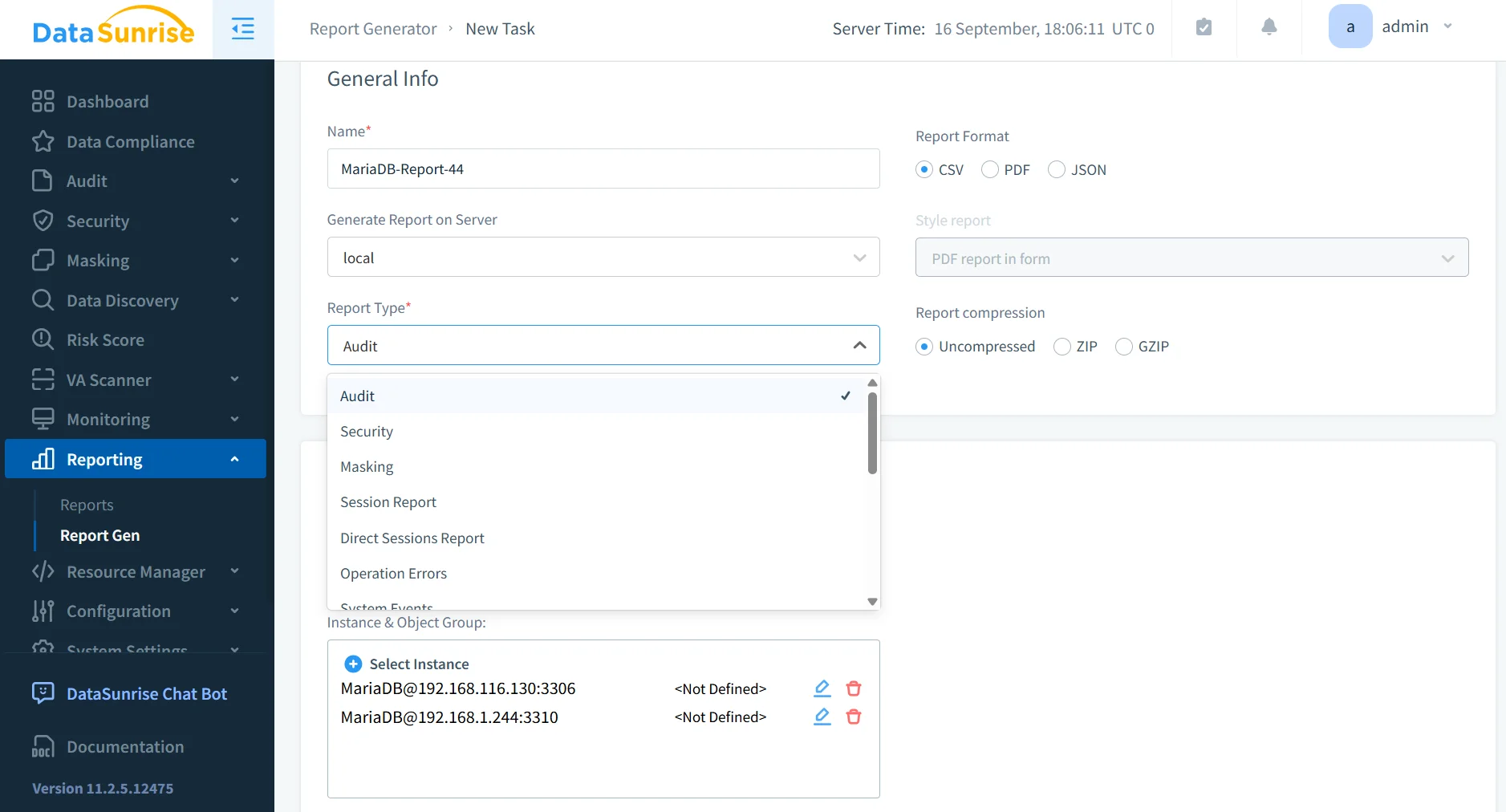
With automated compliance reporting, documentation becomes effortless:
- One-click audit-ready reports for GDPR, HIPAA, PCI DSS, and SOX.
- Scheduling options to ensure continuous inspection readiness.
- ML-generated insights into risk trends and compliance drift.
Reports can be customized for internal stakeholders or external regulators, reducing manual report preparation time. Dashboards also provide visual compliance scores, helping organizations track improvements and prioritize remediation steps. Reporting integrates with report generation tools to further simplify audits.
Business Impact of AI-Driven MariaDB Compliance
Implementing NLP, LLM, and ML tools with DataSunrise yields measurable benefits:
| Benefit | Description |
|---|---|
| Risk Reduction | AI-driven detection minimizes compliance gaps and insider threats. |
| Efficiency | Automated audits reduce manual review workloads. |
| Regulatory Confidence | Demonstrates strong compliance posture to regulators. |
| Cost Optimization | Streamlined reporting lowers overall compliance costs. |
| Competitive Advantage | Trust and transparency improve customer relationships. |
These advantages also strengthen overall database security and support enterprise adoption of compliance manager.
Conclusion
While MariaDB provides a baseline for monitoring and compliance, its native tools are limited in scalability and adaptability. By integrating NLP, LLM, and ML into compliance workflows, organizations gain continuous oversight, intelligent automation, and proactive threat detection.
DataSunrise delivers these advanced features through seamless deployment, centralized monitoring, and adaptive compliance frameworks. For organizations seeking future-ready compliance for MariaDB, combining AI-driven insights with proven auditing and masking tools is the optimal strategy.
Protect Your Data with DataSunrise
Secure your data across every layer with DataSunrise. Detect threats in real time with Activity Monitoring, Data Masking, and Database Firewall. Enforce Data Compliance, discover sensitive data, and protect workloads across 50+ supported cloud, on-prem, and AI system data source integrations.
Start protecting your critical data today
Request a Demo Download Now