NLP, LLM & ML Data Compliance Tools for Teradata
Organizations using Teradata face constant regulatory pressure to safeguard sensitive data while maintaining operational efficiency. Compliance now extends beyond structured tables into semi-structured and unstructured sources such as logs, images, and text streams. Traditional auditing alone is no longer enough.
Modern compliance relies on NLP (Natural Language Processing), LLM (Large Language Models), and ML (Machine Learning) to discover hidden risks, detect suspicious behavior, and enforce consistent policies. These technologies help organizations reduce manual oversight, adapt policies in real time, and achieve faster audit readiness.
The urgency is underscored by global statistics:
- According to IBM’s Data Breach Report, the average cost of a breach reached $4.45M in 2023.
- UNCTAD research shows that the majority of countries have adopted or are adopting data protection regulations, creating a growing need for compliance automation.
- ISO/IEC 27001 highlights the importance of strong controls for data security and compliance.
For broader context, see Data Compliance overview and Regulatory Compliance knowledge center.
What is Data Compliance?
Data compliance is the discipline of managing sensitive information in a way that satisfies legal, regulatory, and internal requirements. It applies to structured databases, semi-structured formats, and even unstructured content like files, logs, or scanned images.
Core Principles
- Regulatory Alignment – adhere to frameworks such as GDPR, HIPAA, and PCI DSS.
- Auditability – maintain audit trails and access controls for accountability.
- Data Protection – apply data masking and anonymization to safeguard sensitive records.
Why It Matters
Without robust compliance, organizations risk fines, reputational damage, and operational disruptions. A strong compliance program ensures not only regulatory readiness but also customer trust and operational resilience.
Native Compliance Features in Teradata
Teradata provides several built-in mechanisms that form the baseline for compliance monitoring:
Teradata Logging and Auditing
Native audit facilities capture user logins, query execution, and schema modifications. Logs are stored for later review, enabling administrators to track access and changes. Teradata’s logging complements external data audit strategies for organizations that need extended oversight.
-- Example: enabling query logging
BEGIN LOGGING WITH TEXT ON EACH ALL;
SELECT *
FROM sensitive_table
WHERE account_id = 12345;
END LOGGING;
Audit logs provide chronological trails but require manual analysis to uncover patterns.
Row- and Column-Level Security
Teradata allows administrators to enforce policies at a granular level. Using views and access rights, organizations can restrict which rows or columns a role can query. This supports alignment with role-based access control models.
-- Example: secure view for compliance
CREATE VIEW secure_customer_view AS
SELECT customer_id,
       CASE
           WHEN CURRENT_ROLE = 'Compliance_Auditor' THEN ssn
           ELSE '***MASKED***'
       END AS ssn
FROM customer_data;
Limitations
Despite offering useful compliance features, Teradata’s native tools have several drawbacks:
- Native tools focus on structured queries but lack automated discovery of PII across unstructured datasets.
- Manual policy configuration can lead to compliance drift.
- Real-time anomaly detection is limited without ML or NLP integration.
- Logs can grow rapidly in large-scale environments, creating storage and management challenges.
- Advanced policy orchestration is not centralized, forcing administrators to configure rules separately across environments.
- No built-in dynamic data masking, which limits protection when sensitive data must be accessed by multiple user roles.
- Integration with external SIEM and compliance reporting platforms is minimal, requiring custom scripting for enterprise-scale workflows.
Enhanced Compliance with DataSunrise
While Teradata’s native features create a foundation, DataSunrise provides autonomous, zero-touch compliance orchestration. Its NLP, LLM, and ML engines extend monitoring into new areas.
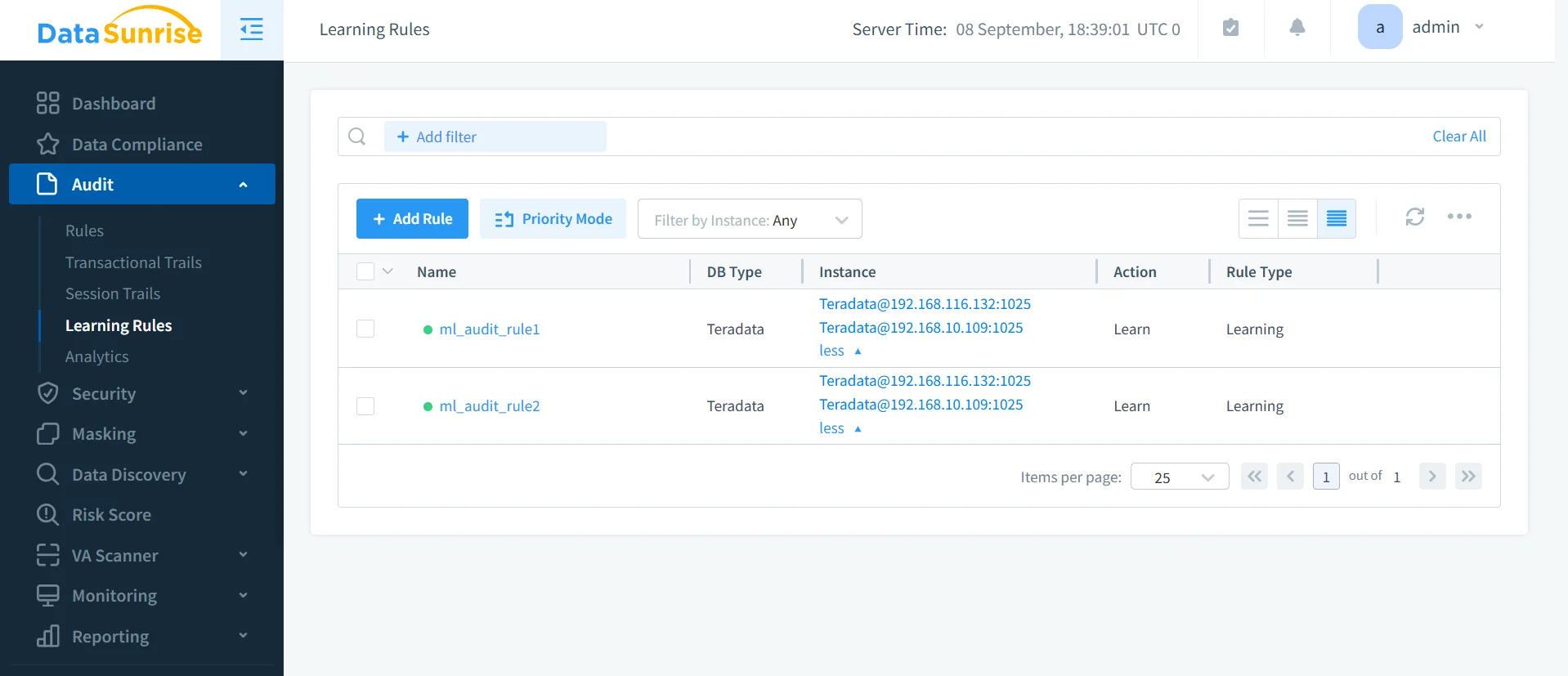
Machine Learning Audit Rules
Adaptive ML audit rules build baselines of normal behavior. Anomalous queries, mass exports, or abnormal data joins trigger real-time alerts. The system evolves continuously without requiring constant manual tuning. Over time, the models improve accuracy, reducing false positives and alert fatigue. Administrators gain deep insights into emerging risks by comparing current activity with historical patterns. ML-driven auditing is critical for addressing insider threats and advanced persistent risks. You can read more about audit logs.
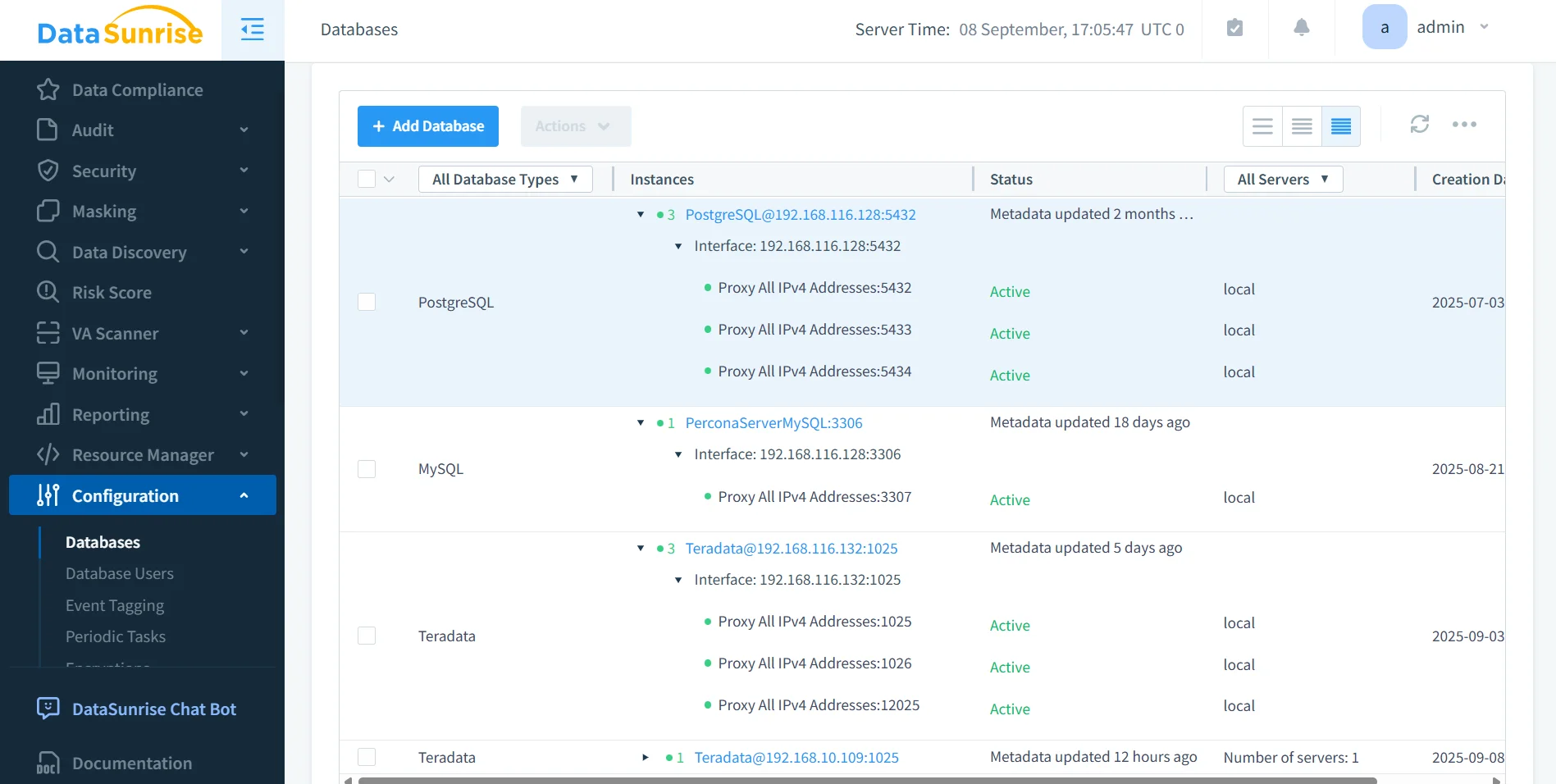
Centralized Monitoring Across Platforms
Instead of monitoring Teradata in isolation, DataSunrise offers a centralized monitoring platform spanning more than 40 supported databases and storage systems. Administrators gain one unified console for activity history, alerts, and compliance evidence. Centralized monitoring eliminates silos, ensuring security teams see the full picture of data use across the enterprise. This approach reduces complexity and speeds up incident response. It also supports continuous data protection, ensuring consistency across environments. Further information is available in the database activity history section.
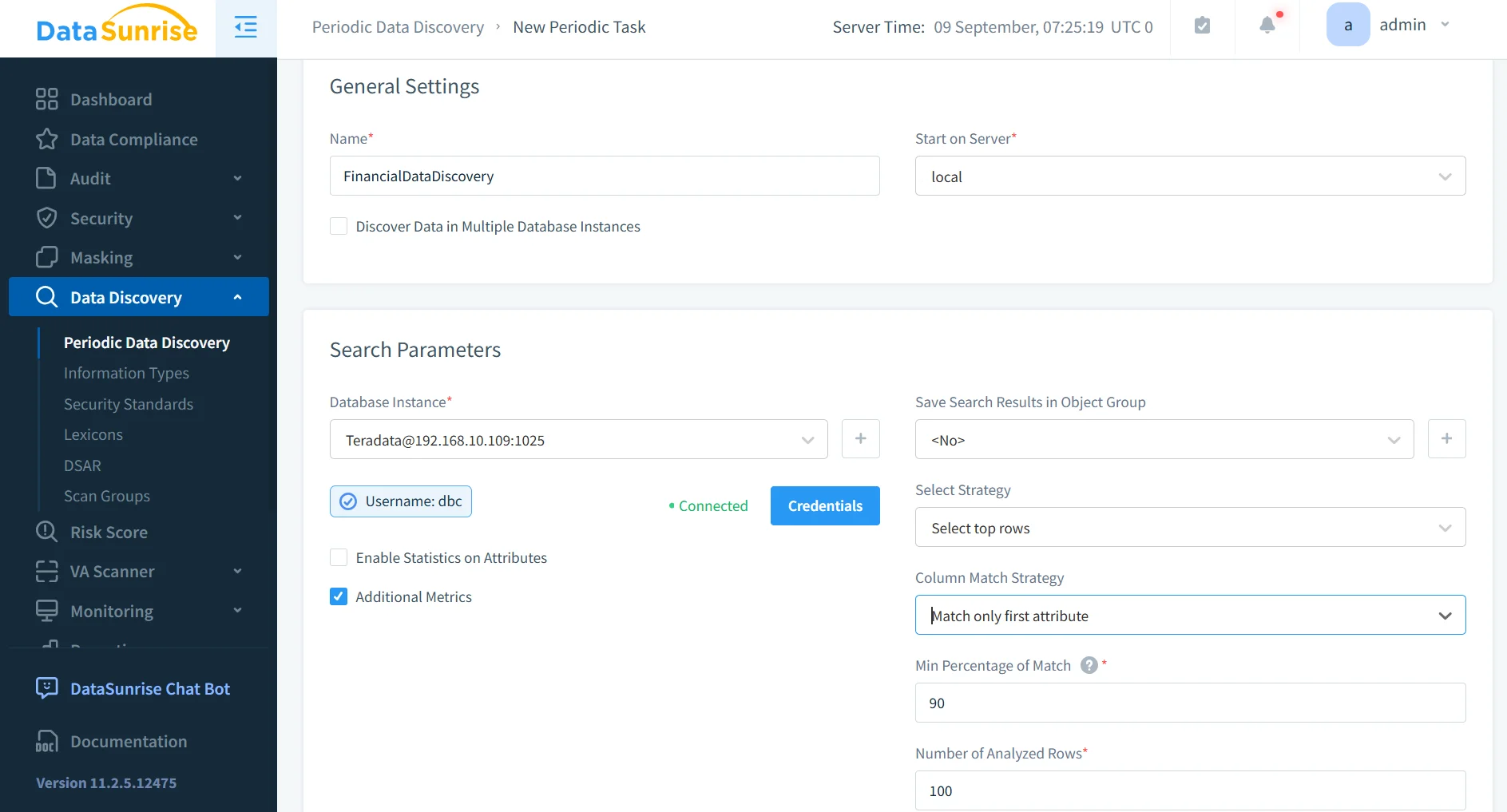
Sensitive Data Discovery with NLP
DataSunrise uses NLP-driven discovery to identify sensitive information in both structured SQL data and unstructured text (emails, notes, scanned contracts via OCR). Unlike static regex, contextual NLP models detect hidden PII/PHI with higher accuracy. This makes it possible to protect sensitive data that might otherwise remain invisible in unstructured sources. Discovery tasks can also be scheduled to ensure continuous scanning of new datasets. Administrators can link detection results directly with masking and auditing rules, creating a seamless compliance workflow. Learn more about data discovery.
LLM-Driven Compliance Autopilot
Compliance Autopilot aligns policies dynamically with frameworks like GDPR, HIPAA, PCI DSS, and SOX. LLM models interpret policies, generate audit rules automatically, and adjust when new data objects or roles appear.
- Prevents compliance drift by continuously aligning governance rules with updated regulations.
- Automates the generation of complex audit policies, saving administrative time.
- Monitors newly created data objects and immediately applies relevant compliance checks.
- Provides ongoing calibration to detect compliance gaps before they become critical.
- Ensures organizations stay audit-ready at all times with minimal manual intervention.
Additional details are available in the compliance regulations section.
Key Features of NLP, LLM & ML Tools in DataSunrise
- Zero-Touch Policy Automation – auto-generate masking, audit, and firewall rules.
- Continuous Regulatory Calibration – ensures alignment with evolving regulations.
- Context-Aware Protection – NLP parses query context to avoid false positives.
- Behavior Analytics – detect insider threats via user behavior analysis.
- Real-Time Notifications – email, Slack, or MS Teams alerts for suspicious events.
- Cross-Platform Coverage – monitor structured, semi-structured (JSON/XML), and unstructured text or image data.
Business Impact of AI-Powered Teradata Compliance
| Benefit | Description |
|---|---|
| Reduced Compliance Gaps | NLP and ML discover hidden sensitive data that native tools miss. |
| Faster Audit Readiness | Automated compliance reporting provides one-click evidence for GDPR, HIPAA, PCI DSS. |
| Operational Efficiency | Eliminates repetitive manual rule tuning through Compliance Autopilot. |
| Enhanced Security Posture | Detects insider threats and external exploits in real time. |
| Scalable Coverage | Works across hybrid cloud, on-prem, and multi-database environments. |
| Improved Audit Transparency | Clear visibility into who accessed data, when, and how, improving accountability. |
| Lower Compliance Costs | Automation reduces the need for extensive manual audits, cutting operational expenses. |
Conclusion
While Teradata offers native compliance features, they are limited in scope and automation. DataSunrise enhances Teradata with NLP, LLM, and ML tools, delivering dynamic masking, intelligent policy orchestration, and real-time anomaly detection.
With zero-touch deployment, centralized monitoring, and adaptive compliance alignment, DataSunrise ensures organizations minimize risk, accelerate audit readiness, and maintain trust in their data operations.
Protect Your Data with DataSunrise
Secure your data across every layer with DataSunrise. Detect threats in real time with Activity Monitoring, Data Masking, and Database Firewall. Enforce Data Compliance, discover sensitive data, and protect workloads across 50+ supported cloud, on-prem, and AI system data source integrations.
Start protecting your critical data today
Request a Demo Download Now