Data Anonymization in Elasticsearch
As organizations increasingly rely on Elasticsearch to index and analyze operational, customer, and security data, protecting personally identifiable information (PII), financial records, and other confidential content becomes a growing challenge. While search capabilities improve accessibility and analytics, they also increase the risk of exposing sensitive information to unauthorized users, developers, analysts, or third-party applications.
Data anonymization addresses this challenge by transforming sensitive values into irreversible or non-identifiable representations while preserving the overall usefulness of the indexed information. Organizations commonly anonymize production datasets before using them for analytics, software development, testing, machine learning, or data sharing, helping satisfy privacy regulations such as GDPR, HIPAA, PCI DSS, SOX, and CCPA without unnecessarily exposing confidential records.
Elasticsearch offers several native mechanisms that can assist with anonymization during data ingestion or reindexing. These include ingest pipelines, processors, runtime fields, and scripting capabilities that enable administrators to modify or remove sensitive fields before documents become searchable. Additional flexibility is provided through the runtime fields feature, which can generate anonymized views of indexed data at query time.
However, enterprise environments often require significantly more than field transformations alone. Large-scale infrastructures demand automated Sensitive Data Discovery, centralized governance, intelligent policy generation, continuous regulatory alignment, and consistent anonymization across cloud, on-premises, and hybrid deployments.
This article explores Elasticsearch's native data anonymization capabilities, their advantages and limitations, and demonstrates how DataSunrise delivers enterprise-grade automated data anonymization through centralized security and compliance management.
What is Data Anonymization in Elasticsearch?
Data anonymization in Elasticsearch is the process of permanently transforming sensitive information so that individual identities can no longer be determined while preserving the value of the remaining dataset for operational or analytical purposes.
Unlike encryption, which protects data but allows authorized users to recover its original value, anonymization removes or irreversibly alters identifying information. Common anonymization techniques include:
- Removing sensitive fields entirely
- Replacing values with hashes or tokens
- Generalizing detailed information into broader categories
- Randomizing or pseudonymizing identifiers
- Transforming datasets during ingestion or reindexing
Typical anonymization targets include:
- Customer names
- Email addresses
- Phone numbers
- National identification numbers
- Payment information
- Medical records
- IP addresses
- Employee identifiers
Elasticsearch enables many of these transformations through ingest pipelines and reindex operations before documents are indexed. Runtime fields can also generate anonymized views of existing data without modifying the underlying documents, making them useful for read-time privacy controls.
For organizations handling personally identifiable information (PII), anonymization helps reduce privacy risks while preserving the analytical value of indexed data. It also complements broader data security strategies by minimizing the exposure of confidential information across development, analytics, and reporting environments.
These native capabilities provide flexibility for many organizations. However, they generally require administrators to manually identify sensitive fields, build transformation logic, maintain scripts, and continuously update policies as schemas evolve or new compliance requirements emerge. Enterprise environments often supplement these native features with centralized data masking and anonymization solutions that automate policy management and simplify regulatory compliance.
Native Elasticsearch Data Anonymization
Elasticsearch does not include a dedicated data anonymization feature. Instead, it provides flexible building blocks that allow administrators to transform, remove, or replace sensitive information before or during indexing. By combining ingest pipelines, processors, runtime fields, and reindex operations, organizations can implement anonymization workflows tailored to their requirements.
Ingest Pipelines
Ingest pipelines process documents before they are indexed. They provide one of the most effective native methods for anonymizing sensitive information because transformations occur before the data becomes searchable.
For example, the remove processor permanently deletes confidential fields:
PUT _ingest/pipeline/remove_sensitive_fields
{
  "processors": [
    {
      "remove": {
        "field": [
          "email",
          "phone",
          "credit_card"
        ]
      }
    }
  ]
}
Documents indexed through this pipeline no longer contain the specified fields.
More complex anonymization can be implemented using the script processor.
Script Processor
The script processor allows administrators to modify field values using the Painless scripting language before indexing.
The following example hashes an email address instead of storing the original value:
PUT _ingest/pipeline/hash_email
{
  "processors": [
    {
      "script": {
        "source": """
          if (ctx.email != null) {
            ctx.email = ctx.email.hashCode().toString();
          }
        """
      }
    }
  ]
}
Scripts can also replace values with placeholders, truncate identifiers, or normalize sensitive information according to organizational policies.
Reindex API
Organizations frequently need to anonymize data that has already been indexed. Elasticsearch supports this through the Reindex API together with ingest pipelines.
POST _reindex
{
  "source": {
    "index": "customers"
  },
  "dest": {
    "index": "customers_anonymized",
    "pipeline": "remove_sensitive_fields"
  }
}
This approach creates a new anonymized index while preserving the original data for authorized administrative use.
Runtime Fields
Runtime fields generate transformed values at query time without modifying stored documents.
For example, a runtime field can expose only the email domain:
PUT customers/_mapping
{
  "runtime": {
    "email_domain": {
      "type": "keyword",
      "script": {
        "source": """
          emit(
            doc['email.keyword']
              .value
              .substring(doc['email.keyword'].value.indexOf('@') + 1)
          );
        """
      }
    }
  }
}
Runtime fields are particularly useful when applications require anonymized views while retaining original values for restricted administrative users.
API Example
The following request indexes a document through an anonymization pipeline:
POST customers/_doc?pipeline=remove_sensitive_fields
{
  "name": "John Smith",
  "email": "[email protected]",
  "phone": "+1-555-123-4567",
  "city": "Chicago"
}
After processing, only non-sensitive fields remain indexed.
How DataSunrise Enhances Data Anonymization in Elasticsearch
While Elasticsearch provides flexible native tools for transforming sensitive information, enterprise environments often require automated discovery, centralized governance, and compliance-aware anonymization that extends well beyond individual ingest pipelines. Managing hundreds of indices, evolving schemas, and multiple regulatory frameworks manually can quickly become operationally complex.
DataSunrise deploys Zero-Touch Data Anonymization to deliver seamless protection with minimal administrative effort. Through flexible deployment modes and non-intrusive integration, organizations can anonymize Elasticsearch data without modifying applications, redesigning existing workflows, or changing client behavior.
Unlike solutions that rely on manually maintained scripts and ingest pipelines, DataSunrise combines Compliance Autopilot, Automatic Policy Generation, Sensitive Data Discovery, Continuous Regulatory Calibration, and Machine Learning Audit Rules into a centralized platform that continuously adapts to changing data environments.
The platform protects structured, semi-structured, and unstructured information while extending governance beyond Elasticsearch to databases, data warehouses, cloud storage, file systems, and hybrid infrastructures.
Zero-Touch Data Anonymization
Instead of manually creating anonymization scripts for every index, DataSunrise automatically identifies sensitive fields and applies centralized anonymization policies across Elasticsearch deployments. Organizations can protect personally identifiable information (PII), financial records, healthcare information, customer identifiers, authentication credentials, and other business-sensitive data using a wide range of anonymization techniques.
The platform supports substitution, hashing, randomization, tokenization, format-preserving replacement, and custom transformation rules, allowing organizations to balance privacy protection with operational requirements. Because anonymization policies are managed centrally, newly discovered sensitive fields can automatically inherit existing protection rules without requiring administrators to update ingest pipelines or scripts individually.
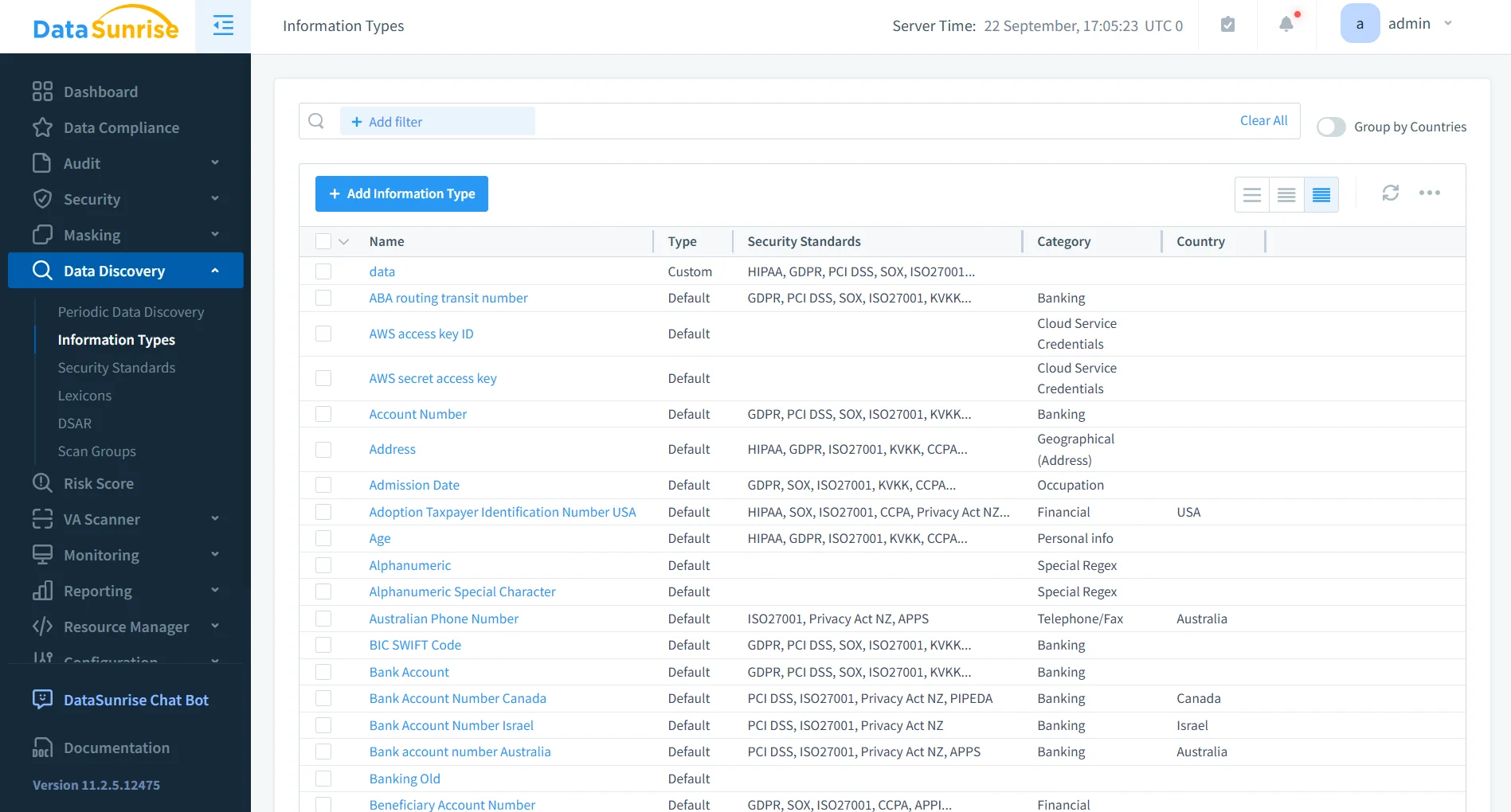
Sensitive Data Discovery
Identifying sensitive information across growing Elasticsearch environments is often one of the most time-consuming aspects of privacy management. DataSunrise addresses this challenge through automated Sensitive Data Discovery, which scans Elasticsearch clusters using predefined dictionaries, customizable classifiers, pattern matching, and machine learning algorithms.
The platform analyzes indices, documents, nested objects, JSON fields, attachments, and metadata to locate confidential information. Discovered data is automatically classified according to regulatory categories, enabling organizations to understand their overall risk exposure before implementing anonymization policies. Discovery extends beyond Elasticsearch to relational databases, NoSQL platforms, cloud storage, enterprise file systems, and OCR-extracted content from images, providing a unified view of sensitive data throughout the organization.
Compliance Autopilot
Privacy regulations evolve continuously, making manual compliance management increasingly difficult. DataSunrise's Compliance Autopilot automatically maps discovered sensitive information to major regulatory frameworks, including GDPR, HIPAA, PCI DSS, SOX, CCPA, ISO 27001, NIST, and SOC 2.
Rather than requiring administrators to interpret each regulation individually, the platform recommends anonymization policies based on applicable compliance requirements. This automated approach accelerates regulatory alignment while significantly reducing manual effort and minimizing compliance gaps.
Automatic Policy Generation
Managing anonymization rules manually across hundreds of Elasticsearch indices can quickly become unmanageable. DataSunrise simplifies this process through Automatic Policy Generation, which creates anonymization policies based on discovered sensitive data, metadata analysis, compliance requirements, and organizational security standards.
As new indices, fields, or data sources are introduced, the platform can automatically generate appropriate protection policies. This ensures consistent anonymization across the environment while reducing administrative overhead and eliminating repetitive manual configuration.
Continuous Regulatory Calibration
Compliance is an ongoing process rather than a one-time implementation. DataSunrise continuously evaluates protected environments through scheduled discovery tasks that identify newly created sensitive fields, schema modifications, and evolving regulatory requirements.
When new compliance risks are detected, anonymization policies can be updated automatically. This continuous calibration reduces compliance drift, keeps protection aligned with current regulations, and minimizes the need for constant manual intervention.
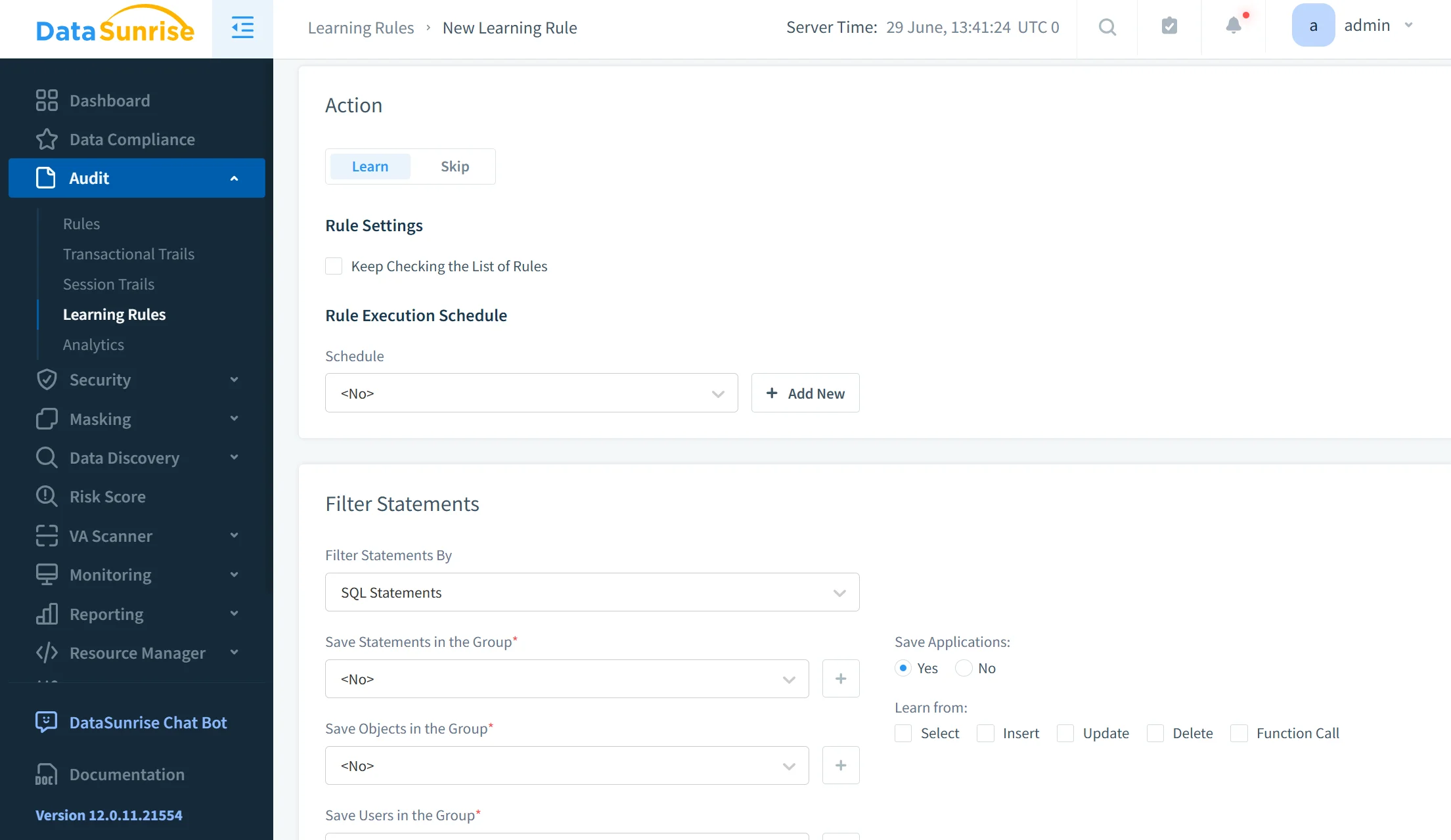
Machine Learning Audit Rules
Effective anonymization benefits from continuous monitoring of data access and user behavior. Machine Learning Audit Rules analyze query activity, privilege usage, access patterns, and user interactions to identify unusual attempts to access sensitive information.
By combining behavioral analytics with anonymization policies, DataSunrise provides an additional layer of protection against insider threats, compromised accounts, and abnormal access patterns that traditional static rules may fail to detect.
Centralized Policy Management
Organizations rarely operate a single Elasticsearch cluster. DataSunrise provides centralized management for anonymization policies across multiple environments through a unified administration console.
Security teams can create reusable anonymization policies, apply them across multiple Elasticsearch clusters, monitor anonymization coverage, review compliance posture, and generate audit-ready reports from a single interface. This centralized governance improves consistency while significantly simplifying enterprise-scale security administration.
Cloud, On-Premises, and Hybrid Support
Modern Elasticsearch deployments frequently span cloud-native, on-premises, and hybrid infrastructures. DataSunrise supports all of these environments through non-intrusive deployment modes, allowing organizations to implement consistent anonymization policies without changing existing applications or workflows.
Beyond Elasticsearch, the platform extends protection to relational databases, NoSQL platforms, data warehouses, data lakes, cloud storage services, enterprise file systems, and other supported repositories, enabling organizations to maintain unified security and compliance policies across their entire data ecosystem.
Business Benefits
| Benefit | Business Value |
|---|---|
| Zero-Touch Data Anonymization | Reduces manual configuration while accelerating deployment. |
| Automated Sensitive Data Discovery | Identifies hidden confidential information across enterprise environments. |
| Compliance Autopilot | Simplifies adherence to GDPR, HIPAA, PCI DSS, SOX, CCPA, and other regulations. |
| Automatic Policy Generation | Eliminates repetitive rule creation and reduces administrative effort. |
| Continuous Regulatory Calibration | Keeps anonymization policies aligned with changing regulatory requirements. |
| Centralized Policy Management | Ensures consistent governance across multiple Elasticsearch clusters. |
| Machine Learning Audit Rules | Detects abnormal access patterns involving sensitive information. |
| Multi-Environment Coverage | Provides unified protection across cloud, on-premises, and hybrid infrastructures. |
Organizations seeking comprehensive data privacy can further strengthen their Elasticsearch security by combining data anonymization with Data Masking, Static Data Masking, and Sensitive Data Discovery. Continuous visibility through Database Activity Monitoring and Data Audit helps security teams verify that anonymization policies are functioning as intended. Organizations can further improve their security posture with the Database Firewall, simplify regulatory compliance using Compliance Manager, and deploy these capabilities consistently across cloud, on-premises, and hybrid infrastructures using DataSunrise's flexible deployment modes.
Conclusion
Elasticsearch provides flexible native capabilities for anonymizing sensitive information through ingest pipelines, script processors, runtime fields, and reindex operations. These features enable organizations to remove, transform, or replace confidential data before or during indexing, establishing a solid foundation for protecting sensitive information in many environments.
However, enterprise-scale anonymization requires considerably more than isolated field transformations. Modern compliance initiatives depend on centralized governance, automated Sensitive Data Discovery, intelligent policy generation, continuous regulatory alignment, and consistent anonymization across diverse infrastructures.
DataSunrise enhances Elasticsearch data anonymization through Zero-Touch Data Anonymization, Compliance Autopilot, Automatic Policy Generation, Continuous Regulatory Calibration, Machine Learning Audit Rules, Sensitive Data Discovery, and centralized policy management. The platform secures structured, semi-structured, and unstructured information while delivering unified protection across cloud, on-premises, and hybrid environments.
The result is an enterprise-ready security platform that reduces compliance risk, minimizes administrative overhead, strengthens privacy protection, and delivers scalable data anonymization for Elasticsearch deployments.
Learn more about DataSunrise's Data Masking, Static Data Masking, Sensitive Data Discovery, Compliance Manager, Database Activity Monitoring, Data Audit, Database Firewall, and flexible deployment options, or schedule a live demo to see how automated data anonymization can simplify Elasticsearch security and regulatory compliance.
Protect Your Data with DataSunrise
Secure your data across every layer with DataSunrise. Detect threats in real time with Activity Monitoring, Data Masking, and Database Firewall. Enforce Data Compliance, discover sensitive data, and protect workloads across 50+ supported cloud, on-prem, and AI system data source integrations.
Start protecting your critical data today
Request a Demo Download Now